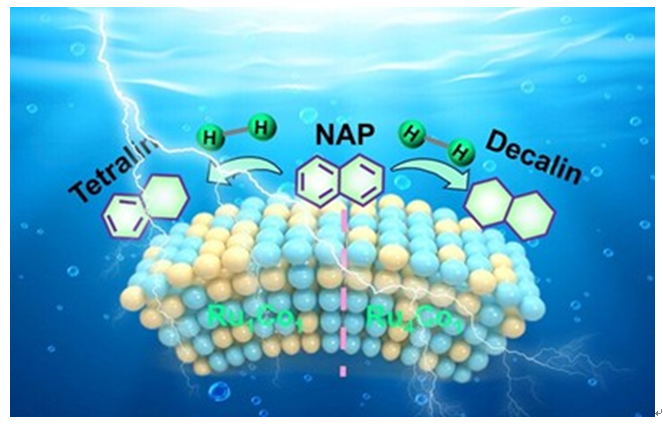
萘(Naphthalene,NAP)的选择性加氢在石油精制、有机液态储氢、精细化工及环境保护等领域具有重要意义。萘不仅是高储氢密度有机液态储氢体系的重要组成部分,同时在石化工程领域,可通过催化加氢转化为高十六烷值的轻质芳烃。针对萘加氢反应中活性与选择性难以兼顾的问题,本文设计并制备了一系列Ru-Co双金属合金催化剂,通过调控催化剂组成与金属比例,实现了萘分别向四氢萘(Tetralin)和十氢萘(Decalin)的高效选择性转化。在室温、2 MPa H2、反应30 min的条件下,Ru4Co1/CNFs的十氢萘选择性可达100%;而Ru1Co1/CNFs在相同条件下对四氢萘的选择性高达99%,且即使延长反应时间,反应仍主要停留在四氢萘阶段,表现出对深度加氢的显著抑制作用。动力学分析表明,Ru4Co1/CNFs的表观活化能显著低于Ru1Co1/CNFs。不同Ru/Co组分比例通过调控催化剂的d带中心及反应动力学行为,进而影响萘的加氢深度与产物选择性。
伏太平
,
景泽坤
,
牛碧野
,
吴汶峰
,
郭亚昆
,
帅茂兵
. 室温无溶剂下Ru-Co合金催化萘高选择性加氢研究[J]. 化学学报, 0
: 1010234
-1010234
.
DOI: 10.6023/A26070234
The selective hydrogenation of naphthalene (NAP) is of great significance in fields such as petroleum refining, organic liquid hydrogen storage, fine chemicals, and environmental protection. Not only is it an organic liquid hydrogen storage material with high hydrogen storage density, but in the petrochemical engineering sector, it can also be converted into light aromatic hydrocarbons with high cetane numbers through catalytic hydrogenation. To address the challenge of balancing activity and selectivity in the naphthalene hydrogenation reaction, this study involved the nitric acid modification of carbon fibres, which were then used as supports onto which metal nanoparticles were loaded. A series of Ru-Co bimetallic alloy catalysts with different metal molar ratios were prepared using a simple and versatile sol-gel method, and all samples underwent material characterisation testing. Inductively coupled plasma emission spectroscopy was employed to determine the actual elemental ratios; X-ray diffraction and X-ray photoelectron spectroscopy confirmed that all samples exhibited a single-phase hcp structure; N2 adsorption-desorption area measurements revealed the catalysts' pore structure and specific surface area; and transmission electron microscopy results demonstrated that the alloy catalysts were characterised by nanoscale particle sizes, uniform elemental distribution and high metal dispersion. By adjusting the catalyst composition and metal ratio, highly efficient selective conversion of naphthalene to tetralin and decalin was achieved. Under conditions of room temperature, 2 MPa H2, and a 30-minute reaction time, the decalin selectivity of Ru4Co1/CNFs reached 100%; whereas Ru1Co1/CNFs exhibited a tetralin selectivity as high as 99% under the same conditions, and even with extended reaction times, the reaction remained predominantly in the tetralin formation stage, demonstrating a significant suppression of deep hydrogenation. The key factor underlying this difference lies in the disparity in their apparent activation energies; the apparent activation energy of Ru4Co1/CNFs is significantly lower than that of Ru1Co1/CNFs. The component strategy regulates the d-band center and reaction rate, ultimately manifesting as selective hydrogenation. Furthermore, both Ru-Co catalysts exhibit good cycle stability and recoverability, providing key performance parameters for the industrial application of catalytic hydrogenation of polycyclic aromatic hydrocarbons.
[1] Wang D; Li J; Ma H; Yang C; Pan Z; Qu W; Tian Z. J.Energy Chem. 2021, 63: 294-304.
[2] Kalenchuk A; Bogdan V; Dunaev S; Kustov L. Fuel, 2020, 280.
[3] Lamichhane S; Bal Krishna, K C; Sarukkalige, R. Chemosphere, 2016, 148: 336-53.
[4] Guo J-H; Li S-J; Su Y; Chen G. Int.[J]. Hydrogen Energy. 2020, 45(48): 25900-11.
[5] Liu H; Liu C; Yin C; Liu B; Li X; Li Y; Chai Y; Liu Y. Catal.Today. 2016, 276: 46-54.
[6] Su X; An P; Gao J; Wang R; Zhang Y; Li X; Zhao Y; Liu Y; Ma X; Sun M. Chin.[J]. Chem. Eng. 2020, 28(10): 2566-76.
[7] Qi S; Li Y; Yue J; Chen H; Yi C; Yang B. Chin.[J]. Catal. 2014, 35(11): 1833-9.
[8] Ma Y; Liu J; Chen M; Yang Q; Chen H; Guan G; Qin Y; Wang T. Adv. Funct. Mater. 2022, 32(25).
[9] Tian Z-W; Da W-M; Wang L; Yang Y; Wei M. Acta Chim Sinica, 2022, 80(9).
(in Chinese) (田钊炜,达伟民,王雷,杨宇森,卫敏,化学学报, 2022, 80(9).)
[10] Zhang M; Song Q; He Z; Wang Q; Wang L; Zhang X; Li G. Int.[J]. Hydrogen Energy. 2022, 47(48): 20881-93.
[11] Liu Z; Mei J; Wang D; Kong X; Yu K; Cao Z; Wang C; Gong Y; Duan A; Xu C; Wang X. Fuel, 2024, 368.
[12] Gong P; Li B; Kong X; Liu J; Zuo S. Appl. Surf. Sci. 2017, 423: 433-42.
[13] Cao Z; Zhang X; Guo R; Ding S; Mei J; Wang X; Zheng P; Fan J; Xu C; Duan A. ACS Catal. 2020, 10(21): 12342-53.
[14] Li J; Shi L; Feng G; Shi Z; Sun C; Kong D. Catalysts, 2020, 10(10).
[15] Zhang C; Cao J-P; Zhao X-Y; Xie J-X; Zhao L; Jiang W; He Z-M; Cong H-L; Bai, H-C. Ind. Eng. Chem.Res. 2023, 62(17): 6780-9.
[16] Nunes M P; Jawale D V; Delolo F G; Araujo M H; Gravel E; Doris E; Da Silva Junior, E N. Chem. Commun. 2023, 59(19): 2763-6.
[17] Zhang M; He Z; Zhang M; Wang L; Wang Q; Zhang X; Li G. Fuel, 2022, 316.
[18] Luo Q; Wang H; Xiang Q; Lv Y; Yang J; Song L; Cao X; Wang L; Xiao F-S.[J]. Am. Chem. Soc. 2024, 146(38): 26379-86.
[19] Zhu L; Zhu H; Shakouri M; Zeng L; Yang Z; Hu Y; Ye H; Wang H; Chen B H; Luque R. Appl. Catal. B Environ. 2021, 297.
[20] Woodhead A L; De Souza, M L; Church, J S. Appl. Surf. Sci. 2017, 401: 79-88.
[21] Hu Y; Guo Y; Huang P; Peng Y; Wu G; Du J; Wang J; Deng Q. ACS Catal. 2025, 15(19): 16851-62.
[22] Ling Z-P; Chen H-T; Gao H-X; Dai H-C; Zhao Z-C; Yang Q-H.Chemical journal of Chinese Universities. 2025, 46(8), 20250048.
(in Chinese) (凌宗鹏,陈海涛,高红霞,戴慧聪,赵侦超,杨启华,高等学校化学学报, 2025, 46(8), 20250048.)
[23] Zhao P; Cao Z; Liu X; Ren P; Cao D-B; Xiang H; Jiao H; Yang Y; Li Y-W; Wen X-D. ACS Catal. 2019, 9(4): 2768-76.
[24] Sun H; Guo W; Zhou X; Chen Z; Liu Z; Liu S.Progress in Chin.[J]. Catal. 2011, 32(1-2): 1-16.
[25] Mao J; Chen W; Sun W; Chen Z; Pei J; He D; Lv C; Wang D; Li Y. Angew. Chem. Int. Ed. 2017, 56(39): 11971-5.
[26] Zhu L; Zhang H; Zhong L; Zheng J; Yu C; Zhang N; Chen B H. Fuel, 2018, 216: 208-17.
[27] Deng X; Zhu L; Zhang H; Kroner A; Zheng J; Zhang N; He J; Chen B H. Int. J.Hydrogen Energy. 2018, 43(32): 15055-63.
[28] Zhou J; Li P; Xia X; Zhao Y; Hu Z; Xie Y; Yang L; Liu Y; Du Y; Zhou Q; Yu L; Yu Y. Appl. Catal. B Environ. 2024, 359.
[29] Wang Z; Yuan X; Guo H; Zhang X; Peng J; Pan Y.Energy Environ. Sci. 2024, 17(21): 8019-56.
[30] Quan H-L; Tang J-L; Zhang C-Z; Zhang Y-H; Li J-Q; Zhou T-G. Acta Chim Sinica, 2025, 83(11).
(in Chinese) (全洪林, 唐鋆磊, 张承志, 张恒溢, 李佳奇, 周太刚, 化学学报, 2025, 83(11).)
[31] Tan Z; Fan G; Zheng L; Li F. ACS Catal. 2024, 14(15): 11218-30.
[32] Jiang W; Cao J-P; Zhang C; Tang W; Chen C-X; He Z-M; Zhao X-Y; Bai H-C. Fuel, 2023, 351.
[33] Guo J; Wang L; Jin Z; Liu Z; Hao H; Gong J; Wang Z. Chem. Eng. J. 2024, 498.