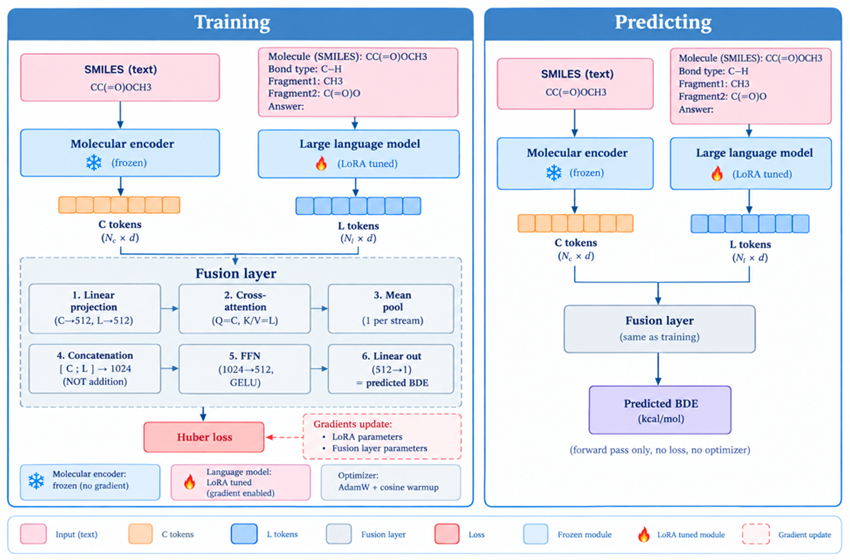
键解离能(Bond Dissociation Energy, BDE)是表征化学键强度的基础热力学参数,决定有机分子的反应活性与热力学行为。传统实验测量与高精度量子化学计算耗时费力、资源开销大,难以满足大规模分子筛选的需求。尽管数据驱动的机器学习方法已成为高效替代方案,但现有方法多依赖分子图或分子指纹等单一尺度表征,忽略了键类型、官能团环境与碎片结构等自然语言描述中蕴含的化学语义信息。本研究提出一种整合分子结构序列与化学自然语言文本的多尺度融合框架,用于预测有机化合物的键解离能。框架包含三个模块:预训练分子编码器(ChemBERTa或MolFormer)从SMILES序列提取结构特征,大语言模型(DeepSeek-7B、Qwen2-7B或Mistral-7B)编码化学文本语义,交叉注意力融合层实现两者的自适应交互。采用低秩适配(LoRA)微调,仅更新约0.1%的参数。在包含531244条BDE记录、65540个有机分子的数据集上系统评估了6种模型组合,最优的ChemBERTa+Qwen2-7B组合在验证集上MAE为0.98 kcal mol-1、决定系数为0.9830。在数据发布方公开划分下重训并评测,官方测试集MAE为0.98 kcal mol-1,仍高于同划分下以键为中心的图神经网络报告值(0.61-0.64 kcal mol-1),差距集中于含杂原子的极性键。规模对照(Qwen2-0.5B/1.5B/7B:1.15/1.04/0.98)与输出头对照(纯文本配置下回归头1.39、生成式1.22 kcal mol-1)表明,分子编码器的融合而非输出头形式决定精度。结果表明,多尺度融合有效利用分子拓扑与化学语义的互补优势,为在不引入三维构型与量子化学特征的前提下开展大规模BDE预测提供了一条通用技术路线。
Bond dissociation energy (BDE) is a fundamental thermodynamic parameter that characterizes chemical bond strength and governs the reactivity and thermal behavior of organic molecules. Traditional experimental measurements and high-level quantum chemical calculations are time-consuming and resource-intensive, thus impractical for large-scale molecular screening. Although data-driven machine learning methods have emerged as efficient alternatives, existing approaches rely predominantly on single-modal representations such as molecular graphs or fingerprints, overlooking the chemical semantics embedded in natural language descriptions of bond types, functional group environments, and fragment structures. Here we propose a multimodal fusion framework that integrates molecular structure sequences with chemical natural language text for BDE prediction. The framework comprises three modules: a pre-trained molecular encoder (ChemBERTa or MolFormer) extracting structural features from SMILES, a large language model (DeepSeek-7B, Qwen2-7B or Mistral-7B) encoding chemical text semantics, and a cross-attention-based fusion layer that enables adaptive interaction between them. Low-Rank Adaptation (LoRA) fine-tuning updated only approximately 0.1% of the parameters. Six model combinations were evaluated on a dataset of 531244 BDE records from 65540 organic molecules; the optimal ChemBERTa+Qwen2-7B combination reached a mean absolute error (MAE) of 0.98 kcal mol-1 and a coefficient of determination (R2) of 0.9830 on the validation set. On the publicly released split, the model attains an MAE of 0.98 kcal mol-1 on the official test set, still above the 0.61-0.64 kcal mol-1 reported for bond-centred graph neural networks, with the gap concentrated on heteroatom-containing polar bonds. Scale ablation (Qwen2-0.5B/1.5B/7B: 1.15/1.04/0.98 kcal mol-1) and an output-head ablation (regression head 1.39 vs. generative 1.22 kcal mol-1) show that the fusion of molecular representations, not the output-head form, governs accuracy. The framework thus exploits the complementary strengths of molecular topology and chemical semantics, offering a general route to large-scale BDE prediction without three-dimensional geometries or quantum-chemical features.
[1] Luo Y.-R.Comprehensive Handbook of Chemical Bond Energies, CRC Press, Boca Raton, 2007.
[2] Warnatz J.; Maas U.; Dibble R.Combustion: Physical and Chemical Fundamentals, 4th ed., Springer, Berlin, 2006.
[3] Gugumus, F. Polym. Degrad. Stab.1990, 27, 19.
[4] Denisov E. T.; Afanas’ev I. B.Oxidation and Antioxidants in Organic Chemistry and Biology, CRC Press, Boca Raton, 2005.
[5] Schwarzenbach R. P.; Gschwend P. M.; Imboden D. M.Environmental Organic Chemistry, 3rd ed., Wiley, Hoboken, 2016.
[6] Blanksby S. J.; Ellison G. B.Acc.Chem. Res. 2003, 36, 255.
[7] Becke A. D.J. Chem. Phys. 1993, 98, 5648.
[8] Vaswani A.; Shazeer N.; Parmar N.; Uszkoreit J.; Jones L.; Gomez A. N.; Kaiser L.; Polosukhin I.In Advances in Neural Information Processing Systems 30, Eds.: Guyon, I.; Luxburg, U. V.; Bengio, S.; Wallach, H.; Fergus, R.; Vishwanathan, S.; Garnett, R., Curran Associates, Red Hook, 2017, pp. 5998-6008.
[9] Chithrananda S.; Grand G.; Ramsundar B.ChemBERTa: Large-Scale Self-Supervised Pretraining for Molecular Property Prediction, arXiv:2010.09885, 2020.
[10] Ross J.; Belgodere B. M.; Chenthamarakshan V.; Padhi I.; Mroueh Y.; Das, P. Nat. Mach. Intell.2022, 4, 1256.
[11] Weininger, D. J. Chem. Inf. Comput. Sci.1988, 28, 31.
[12] St. John P. C.; Guan Y.; Kim Y.; Kim S.; Paton, R. S. Nat. Commun.2020, 11, 2328.
[13] Liu Z.; Li S.; Luo Y.; Fei H.; Cao Y.; Kawaguchi K.; Wang X.; Chua T.-S.In Proceedings of the 2023 Conference on Empirical Methods in Natural Language Processing, Eds.: Bouamor, H.; Pino, J.; Bali, K., Association for Computational Linguistics, Singapore, 2023, pp. 16343-16359.
[14] Liu P.; Ren Y.; Tao J.; Ren, Z. Comput. Biol. Med.2024, 171, 108073.
[15] Anslyn E. V.; Dougherty D. A.Modern Physical Organic Chemistry, University Science Books, Sausalito, 2006.
[16] Hu E. J.; Shen Y.; Wallis P.; Allen-Zhu, Z.; Li, Y.; Wang, S.; Wang, L.; Chen, W. In Proceedings of the 10th International Conference on Learning Representations, OpenReview.net, 2022.
[17] Li W.; Luan Y.; Zhang Q.; Aires-de-Sousa J. Mol. Inform.2022, 41, 2200193.
[18] Bran A. M.; Cox S.; Schilter O.; Baldassari C.; White A. D.; Schwaller, P. Nat. Mach. Intell.2024, 6, 525.
[19] Boiko D. A.; MacKnight R.; Kline B.; Gomes G. Nature2023, 624, 570.
[20] Gao B.; Li P.; Zhang D.; Tan Q.; Liu W.; Wang X.; Li J.; Zhang S.; Zhou D.; Li Y.; Yin G. CCS Chemistry, 2026, 8, 2978-2986.
[21] Shree Sowndarya,S. V.; Kim, Y.; Kim, S.; St. John, P. C.; Paton, R. S. Digital Discovery, 2023, 2, 1900-1910.
[22] Liu Y.; Li Y.; Yang Q.; Yang J.-D.; Zhang L.; Luo S.Chinese Journal of Chemistry, 2024, 42, 1967-1974.
[23] Wen M.; Blau S. M.; Spotte-Smith E. W. C.; Dwaraknath S.; Persson, K. A. Chemical Science,2021, 12, 1858-1868.
[24] Gao P.; Zhang J.; Qiu H.; Zhao, S. Physical Chemistry Chemical Physics,2021, 23, 13242-13249.
[25] Jacobs R.; Polak M. P.; Schultz L. E.; Mahdavi H.; Honavar V.; Morgan, D. Regression with Large Language Models for Materials and Molecular Property Prediction arXiv:2409.06080, 2024.
[26] Huo Y. Y.; Jiang, J. Chin. J. Chem. Phys.,2024, 37 (1), 51. doi: 10.1063/1674-0068/cjcp2208128 [霍姚远, 江俊. 化学物理学报, 2024, 37(1), 51.]
[27] Song Z. L.; Lu S. H.; Zhou Q. H.; Wang, J. L. Acta Phys.-Chim. Sin.,2026, 42 (5), 100213. doi: 10.1016/j.actphy.2025.100213 [宋志龙, 陆帅华, 周跫桦, 王金兰. 物理化学学报, 2026, 42(5), 100213.]