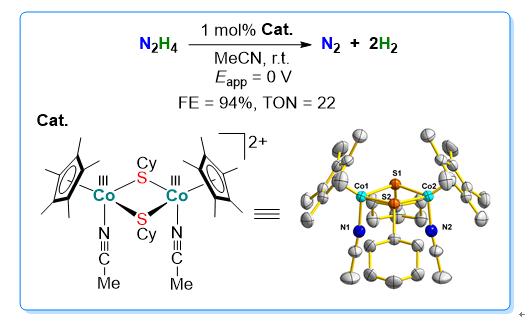
肼(N2H4)是一种能量密度较高,常温下为液体且便于储运的重要能源分子。肼氧化反应(HzOR)作为直接肼燃料电池的阳极反应,开发其结构明确的均相分子催化剂具有重要意义。本文以2-萘硫酚、4-吡啶硫醇和环己基硫醇为桥联配体,通过盐交换复分解策略合成了三例新型硫桥联双钴配合物1-3,其中环己基硫桥联双钴配合物3可以经历双电子氧化过程生成双钴双乙腈配合物4,这些配合物的结构通过多种表征手段确认。电化学研究表明,配合物4是一种良好的HzOR分子电催化剂,其催化启动电位和过电位分别为-0.54和0.84 V。通过控制电位电解实验和气相色谱分析确定催化产物为N2,相应的转换数(TON)为22,法拉第效率为94%。上述结果展现了双钴分子体系在含氮能源分子的电催化转化方面的应用潜力。
Hydrazine (N2H4) is regarded as an important energy carrier owing to its high energy density and liquid state under ambient conditions, which facilitates convenient storage and transportation. From a practical perspective, hydrazine hydrate (N2H4∙H2O) is particularly attractive because it has a lower explosion risk compared with anhydrous N2H4. The hydrazine oxidation reaction (HzOR) serves as the key anodic process in direct hydrazine fuel cells (DHFCs). Therefore, development of structurally well-defined homogeneous molecular catalysts is of importance, not only for enabling efficient HzOR electrocatalysis, but also for gaining molecular-level insight into the associated mechanisms. Thiolate-bridged dicobalt complexes represent promising molecular platforms due to their robust bimetallic cores and highly tunable coordination environments. In this work, three novel thiolate-bridged dicobalt complexes 1-3 were designed and synthesized via a salt metathesis strategy using 2-naphthalenethiol, 4-mercaptopyridine, and cyclohexanethiol as bridging ligands. These complexes were systematically characterized by proton nuclear magnetic resonance (1H NMR) spectroscopy, elemental analysis, and single-crystal X-ray diffraction analysis, confirming the successful construction of well-defined thiolate-bridged dicobalt frameworks with distinct coordination environments. Reactivity studies revealed that oxidation of the coordinatively unsaturated dicobalt complex [Cp*CoII(μ-SCy)2CoIICp*] (3, Cp* = ƞ5-C5Me5) afforded a stable bis(acetonitrile)-coordinated dicobalt complex [Cp*CoIII(μ-SCy)(MeCN)]2[PF6]2 (4). Complex 4 was characterized by 1H NMR spectroscopy and high-resolution mass spectrometry, and its molecular structure was determined by single-crystal X-ray diffraction analysis. Structural analysis revealed that upon oxidation and acetonitrile coordination, complex 4 undergoes pronounced conformational changes relative to precursor 3, accompanied by an elongation of the Co∙∙∙Co distance from 0.25238(9) to 0.3437(1) nm. Electrochemical studies demonstrated that 4 exhibits well-defined and stable redox behavior, motivating further investigation of its electrocatalytic HzOR activity. Upon addition of N2H4∙H2O into the MeCN solution of 4, the cyclic voltammogram exhibited an obvious catalytic oxidation current with an onset potential of -0.54 V (vs. Fc+/Fc), which corresponds to an overpotential of 0.84 V. The catalytic current increased with increasing N2H4∙H2O concentration, further supporting the involvement of N2H4∙H2O in the electrocatalytic process. Controlled potential electrolysis at 0 V (vs. Fc+/Fc) for 1 h followed by gas chromatographic analysis confirmed the formation of N2 at the anode together with H2 at the cathode. The corresponding turnover number (TON) and the Faradaic efficiency (FE) for N2 formation were determined to be 22 and 94%, respectively. These experimental results establish 4 as a molecular electrocatalyst for HzOR and demonstrate the potential of thiolate-bridged dicobalt platforms for electrocatalytic conversion of nitrogen-containing energy carriers.
[1] Chu S.; Majumdar A.Nature 2012, 488, 294.
[2] Yang X.; Zhang Y.; Sun P.; Peng C. Smart Mol.2024, 2, e20240019.
[3] Sakamoto T.; Serov A.; Masuda T.; Kamakura M.; Yoshimoto K.; Omata T.; Kishi H.; Yamaguchi S.; Hori A.; Horiuchi Y.; Terada T.; Artyushkova K.; Atanassov P.; Tanaka H.J. Power Sources 2018, 375, 291.
[4] Badreldin A.; Youssef E.; Djire A.; Abdala A.; Abdel-Wahab, A. Cell Rep. Phys. Sci.2023, 4, 101427.
[5] Schirmann J. P.; Bourdauducq P. Hydrazine,Ullmann’s Encyclopedia of Industrial Chemistry. John Wiley & Sons, Paris, 2001, pp. 80—96.
[6] Varcoe J. R.; Atanassov P.; Dekel D. R.; Herring A. M.; Hickner M. A.; Kohl P. A.; Kucernak A. R.; Mustain W. E.; Nijmeijer K.; Scott K.; Xu T.; Zhuang L.Energy Environ. Sci. 2014, 7, 3135.
[7] Sakamoto T.; Asazawa K.; Martinez U.; Halevi B.; Suzuki T.; Arai S.; Matsumura D.; Nishihata Y.; Atanassov P.; Tanaka, H. J. Power Sources2013, 234, 252.
[8] Burshtein T. Y.; Yasman Y.; Muñoz-Moene, L.; Zagal, J.; Eisenberg, D.ACS Catal. 2024, 14, 2264.
[9] Evans G. E.; Kordesch K. V.Science 1967, 158, 1148.
[10] Andrew M. R.; Gressler W. J.; Johnson J. K.; Short R. T.; Williams K. R.; J. Appl. Electrochem.1972, 2, 327.
[11] Qian Q.; Zhang J.; Li J.; Li Y.; Jin X.; Zhu Y.; Liu Y.; Li Z.; El-Harairy, A.; Xiao, C.; Zhang, G.; Xie, Y.Angew. Chem. Int. Ed. 2021, 60, 5984.
[12] Zagal J. H.J. Electroanal. Chem. 1980, 109, 389.
[13] Zagal J.; Muñoz E.; Ureta-Zañartu, S.Electrochim. Acta 1982, 27, 1373.
[14] Zagal J. H.; Griveau S.; Silva J. F.; Nyokong T.; Bedioui F.Coord. Chem. Rev. 2010, 254, 2755.
[15] Bennett J. E.; Malinski T.Chem. Mater. 1991, 3, 490.
[16] Ojha K.; Farber E. M.; Burshtein T. Y.; Eisenberg D.Angew. Chem. Int. Ed. 2018, 57, 17168.
[17] Offen-Polak, I.; Samala, N. R.; Burshtein, T. Y.; Zahan, S. M.; Xiang, S.; Shahaf, Y.; Studnik, C.; Ni, L.; Delgado-Jaime, M. U.; Kramm, U.; Dekel, D. D.; Vogt, C.; Frenkel, A. I.; Grinberg, I.; Eisenberg, D. J. Am. Chem. Soc. 2025, 147, 31731.
[18] Yang D.; Wang B.; Qu, J. Acc. Chem. Res.2024, 57, 1761.
[19] Tard C.; Pickett C. J.Chem. Rev. 2009, 109, 2245.
[20] Li S.; Ouyang Z.; Zou J.; Wang D.; Xu B.; Deng, L. Acta Chim. Sinica2022, 80, 272.
[21] Li Y.; Li Y.; Wang B.; Luo Y.; Yang D.; Tong P.; Zhao J.; Luo L.; Zhou Y.; Chen S.; Cheng F.; Qu J. Nat. Chem.2013, 5, 320.
[22] Zhang Y.; Zhao J.; Yang D.; Wang B.; Zhou Y.; Wang J.; Chen H.; Mei T.; Ye S.; Qu J. Nat. Chem.2022, 14, 46.
[23] Mei T.; Yang D.; Di K.; Zhang Y.; Zhao J.; Wang B.; Qu J. Organometallics2022, 41, 1334.
[24] Wang Z.; Zhang H.; Zhang P.; Di K.; Zhao J.; Wang B.; Qu J.; Ye S.; Yang, D. J. Am. Chem. Soc.2024, 29, 19737.
[25] Su L.; Yang D.; Jiang Y.; Li Y.; Di K.; Wang B.; Ye S.; Qu J.Angew. Chem. Int. Ed. 2022, e202203121.
[26] Sun P.; Yang D.; Li Y.; Zhang Y.; Su. L.; Wang B.; Qu J. Organometallics2016, 35, 751.
[27] Wang C.; Jiang H.; Du R.; Li J.; Wang B.; Liao R.-Z.; Yang D.; Qu J.CCS Chem. 2025, 8, 2748.
[28] Tong P.; Xie W.; Yang D.; Wang B.; Ji X.; Li J.; Qu J. Dalton Trans.2016, 45, 18559.
[29] Wu H.; Li J.; Yang D.; Tong P.; Zhao J.; Wang B.; Qu J.Inorg. Chem. Front. 2019, 6, 2185.
[30] Mei T.; Zhang P.; Song Z.; Wang B.; Qu J.; Ye S.; Yang, D. J. Am. Chem. Soc.2023, 145, 20578.
[31] Kölle U.; Khouzami F.; Bernhard, F. Angew Chem. Int. Ed. Engl.1982, 21, 131.
[32] Kölle U.; Fuss B.; Belting M.; Raabe E.Organometallics 1986, 5, 980.
[33] Wang C.; Li J.; Yang D.; Tong P.; Sun P.; Wang B.; Qu J.Eur. J. Inorg. Chem. 2020, 2020, 2757.
[34] Bányai, I. New J. Chem.2018, 42, 7569.
[35] Randles, J. E. B. Trans. Faraday Soc.1948, 44, 327.
[36] Bard A. J.; Faulkner L. R.Electrochemical Methods: Fundamental and Applications. John Wiley & Sons, Hoboken 2000, pp. 5—9.
[37] Lindley B. M.; Appel A. M.; Krogh-Jespersen, K.; Mayer, J. M.; Miller, A. J. M.ACS Energy Lett. 2016, 1, 698.
[38] Pavlishchuk V. V.; Addison A. W.Inorg. Chim. Acta 2000, 298, 97.
[39] Costentin C.; Savéant J.-M.ChemElectroChem 2014, 1, 1226.
[40] Costentin C.; Drouet S.; Robert M.; Savéant J.-M.Science 2012, 338, 90.
[41] Matheu R.; Neudeck S.; Meyer F.; Sala X.; Llobet A.ChemSusChem 2016, 9, 3361.
[42] Li Y.; Chen J.-Y.; Miao Q.; Yu X.; Feng L.; Liao R.-Z.; Ye S.; Tung C.-H.; Wang W. J. Am. Chem. Soc. 2022, 144, 4365.
[43] Wang V. C.C.; Johnson, B. A.ACS Catal. 2019, 9, 7109.
[44] Katipamula S.; White N. M.; Waldie K. M.Chem. Catal. 2023, 3, 100561.