研究通讯

基于生物质呋喃衍生物聚硅醚共聚物的合成及性能研究★

  • 张弛 ,
  • 何嘉伦 ,
  • 朱子杰 ,
  • 陈锐 ,
  • 赵威 ,
  • 周翰廷 ,
  • 邬金才 ,
  • 李振华 ,
  • 潘效波
展开
  • a兰州大学 化学化工学院 兰州 730000;
    b西北民族大学 化工学院 兰州 730030
★纪念兰州大学化学学科创建80周年”专辑

收稿日期: 2026-06-18

  网络出版日期: 2026-10-15

基金资助

国家重点研发计划‘催化科学’专项资助(2023YFA1506804), 甘肃省自然科学基金专项(优秀博士生项目, 26JRRA266), 西北民族大学中央高校基本科研业务费(31920260069).

Synthesis and Properties of Poly(silyl ether)s Copolymers Based on Biomass Furan Derivatives

  • Zhang Chi ,
  • He Jialun ,
  • Zhu Zijie ,
  • Chen Rui ,
  • Zhao Wei ,
  • Zhou Hanting ,
  • Wu Jincai ,
  • Li Zhenhua ,
  • Pan Xiaobo
Expand
  • aCollege of Chemistry and Chemical Engineering, Lanzhou University, Lanzhou 730000;
    bCollege of Chemical Engineering, Northwest Minzu University, Lanzhou, 730030

Received date: 2026-06-18

  Online published: 2026-10-15

Supported by

National Key R&D Program of China (2023YFA1506804, Special Project of Gansu Provincial Natural Science Foundation (Excellent Doctoral Student Program) (26JRRA266), Fundamental Research Fund for the Central Universities, Northwest Minzu University (No, 31920260069).

摘要

聚硅醚(Poly(silyl ether)s,PSEs)是一类主链中含有Si-O-C键的聚合物,具有高热稳定性、低玻璃化转变温度、阻燃性和可降解性,使其在弹性体、透气薄膜和生物相容性涂料方面具有广阔的应用前景.聚硅醚结构单元的种类和连接顺序对材料的性质和降解性能等起到关键的作用.因此,如何通过调控结构单元种类和连接顺序,改变材料性质、热稳定性与环境相容性,是构筑高性能聚硅醚的研究热点之一.本论文使用弱路易斯酸(平面芳基硼烷)和弱路易斯碱(三正丁基氧化膦)组成的受阻路易斯酸碱对(FLP)作为催化剂,采用分步法和一锅法实现了在温和条件下将呋喃类衍生物、对苯二甲醛(TPAL)与1,4-二(二甲基硅烷基)苯(1,4-BDSD)进行共聚,高效制备了呋喃基聚硅醚共聚物,展现了高热稳定性以及低玻璃化转变温度.该工作不仅实现了呋喃基功能聚硅醚的高效合成,还丰富了可再生聚合物的种类体系,具有重要的研究意义.

本文引用格式

张弛 , 何嘉伦 , 朱子杰 , 陈锐 , 赵威 , 周翰廷 , 邬金才 , 李振华 , 潘效波 . 基于生物质呋喃衍生物聚硅醚共聚物的合成及性能研究★[J]. 化学学报, 2026 : 26060205 . DOI: 10.6023/A26060205

Abstract

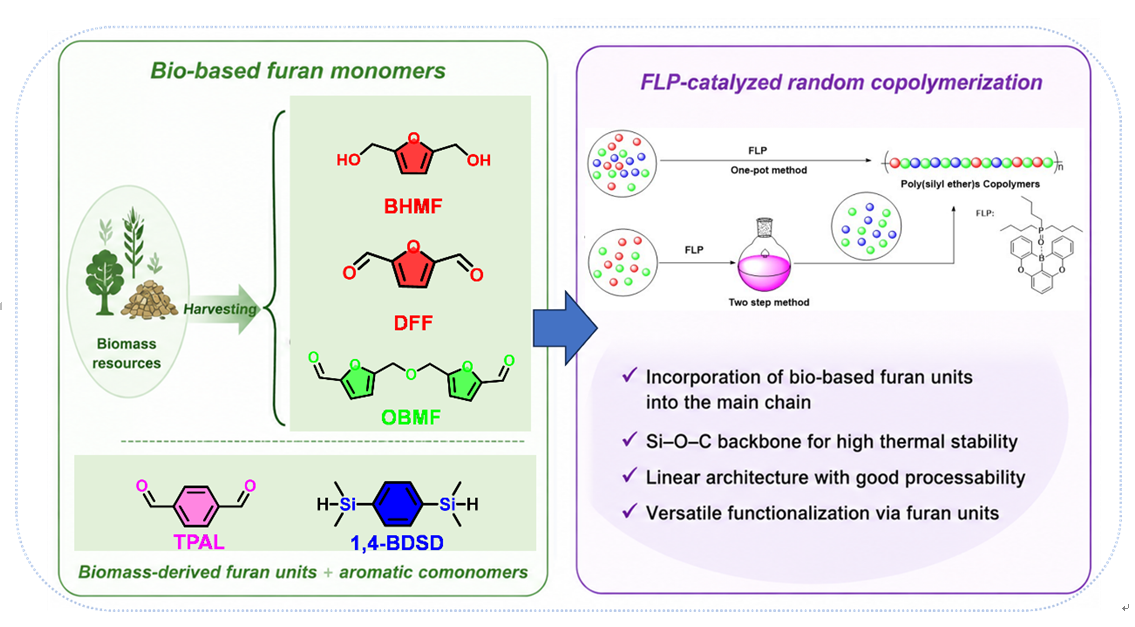
Poly(silyl ether)s (PSEs) are a class of polymers with Si-C-O linkages in the main chain. They feature high thermal stability, low glass transition temperature, flame retardancy and degradability, and thus hold broad application prospects in elastomers, gas-permeable films, and biocompatible coatings. The degradation behavior and functional properties of poly(silyl ether)s can be tailored by adjusting the sequence of structural units and molecular packing of the main chain. Therefore, the development of efficient catalytic systems for the mild synthesis of bio-based PSEs is highly desirable. In this work, a frustrated Lewis pair (FLP) catalytic system composed of an oxygen-bridged constrained planar arylborane (DOBA) as a weak Lewis acid and tri-n-butylphosphine oxide (TBPO) as a weak Lewis base was employed for the synthesis of bio-based PSEs under mild conditions. A series of biomass-derived furan monomers, including 2,5-diformylfuran (DFF), 2,5-bis(hydroxymethyl)furan (BHMF), and bis(5-formylfurfuryl) ether (OBMF), together with terephthalaldehyde (TPAL), were copolymerized with 1,4-bis(dimethylsilyl)benzene (1,4-BDSB) through stepwise method and one-pot method under mild conditions to efficiently synthesize furan-based poly(silyl ether) copolymers. The obtained polymers exhibited number-average molecular weights (Mn) ranging from 5.95 to 18.99 kDa, with dispersities (Đ) of 1.33-2.41. Thermal analysis revealed low glass-transition temperatures (Tg = -29.8 to -21.1 °C) and good thermal stability, with 5% weight-loss temperatures (Td, 5%) ranging from 275.3 to 310.1 °C. Comparative analysis further indicated that the molecular structures of the monomers strongly influenced the thermal and thermomechanical properties of the resulting polymers: the incorporation of rigid aromatic units enhanced thermal stability, whereas flexible furan-derived ether segments favored lower Tg values. These results demonstrate that the structural diversity of biomass-derived monomers can be exploited to regulate the properties of PSEs. This work establishes an efficient metal-free FLP-catalyzed strategy for the synthesis of bio-based linear poly(silyl ether)s under mild conditions and provides a viable approach for integrating renewable furan-derived building blocks into sustainable silicon-containing polymeric materials.

参考文献

[1] Hao Zhou, Y. J. Y. W. Acta Physico-Chimica Sinica, 2022, 38(10), 2203016.
[2] Cai Z.; Liu Y.; Tao Y.; Zhu J.-B.Acta Chim. Sinica 2022, 80, 1165 (in Chinese).
(蔡中正, 刘野, 陶友华, 朱剑波, 化学学报, 2022, 80, 1165.)
[3] Wang, L., Chen, E. Y.X. ACS Catalysis, 2015, 5(11), 6907-6917.
[4] Duan Zhi-Yong, Z. J.-Z. X. U. X.-X. Acta Chimica Sinica, 2004, 62(8), 811-817.
[5] Qian He, J. L. S. Y. D. W. J. Y. P. H. Acta Chimica Sinica, 2023, 81(10), 1265-1270.
[6] Wang Z.; Xiao Y.; Jin H.; Tan T.; Wang S.; Li X.Acta Chim. Sinica 2014, 72, 731 (in Chinese).
(王志强, 肖殷, 金会义, 谈廷风, 王世荣, 李祥高, 化学学报, 2014, 72, 731.)
[7] Cheng C., Watts A., Hillmyer M. A., Hartwig J. F. Angewandte Chemie International Edition, 2016, 55(39), 11872-11876.
[8] Miller S. A. ACS Macro Letters, 2013, 2(6), 550-554.
[9] Rücker, C., Kümmerer, K. Chemical Reviews, 2015, 115(1), 466-524.
[10] Sahmetlioglu, E., Nguyen, H. T.H., Nsengiyumva, O., Göktürk, E., Miller, S. A. ACS Macro Letters, 2016, 5(4), 466-470.
[11] Wu Y.; Fan H.; Zhang W.; Wang M.; Cai Z.; Zhu J. Macromolecules (2022) 55(20): 9232-9241.
[12] Wu Y.; Fan H.; Shan S.; Wang S.; Cai Z.; Zhu J. Chem.Res. Chinese Universities, 2023, 39, 809-815
[13] Curry, J. E., Byrd, J. D. Journal of Applied Polymer Science, 1965, 9(1), 295-311.
[14] Liu X., Bekmirzaev J., Robert C., Gauvin R. M., Thomas C. M. Green Chemistry, 2025, 27(39), 12002-12028.
[15] Upitak, K., Thomas, C. M. Angewandte Chemie International Edition, 2025, 64(19), e202418908.
[16] Ware T., Jennings A. R., Bassampour Z. S., Simon D., Son D. Y., Voit W. RSC Advances, 2014, 4(75), 39991-40002.
[17] Yang F., Sun F., Thomas C. M. Angewandte Chemie International Edition, 2026, 65(8), e21137.
[18] Wang Q., Wu X., Hao X., Wang Z., Zhang C., Wu J., Pan X. ACS Catalysis, 2026, 16(9), 7998-8007.
[19] Hada R., Kanazawa A., Aoshima S. Macromolecules, 2022, 55(13), 5474-5484.
[20] Li Y.; Wang X.; Tang Y.Acta Chim. Sinica 2024, 82, 213 (in Chinese).
(李雅宁, 王晓艳, 唐勇, 化学学报, 2024, 82, 213.)
[21] Wang Y.; Wang C.; Ma H.Acta Chim. Sinica 2025, 83, 25 (in Chinese).
(王玉娜, 王超, 马海燕, 化学学报, 2025, 83, 25.)
[22] Wang Y.; Yan J.Acta Chim. Sinica 2023, 81, 275 (in Chinese).
(汪阳, 阎敬灵, 化学学报, 2023, 81, 275.)
[23] Huang H.; Xie M.; Huang Y.; Cui J.; Cai Z.; Zhu J.-B.Acta Chim. Sinica 2025, 83, 810 (in Chinese).
(黄皓毅, 谢敏, 黄玉婷, 崔嘉豪, 蔡中正, 朱剑波, 化学学报, 2025, 83, 810.)
[24] Shi L.; Dai Y. Wu,W.; Li, S. Mou, Z. Acta Chim. Sinica 2025, 83, 1488 (in Chinese).
(石力双, 戴雅男, 伍伟豪, 李世辉, 牟泽怀, 化学学报, 2025, 83, 1488.)
[25] Xu T, Chen E Y. J Am Chem Soc, 2014, 136(5): 1774-1777.
[26] He J, Zhang Y, Falivene L. Macromolecules, 2014, 47(22): 7765-7774.
[27] Hong M, Chen J, Chen E Y.Chem. Rev, 2018, 118, 10551-10616.
文章导航

/

〈 〉