化学学报 >

0 26080280 - 26080280

DOI: https://doi.org/10.6023/A26080280

研究论文

核酸适体介导的高阶蛋白组装体用于微环境响应的蛋白活性调控研究

  • 毛瑞 ,
  • 刘悦 ,
  • 望志强 ,
  • 文纳川 ,
  • 陈红 ,
  • 张强 ,
  • 王倩倩 ,
  • 吴慧 ,
  • 王智敏 ,
  • 邱丽萍
展开
  • a湖南大学 化学化工学院 湖南长沙 410082;
    b中国科学院 杭州医学研究所 浙江杭州 310022
#共同第一作者

收稿日期: 2026-08-07

  网络出版日期: 2026-10-23

基金资助

国家自然科学基金(NSFC 22404051、22595382和22504153),国家重点研发计划(2024YFC2419104),教育部基础学科与交叉学科突破计划(JYB2025XDXM602)以及浙江省创新创业领军团队引进计划(2025R01009)

Aptamer-Mediated High-Order Protein Nanoclusters Enable Microenvironment-Responsive Manipulation of Protein Activity

  • Rui Mao ,
  • Yue Liu ,
  • Zhiqiang Wang ,
  • Nachuan Wen ,
  • Hong Chen ,
  • Qiang Zhang ,
  • Qianqian Wang ,
  • Hui Wu ,
  • Zhimin Wang ,
  • Liping Qiu
Expand
  • aCollege of Chemistry and Chemical Engineering, Hunan University, Changsha, Hunan 410082, China;
    bHangzhou Institute of Medicine (HIM), Chinese Academy of Sciences, Hangzhou, Zhejiang 310022, China
#These authors contributed equally to this work

Received date: 2026-08-07

  Online published: 2026-10-23

Supported by

National Natural Science Foundation of China (NSFC 22404051, 22595382 and 22504153), the National Key Research and Development Program of China (2024YFC2419104), the Fundamental and Interdisciplinary Disciplines Breakthrough Plan of the Ministry of Education of China (JYB2025XDXM602) and the Leading Innovative and Entrepreneur Team Introduction Program of Zhejiang Province (2025R01009).

摘要

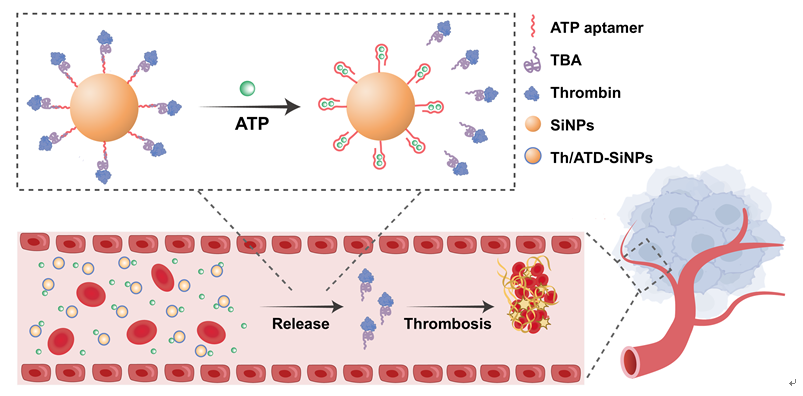
蛋白质是生命活动的核心执行者,其功能发挥依赖于活性的精确调控。然而,同一种蛋白在不同组织中往往具有不同的活性需求,如何实现蛋白质活性的组织微环境特异性动态调控仍面临挑战。因此,本研究构建了一种核酸适体介导的组织微环境响应型蛋白调控平台。以凝血酶为模型蛋白,利用肿瘤微环境中高表达的三磷酸腺苷(ATP)作为响应信号,将ATP核酸适体(ATPA)与凝血酶核酸适体(TBA)组装形成ATP响应性双链(ATPA-TBA),并进一步修饰于二氧化硅纳米颗粒表面。进而通过负载凝血酶,构建了ATP响应型高阶蛋白组装调控纳米平台(Th/ATD-SiNPs)。在生理条件下,该纳米平台通过多价识别捕获凝血酶并诱导其形成高阶蛋白组装体,使凝血酶维持失活状态;而在ATP富集的肿瘤环境中,ATP促使ATPA-TBA双链解离,导致凝血酶从纳米颗粒表面释放从而恢复凝血酶的催化活性。体外实验表明,该纳米平台能够有效抑制凝血酶活性,且在ATP浓度低至0.05 mM时即可发生响应性解离;同时,该平台即使在含10%胎牛血清条件下孵育6 h后,经ATP刺激仍可恢复38%以上的凝血酶活性,表现出良好的微环境响应性能和生物稳定性。体内实验进一步证实,该纳米平台可在肿瘤部位持续富集12 h以上,并依赖肿瘤微环境中较高水平的ATP选择性恢复凝血酶活性,诱导肿瘤内血栓形成并显著抑制肿瘤生长,同时未引起明显的系统毒性及凝血功能异常。本研究建立了一种基于微环境信号驱动的蛋白活性调控策略,为组织特异性蛋白质活性精准调节及智能蛋白治疗体系的设计提供了新思路。

本文引用格式

毛瑞 , 刘悦 , 望志强 , 文纳川 , 陈红 , 张强 , 王倩倩 , 吴慧 , 王智敏 , 邱丽萍 . 核酸适体介导的高阶蛋白组装体用于微环境响应的蛋白活性调控研究[J]. 化学学报, 0 : 26080280 -26080280 . DOI: 10.6023/A26080280

Abstract

Proteins serve as the fundamental molecules in biological systems, whose functions rely on precise regulation of their activity. However, the same protein often requires distinct activity profiles in different tissues, and achieving tissue microenvironment-specific dynamic regulation of protein activity remains a major challenge. Here, we developed an aptamer-based tissue microenvironment-responsive protein regulatory nanoplatform that enabled programmable modulation of protein activity through reversible higher-order protein assemblies. Thrombin was selected as a model protein, while adenosine triphosphate (ATP), which is highly enriched in the tumor microenvironment, was employed as the responsive signal. An ATP-responsive duplex was constructed by hybridizing an ATP aptamer (ATPA) with a thrombin-binding aptamer (TBA) and subsequently immobilized onto silica nanoparticles. By loading thrombin onto this system, an ATP-responsive nanoplatform (Th/ATD-SiNPs) capable of regulating higher-order protein assembly was constructed. Under physiological conditions with low ATP levels, the nanoplatform efficiently captured thrombin through multivalent recognition and induced the formation of high-order protein clusters. The resulting spatial confinement shielded the catalytic sites and maintained thrombin in an inactive state. Upon exposure to ATP-enriched tumor microenvironments, ATP binding induced conformational switching of the responsive aptamers, resulting in the release of thrombin and restoring thrombin activity. In vitro studies demonstrated the nanoplatform responded to ATP concentrations as low as 0.05 mM and restored more than 38% of thrombin activity after incubation in 10% fetal bovine serum for 6 h, indicating excellent responsiveness and stability under biologically relevant conditions. In vivo fluorescence imaging revealed prolonged tumor retention of the nanoplatform for at least 12 h. Benefiting from the elevated ATP level within tumor microenvironments, selective activation of thrombin induced extensive intratumoral thrombosis and significantly inhibited tumor growth without causing detectable systemic toxicity, coagulation abnormalities, or organ damage. Collectively, this work established a microenvironment signal-driven strategy for dynamically regulating protein activity, providing a versatile framework for tissue-specific protein regulation and advancing the development of intelligent protein therapeutics with enhanced precision and safety.

参考文献

[1] Liu J., Wang Y., Tang C., Zhang L., Xiong S., Wang J., Dong C. Mol. Biomed.2026, 7, 9.
[2] Massagué, J., Sheppard, D. Cell2023, 186, 4007-4037.
[3] He H.; Zhou, L., Liu, Z. Acta Chim. Sinica2021, 79, 45-57(in Chinese). (贺晖, 周玲俐, 刘震, 化学学报, 2021, 79, 45-57.)
[4] Chen C., Shi H., Hao R., Fang L., Xua, H. Acta Chim. Sinica2024, 82, 613-620(in Chinese). (陈从丽, 师怀怀, 郝芮, 房丽晶, 徐华栋, 化学学报, 2024, 82, 613-620.)
[5] Chen X., Liu L., Kang S., Gnanaprakasam J. R., Wang R.Sci. Adv.2023, 9, eadd9554.
[6] Luo Z., Tian M., Yang G., Tan Q., Chen Y., Li G., Zhang Q., Li Y., Wan P., Wu, J. Signal Transduction Targeted Ther.2022, 7, 218.
[7] Coughlin, S. R. Nature2000, 407, 258-264.
[8] Crawley J. T. B., Zanardelli S., Chion C. K. N. K., Lane, D. A. J. Thromb. Haemostasis2007, 5, 95-101.
[9] Yin J., Wang S., Wang J., Zhang Y., Fan C., Chao J., Gao Y., Wang L. Nat. Mater.2024, 23, 854-862.
[10] Li S., Zhang Y., Ho S.-H., Li B., Wang M., Deng X., Yang N., Liu G., Lu Z., Xu J., Shi Q., Han J.-Y., Zhang L., Wu Y., Zhao Y., Nie, G. Nat. Biomed. Eng.2020, 4, 732-742.
[11] Li S., Jiang Q., Liu S., Zhang Y., Tian Y., Song C., Wang J., Zou Y., Anderson G. J., Han J.-Y., Chang Y., Liu Y., Zhang C., Chen L., Zhou G., Nie G., Yan H., Ding B., Zhao Y. Nat. Biotechnol.2018, 36, 258-264.
[12] Jackson, S. P. Nat. Med.2011, 17, 1423-1436.
[13] Zamani, M. R., Šácha, P. Med. Oncol.2025, 42, 273.
[14] Ramos-Casals M., Brahmer J. R., Callahan M. K., Flores-Chávez A., Keegan N., Khamashta M. A., Lambotte O., Mariette X., Prat A., Suárez-Almazor, M. E. Nat. Rev. Dis. Primers2020, 6, 38.
[15] Arkin Michelle R., Tang Y., Wells, James A. Chem. Biol.2014, 21, 1102-1114.
[16] Nada H., Choi Y., Kim S., Jeong K. S., Meanwell N. A., Lee K.Signal Transduction Targeted Ther. 2024, 9, 341.
[17] Yang H., Bi S., Yu B., Fang P., Wang, J. Acta Chim. Sinica2025, 83, 725-754(in Chinese). (杨翰明, 毕舒杨, 俞飚, 房鹏飞, 王婧, 化学学报, 2025, 83, 725-754.)
[18] Zhu L., Hou T., Chen L., Xu X. Acta Chim. Sinica2001, 59, 1078-1083(in Chinese). (朱丽荔, 候廷军, 陈丽蓉, 徐筱杰, 化学学报, 2001, 59, 1078-1083.)
[19] Redchuk T. A., Karasev M. M., Verkhusha P. V., Donnelly S. K., Hülsemann M., Virtanen J., Moore H. M., Vartiainen M. K., Hodgson L., Verkhusha, V. V. Nat. Commun.2020, 11, 605.
[20] Stanton B. Z., Chory E. J., Crabtree G. R. Science2018, 359, eaao5902.
[21] Shiang Y.-C., Huang C.-C., Wang T.-H., Chien C.-W., Chang, H.-T. Adv. Funct. Mater.2010, 20, 3175-3182.
[22] Xie S., Qiu L., Cui L., Liu H., Sun Y., Liang H., Ding D., He L., Liu H., Zhang J., Chen Z., Zhang X., Tan W. Chem2017, 3, 1021-1035.
[23] Di Virgilio F., Sarti A. C., Falzoni S., De Marchi E., Adinolfi, E. Nat. Rev. Cancer2018, 18, 601-618.
[24] Xie S., Wang Z., Fu T., Zheng L., Wu H., He L., Huang H., Yang C., Wang R., Qian X., Qiu L., Tan W. Angew. Chem., Int. Ed.2022, 61, e202201220.
[25] Huizenga, D. E., Szostak, J. W. Biochemistry1995, 34, 656-665.
[26] Tasset D. M., Kubik M. F., Steiner, W. J. Mol. Biol.1997, 272, 688-698.
[27] Gilbert S. M., Oliphant C. J., Hassan S., Peille A. L., Bronsert P., Falzoni S., Di Virgilio F., McNulty S., Lara R. Oncogene2019, 38, 194-208.
[28] Pellegatti P., Raffaghello L., Bianchi G., Piccardi F., Pistoia V., Di Virgilio, F. PLoS One2008, 3, e2599.
[29] Sun Y., Zha L. G. H., Zhang J., Guan C., Zheng L., Li W., Qiao J. Acta Chim. Sinica2011, 69, 967-972(in Chinese). (孙艳华, 扎拉嘎胡, 张金利, 关丛笑, 郑琳, 李韡, 乔建军, 化学学报, 2011, 69, 967-972.)
文章导航

/

〈 〉