

Acta Chimica Sinica ›› 2026, Vol. 84 ›› Issue (4): 601-616.DOI: 10.6023/A25110381 Previous Articles
Review
王玉珍a, 常亚冉a,b,*( ), 郭广生a, 汪夏燕a,*()
投稿日期:2025-11-24
发布日期:2026-03-16
通讯作者:
常亚冉, 汪夏燕
作者简介: |
王玉珍, 就读于北京工业大学化学与生命科学学院, 2023级化学专业硕士. 主要研究方向为血脑屏障芯片构建及应用. |
 |
常亚冉, 博士, 北京大学材料科学与工程学院博士后, 2024年毕业于北京工业大学, 获得工学博士学位, 主要研究方向为微流控芯片的构建与应用. |
 |
郭广生, 博士, 北京工业大学化学与生命科学学院教授, 国务院特殊津贴获得者、北京市首批战略科技人才. 研究方向包括微流控芯片系统的构建与应用、微纳尺度分离分析和新型微纳分析仪器研制等. |
 |
汪夏燕, 博士, 北京工业大学化学与生命科学学院教授, 国家杰出青年科学基金获得者、国家“万人计划”科技创新领军人才、国务院特殊津贴获得者、北京市优秀教师. 研究方向包括微流控芯片系统的构建与应用、微纳尺度分离分析、单细胞分析和新型微纳分析仪器研制等. |
基金资助:
Yuzhen Wanga, Yaran Changa,b,*(), Guangsheng Guoa, Xiayan Wanga,*()
Received:2025-11-24
Published:2026-03-16
Contact:
Yaran Chang, Xiayan Wang
Supported by:Share
Yuzhen Wang, Yaran Chang, Guangsheng Guo, Xiayan Wang. Construction and Evaluation of Microfluidic Blood-Brain Barrier Organ-on-Chips System[J]. Acta Chimica Sinica, 2026, 84(4): 601-616.
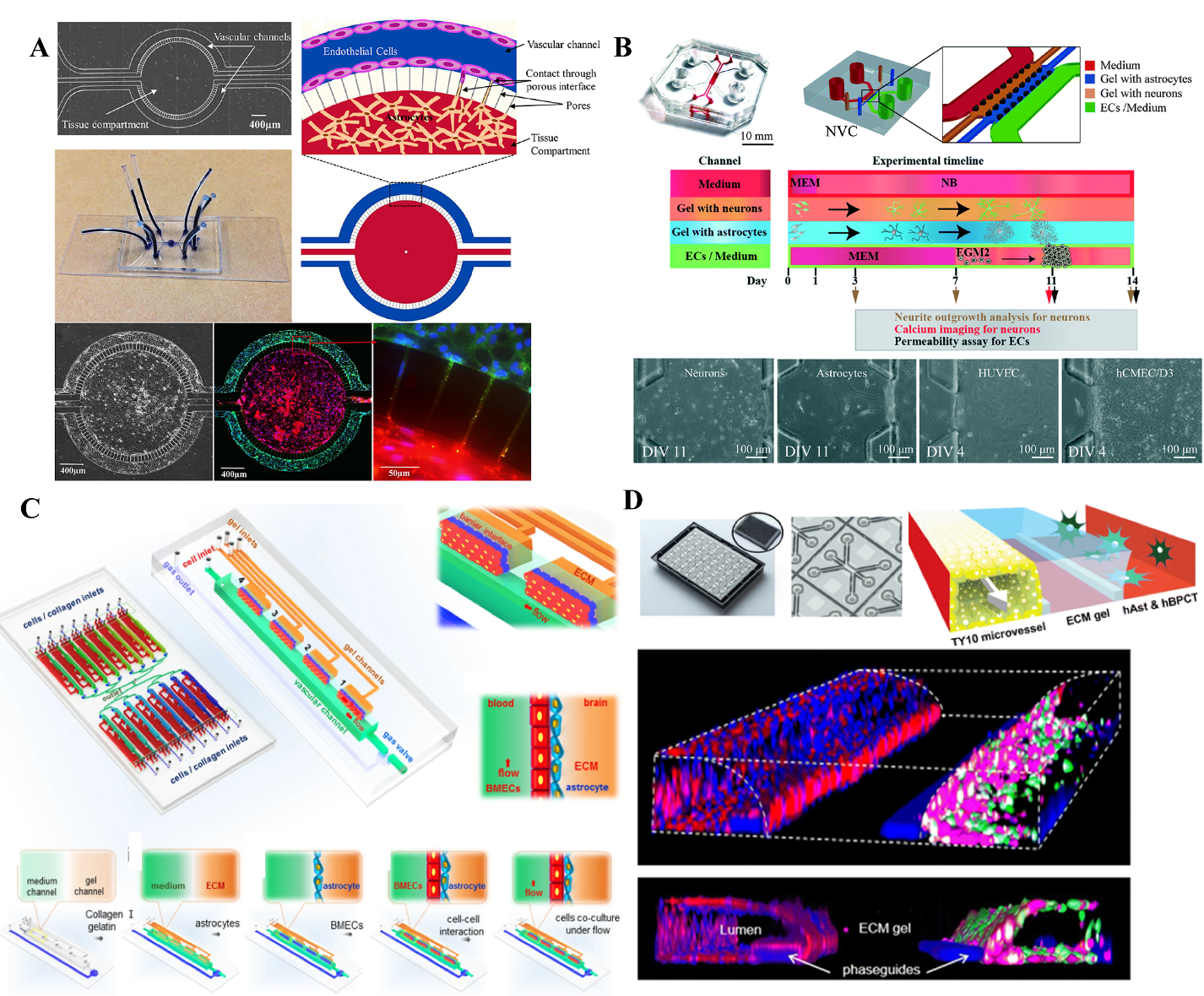
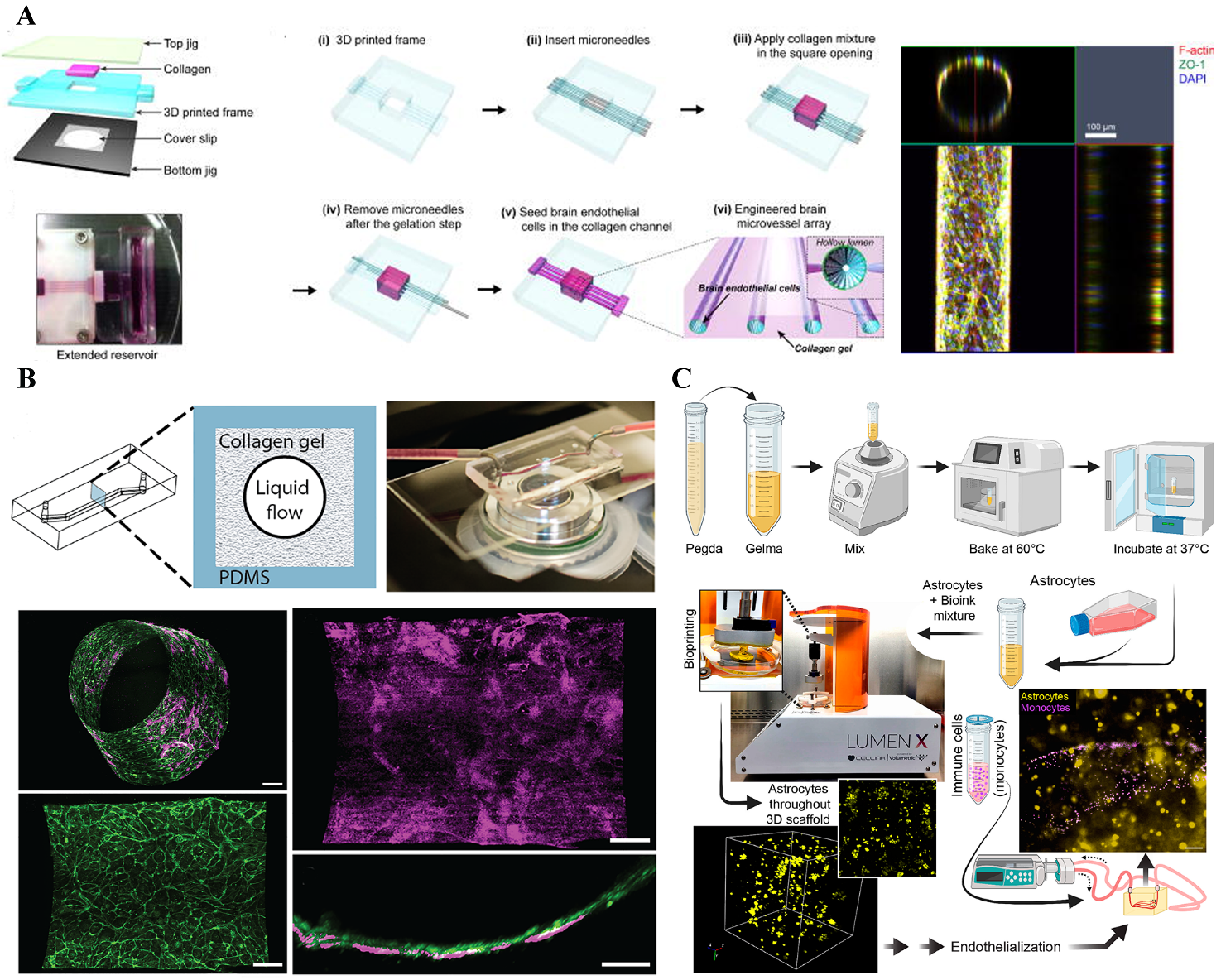
| 芯片类型 | 芯片结构 | 生理 相关性 | 芯片材料 | 胶原材料 | 细胞接种方式 | 屏障完整性指标 | 优点 | 局限性 | 适用场景 |
|---|---|---|---|---|---|---|---|---|---|
| 三明治结构 芯片 | 上下层通道 +多孔膜 | 中等 | PDMS+ PC/PET | 纤连蛋白 | 膜两侧接种 | TEER; 渗透率; 特异性蛋白表达 | 工艺成熟; 便于TEER、 渗透率测量 | 3D血管缺失; 高分辨成像受限 | 高通量药物筛选; 屏障功能探究 |
| 平行结构 芯片 | 平行通道 +微柱阵列 | 中等 | COCa; PDMS | 基质胶; 纤连蛋白 | 通道内接种; 水凝胶内包埋 | 渗透率; 特异性蛋白表达 | 成像兼容性好; 利于细胞交流 | 3D血管缺失; TEER测量困难 | 细胞相互作用研究; 实时动态成像检测 |
| 3D管状 芯片 | 中空管状 微血管 | 高 | COC; PDMS | 水凝胶 | 管腔内壁接种; 水凝胶内包埋 | 渗透率; 特异性蛋白表达 | 高仿生管腔 | 制备工艺复杂; TEER难测量 | 血流动力学研究; 肿瘤跨内皮迁移研究 |
| 血管生成 芯片 | 3D自组装 微血管网络 | 最高 | PDMS; PMMAb | 纤维蛋白原 +凝血酶 | 胶原内包埋 | 渗透率; 特异性蛋白表达 | 高仿生3D 血管网络 | 批次效应强; 灌注操作困难; TEER难测量 | 血管生成机制研究; 复杂疾病模型构建 |
| 芯片类型 | 芯片结构 | 生理 相关性 | 芯片材料 | 胶原材料 | 细胞接种方式 | 屏障完整性指标 | 优点 | 局限性 | 适用场景 |
|---|---|---|---|---|---|---|---|---|---|
| 三明治结构 芯片 | 上下层通道 +多孔膜 | 中等 | PDMS+ PC/PET | 纤连蛋白 | 膜两侧接种 | TEER; 渗透率; 特异性蛋白表达 | 工艺成熟; 便于TEER、 渗透率测量 | 3D血管缺失; 高分辨成像受限 | 高通量药物筛选; 屏障功能探究 |
| 平行结构 芯片 | 平行通道 +微柱阵列 | 中等 | COCa; PDMS | 基质胶; 纤连蛋白 | 通道内接种; 水凝胶内包埋 | 渗透率; 特异性蛋白表达 | 成像兼容性好; 利于细胞交流 | 3D血管缺失; TEER测量困难 | 细胞相互作用研究; 实时动态成像检测 |
| 3D管状 芯片 | 中空管状 微血管 | 高 | COC; PDMS | 水凝胶 | 管腔内壁接种; 水凝胶内包埋 | 渗透率; 特异性蛋白表达 | 高仿生管腔 | 制备工艺复杂; TEER难测量 | 血流动力学研究; 肿瘤跨内皮迁移研究 |
| 血管生成 芯片 | 3D自组装 微血管网络 | 最高 | PDMS; PMMAb | 纤维蛋白原 +凝血酶 | 胶原内包埋 | 渗透率; 特异性蛋白表达 | 高仿生3D 血管网络 | 批次效应强; 灌注操作困难; TEER难测量 | 血管生成机制研究; 复杂疾病模型构建 |
| 细胞来源 | 代表细胞 | 优势 | 局限性 | 屏障水平 | 适用场景 | 参考文献 |
|---|---|---|---|---|---|---|
| 永生化 细胞系 | bEnd.3 RBE4a hCMEC/D3b | 成本低; 稳定性强; 增殖能力强 | 屏障功能弱; 转运体活性低 | 低 | 药物筛选; 工艺探索 | [14, 74-79] |
| 原代细胞 | hBMEC | 保留天然表型 | 成本高; 获取难; 传代有限 | 高 | 生理参数测定; 高生理相关性模型 | [26-27, 80] |
| 干细胞分化 | iBMECsc (健康个体/患者来源) | 病理模拟; 个体化潜力 | 耗时长; 分化复杂; 批次差异 | 高 | 疾病建模; 个性化医疗 | [ |
| 细胞来源 | 代表细胞 | 优势 | 局限性 | 屏障水平 | 适用场景 | 参考文献 |
|---|---|---|---|---|---|---|
| 永生化 细胞系 | bEnd.3 RBE4a hCMEC/D3b | 成本低; 稳定性强; 增殖能力强 | 屏障功能弱; 转运体活性低 | 低 | 药物筛选; 工艺探索 | [14, 74-79] |
| 原代细胞 | hBMEC | 保留天然表型 | 成本高; 获取难; 传代有限 | 高 | 生理参数测定; 高生理相关性模型 | [26-27, 80] |
| 干细胞分化 | iBMECsc (健康个体/患者来源) | 病理模拟; 个体化潜力 | 耗时长; 分化复杂; 批次差异 | 高 | 疾病建模; 个性化医疗 | [ |
| [1] |
doi: 10.1186/s12987-024-00557-1 |
| [2] |
|
| [3] |
doi: 10.1016/j.actbio.2025.03.041 |
| [4] |
doi: 10.1039/d2lc00305h pmid: 36004771 |
| [5] |
doi: 10.1038/s41586-025-08589-9 |
| [6] |
doi: 10.1016/j.mattod.2020.02.001 |
| [7] |
|
| [8] |
doi: 10.1016/j.pharmthera.2022.108119 |
| [9] |
doi: 10.1186/s12974-024-03261-x |
| [10] |
doi: 10.1038/s41593-024-01743-y |
| [11] |
doi: 10.1021/acsbiomaterials.4c02221 |
| [12] |
doi: 10.1039/D3LC00996C |
| [13] |
doi: 10.1021/acsnano.4c00994 |
| [14] |
doi: 10.3724/j.pibb.2025.0441 |
|
(张雪桐, 陈铄, 方瑾, 生物化学与生物物理进展, 2026, 53, 223.)
|
|
| [15] |
doi: 10.1631/bdm.2400107 |
| [16] |
doi: 10.1126/science.1076996 pmid: 12351675 |
| [17] |
doi: 10.6023/A24120375 |
|
(李帅, 刘亚婷, 仰大勇, 化学学报, 2025, 83, 428.)
doi: 10.6023/A24120375 |
|
| [18] |
|
|
(初向南, 张兰岐, 马起, 殷玉龙, 习国才, 王有福, 周李宸, 刘建行, 李晴, 陶胜洋, 化工进展, 2026, DOI: 10.16085/j.issn.1000-6613.2025-1100.)
|
|
| [19] |
doi: 10.1016/j.bprint.2025.e00394 |
| [20] |
|
|
(袁会领, 宋国田, 齐显尼, 张媛媛, 陈李, 项楠, 王钦宏, 生物工程学报, 2025, 41, 4004.)
|
|
| [21] |
doi: 10.1631/bdm.2500091 |
| [22] |
doi: 10.1039/D4LC00104D |
| [23] |
doi: 10.3390/bios15060338 |
| [24] |
doi: 10.1039/c2lc40094d pmid: 22422217 |
| [25] |
doi: 10.1038/s41467-019-10588-0 |
| [26] |
doi: 10.1038/nbt.4226 pmid: 30125269 |
| [27] |
doi: 10.1038/s41551-023-01054-w |
| [28] |
doi: 10.1038/s41467-019-13896-7 |
| [29] |
doi: 10.1038/s41467-025-59042-4 |
| [30] |
doi: 10.1371/journal.pone.0142725 |
| [31] |
doi: 10.1039/c6lc00638h pmid: 28001148 |
| [32] |
doi: 10.1038/srep36670 |
| [33] |
doi: 10.1186/s12987-018-0108-3 |
| [34] |
doi: 10.1016/j.tibtech.2019.04.006 |
| [35] |
doi: 10.1002/admt.v3.4 |
| [36] |
doi: 10.1063/1.4917508 |
| [37] |
doi: S0142-9612(16)30619-6 pmid: 27886553 |
| [38] |
doi: 10.3390/cells14060456 |
| [39] |
doi: 10.1371/journal.pone.0150360 |
| [40] |
doi: 10.1002/bit.v117.4 |
| [41] |
doi: 10.1016/j.biomaterials.2020.119980 |
| [42] |
doi: 10.3390/bioengineering10070817 |
| [43] |
doi: 10.1088/1758-5090/ad0260 |
| [44] |
doi: 10.1007/s00401-009-0522-3 |
| [45] |
doi: 10.1002/adhm.v9.7 |
| [46] |
doi: 10.1177/1535370217694100 |
| [47] |
doi: 10.1038/s41596-021-00635-w |
| [48] |
|
|
(王芳田, 赵亮, 郭广生, 汪夏燕, 化学进展, 2024, 36, 840.)
doi: 10.7536/PC240121 |
|
| [49] |
doi: 10.1038/s41598-017-07416-0 |
| [50] |
doi: S0142-9612(18)30491-5 pmid: 30032046 |
| [51] |
doi: 10.1039/D1LC00605C |
| [52] |
|
|
(江林, 徐索文, 生物学杂志, 2025, 42, 80.)
|
|
| [53] |
doi: 10.1152/physrev.1995.75.3.519 pmid: 7624393 |
| [54] |
doi: 10.1016/j.mvr.2012.11.003 pmid: 23154279 |
| [55] |
doi: 10.1063/5.0150887 |
| [56] |
doi: 10.1186/2045-8118-10-33 pmid: 24262108 |
| [57] |
doi: 10.1371/journal.pone.0205158 |
| [58] |
doi: 10.3390/bioengineering11111116 |
| [59] |
doi: 10.1002/adhm.v14.15 |
| [60] |
doi: 10.1016/j.snb.2015.07.110 |
| [61] |
doi: 10.3390/bios12110956 |
| [62] |
doi: 10.1016/j.ijpharm.2023.122629 |
| [63] |
doi: 10.1039/D5LC00937E |
| [64] |
doi: 10.1039/D5LC00003C |
| [65] |
doi: 10.6023/A25070250 |
|
(杨皓琛, 马颖超, 李自远, 张隽佶, 化学学报, 2025, 83, 1309.)
doi: 10.6023/A25070250 |
|
| [66] |
doi: 10.1039/D3LC00719G |
| [67] |
doi: 10.1016/j.sna.2025.117182 |
| [68] |
doi: 10.3389/fphys.2024.1425618 |
| [69] |
doi: 10.1039/D4AN00404C |
| [70] |
doi: 10.1038/s41551-021-00743-8 |
| [71] |
|
| [72] |
doi: 10.1039/D4LC00835A |
| [73] |
|
| [74] |
|
| [75] |
doi: 10.1186/s12951-023-01798-2 pmid: 36978078 |
| [76] |
doi: 10.1039/c2lc41208j pmid: 23344641 |
| [77] |
doi: 10.1021/acsami.8b19641 |
| [78] |
doi: 10.1063/1.4935594 |
| [79] |
pmid: 7711112 |
| [80] |
doi: 10.3389/fnmol.2023.1250123 |
| [81] |
|
| [82] |
doi: S1934-5909(19)30215-2 pmid: 31173718 |
| [83] |
doi: 10.1186/s11689-024-09543-y |
| [84] |
doi: 10.1039/d3lc00901g pmid: 38165817 |
| [85] |
doi: 10.1002/bit.v114.1 |
| [86] |
doi: 10.1021/acs.analchem.4c06602 |
| [87] |
doi: 10.1039/D4LC00633J |
| [88] |
doi: 10.1007/s10404-024-02741-z |
| [89] |
doi: 10.1016/j.snb.2024.135567 |
| [90] |
doi: 10.1016/j.nantod.2023.101947 |
| [91] |
doi: 10.1186/s12987-025-00683-4 |
| [92] |
doi: 10.1002/bit.v117.3 |
| [1] | Shuai Li, Yating Liu, Dayong Yang. Recent Progress on Exosome Separation [J]. Acta Chimica Sinica, 2025, 83(4): 428-438. |
| [2] | Liu Xin, Zhao Long, Wang Yuan, Mou Lingyun, Zhang Yixin, Zhou Jingjing, Wang Rui. Design and Synthesis of a Novel Series of Opioid Dipeptides and Evaluation of Their Analgesic Effect in Vivo [J]. Acta Chim. Sinica, 2016, 74(1): 44-48. |
| Viewed | ||||||
|
Full text |
|
|||||
|
Abstract |
|
|||||
