

Acta Chimica Sinica ›› 2026, Vol. 84 ›› Issue (7): 1211-1224.DOI: 10.6023/A26040140 Previous Articles
Review
丁龙华, 王爱珠, 蔡砺寒*( ), 于欣*()
投稿日期:2026-04-28
发布日期:2026-06-18
作者简介: |
丁龙华, 济南大学前沿交叉科学研究院副教授, 硕士生导师. 于2015年在浙江大学获得博士学位. 主要致力于纳米催化材料设计制备、催化活性调控、催化机理研究及其在生物诊疗方面的应用研究. 在包括Adv. Funct. Mater.、Anal. Chem.等学术期刊发表SCI论文50余篇, 获得授权发明专利4项. 担任Rare Metals, JAT等期刊的青年编委. |
 |
王爱珠, 济南大学前沿交叉科学研究院副教授, 硕士生导师. 2016年博士毕业于山东大学, 2015~2016博士期间曾赴昆士兰科技大学联合培养, 2016~2018加入新加坡国立大学做 Research Fellow, 随后加入济南大学前沿交叉科学研究院. 主要研究方向为低维纳米材料电学、磁学、光学和力学性质的理论研究及其潜在的应用分析; 新型2D Dirac材料及其拓扑特效的理论设计与预测; 氧化还原反应等方面的研究. 在ACS Nano, Angew. Chem. Int. Ed., J. Phys. Chem. Lett., Nano Res.等国际核心刊物上公开发表学术论文70余篇. |
 |
蔡砺寒, 济南大学前沿交叉科学研究院讲师. 2025 年毕业于大连理工大学化工学院精细化工全国重点实验室, 获精细化工专业博士学位. 主要研究方向为纳米材料合成、功能调控及生物治疗应用基础研究. 参与发表SCI论文20余篇, 以第一作者在J. Am. Chem. Soc., ACS Nano, Sci. China Mater.等期刊发表学术论文5篇, 1篇入选ESI高被引论文. |
 |
于欣, 济南大学前沿交叉科学研究院教授, 副院长, 博士生导师, 国家基金委优青, 山东省杰青, 泰山学者青年专家. 于2017年在中国科学院大学获得博士学位. 主要聚焦纳米催化材料在生物治疗及传感与器件领域, 开展多学科交叉的基础与应用研究. 以第一/通讯作者在Angew. Chem. Int. Ed., Adv. Mater., ACS Nano等学术期刊上发表论文70余篇. 担任Advanced Antibacterial Materials杂志的编委, BMEMat杂志的学术副主编, IJMMM的学术编辑等, 现为第七届中国青年科技工作者协会会员, 山东省高层人才发展促进会会员. |
基金资助:
Longhua Ding, Aizhu Wang, Lihan Cai*(), Xin Yu*()
Received:2026-04-28
Published:2026-06-18
Contact:
* E-mail: ifc_cailh@ujn.edu.cn;
ifc_yux@ujn.edu.cn
Supported by:Share
Longhua Ding, Aizhu Wang, Lihan Cai, Xin Yu. Recent Advances in Optical Sensors for Rapid Determination of Neonicotinoid Pesticides[J]. Acta Chimica Sinica, 2026, 84(7): 1211-1224.
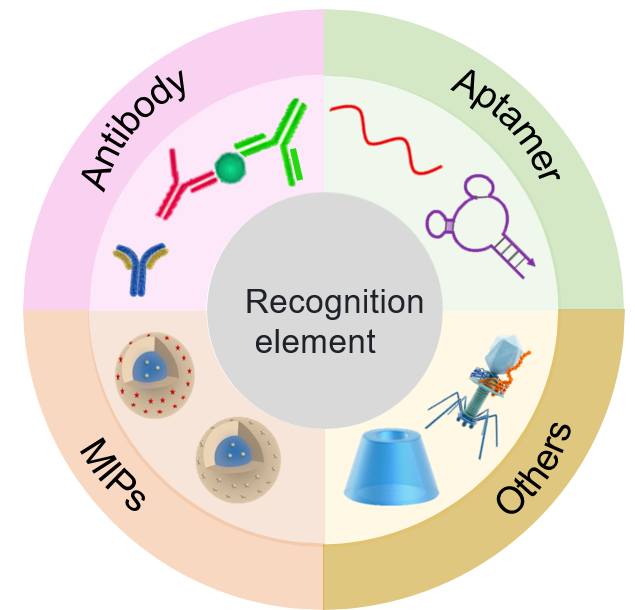
| 识别元件 | 特异性 | 稳定性(温度、pH耐受性) | 制备周期 | 综合成本 |
|---|---|---|---|---|
| 抗体 | 极高 | 较差、不耐高温与酸碱 | 长(数周~数月) | 高 |
| 适配体 | 高 | 良好、耐宽温、弱酸碱 | 中等(1~2周) | 中低 |
| 分子印迹聚合物 | 较高 | 优异、耐高温、强酸碱 | 中等(主流工艺3~7天) | 低 |
| β-环糊精 | 中等 | 优异 | 极短(数小时) | 极低 |
| 噬菌体展示肽 | 高 | 良好 | 较长(2~4周) | 中等 |
| 识别元件 | 特异性 | 稳定性(温度、pH耐受性) | 制备周期 | 综合成本 |
|---|---|---|---|---|
| 抗体 | 极高 | 较差、不耐高温与酸碱 | 长(数周~数月) | 高 |
| 适配体 | 高 | 良好、耐宽温、弱酸碱 | 中等(1~2周) | 中低 |
| 分子印迹聚合物 | 较高 | 优异、耐高温、强酸碱 | 中等(主流工艺3~7天) | 低 |
| β-环糊精 | 中等 | 优异 | 极短(数小时) | 极低 |
| 噬菌体展示肽 | 高 | 良好 | 较长(2~4周) | 中等 |
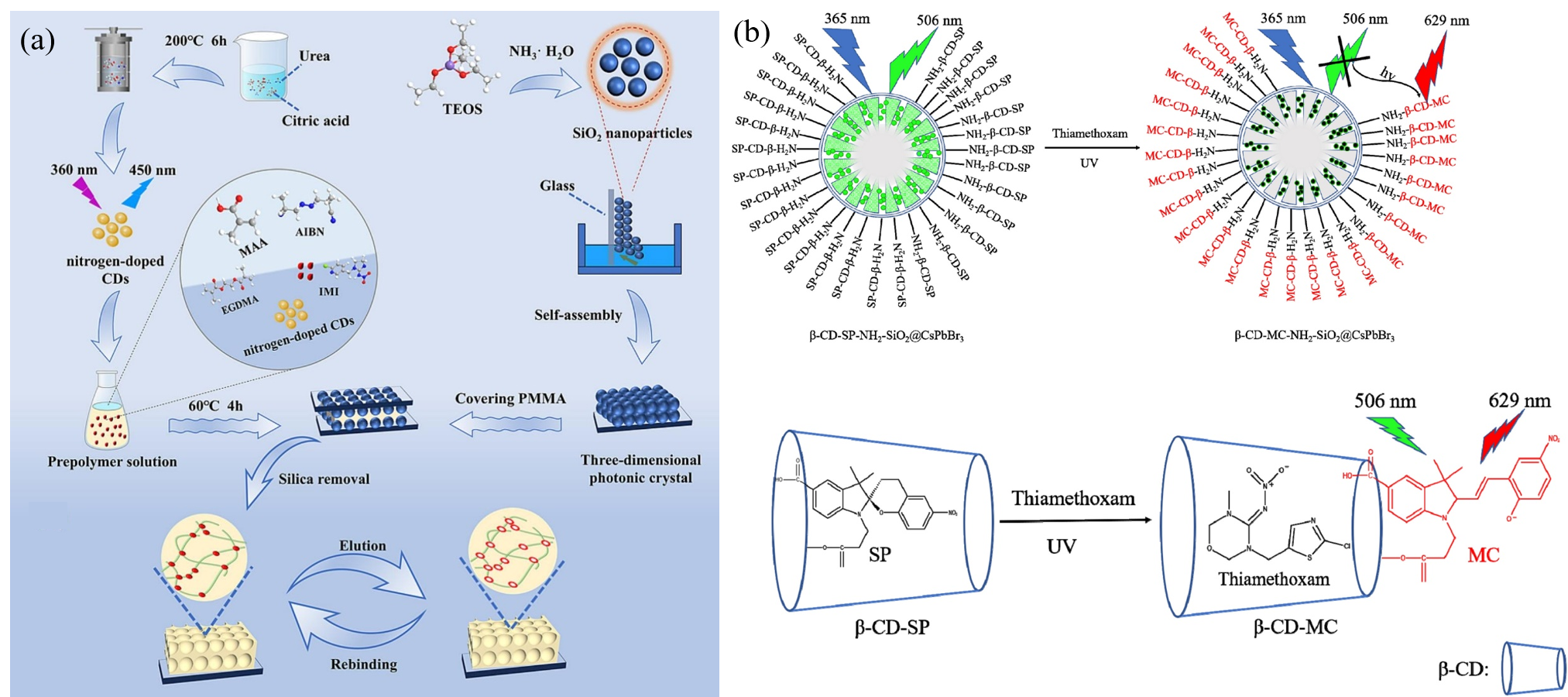
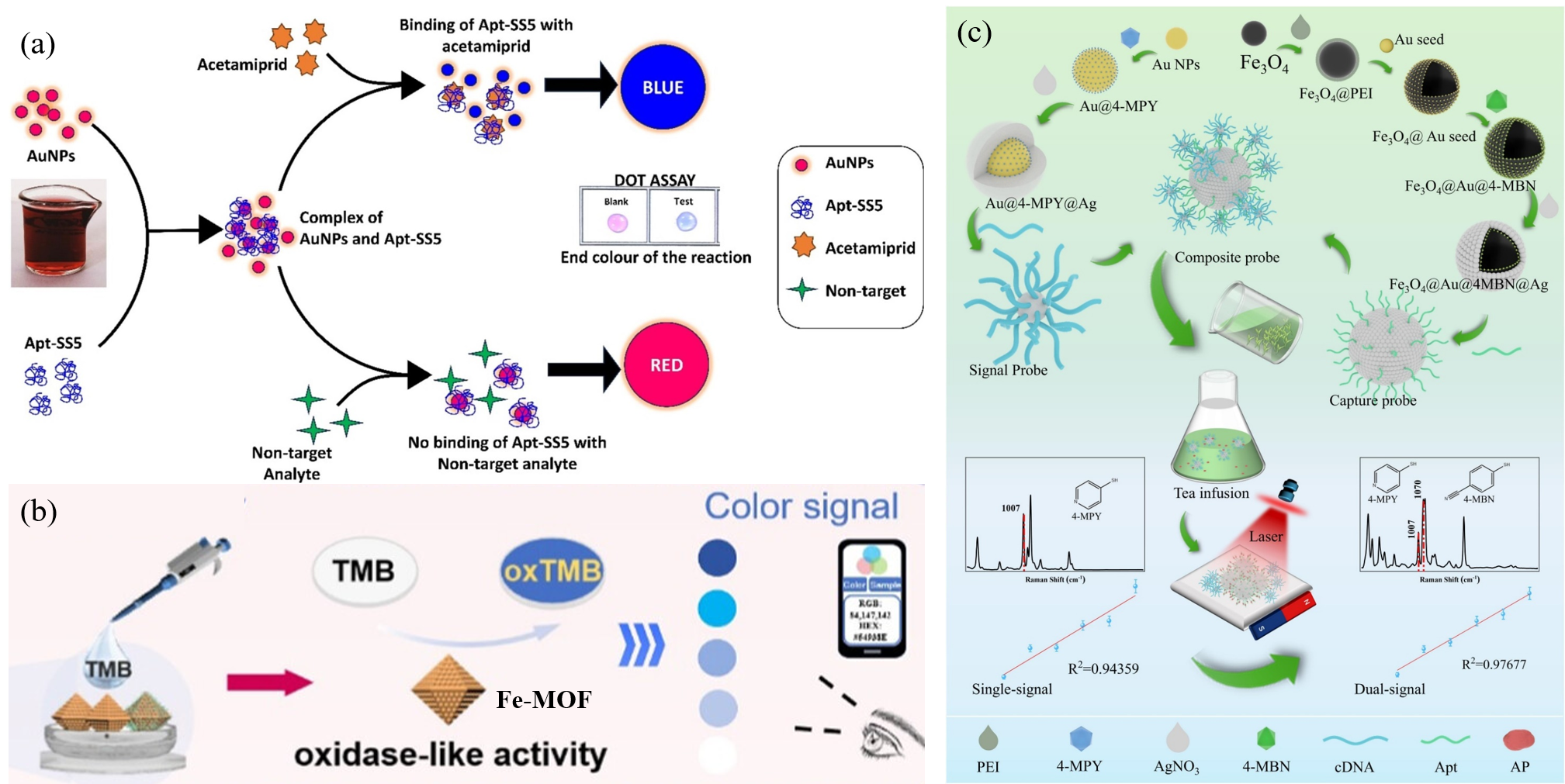
| Method | Materials | Target | Recognition element | Linear range/(μg•mL−1) | LOD/(μg•mL−1) | Ref. | |
|---|---|---|---|---|---|---|---|
| Fluorescence | B-CDs@MIPs/R-CDs | thiamethoxam | MIPs | 14.59~7292.75 | 3.94 | [ | |
| AuNPs/CDs | acetamiprid | aptamer | 0.005~0.100 | 0.001 | [ | ||
| nitrogen-doped CDs | imidacloprid | MIPs | 0.1~50 | 0.065 | [ | ||
| H2-SiO2@CsPbBr3 | thiamethoxam | β-CD | 0.004~0.018 | 0.001 | [ | ||
| Colorimetry | Fe-MOF | acetamiprid | 1×10⁻⁷~10 | 3.15×10⁻⁸ | [ | ||
| magnetic beads (MBs) | imidacloprid | Antibody | 5×10⁻⁵~0.05 | 6.3×10⁻⁵ | [ | ||
| graphene oxide (GO) | thiamethoxam | aptamer | 0.0015~0.0438 | 5×10⁻⁴ | [ | ||
| ECL | Fe/Zn-BTC@C-dots | thiamethoxam | aptamer | 1.5×10⁻⁵~1.46×10⁻² | 3×10⁻⁶ | [ | |
| NiFe-LDHs/Cu-SAs | thiamethoxam | aptamer | 5.8×10⁻⁷~1.75×10⁻³ | 1.9×10⁻⁷ | [ | ||
| RuZn-MOF | acetamiprid | aptamer | 1.0×10⁻⁷~1 | 3.33×10⁻⁸ | [ | ||
| Gd-MOF | acetamiprid | aptamer | 2.23×10⁻⁸~2.23×10⁻³ | 7.35×10⁻⁹ | [ | ||
| Zn-MOFs/Pt@Cu2O | acetamiprid | aptamer | 0~2.23×10⁻⁶ | 3.90×10⁻⁹ | [ | ||
| SERS | AuNPs/ITO | acetamiprid | MIPs | 0.022~44.53 | 7.12×10⁻⁴ | [ | |
| Au@pBDT-TA | thiamethoxam | Antibody | 2.0×10⁻⁶~8.0×10⁻⁵ | 5.0×10⁻⁷ | [ | ||
| UiO-66@TiO2/Au | thiamethoxam | 0.001 ~10 | 6.6×10⁻⁵ | [ | |||
| Dual-mode | HAuNPs/BSA-AuNCs | imidacloprid | Antibody | 2.0×10⁻⁵~2.0×10⁻³ (fluorescence); 2.0×10⁻⁵~1.0×10⁻³ (colorimetry) | 7.8×10⁻⁶ (fluorescence); 4.78×10⁻⁵ (colorimetry) | [ | |
| Au@Pt | imidacloprid | Antibody | 0~0.02 (fluorescence); 0.001 ~ 0.05 (colorimetry) | 1.14×10⁻³ (fluorescence); 8.8×10⁻⁴ (colorimetry) | [ | ||
| Method | Materials | Target | Recognition element | Linear range/(μg•mL−1) | LOD/(μg•mL−1) | Ref. | |
|---|---|---|---|---|---|---|---|
| Fluorescence | B-CDs@MIPs/R-CDs | thiamethoxam | MIPs | 14.59~7292.75 | 3.94 | [ | |
| AuNPs/CDs | acetamiprid | aptamer | 0.005~0.100 | 0.001 | [ | ||
| nitrogen-doped CDs | imidacloprid | MIPs | 0.1~50 | 0.065 | [ | ||
| H2-SiO2@CsPbBr3 | thiamethoxam | β-CD | 0.004~0.018 | 0.001 | [ | ||
| Colorimetry | Fe-MOF | acetamiprid | 1×10⁻⁷~10 | 3.15×10⁻⁸ | [ | ||
| magnetic beads (MBs) | imidacloprid | Antibody | 5×10⁻⁵~0.05 | 6.3×10⁻⁵ | [ | ||
| graphene oxide (GO) | thiamethoxam | aptamer | 0.0015~0.0438 | 5×10⁻⁴ | [ | ||
| ECL | Fe/Zn-BTC@C-dots | thiamethoxam | aptamer | 1.5×10⁻⁵~1.46×10⁻² | 3×10⁻⁶ | [ | |
| NiFe-LDHs/Cu-SAs | thiamethoxam | aptamer | 5.8×10⁻⁷~1.75×10⁻³ | 1.9×10⁻⁷ | [ | ||
| RuZn-MOF | acetamiprid | aptamer | 1.0×10⁻⁷~1 | 3.33×10⁻⁸ | [ | ||
| Gd-MOF | acetamiprid | aptamer | 2.23×10⁻⁸~2.23×10⁻³ | 7.35×10⁻⁹ | [ | ||
| Zn-MOFs/Pt@Cu2O | acetamiprid | aptamer | 0~2.23×10⁻⁶ | 3.90×10⁻⁹ | [ | ||
| SERS | AuNPs/ITO | acetamiprid | MIPs | 0.022~44.53 | 7.12×10⁻⁴ | [ | |
| Au@pBDT-TA | thiamethoxam | Antibody | 2.0×10⁻⁶~8.0×10⁻⁵ | 5.0×10⁻⁷ | [ | ||
| UiO-66@TiO2/Au | thiamethoxam | 0.001 ~10 | 6.6×10⁻⁵ | [ | |||
| Dual-mode | HAuNPs/BSA-AuNCs | imidacloprid | Antibody | 2.0×10⁻⁵~2.0×10⁻³ (fluorescence); 2.0×10⁻⁵~1.0×10⁻³ (colorimetry) | 7.8×10⁻⁶ (fluorescence); 4.78×10⁻⁵ (colorimetry) | [ | |
| Au@Pt | imidacloprid | Antibody | 0~0.02 (fluorescence); 0.001 ~ 0.05 (colorimetry) | 1.14×10⁻³ (fluorescence); 8.8×10⁻⁴ (colorimetry) | [ | ||
| [1] |
doi: 10.1016/j.envint.2023.108044 |
| [2] |
doi: 10.1021/acs.est.5c00372 |
| [3] |
doi: 10.1021/acs.est.5c18084 |
| [4] |
doi: 10.1016/j.envint.2025.109957 |
| [5] |
doi: 10.1016/j.envpol.2025.126814 |
| [6] |
doi: 10.1016/j.foodchem.2026.148256 |
| [7] |
doi: 10.1016/j.foodchem.2026.147885 |
| [8] |
doi: 10.6023/A26010003 |
|
(邵铭赫, 田烨, 汪娟丽, 苗荣, 房喻, 化学学报, 2026, 84, 484.)
doi: 10.6023/A26010003 |
|
| [9] |
doi: 10.1016/j.trac.2023.117152 |
| [10] |
doi: 10.1016/j.talanta.2024.125937 |
| [11] |
doi: 10.1016/j.trac.2025.118428 |
| [12] |
doi: 10.1016/j.foodchem.2023.137456 |
| [13] |
doi: 10.1021/acssensors.5c03955 |
| [14] |
doi: 10.1038/s44222-023-00067-z |
| [15] |
doi: 10.1016/j.snb.2025.138565 |
| [16] |
doi: 10.1007/s00604-024-06718-1 |
| [17] |
doi: 10.1016/j.talanta.2024.126190 |
| [18] |
doi: 10.1016/j.microc.2024.112083 |
| [19] |
doi: 10.1016/j.aca.2022.339677 |
| [20] |
doi: 10.1016/j.talanta.2023.124712 |
| [21] |
doi: 10.1016/j.trac.2025.118472 |
| [22] |
doi: 10.1016/j.bios.2023.115559 |
| [23] |
doi: 10.1016/j.foodchem.2025.143497 |
| [24] |
doi: 10.1016/j.cej.2024.151301 |
| [25] |
doi: 10.1016/j.foodchem.2023.137194 |
| [26] |
doi: 10.1016/j.jhazmat.2021.128011 |
| [27] |
doi: 10.1016/j.jare.2025.06.082 |
| [28] |
doi: 10.1016/j.trac.2025.118552 |
| [29] |
doi: 10.1016/j.foodchem.2024.141601 |
| [30] |
doi: 10.1039/D5NH00446B |
| [31] |
doi: 10.1002/cjoc.v43.18 |
| [32] |
doi: 10.1021/acsami.4c18752 |
| [33] |
doi: 10.1021/acs.analchem.5c01265 |
| [34] |
doi: 10.1016/j.jhazmat.2020.123619 |
| [35] |
doi: 10.1007/s12161-013-9732-3 |
| [36] |
doi: 10.1016/j.trac.2025.118562 |
| [37] |
doi: 10.1016/j.cej.2025.170337 |
| [38] |
doi: 10.1021/acsnano.5c03245 |
| [39] |
doi: 10.1002/smll.v18.3 |
| [40] |
doi: 10.1021/acs.jafc.5c07935 |
| [41] |
doi: 10.1021/acssensors.5c02604 |
| [42] |
doi: 10.1039/C8AN01166D |
| [43] |
doi: 10.1016/j.snb.2022.131671 |
| [44] |
doi: 10.1016/j.bios.2026.118632 |
| [45] |
doi: 10.1016/j.cej.2024.153325 |
| [46] |
doi: 10.1002/adma.v37.44 |
| [47] |
doi: 10.1016/j.aca.2021.338938 |
| [48] |
|
| [49] |
doi: 10.1016/j.bios.2018.10.006 |
| [50] |
doi: 10.1016/j.bios.2025.117379 |
| [51] |
doi: 10.1002/adfm.v35.47 |
| [52] |
doi: 10.1016/j.bios.2023.115554 |
| [53] |
doi: 10.1016/j.bios.2022.114841 |
| [54] |
doi: 10.1021/acs.analchem.4c05692 |
| [55] |
doi: 10.1016/j.cej.2025.170656 |
| [56] |
doi: 10.1016/j.foodchem.2025.147143 |
| [57] |
doi: 10.1016/j.snb.2025.137398 |
| [58] |
doi: 10.1021/acs.jafc.4c02612 |
| [59] |
doi: 10.1002/smll.v22.16 |
| [60] |
doi: 10.1016/j.snb.2023.134415 |
| [61] |
doi: 10.1007/s00604-025-07457-7 |
| [62] |
doi: 10.1021/acs.analchem.4c00364 |
| [63] |
doi: 10.1016/j.bios.2025.117286 |
| [64] |
doi: 10.1016/j.bios.2025.118107 |
| [65] |
doi: 10.1021/acs.analchem.5c04394 |
| [66] |
doi: 10.1016/j.cej.2025.160813 |
| [67] |
doi: 10.1016/j.foodres.2024.115388 |
| [68] |
doi: 10.1016/j.foodchem.2025.143439 |
| Viewed | ||||||
|
Full text |
|
|||||
|
Abstract |
|
|||||
