

Acta Chimica Sinica ›› 2026, Vol. 84 ›› Issue (8): 1283-1293.DOI: 10.6023/A26060194 Previous Articles Next Articles
Article
刘聪, 王艺霈, 张天宇, 覃文武*( )
)
投稿日期:2026-06-10
发布日期:2026-08-22
作者简介:★“纪念兰州大学化学学科创建80周年”专辑.
基金资助:
Cong Liu, Yipei Wang, Tianyu Zhang, Wenwu Qin*()
Received:2026-06-10
Published:2026-08-22
Contact:
E-mail: About author:★For the VSI “Celebration of 80th Anniversary of Chemistry in Lanzhou University”.
Supported by:Share
Cong Liu, Yipei Wang, Tianyu Zhang, Wenwu Qin. Synthesis of Mono/Di-Substituted Fluorescent Probes for Detection of H2S★[J]. Acta Chimica Sinica, 2026, 84(8): 1283-1293.
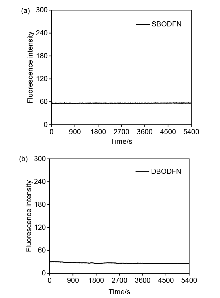
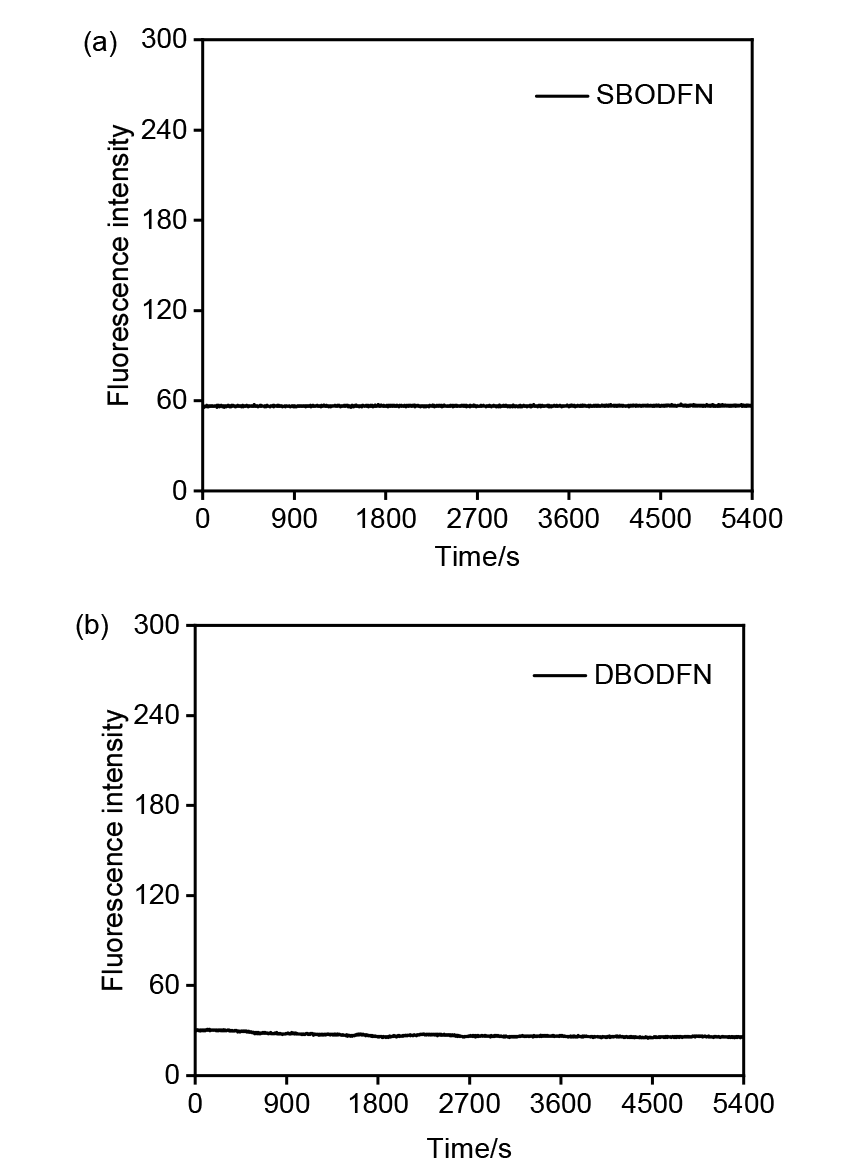
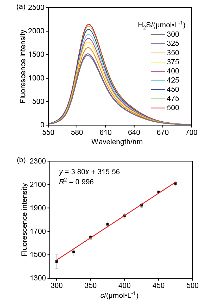
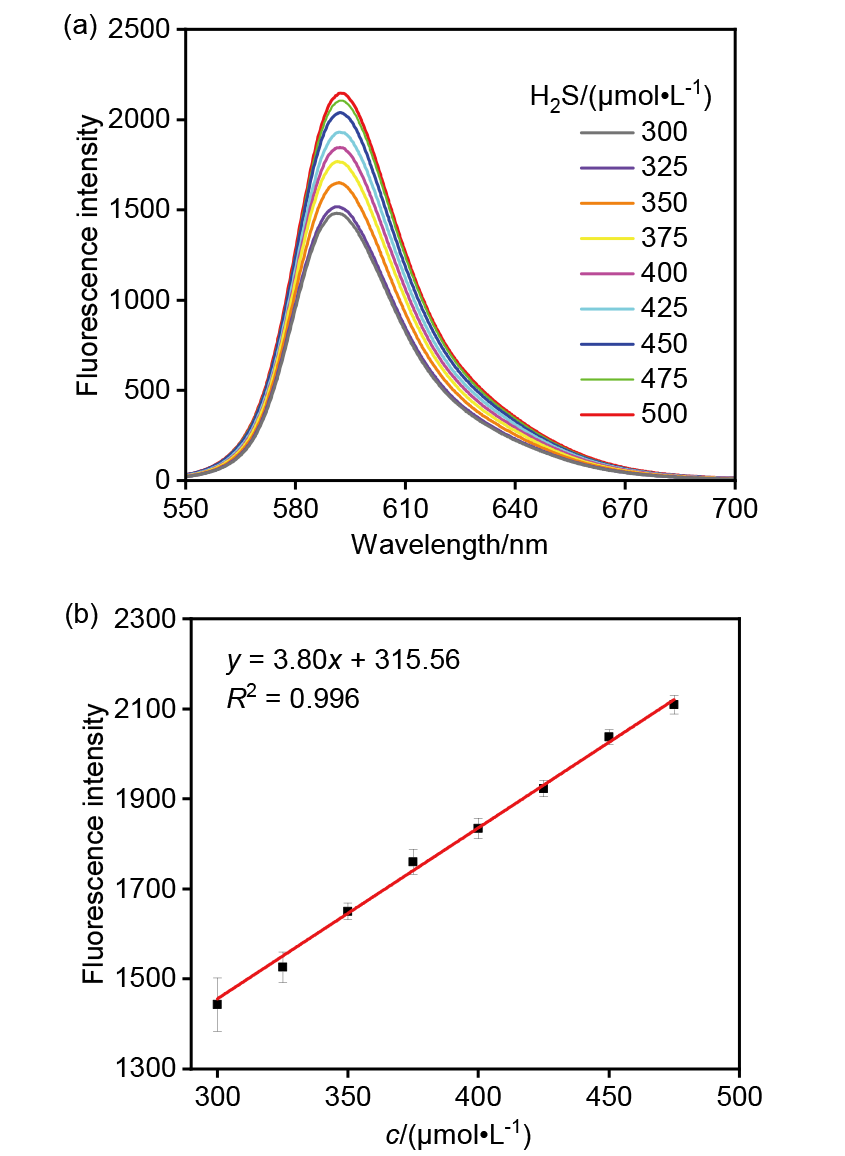
| Sample | Added/(μmol•L-1) | Fluorescence Intensity | Measured Value /(μmol•L-1) | Recovery/% | RSD/% |
|---|---|---|---|---|---|
| Tap water | 380 | 1858 | 406 | 106.82 | 4.89 |
| 1720 | 370 | 97.26 | |||
| 1828 | 398 | 104.74 | |||
| lake water | 380 | 1817 | 395 | 103.98 | 6.33 |
| 1683 | 360 | 94.70 | |||
| 1862 | 407 | 107.09 | |||
| Yellow River water | 380 | 1689 | 361 | 95.11 | 2.94 |
| 1764 | 381 | 100.31 | |||
| 1697 | 364 | 95.67 |
| Sample | Added/(μmol•L-1) | Fluorescence Intensity | Measured Value /(μmol•L-1) | Recovery/% | RSD/% |
|---|---|---|---|---|---|
| Tap water | 380 | 1858 | 406 | 106.82 | 4.89 |
| 1720 | 370 | 97.26 | |||
| 1828 | 398 | 104.74 | |||
| lake water | 380 | 1817 | 395 | 103.98 | 6.33 |
| 1683 | 360 | 94.70 | |||
| 1862 | 407 | 107.09 | |||
| Yellow River water | 380 | 1689 | 361 | 95.11 | 2.94 |
| 1764 | 381 | 100.31 | |||
| 1697 | 364 | 95.67 |
| Sample | Added/(μmol•L-1) | Fluorescence Intensity | Measured Value /(μmol•L-1) | Recovery/% | RSD/% |
|---|---|---|---|---|---|
| Tap water | 440 | 1781 | 448 | 101.73 | 2.50 |
| 1734 | 440 | 99.90 | |||
| 1654 | 426 | 96.80 | |||
| lake water | 440 | 1761 | 444 | 100.95 | 0.85 |
| 1804 | 452 | 102.62 | |||
| 1773 | 446 | 101.42 | |||
| Yellow River water | 440 | 1823 | 455 | 103.36 | 3.83 |
| 1636 | 423 | 96.10 | |||
| 1787 | 449 | 101.96 |
| Sample | Added/(μmol•L-1) | Fluorescence Intensity | Measured Value /(μmol•L-1) | Recovery/% | RSD/% |
|---|---|---|---|---|---|
| Tap water | 440 | 1781 | 448 | 101.73 | 2.50 |
| 1734 | 440 | 99.90 | |||
| 1654 | 426 | 96.80 | |||
| lake water | 440 | 1761 | 444 | 100.95 | 0.85 |
| 1804 | 452 | 102.62 | |||
| 1773 | 446 | 101.42 | |||
| Yellow River water | 440 | 1823 | 455 | 103.36 | 3.83 |
| 1636 | 423 | 96.10 | |||
| 1787 | 449 | 101.96 |
| [1] |
|
| [2] |
doi: 10.1016/j.saa.2020.118959 |
| [3] |
doi: 10.1016/j.aca.2025.344792 |
| [4] |
doi: 10.1016/j.talanta.2024.126869 |
| [5] |
doi: 10.6023/A25060234 |
|
(杜云哲, 李曙懿, 程思柳, 贾慧劼, 王政, 韩利民, 竺宁, 化学学报, 2026, 84, 93.)
doi: 10.6023/A25060234 |
|
| [6] |
doi: 10.6023/A18070293 |
|
(杨文远, 梁红, 乔智威, 化学学报, 2018, 76, 785.)
doi: 10.6023/A18070293 |
|
| [7] |
doi: 10.1016/j.dyepig.2022.110740 |
| [8] |
doi: 10.1016/j.dyepig.2023.111418 |
| [9] |
doi: 10.1016/j.talanta.2018.05.076 |
| [10] |
doi: 10.1007/s12161-018-01421-3 |
| [11] |
doi: 10.1016/j.cej.2025.164230 |
| [12] |
doi: 10.1016/j.saa.2025.127006 |
| [13] |
doi: 10.1016/j.foodchem.2023.136701 |
| [14] |
doi: 10.1016/j.microc.2025.115252 |
| [15] |
doi: 10.1016/j.cclet.2016.07.008 |
| [16] |
doi: 10.1016/j.cbi.2022.110022 |
| [17] |
doi: 10.1016/j.snb.2020.128937 |
| [18] |
doi: 10.1016/j.microc.2025.115730 |
| [19] |
doi: 10.1016/j.aca.2022.339670 |
| [20] |
doi: 10.1016/j.bios.2024.116798 |
| [21] |
doi: 10.1016/j.talanta.2025.127808 |
| [22] |
doi: 10.1007/s42994-021-00035-4 |
| [23] |
doi: 10.1016/j.snb.2019.05.010 |
| [24] |
doi: 10.1016/j.saa.2026.127955 |
| [25] |
doi: 10.1016/j.aca.2024.343558 |
| [26] |
doi: 10.1021/acs.analchem.2c01850 |
| [27] |
doi: 10.1016/j.talanta.2019.01.042 |
| [28] |
doi: 10.1039/D5CC05198C |
| [29] |
doi: 10.1016/j.saa.2019.01.085 |
| [30] |
doi: 10.1016/j.saa.2020.118578 |
| [31] |
doi: 10.1039/C9CC10028H |
| [32] |
doi: 10.1021/acssensors.2c01402 |
| [33] |
doi: 10.1039/D5SD00201J |
| [34] |
doi: 10.1039/D0RA08802A |
| [35] |
doi: 10.6023/A15030158 |
|
(于海波, 李红玲, 张新富, 肖义, 方沛菊, 吕春娇, 侯伟, 化学学报, 2015, 73, 450.)
doi: 10.6023/A15030158 |
|
| [36] |
doi: 10.1016/j.niox.2014.11.008 pmid: 25461270 |
| [37] |
|
| [38] |
doi: 10.1021/acs.analchem.8b04811 pmid: 30585489 |
| [39] |
doi: 10.1016/j.saa.2025.126918 |
| [40] |
doi: 10.1002/anie.v55.34 |
| [41] |
doi: 10.6023/cjoc202402010 |
|
(何春, 刘姝祺, 成奋民, 郝远强, 陈述, 张培盛, 曾荣今, 有机化学, 2024, 44, 2869.)
doi: 10.6023/cjoc202402010 |
|
| [42] |
|
|
(王若曦, 张冬菊, 武剑, 刘成卜, 化学学报, 2007, 65, 107.)
|
|
| [43] |
doi: 10.1016/j.snb.2021.131202 |
| [44] |
doi: 10.1007/s10895-024-03949-6 |
| [45] |
doi: 10.1021/acsami.7b07688 |
| [46] |
doi: 10.1021/acs.orglett.3c01755 |
| [47] |
doi: 10.1021/acs.orglett.3c00173 |
| [1] | Guanghui Yang, Jie Han, Qingshui Chi, Jiaxuan Li, Yupeng Wang, Xia Tian, Wei Su, Yingzhuang Xu, Jianrong Han. Copper Ion Fluorescence Sensing Film Based on Pillar[5]arene Supramolecular Polymer [J]. Acta Chimica Sinica, 2026, 84(6): 812-819. |
| [2] | Yang Zhang, Jinli Zhang, Jiandong Pang, Xian-He Bu. High-sensitivity Eu-MOF Fluorescent Probe for the Detection of 1-Hydroxypyrene in Urine★ [J]. Acta Chimica Sinica, 2026, 84(5): 667-672. |
| [3] | Qian Meng, Qiwei Zhang. Organic Small-Molecule Fluorescent Probes for Neurotransmitter Sensing and Bioimaging★ [J]. Acta Chimica Sinica, 2025, 83(10): 1252-1266. |
| [4] | Li Jiang, Zihan Chen, Yong Fan. Research Progress on Fluorescent Probes in the Second Near-Infrared Window for In Vivo Multiplexed Imaging [J]. Acta Chimica Sinica, 2024, 82(10): 1069-1085. |
| [5] | Hongyue Wu, Rui Guo, Hanwen Chi, Yonghe Tang, Sirui Song, Enxiang Ge, Weiying Lin. Viscosity Fluorescent Probes Based on Quinoline Group and Its Applications [J]. Acta Chimica Sinica, 2023, 81(8): 905-911. |
| [6] | Xiaomeng He, Fang Yuan, Suya Zhang, Jianjian Zhang. Development of a Near-Infrared Fluorescent Probe Based on Nile Red for ONOO– and Its Imaging Applications [J]. Acta Chimica Sinica, 2023, 81(11): 1515-1521. |
| [7] | Li Sun, Yajing Wang, Tao Li, Yingshu Guo, Shusheng Zhang. Au Nanocages Probes for Mitochondrial Imaging and Photothermal Damage Cells★ [J]. Acta Chimica Sinica, 2023, 81(10): 1301-1310. |
| [8] | Sirui Song, Yonghe Tang, Liangguang Sun, Rui Guo, Guanfan Jiang, Weiying Lin. Development of a Novel Fluorescent Probe Based on Coumarin Fluorophore for Polarity Detection and Its Imaging Applications [J]. Acta Chimica Sinica, 2022, 80(9): 1217-1222. |
| [9] | Yong Li, Xu Wang, Xilei Xie, Jian Zhang, Bo Tang. Progress in Organic Fluorescent Probes and Photocontrolled Releasers for Carbon Monoxide [J]. Acta Chimica Sinica, 2021, 79(1): 36-44. |
| [10] | Luo Xingrui, Chen Minwen, Yang Qinglai. Research Progress on Near Infrared II Technology for in Vivo Imaging [J]. Acta Chimica Sinica, 2020, 78(5): 373-381. |
| [11] | Jia Yiyi, Wang Wenjie, Liang Ling, Yuan Quan. Bioassay Applications of Aptamer-Functionalized Rare Earth Nanomaterials [J]. Acta Chimica Sinica, 2020, 78(11): 1177-1184. |
| [12] | Liu Hongwen, Zhu Longmin, Lou Xiaofeng, Yuan Lin, Zhang Xiao-Bing. A Two-Photon Fluorescent Probe for Specific Imaging of Furin Activity in Living Cells and Tissues [J]. Acta Chimica Sinica, 2020, 78(11): 1240-1245. |
| [13] | Zheng Bin, Cheng Sheng, Dong Huaze, Zhu Jinmiao, Han Yu, Yang Liang, Hu Jinming. Construction of Nitric Oxide (NO)-Responsive Fluorescent Polymer and Its Application in Cell Imaging [J]. Acta Chimica Sinica, 2020, 78(10): 1089-1095. |
| [14] | Yang Wenyuan, Liang Hong, Qiao Zhiwei. High-Throughput Screening of Metal-Organic Frameworks for the Separation of Hydrogen Sulfide and Carbon Dioxide from Natural Gas [J]. Acta Chim. Sinica, 2018, 76(10): 785-792. |
| [15] | Wang Shaojing, Li Changwei, Li Jin, Chen Bang, Guo Yuan. Novel Coumarin-Based Fluorescent Probes for Detecting Fluoride Ions in Living Cells [J]. Acta Chim. Sinica, 2017, 75(4): 383-390. |
| Viewed | ||||||
|
Full text |
|
|||||
|
Abstract |
|
|||||
