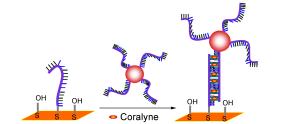
Coralyne, a kind of planar alkaloid, has more pronounced antitumor activity compared to other protoberberine alkaloids. It was found that coralyne could induce the adenine (A)-rich DNA oligonucleotides to form a double strand DNA, with a stoichiometry of one coralyne per four adenine bases. In this paper, a high sensitive approach for the detection of anticancer drug coralyne based on surface plasmon resonance (SPR) and the high selectivity and sensitivity recognition process of coralyne with the A-rich DNA oligonucleotides was established. Generally, it was difficult to detect small molecules directly using conventional SPR biosensors since the changes of refractive index, which was resulted by binding small molecules, were usually small. Here, the Au nanoparticles was introduced for enhancing the sensitivity. The A-rich DNA strands were modified on Au nanoparticles and on Au film respectively. In the presence of coralyne and the functional Au nanoparticles, the A-rich DNA strands could form the duplex through the specific coordination between coralyne and adenine, and then the functional Au nanoparticles were captured on the Au film. SPR signal was enhanced by the electronic coupling between the localized plasmon of Au nanoparticles and the surface plasmon wave associated with Au film. If only coralyne or the functional Au nanoparticles was present, the resonance wavelength was almost unchanged. It meant that there was no A-coralyne-A complex formed. Thus, this method could be used to detect coralyne, and the background was low. The results showed that the SPR sensor was highly sensitive, and the limit of detection was ca. 0.07 pmol/L (S/N=3). It was about 5-6 orders of magnitude lower than those of fluorescent and colorimetric methods. Moreover, four kinds of small molecule drugs (berberine hydrochloride, penicillin, gentamicin sulfate, and 5-fluorouracil) were used as control to investigate the selectivity of this SPR biosensor. For penicillin, gentamicin sulfate, and 5-fluorouracil, all of the resonance wavelength shifts were lower than 0.4 nm. For high concentration of berberine hydrochloride, the resonance wavelength shifts were ca. 0.5-0.6 nm. The results showed that this SPR biosensor has good selectivity. This work may extend the application of SPR biosensors in drug discovery and development.
[1] Lv, Z. Z.; Wei, H.; Li, B. L.; Wang, E. K. Analyst 2009, 134, 1647.
[2] Wilson, W. D.; Gough, A. N.; Doyle, J. J.; Davidson, M. W. J. Med. Chem. 1976, 19, 1261.
[3] Xu, X.; Wang, J.; Yang, F.; Jiao, K.; Yang, X. Small 2009, 5, 2669.
[4] Lin, Y. H.; Tseng, W. L. Chem. Commun. 2011, 47, 11134.
[5] Wang, Y.; Wang, J.; Yang, F.; Yang, X. Anal. Chem. 2012, 84, 924.
[6] Homola, J. Chem. Rev. 2008, 108, 462.
[7] Situ, C.; Mooney, M. H.; Elliott, C. T.; Buijs, J. Trends Anal. Chem. 2010, 29, 1305.
[8] Altintas, Z.; Uludag, Y.; Gurbuz, Y.; Tothill, I. Anal. Chim. Acta 2012, 712, 138.
[9] Yang, X.-H.; Li, Z.-H.; Wang, Q.; Wang, K.-M. Acta Chim. Sinica 2007, 65, 1185 (in Chinese). (羊小海, 黎振华, 王青, 王柯敏, 化学学报, 2007, 65, 1185.)
[10] Golub, E.; Pelossof, G.; Freeman, R.; Zhang, H.; Willner, I. Anal. Chem. 2009, 81, 9291.
[11] Wang, Q.; Huang, J. H.; Yang, X. H.; Wang, K. M.; He, L. L.; Li, X. P.; Xue, C. Y. Sens. Actuators B 2011, 156, 893.
[12] Wang, L.; Li, T.; Du, Y.; Chen, C.; Li, B.; Zhou, M.; Dong, S. Bio-sens. Bioelectron. 2010, 25, 2622.
[13] Lyon, L. A.; Musick, M. D.; Smith, P. C.; Reiss, B. D.; Pe?a, D. J.; Natan, M. J. Sens. Actuators B 1999, 54, 118.
[14] Kira, A.; Kim, H.; Yasuda, K. Langmuir 2009, 25, 1285.
[15] Adam, B. S.; Tonya, M. H.; Michael, J. T. Anal. Chem. 1998, 70, 4670.
[16] Wang, Q.; Yang, L. J.; Yang, X. H.; Wang, K. M.; He, L. L.; Zhu, J. Q. Anal. Chim. Acta 2011, 688, 163.
[17] Zhou, Y.-W.; Li, C.-M.; Xiong, Z.-H.; Huang, C.-Z. Acta Chim. Sinica 2012, 70, 352 (in Chinese). (周亚文, 李春梅, 熊祖洪, 黄承志, 化学学报, 2012, 70, 352.)
[18] Giri, P.; Kumar, G. S. Arch. Biochem. Biophys. 2008, 474, 183.
[19] Yang, X. H.; Wang, Q.; Wang, K. M.; Tan, W. H.; Li, H. M. Biosens. Bioelectron. 2007, 22, 1106.
[20] Storhoff, J. J.; Elghanian, R.; Mucic, R. C.; Mirkin, C. A.; Letsinger, R. L. J. Am. Chem. Soc. 1998, 120, 1959.


