Review

Luminescent Polymers Containing Unconventional Chromophores

  • Huang Tian ,
  • Wang Zhaoyang ,
  • Qin Anjun ,
  • Sun Jingzhi ,
  • Tang Benzhong
Expand
  • a MOE Key Laboratory of Macromolecule Synthesis and Functionalization, Department of Polymer Science and Engineering, Zhejiang University, Hangzhou 310027, China;
    b Department of Chemistry, Institute of Molecular Functional Materials, the Institute for Advanced Study (IAS), The Hong Kong University of Science & Technology, Clear Water Bay, Kowloon, Hong Kong, China

Received date: 2013-01-15

  Online published: 2013-03-15

Supported by

Projects supported by the National Natural Science Foundation of China (No. 21074113) and the Ministry of Science and Technology of China (No. 2013CB834704).

Abstract

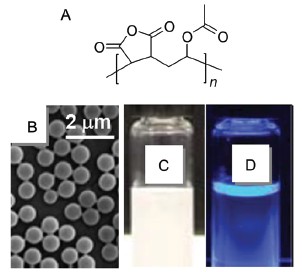
Luminescent polymers are referred to as conjugated polymers, which are constructed by p-aromatic building blocks functioning as emitting units. But in recent years, it has been found that a few kinds of polymers only containing auxochromophores or unconventional chromophores such as aliphatic tertiary amine, carbonyl, ester, and amide demonstrate strong luminescence under proper conditions. Poly(amido amine) (PAMAM) dendrimers and hyperbranched poly(amido amine)s are the first reported and most investigated luminescent polymers containing unconventional chromophores. Lately, this kind of polymers have been extended to hyperbranched poly(amino ester)s (hb-PAEs), hyperbranched poly(ether amide)s (hb-PEAs), and polyurea dendrimers (PUREs) containing tertiary amine moieties. The luminogen of PAMAMs, hb-PAEs, hb-PEAs and PUREs is associated with the N-branched tertiary amine moiety and the oxidation of the tertiary amine is assigned to the emitting source. Meanwhile, some distinct polymers had been also reported to be luminescent. Poly[(maleic anhydride)-alt-(vinyl acetate)], polyisobutene succinic anhydrides, glycodynamer analogues of poly(acrylhydrazone)s and multiblock polymer derived by poly(trithiocarbonate) mediated reversible addition-fragmentation chain transfer (RAFT) polymerization of N-isopropyl-acrylamide. A common feature of these polymers is that only carbonyl and ester groups rather than tertiary amine are involved in the polymer structure. Aggregation of multiple carbonyl groups induced emission is usually adopted to explain the mechanism of the emission, and the interaction between carbonyl and phenyl groups was also used to explain the unconventional emission.
Cite this article

Huang Tian , Wang Zhaoyang , Qin Anjun , Sun Jingzhi , Tang Benzhong . Luminescent Polymers Containing Unconventional Chromophores[J]. Acta Chimica Sinica, 2013 , 71(07) : 979 -990 . DOI: 10.6023/A13010071

References

[1] Dong, J. H.; Zhang, X.; Wang, L. X. Frontier and Prospect of Polymer Science, Science Press, Beijing, 2011, pp. 409~485. (董建华, 张希, 王立祥, 高分子科学学科前沿与展望, 科学出版社, 北京, 2011, pp. 409~485.)
[2] Demas, J. N.; Crosby, G. A. J. Phys. Chem. 1971, 75, 991.
[3] Varnavski, O.; Ispasoiu, R. G.; Balogh, L.; Tomalia, D.; Goodson III, T. J. Chem. Phys. 2001, 114, 1962.
[4] Zheng, J.; Petty, J. T.; Dickson, R. M. J. Am. Chem. Soc. 2003, 125, 7780.
[5] Lee, W. I.; Bae, Y.; Bard, A. J. J. Am. Chem. Soc. 2004, 126, 8358.
[6] Wang, D.; Imae, T. J. Am. Chem. Soc. 2004, 126, 13204.
[7] Cao, L.; Yang, W. L.; Wang, C. C.; Fu, S. K. J. Macromol. Sci. Part A: Pure Appl. Chem. 2007, 44, 417.
[8] Wang, D.; Imae, T.; Miki, M. J. Colloid Interface Sci. 2007, 306, 222.
[9] Chu, C.-C.; Imae, T. Macromol. Rapid Commun. 2009, 30, 89.
[10] Pastor-Pe′rez, L.; Chen, Y.; Shen, Z.; Lahoz, A.; Stiriba, S.-E. Macromol. Rapid Commun. 2007, 28, 1404.
[11] Lin, S.-Y.; Wu, T.-H.; Jao, Y.-C.; Liu, C.-P.; Lin, H.-Y.; Lo, L.-W.; Yang, C.-S. Chem. Eur. J. 2011, 17, 7158.
[12] Saravanan, G.; Imae, T. J. Nanosci. Nanotechnol. 2011, 11, 4838.
[13] Tsai, Y.-J.; Hu, C.-C.; Chu, C.-C.; Imae, T. Biomacromolecules 2011, 12, 4283.
[14] Imae, T.; Hamaguchi, S. Carbohydr. Polym. 2012, 88, 352.
[15] Yang, W.; Pan, C.-Y. Macromol. Rapid Commun. 2009, 30, 2096.
[16] Yang, W.; Pan, C.-Y.; Luo, M.-D.; Zhang, H.-B. Biomacromolecules 2010, 11, 1840.
[17] Yang, W.; Pan, C.-Y.; Liu, X.-Q.; Wang, J. Biomacromolecules 2011, 12, 1523.
[18] You, Y.-Z.; Yu, Z.-Q.; Cui, M.-M.; Hong, C.-Y. Angew. Chem. Int. Ed. 2010, 49, 1099.
[19] Chen, Y.; Zhou, L.; Pang, Y.; Huang, W.; Qiu, F.; Jiang, X.; Zhu, X. Y.; Yan, D.; Chen, Q. Bioconjugate Chem. 2011, 22, 1162.
[20] Wu, D. C.; Liu, Y.; He, C. B.; Goh, S. H. Macromolecules 2005, 38, 9906.
[21] Wu, D. C.; Liu, Y.; Chen, L.; He, C. B.; Chung, T. S.; Goh, S. H. Macromolecules 2005, 38, 5519.
[22] Sun, M.; Hong, C.-Y.; Pan, C.-Y. J. Am. Chem. Soc. 2012, 134, 20581.
[23] Halpern, A. M.; Wryzykowska, K. J. Photochem. 1981, 15, 147.
[24] Liu, Y.; Gao, J.-W.; Liu, H.-W.; Li, Y.-S. Macromolecules 2009, 42, 3237.
[25] Restani, R. B.; Morgado, P. I.; Ribeiro, M. P.; Correia, I. J.; Aguiar-Ricardo, A.; Bonifácio, V. D. B. Angew. Chem. Int. Ed. 2012, 51, 5162.
[26] Hong, Y.; Lam, J. W. Y.; Tang, B. Z. Chem. Soc. Rev. 2011, 40, 5361.
[27] Zhang, S.; Qin, A.; Sun, J. Z.; Tang, B. Z. Prog. Chem. 2011, 23, 623.
[28] Hong, Y. N.; Lam, J. W. Y.; Tang, B. Z. Chem. Commun. 2009, 4332.
[29] Xing, C. M.; Lam, J. W. Y.; Qin, A. J.; Dong, Y. Q.; Haussler, M.; Yang, W. T.; Tang, B. Z. Polym. Mater. Sci. Eng. 2007, 96, 418.
[30] Qin, A.; Lam, J. W. Y.; Tang, B. Z. Prog. Polym. Sci. 2012, 37, 182.
[31] Pucci, A.; Rausa, R.; Ciardelli, F. Macromol. Chem. Phys. 2008, 209, 900.
[32] Ruff, Y.; Lehn, J.-M. Angew. Chem. Int. Ed. 2008, 47, 3556.
[33] Gao, L.; Fei, J. B.; Zhao, J.; Cui, W.; Cui, Y.; Li, J. B. Chem. Eur. J. 2012, 18, 3185.
[34] Chen, Y.; Spiering, A. J. H.; Karthikeyan, S.; Peters, G. W. M.; Meijer, E. W.; Sijbesma, R. P. Nat. Chem. 2012, 4, 559.
[35] Yan, J.-J.; Wang, Z.-K.; Lin, X.-S.; Hong, C.-Y.; Liang, H.-J.; Pan, C.-Y.; You, Y.-Z. Adv. Mater. 2012, 24, 5617.
Outlines

/

