Article

Synthesis and Supercapacitor Property of Three-dimensional Graphene/Ni-Al Layered Double Hydroxide Composite

  • Yan Lin ,
  • Kong Hui ,
  • Li Zaijun
Expand
  • School of Chemical and Material Engineering, Jiangnan University, Wuxi 214122

Received date: 2013-01-12

  Online published: 2013-03-26

Supported by

Project supported by the National Natural Science Foundation of China (No. 21176101) and the Ministry of Education to Independent Research Program (No. JUSRP51314B).

Abstract

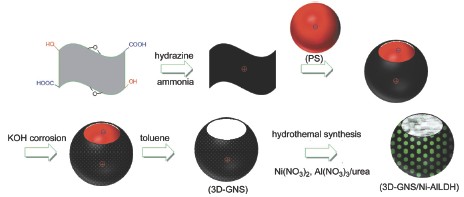
Graphite oxide and polystyrene colloidal microsphere (PS) were dispersed in deionized water with the help of ultrasonic wave to form a stable dispersion. The ammonia and hydrazine were seperately added to the dispersion to reduce graphene oxide and form the PS wrapped with graphene nanosheet. During the process, graphite oxide was chemically reduced by hydrazine in the presence of ammonia to produce positively charged reduced graphite oxide, then the PS colloidal particles negtively charged were wrapped by the graphene nanosheets to form PS/graphene microspheres due to the electrostatic interactions between them. To obtain three-dimensional macroporous graphene nanosheets (3D-GNS), it was orderly treated by the alkali corrosion in a 6 mol·L-1 potassium hydroxide solution and remove of the PS in a toluene. The as-prepared 3D-GNS was well dispersed in deionized water by means of ultrasonic wave and then hydrothermal synthesis method was used to prepare 3D graphene/nickel-aluminium layered double-hydroxide (3D-GNS/Ni-Al LDH) nanocomposite in a Teflon-lined stainless steel autoclave at 100 ℃ for 24 h, in which nickel nitrate, aluminum nitrate and urea were employed as nickel, aluminium and base resources. In this study, IR spectrum, Raman spectroscopy, X-ray diffraction, scanning electron microscopy, transmission electron microscopy and galvanostatic charge-discharge measurement were used to investigate the structure, morpholoy and electrochemical property of the nanocomposite respectively. It was found that the graphite oxide was effectively reduced into the graphene with a 3D micropore structure. Ni-Al LDH nanoflakes were well dispersed in and out of the wall of 3D-GNS. Moreover, electrochemical performance of the 3D-GNS/Ni-Al LDH composite was investigated as supercapacitor electrode materials. A 1054.8 F·g-1 of the specific capacitance was found at the current density of 1 A·g-1. When the current density increased up to 8 A·g-1, the specific capacitance remains 628.1 F·g-1. The value was above 97% of capacitance retention after 1000 cycles, indicating that the composite is of excellent electrochemical performance.
Cite this article

Yan Lin , Kong Hui , Li Zaijun . Synthesis and Supercapacitor Property of Three-dimensional Graphene/Ni-Al Layered Double Hydroxide Composite[J]. Acta Chimica Sinica, 2013 , 71(05) : 822 -828 . DOI: 10.6023/A13010056

References

[1] Liu, C.; Li, F.; Ma, L. P.; Cheng, H. M. Adv. Mater. 2010, 22, E28.
[2] Niu, Y. L.; Jin, X.; Zheng, J.; Li, Z. J.; Gu, Z. G.; Yan, T.; Fang, Y. J. Chin. J. Inorg. Chem. 2012, 28, 1879. (牛玉莲, 金鑫, 郑佳, 李在均, 顾志国, 严涛, 方银军, 无机化学学报, 2012, 28, 1879.)
[3] Chen, Y. F.; Li, Y. Y.; Deng, M. G. Chin. J. Electron. Components Mater. 2008, 27, 6. (陈英放, 李媛媛, 邓梅根, 电子元件与材料, 2008, 27, 6.)
[4] Frackowiak, E.; Béguin, F. Carbon 2001, 39, 937.
[5] Pröbstle, H.; Schmitt, C.; Fricke, J. J. Power Sources 2002, 105, 189.
[6] Park, J. H.; Ko, J. M.; Park, O. O. J. Electrochem. Soc. 2003, 150, A864.
[7] Kim, T. Y.; Lee, H. W.; Stoller, M.; Dreyer, D. R.; Bielawski, C. W.; Ruoff, R. S.; Suh, K. S. ACS Nano 2010, 5, 436.
[8] Susanti, D.; Tsai, D. S.; Huang, Y. S.; Korotcov, A.; Chung, W. H. J. Phys. Chem. C 2007, 111, 9530.
[9] Subramanian, V.; Zhu, H. W.; Wei, B. Q. J. Power Sources 2006, 159, 361.
[10] Xu, J.; Gao, L.; Cao, J. Y.; Wang, W. C.; Chen, Z. D. Electrochim. Acta 2010, 56, 732.
[11] Zhao, B.; Ke, X. K.; Bao, J. H.; Wang, C. L.; Dong, L.; Chen, Y. W.; Chen, H. L. J. Phys. Chem. C 2009, 113, 14440.
[12] Wang, H. L.; Casalongue, H. S.; Liang, Y. Y.; Dai, H. J. J. Am. Chem. Soc. 2010, 132, 7472.
[13] Wang, K.; Huang, J. Y.; Wei, Z. X. J. Phys. Chem. C 2010, 114, 8062.
[14] Vivekchand, S.; Rout, C. S.; Subrahmanyam, K.; Govindaraj, A.; Rao, C. N. R. J. Chem. Sci. 2008, 120, 9.
[15] Stoller, M. D.; Park, S.; Zhu, Y.; An, J.; Ruoff, R. S. Nano Lett. 2008, 8, 3498.
[16] Wang, Y.; Shi, Z. Q.; Huang, Y.; Ma, Y. F.; Wang, C. Y.; Chen, M. M.; Chen, Y. S. J. Phys. Chem. C 2009, 113, 13103.
[17] Williams, G. R.; O'Hare, D. J. Mater. Chem. 2006, 16, 3065.
[18] Wang, J.; Song, Y. C.; Li, Z. S.; Liu, Q.; Zhou, J, D.; Jing, X. Y.; Zhang, M, L.; Jiang, Z. H. Energy Fuels 2010, 24, 6463.
[19] Wang, L.; Wang, D.; Dong, X. Y.; Zhang, Z. J.; Pei, X. F.; Chen, X. J., Chen, B.; Jin, J. Chem. Commun. 2011, 47, 3556.
[20] Hu, Z. A.; Xie, Y. L.; Wang, Y. X.; Wu, H. Y.; Yang, Y. Y.; Zhang, Z. Y. Electrochim. Acta 2009, 54, 2737.
[21] Ma, W. S.; Zhou, J. W.; Cheng, S. X. J. Chem. Eng. Chin. Univ. 2010, 24, 719. (马文石, 周俊文, 程顺喜, 高校化学工程学报, 2010, 24, 719.)
[22] Su, P.; Guo, H. L.; Peng, S.; Ning, S. K. Acta Phys.-Chim. Sin. 2012, 28, 2745. (苏鹏, 郭慧林, 彭三, 宁生科, 物理化学学报, 2012, 28, 2745.)
[23] Hu, H. T. M.S. Thesis, Hubei University, Wuhan, 2010. (胡华亭, 硕士论文, 湖北大学, 武汉, 2010.)
[24] Yang, Y. H.; Sun, H. J.; Peng, T. J. Chin. J. Inorg. Chem. 2010, 26, 2083. (杨永辉, 孙红娟, 彭同江, 无机化学学报, 2010, 26, 2083.)
[25] Gao, Z.; Wang, J.; Li, Z. S.; Yang, W. L.; Wang, B.; Hou, M. J.; He, Y.; Liu, Q.; Mann, T.; Yang, P. P.; Zhang, M. L.; Liu, L. H. Chem. Mater. 2011, 23, 3509.
[26] Su, L. H.; Zhang, X. G. J. Power Sources 2007, 172, 999.
[27] Lu, Z. Y.; Yang, Q.; Zhu, W.; Chang, Z.; Liu, J. F.; Sun, X. M.; Evans, D. G.; Duan, X. Nano Res. 2012, 5, 369.
[28] Zheng, M. B.; Cao, J.; Liao, S. T.; Liu, J. S.; Chen, H. Q.; Zhao, Y.; Dai, W. J.; Ji, G. B.; Cao, J. M.; Tao, J. J. Phys. Chem. C 2009, 113, 3887.
[29] Niu, Y. L.; Xiao, X. Q.; Gu, Z. G.; Li, Z. J. Chin. J. Inorg. Chem. 2012, 28, 751. (牛玉莲, 肖雪清, 顾志国, 李在均, 无机化学学报, 2012, 28, 751.)
Outlines

/

