
A SERS Approach for Rapid Detection of Hg2+ Based on Functionalized Fe3O4@Ag Nanoparticles
Received date: 2018-11-26
Online published: 2019-02-15
Supported by
Project supported by the National Natural Science Foundation of China (No. 61875255) and the Direction Program of Hefei Center of Physical Science and Technology (No. 2018ZYFX005).
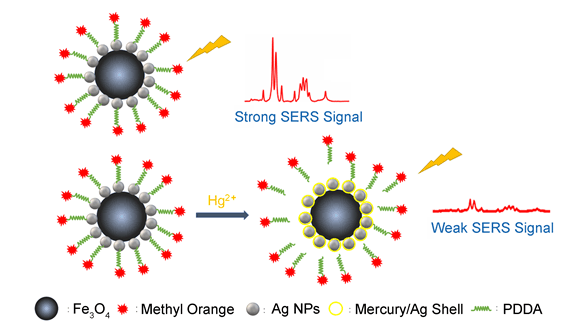
Mercury is an important pollutant, which has attracted wide attention in recent years. Up to now, based on surface enhanced raman spectroscopy (SERS) strategy for detection of Hg2+ is very attractive due to its high sensitivity among various detection methods. Based on the "turn-off" mechanism, we synthesized a magnetic Fe3O4@Ag nanomaterial for SERS detection of Hg2+. The magnetic-plasma resonance nanoparticles, which combine magnetic and plasma resonance properties, can be used for SERS detection of mercury ions with high sensitivity and selectivity. Firstly, the magnetic nanoparticles were prepared by solvothermal reaction, and silver nanoparticles were coated on the surface of magnetic nanoparticles after modification of amino groups. By modifying the positively charged PDADMAC, polyDADMAC (PDDA) layer, the negatively charged methyl orange probe molecule is adsorbed on the surface of Fe3O4@Ag, and in the presence of Hg2+, a significant decrease in SERS signal can be observed. Due to the short-time reaction of Hg2+ and Ag nanoparticles, an amalgam is formed on the surface of the Ag particles, which affects the surface plasmon resonance (SPR) characteristics of the Ag nanoparticles, resulting in enhanced attenuation of the electromagnetic field. And the short-time reaction of Hg2+ and Ag nanoparticles also leads to a decrease in the surface zeta potential of the Ag nanoparticles and affects the adsorption of the Raman probe molecules on the surface, resulting in a decrease in the SERS signal. Therefore, the decrease of SERS intensity in the presence of Hg2+ is mainly attributed to the interaction between Hg2+ and Ag nanoparticles. Through our experiments, it can be proved that the detection limit of the method based on "turn-off" mechanism for detecting Hg2+ ions can be as low as 10-10 mol/L. In addition, this method also shows high selectivity for divalent mercury ions. The SERS nanosensor designed in this experiment can be used to detect the specificity and ultra-sensitivity of Hg2+ in the environment, and it also provides great potential for the construction of SERS nanosensor for heavy metal ions.
Zuo Fangtao , Xu Wei , Zhao Aiwu . A SERS Approach for Rapid Detection of Hg2+ Based on Functionalized Fe3O4@Ag Nanoparticles[J]. Acta Chimica Sinica, 2019 , 77(4) : 379 -386 . DOI: 10.6023/A18110475
[1] Cai, F. D.; Zhu, Q.; Zhao, K.; Deng, A. P.; Li, J. G. Environ. Sci. Technol. 2015, 49, 5013.
[2] Zhang, C. Y.; Meng, Y. Z.; Kuang, J. Z.; Xu, L. Acta Chim. Sinica 2015, 73, 409. (张崇洋, 孟玉珠, 匡金志, 徐岚, 化学学报, 2015, 73, 409.)
[3] Wang, X. W.; Chen, S. Acta Chim. Sinica 2014, 72, 1147. (王晓伟, 陈莎, 化学学报, 2014, 72, 1147.)
[4] Wan, J.; Yin, G.; Ma, X. J.; Xing, L.; Luo, X. L. Electroanalysis 2014, 26, 823.
[5] Taylor, V. F.; Bugge, D.; Jackson, B. P.; Chen, C. Y. Environ. Sci. Technol. 2014, 48, 5058.
[6] Srivastava, R. K.; Sedman, C. B.; Kilgroe, J. D.; Smith, D.; Renninger, S. J. Air Waste Manage. Assoc. 2001, 51, 1460.
[7] Lee, C.; Choo, J. Bull. Korean Chem. Soc. 2011, 32, 2003.
[8] Wu, Y. G.; Zhan, S. S.; Xu, L. R.; Shi, W. W.; Xi, T.; Zhan, X. J.; Zhou, P. Chem. Commun. 2011, 47, 6029.
[9] Shah, A. Q.; Kazi, T. G.; Baig, J. A.; Afridi, H. I.; Arain, M. B. Food Chem. 2012, 134, 2345.
[10] Ye, B. C.; Yin, B. C. Angew. Chem., Int. Ed. 2008, 47, 8386.
[11] Lou, T. T.; Chen, L.; Zhang, C. R.; Kang, Q.; You, H. Y.; Shen, D. Z.; Chen, L. X. Anal. Methods 2012, 4, 488.
[12] Wu, X. F.; Ma, Q. J.; Wei, X. J.; Hou, Y. M.; Zhu, X. Sens. Actuators, B 2013, 183, 565.
[13] Rakkesh, R. A.; Durgalakshmi, D.; Balakumar, S. RSC Adv. 2016, 6, 34342.
[14] Qu, H.; Lai, Y.; Niu, D.; Sun, S. Anal. Chim. Acta 2013, 763, 38.
[15] Du, Y. X.; Liu, R. Y.; Liu, B. H.; Wang, S. H.; Han, M. Y.; Zhang, Z. P. Anal. Chem. 2013, 85, 3160.
[16] Li, D.-W.; Zhai, W.-L.; Li, Y.-T.; Long, Y.-T. Microchim. Acta 2014, 181, 23.
[17] Alvarez-Puebla, R. A.; Liz-Marzan, L. M. Angew. Chem., Int. Ed. 2012, 51, 11214.
[18] Kang, T.; Yoo, S. M.; Yoon, I.; Lee, S.; Choo, J.; Lee, S. Y.; Kim, B. Chem.-Eur. J. 2011, 17, 2211.
[19] Duan, J. L.; Yang, M.; Lai, Y. C.; Yuan, J. P.; Zhan, J. H. Anal. Chim. Acta 2012, 723, 88.
[20] Li, F.; Wang, J.; Lai, Y. M.; Wu, C.; Sun, S. Q.; He, Y. H.; Ma, H. Biosens. Bioelectron. 2013, 39, 82.
[21] Kang, Y.; Wu, T.; Liu, B. X.; Wang, X.; Du, Y. P. Microchim. Acta 2014, 181, 1333.
[22] Ojea-Jimenez, I.; Lopez, X.; Arbiol, J.; Puntes, V. ACS Nano 2012, 6, 2253.
[23] Ding, X.; Kong, L.; Wang, J.; Fang, F.; Li, D.; Liu, J. ACS Appl. Mater. Interfaces 2013, 5, 7072.
[24] Zhang, L.; Chang, H. X.; Hirata, A.; Wu, H. K.; Xue, Q. K.; Chen, M. W. ACS Nano. 2013, 7, 4595.
[25] Chung, E.; Gao, R.; Ko, J.; Choi, N.; Lim, D. W.; Lee, E. K.; Chang, S.-I.; Choo, J. Lab. Chip. 2013, 13, 260.
[26] Esmaielzadeh Kandjani, A.; Sabri, Y. M.; Mohammad-Taheri, M.; Bansal, V.; Bhargava, S. K. Environ. Sci. Technol. 2015, 49, 1578.
[27] Sun, B.; Jiang, X. X.; Wang, H. Y.; Song, B.; Zhu, Y.; Wang, H.; Su, Y. Y.; He, Y. Anal. Chem. 2015, 87, 1250.
[28] Deng, H.; Li, X. L.; Peng, Q.; Wang, X.; Chen, J. P.; Li, Y. D. Angew. Chem., Int. Ed. 2005, 44, 2782.
[29] Zhao, Y. L.; Tao, C. R.; Xiao, G.; Wei, G. P.; Li, L. H.; Liu, C. X.; Su, H. J. Nanoscale 2016, 8, 5313.
[30] Li, Z. X.; Zhao, A. W.; Gao, Q.; Guo, H. Y.; Wang, D. P.; Li, L. Acta Chim. Sinica 2015, 73, 847. (李振兴, 赵爱武, 高倩, 郭红燕, 王大朋, 李磊, 化学学报, 2015, 73, 847.)
[31] Ren, W.; Zhu, C. Z.; Wang, E. Nanoscale 2012, 4, 5902.
[32] Alvarez-Puebla, R. A.; Arceo, E.; Goulet, P. J. G.; Garrido, J. J.; Aroca, R. F. J. Phys. Chem. B 2005, 109, 3787.
[33] He, S. T.; Yao, J. N.; Jiang, P.; Shi, D. X.; Zhang, H. X.; Xie, S. S.; Pang, S. J.; Gao, H. J. Langmuir 2001, 17, 1571.
[34] Katsikas, L.; Gutierrez, M.; Henglein, A. J. Phys. Chem. 1996, 100, 11203.
[35] Ding, S.-Y.; Wu, D.-Y.; Yang, Z.-L.; Ren, B.; Xu, X.; Tian, Z.-Q. Chem. J. Chin. Univ. Chin. 2008, 29, 2569. (丁松园, 吴德印, 杨志林, 任斌, 徐昕, 田中群, 高等学校化学学报, 2008, 29, 2569.)
[36] Zhao, L. B.; Huang, Y. F.; Wu, D. Y.; Ren, B. Acta Chim. Sinica 2014, 72, 1125. (赵刘斌, 黄逸凡, 吴德印, 任斌, 化学学报, 2014, 72, 1125.)
[37] Mclellan, J. M.; Xiong, Y. J.; Hu, M.; Xia, Y. N. Chem. Phys. Lett. 2006, 417, 230.
[38] Wang, G. Q.; Lim, C.; Chen, L. X.; Chon, H.; Choo, J.; Hong, J.; Demello, A. J. Anal. Bioanal. Chem. 2009, 394, 1827.
[39] Ganbold, E.-O.; Park, J.-H.; Ock, K.-S.; Joo, S.-W. Bull. Korean Chem. Soc. 2011, 32, 519.
[40] Sun, Z. L.; Du, J. J.; Lv, B.; Jing, C. Y. RSC Adv. 2016, 6, 73040.
[41] Hou, M. J.; Huang, Y.; Ma, L. W.; Zhang, Z. J. Nanoscale Res. Lett. 2015, 10, 437.
[42] Mou, Y.; Lu, H.; Li, M.; Chen, C. Chin. J. Chem. 2017, 35, 435.
/
| 〈 |
|
〉 |

