
Study on the Origin Traceability of Atractylodes macrocephala Koidz. and Its Correlation with Soil Based on Mineral Elements
Received date: 2021-09-27
Online published: 2021-12-29
Supported by
National Key R&D Program of China(2020YFC1712700); Scientific Research Project of the Education Department of Hunan Province(19C0554)
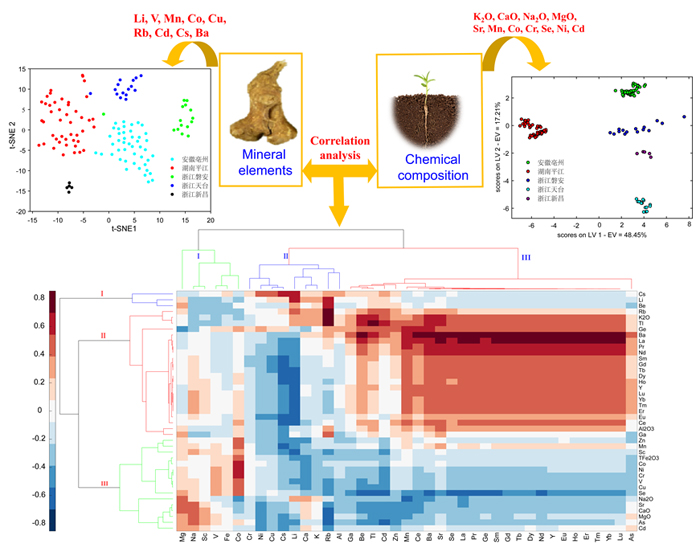
We explored the characteristics of mineral elements of Atractylodes macrocephala Koidz. (AMK) in different producing areas and their correlation with soil factors, which is expected to provide some guidance for the artificial cultivation of AMK. The test solutions of AMK and soil were prepared by digestions, AMK digested with HNO3, while soil using mixed acid such as HClO4+H2SO4+HF+HNO3. In this study, the content of 41 mineral elements in AMK and 41 chemical composition indexes in soil from 5 regions in china were mainly determined by inductively coupled plasma mass spectrometry (ICP-MS). Among them, the chemical composition of Na2O, MgO, Al2O3, K2O, CaO, TFe2O3, Ba, Cr, Mn, Ni, Sr, V in soil were measured by inductively coupled plasma optical emission spectrometry (ICP-OES), and As, Se were detected by atomic fluorescence spectrometry (AFS). In addition, one-way analysis of variance (ANOVA) was used to analyze the difference of mineral element content in different regions, cluster analysis and partial least squares discriminant analysis (PLS-DA) were used for pattern recognition, Pearson correlation analysis was applied to discuss the relationship between multi-element in AMK and soil factors. The results show that both the unsupervised cluster analysis and the supervised PLS-DA can correctly distinguish AMK and soil from different habitats. The content of rare earth elements in AMK in Zhejiang Province is positively correlated with the content of rare earth elements in soil, which also affected by other mineral elements in the soil. Besides, trace elements like Li, V, Mn, Co, Cu, Rb, Cd, Cs, Ba can be regarded as the key factors for traceability of AMK. K2O, CaO, Na2O, MgO, Sr, Mn, Co, Cr, Se, Ni, Cd can be used as the basis for soil discrimination. Mineral elements can be regulated by appropriate control of soil moisture and application of specific fertilizer in the production practice of AMK. Moreover, soil is an important factor for the formation of genuine medicinal materials. Rare earth elements in the soil can promote the absorption of Mn, Zn and other trace elements in AMK. This study will provide some help and references to explain the formation mechanism of genuine AMK and ensure its efficacy and quality.
Xiaozhi Wang , Yao Chen , Hailong Wu , Tong Wang , Jian Yang , Haiyan Fu , Xiaolong Yang , Xufu Li , Yujie Ding , Ruqin Yu . Study on the Origin Traceability of Atractylodes macrocephala Koidz. and Its Correlation with Soil Based on Mineral Elements[J]. Acta Chimica Sinica, 2022 , 80(2) : 159 -167 . DOI: 10.6023/A21090441
| [1] | Zhu, B.; Zhang, Q. L.; Hua, J. W.; Cheng, W. L.; Qin, L. P. J. Ethnopharmacol. 2018, 226, 143. |
| [2] | Chen, Z. L. Acta Chim. Sinica 1989, 47, 1022. (in Chinese) |
| [2] | ( 陈仲良, 化学学报, 1989, 47, 1022.) |
| [3] | Hoang, L. S.; Tran, M. H.; Lee, J. S.; Ngo, Q. M. T.; Woo, M. H.; Min, B. S. Chem. Pharm. Bull. 2016, 64, 507. |
| [4] | Shu, Y. T.; Kao, K. T.; Weng, C. S. Mat. Sci. Eng. C 2017, 77, 606. |
| [5] | Kou, N.; Cho, H.; Kim, H. E.; Sun, Q.; Ahn, K.; Ji, H.; Choi, H.; Kim, O. Bangl. J. Pharmacol. 2017, 12, 140. |
| [6] | Liang, W. Q.; Hu, Y. J.; Pu, J. B.; Yu, Y. F.; Wang, P.; Chen, R. B.; Chen, Z. L.; Xu, P. Chin. J. Mod. Appl. Pharm. 2021, 38, 1302. (in Chinese) |
| [6] | ( 梁卫青, 胡轶娟, 浦锦宝, 俞叶飞, 王盼, 陈如兵, 陈子林, 徐攀, 中国现代应用药学, 2021, 38, 1302.) |
| [7] | Zhao, H. Y.; Yu, C. D.; Li, M. J. Food Compos. Anal. 2017, 63, 15. |
| [8] | Fu, H. Y.; Hai, C. Y.; Chen, H. Y.; Yang, X. L.; Yang, J. J. Nucl. Agr. Sci. 2020, 34, 0069. (in Chinese) |
| [8] | ( 付海燕, 海城英, 陈亨业, 杨小龙, 杨健, 核农学报, 2020, 34, 0069.) |
| [9] | Zhao, H. Y.; Zhang, S. L.; Zhang, Z. W. Food Control 2017, 76, 82. |
| [10] | Liu, H. Y.; Wei, Y. M.; Zhang, Y. Q.; Wei, S.; Zhang, S. S.; Guo, B. L. Int. J. Food Sci. Tech. 2017, 52, 1018. |
| [11] | Li, L.; Wen, B.; Zhang, X. L., Zhao, Y.; Duan, Y.; Song, X. F.; Ren, S.; Wang, Y. H.; Fang, W. P.; Zhu, X. J. Food Control 2018, 90, 18. |
| [12] | He, Y. Y.; Sun, Q. Q.; Guo, B. L.; Zhang, L. J. Nucl. Agr. Sci. 2021, 35, 1565. (in Chinese) |
| [12] | ( 贺媛媛, 孙倩倩, 郭波莉, 张磊, 核农学报, 2021, 35, 1565.) |
| [13] | Zhao, M. F.; Zeng, S. P.; Liu, S. G.; Li, Z. Q.; Jing, L. Ecol. Eng. 2020, 148, 105790. |
| [14] | Fu, B. S.; Sun, A. D. Shandong Chem. Ind. 2018, 47, 74. (in Chinese) |
| [14] | ( 傅炳森, 孙爱德, 山东化工, 2018, 47, 74.) |
| [15] | Chen, L.; Ma, S. S.; Yan, H. F.; Wang, L. B.; Li, J. L. Spectrosc. Lett. 2017, 50, 352. |
| [16] | Gong, F. Y.; Cheng, L.; Han, M.; Yang, L. M.; Lin, H. M. J. Chin. Med. Mater. 2020, 43, 1570. (in Chinese) |
| [16] | ( 宫福雨, 程林, 韩梅, 杨利民, 林红梅, 中药材, 2020, 43, 1570.) |
| [17] | Mu, Q. R.; Jiang, D.; He, Y.; Geng, L.; Ren, G. X.; Bai, Z. F.; Zhang, X.; Zhang, Z. Y.; Liu, C. S. China J. Chin. Mater. Med. 2020, 45, 1059. (in Chinese) |
| [17] | ( 慕祺瑞, 姜丹, 贺元, 耿路, 任广喜, 白贞芳, 张旭, 张仲毅, 刘春生, 中国中药杂志, 2020, 45, 1059.) |
| [18] | Ballabio, D.; Consonni, V. Anal. Methods 2013, 5, 3790. |
| [19] | Brereton, R. G. Chemometrics for Pattern Recognition, John Wiley & Sons, United Kingdom, 2009, pp. 196-201. |
| [20] | Kelly, S.; Heaton, K.; Hoogewerff, J. Trends Food Sci. Tech. 2005, 16, 555. |
| [21] | Kabata-Pendias, A. Geoderma 2004, 122, 143. |
| [22] | Li, X. Y.; He, T. B.; Fu, T. L.; Cheng, J. B. Appl. Chem. Ind. 2021, 50, 1932. (in Chinese) |
| [22] | ( 李相楹, 何腾兵, 付天岭, 成剑波, 应用化工, 2021, 50, 1932.) |
| [23] | Pan, H. X.; Gu, Z. Y.; Zhang, Y.; Xie, Y. J.; He, X. K.; Li, S. C. Miner. Explor. 2020, 11, 1016. (in Chinese) |
| [23] | ( 潘涵香, 谷志云, 张妍, 谢玉洁, 贺晓琨, 李胜昌, 矿产勘查, 2020, 11, 1016.) |
| [24] | Zhang, L.; Li, Y.; Zhang, Y. J. Agr. Sci. Tech. 2020, 22, 123. (in Chinese) |
| [24] | ( 张蕾, 李洋, 张阳, 中国农业科技导报, 2020, 22, 123.) |
| [25] | He, Q. H.; Tan, C. Y.; Cao, X. Y.; Liang, Y. F.; Dai, B.; Zhu, S. Y.; Xie, Y. C. Res. Environ. Sci. 2018, 31, 942. (in Chinese) |
| [25] | ( 何其辉, 谭长银, 曹雪莹, 梁玉峰, 代兵, 朱上游, 谢雨呈, 环境科学研究, 2018, 31, 942.) |
| [26] | Shan, Y. S.; Tysklind, M.; Hao, F. H.; Ouyang, W.; Chen, S. Y.; Lin, C. Y. J. Soil. Sediment. 2013, 13, 720. |
| [27] | Xue, H.; Liu, Z. X.; Yan, M. L. Biotic Resour. 2019, 41, 289. (in Chinese) |
| [27] | ( 薛欢, 刘志祥, 严明理, 生物资源, 2019, 41, 289.) |
| [28] | Li, G.; Qin, T.; Huang, C. G.; Cheng, Y. K. Acta Chim. Sinica 2009, 67, 466. (in Chinese) |
| [28] | ( 李钢, 秦涛, 黄长高, 程永科, 化学学报, 2009, 67, 466.) |
| [29] | Zhou, J.; Guo, L. P.; Xiao, W. J.; Geng, Y. L.; Wang, X.; Shi, X. G.; Staerk, D. China J. Chin. Mater. Med. 2012, 37, 2238. (in Chinese) |
| [29] | ( 周洁, 郭兰萍, 肖文娟, 耿岩玲, 王晓, 时新刚, Staerk, D., 中国中药杂志, 2012, 37, 2238.) |
| [30] | He, Y. J.; Xue, L. Chin. J. Appl. Ecol. 2005, 16, 1983. (in Chinese) |
| [30] | ( 何跃君, 薛立, 应用生态学报, 2005, 16, 1983.) |
/
| 〈 |
|
〉 |

