
Hydrothermal Treatment for Constructing K Doping and Surface Defects in g-C3N4 Nanosheets Promote Photocatalytic Hydrogen Production
Received date: 2023-11-01
Online published: 2024-01-26
Supported by
National Natural Science Foundation of China(21865039); National Natural Science Foundation of China(22369024); Graduate Research and Innovation Fund Project of Yunnan University(KC-22222442)
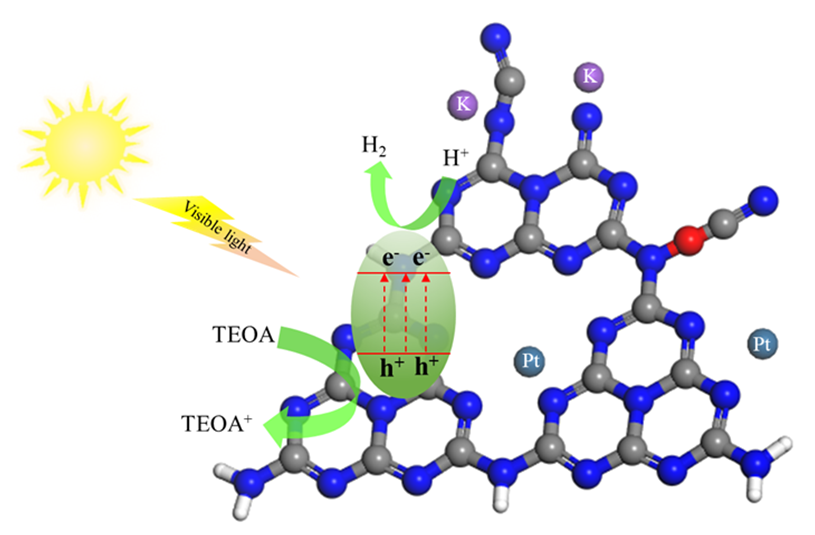
Benefit from its exceptional visible light absorption, cost-effectiveness, outstanding stability, and non-toxic, graphitic carbon nitride (GCN) has emerged as an up-and-coming candidate for visible light photocatalysis. Despite these remarkable properties, the practical utilization of these materials as photocatalysts has been hindered by challenges, such as the high recombination rate of photogenerated charge carriers and limited active reaction sites owing to its inherently low surface area. Among the various strategies aimed at overcoming these limitations, controlled manipulation of morphology is recognized as an effective approach for enhancing the photocatalytic performance of carbon nitride. In this investigation, we employed a hydrothermal treatment method involving potassium cyanate to modify pristine GCN, resulting in the production of carbon nitride nanosheets featuring surface defects, which we designate as CCN-m (with 'm' representing the mass of potassium cyanate, while maintaining a constant usage of 2 g of GCN). Specifically, the GCN precursor, synthesized via the melamine condensation process at 550 ℃ for 3 h, was dispersed in a potassium cyanate solution using ultrasonication and stirring. The suspension was then placed in a Teflon-lined autoclave and maintained at 160 ℃ for 8 h. For the photocatalytic assessment, we utilized a Labsolar-6A test system from Perfeclight, employing a 300 W xenon lamp as the incident light source (with a cut-off filter at λ>420 nm). Triethanolamine served as the sacrificial hole agent, and Pt was employed as the co-catalyst. This evaluation revealed that the post-modulation strategy substantially enhanced the photocatalytic capacity of GCN for H2 evolution. Notably, CCN-4 exhibited an impressive H2 evolution rate of 319.5 μmol•g−1•h−1, representing a substantial 6.2 times increase compared to pristine GCN. Further characterization through scanning electron microscopy, transmission electron microscopy, and N2 adsorption-desorption isotherms indicated a reduction in the thickness of carbon nitride and the formation of mesopores, resulting in an increased number of surface reaction sites. X-ray diffraction patterns illustrated a gradual decrease in the layer spacing of carbon nitride with an increasing amount of added potassium cyanate. Photocurrent response, electrochemical impedance spectroscopy, room-temperature solid-state electron paramagnetic resonance (EPR) spectroscopy, and contact angle measurements collectively demonstrated that surface modification reduced interfacial charge transfer resistance and improved charge carrier separation efficiency. This study not only extends the research avenues for hydrothermal intercalation-exfoliation of graphitic carbon nitride but also offers valuable insights into the efficient synthesis of g-C3N4 nanosheets with surface defects.
Guangzheng Huang , Kunwei Li , Yannan Luo , Qiang Zhang , Yuanlong Pan , Honglin Gao . Hydrothermal Treatment for Constructing K Doping and Surface Defects in g-C3N4 Nanosheets Promote Photocatalytic Hydrogen Production[J]. Acta Chimica Sinica, 2024 , 82(3) : 314 -322 . DOI: 10.6023/A23110484
| [1] | Dai, L.; Chang, D. W.; Baek, J.-B.; Lu, W. Small 2012, 8, 1122. |
| [2] | An, P.; Zhang, Q.; Yang, Z.; Wu, J.; Zhang, J.; Wang, Y.; Li, Y.; Jiang, G. Acta Chim. Sinica 2022, 80, 1629 (in Chinese). |
| [2] | (安攀, 张庆慧, 杨状, 武佳星, 张佳颖, 王雅君, 李宇明, 姜桂元, 化学学报, 2022, 80, 1629.) |
| [3] | Fujishima, A.; Honda, K. J. n. Nature 1972, 238, 37. |
| [4] | Wolff, C. M.; Frischmann, P. D.; Schulze, M.; Bohn, B. J.; Wein, R.; Livadas, P.; Carlson, M. T.; J?ckel, F.; Feldmann, J.; Würthner, F.; Stolarczyk, J. K. Nat. Energy 2018, 3, 862. |
| [5] | Lee, B.-H.; Gong, E.; Kim, M.; Park, S.; Kim, H. R.; Lee, J.; Jung, E.; Lee, C. W.; Bok, J.; Jung, Y.; Kim, Y. S.; Lee, K.-S.; Cho, S.-P.; Jung, J.-W.; Cho, C.-H.; Lebègue, S.; Nam, K. T.; Kim, H.; In, S.-I.; Hyeon, T. Energ. Environ. Sci. 2022, 15, 601. |
| [6] | Wang, X.; Maeda, K.; Thomas, A.; Takanabe, K.; Xin, G.; Carlsson, J. M.; Domen, K.; Antonietti, M. Nat. Mater. 2009, 8, 76. |
| [7] | Cao, S.; Low, J.; Yu, J.; Jaroniec, M. Adv. Mater. 2015, 27, 2150. |
| [8] | Xie, Z.; Xue, Z.; Xu, Z.; Li, Q.; Wang, H.; Li, W. Acta Chim. Sinica 2022, 80 1231 (in Chinese). |
| [8] | (解众舒, 薛中鑫, 许子文, 李倩, 王洪宇, 李维实, 化学学报, 2022, 80 1231.) |
| [9] | Li, K.; Bao, L.; Cao, S.; Xue, Y.; Yan, S.; Gao, H. ACS Appl. Energy Mater. 2021, 4, 12965. |
| [10] | Wang, S.; Zhao, H.; Zhao, X.; Zhang, J.; Ao, Z.; Dong, P.; He, F.; Wu, H.; Xu, X.; Shi, L.; Zhao, C.; Wang, S.; Sun, H. Chem. Eng. J. 2020, 381, 122593. |
| [11] | Jang, D.; Lee, S.; Kwon, N. H.; Kim, T.; Park, S.; Jang, K. Y.; Yoon, E.; Choi, S.; Han, J.; Lee, T.-W.; Kim, J.; Hwang, S.-J.; Park, S. Carbon 2023, 208, 290. |
| [12] | Chang, B.; Guo, Y.; Liu, H.; Li, L.; Yang, B. J. Mater. Chem. A 2022, 10, 3134. |
| [13] | Huang, Y.; Mei, F.; Zhang, J.; Dai, K.; Dawson, G. Acta Phys.-Chim. Sin. 2022, 38, 13 (in Chinese). |
| [13] | (黄悦, 梅飞飞, 张金锋, 代凯, Dawson, G., 物理化学学报, 2022, 38, 13.) |
| [14] | Wang, X.; Meng, J.; Zhang, X.; Liu, Y.; Ren, M.; Yang, Y.; Guo, Y. Adv. Funct. Mater. 2021, 31, 2010763. |
| [15] | Zhao, Z.; Long, Y.; Chen, Y.; Zhang, F.; Ma, J. Chem. Eng. J. 2022, 430, 132682. |
| [16] | Adekoya, D.; Zhang, S.; Hankel, M. Carbon 2021, 176, 480. |
| [17] | Xie, H.; Li, Z.; Zhu, J.; Li, H.; Yang, Q.; Yang, Y.; Li, C. J. Phys. Chem. Lett. 2022, 13, 11982. |
| [18] | Li, J.; Banis, M. N.; Ren, Z.; Adair, K. R.; Doyle-Davis, K.; Meira, D. M.; Finfrock, Y. Z.; Zhang, L.; Kong, F.; Sham, T.-K.; Li, R.; Luo, J.; Sun, X. Small 2021, 17, 2007245. |
| [19] | Zhai, B.; Li, H.; Gao, G.; Wang, Y.; Niu, P.; Wang, S.; Li, L. Adv. Funct. Mater. 2022, 32, 2207375. |
| [20] | Long, H.; Mo, C.; Mo, Y.; Qiu, C.; Jiang, M. Jiangsu University (Nat. Sci. Ed.) 2020, 41, 712. |
| [21] | Lin, B.; Yang, G.; Wang, L. Angew. Chem. Int. Ed. 2019, 58, 4587. |
| [22] | Han, Q.; Wang, B.; Gao, J.; Cheng, Z.; Zhao, Y.; Zhang, Z.; Qu, L. ACS Nano 2016, 10, 2745. |
| [23] | Lu, Y.; Shang, G.; Zhang, H.; Wang, Y.; Tan, Y.; Sun, J.; Liu, G. Chinese J. Inorg. Chem. 2021, 37, 668 (in Chinese). |
| [23] | (陆杨, 上官莉, 张慧, 王岩, 谭宇烨, 孙建华, 刘光祥, 无机化学学报, 2021, 37, 668.) |
| [24] | Niu, P.; Zhang, L.; Liu, G.; Cheng, H.-M. Adv. Funct. Mater. 2012, 22, 4763. |
| [25] | Wu, P.; Wang, J.; Zhao, J.; Guo, L.; Osterloh, F. E. J. Mater. Chem. A 2014, 2, 20338. |
| [26] | Zhang, X.; Xie, X.; Wang, H.; Zhang, J.; Pan, B.; Xie, Y. J. Am. Chem. Soc. 2013, 135, 18. |
| [27] | Dong, C.; Ma, Z.; Qie, R.; Guo, X.; Li, C.; Wang, R.; Shi, Y.; Dai, B.; Jia, X. Appl. Catal. B: Environ. 2017, 217, 629. |
| [28] | Ruan, X.; Cui, X.; Jia, G.; Wu, J.; Zhao, J.; Singh, D. J.; Liu, Y.; Zhang, H.; Zhang, L.; Zheng, W. Chem. Eng. J. 2022, 428, 132579. |
| [29] | Zhao, D.; Wang, Y.; Dong, C.-L.; Huang, Y.-C.; Chen, J.; Xue, F.; Shen, S.; Guo, L. Nat. Energy 2021, 6, 388. |
| [30] | Xu, Y.; He, X.; Zhong, H.; Singh, D. J.; Zhang, L.; Wang, R. Appl. Catal. B: Environ. 2019, 246, 349. |
| [31] | Murugesan, P.; Moses, J. A.; Anandharamakrishnan, C. J. Mater. Sci. 2019, 54, 12206. |
| [32] | Wang, C.; Fan, H.; Ren, X.; Ma, J.; Fang, J.; Wang, W. ChemSusChem 2018, 11, 700. |
| [33] | Ismael, M. J. Alloy. Compd. 2020, 846, 156446. |
| [34] | Vinu, A.; Ariga, K.; Mori, T.; Nakanishi, T.; Hishita, S.; Golberg, D.; Bando, Y. Adv. Mater. 2005, 17, 1648. |
| [35] | Lau, V. W.-h.; Yu, V. W.-z.; Ehrat, F.; Botari, T.; Moudrakovski, I.; Simon, T.; Duppel, V.; Medina, E.; Stolarczyk, J. K.; Feldmann, J.; Blum, V.; Lotsch, B. V. Adv. Energy Mater. 2017, 7, 1602251. |
| [36] | Wu, S.; Yu, H.; Chen, S.; Quan, X. ACS Catal. 2020, 10, 14380. |
| [37] | Zhang, J.; Chen, X.; Takanabe, K.; Maeda, K.; Domen, K.; Epping, J. D.; Fu, X.; Antonietti, M.; Wang, X. Angew. Chem. Int. Ed. 2010, 49, 441. |
| [38] | Zhou, Z.; Shen, Y.; Li, Y.; Liu, A.; Liu, S.; Zhang, Y. ACS Nano 2015, 9, 12480. |
| [39] | Yu, Y.; Yan, W.; Wang, X.; Li, P.; Gao, W.; Zou, H.; Wu, S.; Ding, K. Adv. Mater. 2018, 30, 1705060. |
| [40] | Zhang, M.; Bai, X.; Liu, D.; Wang, J.; Zhu, Y. Appl. Catal. B: Environ. 2015, 164, 77. |
| [41] | Wang, K.; Fu, J.; Zheng, Y. Appl. Catal. B: Environ. 2019, 254, 270. |
| [42] | Zhang, G.; Li, G.; Lan, Z.-A.; Lin, L.; Savateev, A.; Heil, T.; Zafeiratos, S.; Wang, X.; Antonietti, M. Angew. Chem. Int. Ed. 2017, 56, 13445. |
| [43] | Zeng, Z.; Yu, H.; Quan, X.; Chen, S.; Zhang, S. Appl. Catal. B: Environ. 2018, 227, 153. |
| [44] | Jin, Z.; Jiang, X.; Zhang, Q.; Huang, S.; Zhang, L.; Huang, L.; He, T.; Zhang, H.; Ohno, T.; Ruan, S.; Zeng, Y.-J. Commun. Mater. 2020, 1, 90. |
| [45] | Li, Y.; Xue, Y.; Gao, X.; Wang, L.; Liu, X.; Wang, Z.; Shen, S. Adv. Funct. Mater. 2023, n/a, 2312634. |
| [46] | Liu, C.; Zhang, Y.; Dong, F.; Reshak, A. H.; Ye, L.; Pinna, N.; Zeng, C.; Zhang, T.; Huang, H. Appl. Catal. B: Environ. 2017, 203, 465. |
| [47] | Guo, Y.; Bae, J.; Fang, Z.; Li, P.; Zhao, F.; Yu, G. Chem. Rev. 2020, 120, 7642. |
/
| 〈 |
|
〉 |

