


1 引言
此外, 大量具有抗癌活性的喹啉Pt配合物或8-羟基喹啉Pt配合物, 如2-甲基-8-羟基喹啉Pt配合物[6]、4-羟基吖啶Pt配合物[7]、5-取代-8-羟基喹啉Pt配合物[8]、2-[(5-氯吡啶-2-基)-肼甲基]-8-羟基喹啉Pt配合物[9]、5,7-二氯-8-羟基喹啉Pt配合物[10-11]、5-硝基-8-羟基喹啉Pt配合物[12]、5,7-二甲基-8-羟基喹啉酸盐Pt配合物[13]和5,7-二氨基喹啉-8-硫醇Pt配合物[14]等相继被报道, 同时它们的靶点被主要确认为DNA、caspase家族、自噬、端粒/c-myc G-四链体、诱导型NO合酶(iNOS)、p53、端粒酶、活性氧(ROS)、细胞外信号调节激酶1/2 (ERK1/2)和线粒体功能障碍等[6-18]; 然而更为遗憾的是, 喹啉Pt配合物或8-羟基喹啉Pt配合物靶向性不强, 选择性低.
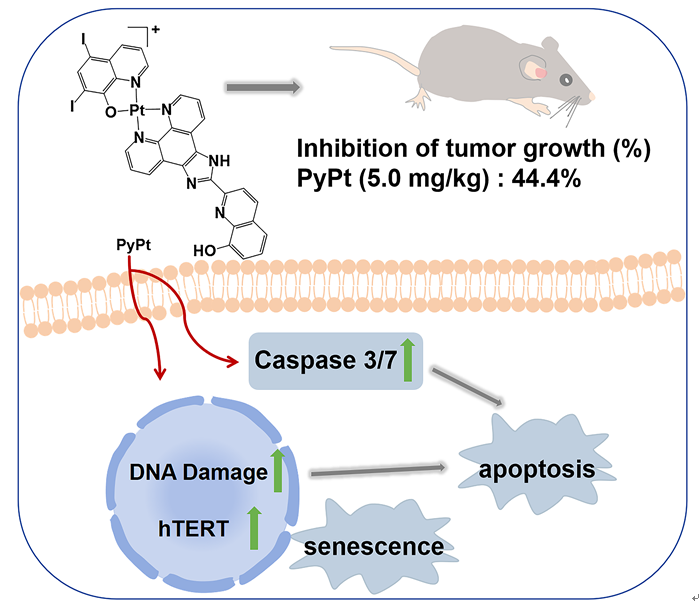
此外, 文献报道经辅助配体Py修饰的2,2'-联吡啶钌(II)抗癌配合物, 可增强对A549肿瘤细胞的抗增殖能力和光动力治疗效果[19]. 受此启发, 我们首次以IQ-OH和Py为活性配体, 合成8-羟基喹啉修饰的Pt(II)多吡啶配合物PyPt; 同时, 还研究PyPt和PtIQ对MDA- MB-231癌细胞和正常细胞HL-7702的抗癌活性和毒性及其抗癌机制进行了探索, 并给出PyPt对体内MDA- MB-231实体瘤模型的抑制效果.
2 结果与讨论
2.1 PyPt和PtIQ的合成与热力学稳定性研究
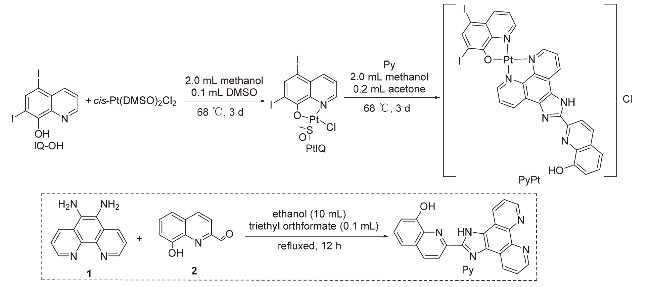
按照文献[19]报道的方法进行制备, 得到黄色辅助配体Py. 此外, 在容积为15.0 mL的高温耐药管中, 加入0.1 mmol的cis-[PtCl2(DMSO)2]和1.0 equiv.的IQ-OH, 随后加入2.0 mL甲醇和0.1 mL的二甲基亚砜(DMSO), 在68 ℃下反应3 d, 冷却至室温, 过滤得到黄色产物PtIQ. 烘干后, 取0.1 mmol的固体PtIQ置于耐药管中, 称取等物质的量的Py, 并加入2.0 mL甲醇和0.2 mL丙酮, 在68.0 ℃下反应3 d, 冷却至室温, 过滤, 用三氯甲烷洗涤3次, 得到深黄色产物PyPt(图1). 通过元素分析、NMR(支持信息图S1~S3)、UV-vis(支持信息图S4)和IR(支持信息图S5、S6)等表征手段确定PyPt和PtIQ的结构, 它们的中心Pt原子为平面四边形几何构型. 支持信息图S4, PyPt在10.0 mmol/L Tris-HCl (pH 7.4)下, UV-vis的峰型没有改变且没有发生红移和蓝移现象, 说明PyPt在生理条件下是稳定存在的; 此外, 液相色谱实验显示, 在10.0 mmol/L Tris-HCl (pH 7.4)静置48.0 h后, PyPt在静置前后的化学位移并没有发生改变, 且有别于IQ-OH和Py配体, 同样也说明了PyPt在生理条件下是稳定存在的(支持信息图S7); 总之, PyPt在生理条件下是稳定存在的, 满足生物实验稳定物种的需求. 同样, 先前文献报道的PtIQ在生理条件下也是稳定存在的[10b].
2.2 抗癌活性研究
众所周知, 噻唑蓝(MTT)比色法或细胞计数试剂盒-8 (CCK-8)广泛应用于活细胞的检测[21]; 因此本研究应用CCK-8研究顺铂、PyPt和PtIQ对A549、A549/DDP、MDA-MB-231和HL-7702细胞的抗癌活性和毒性. 表1的实验结果显示, PyPt、cis-[PtCl2- (DMSO)2]、PtIQ、PtIQ+Py、IQ-OH、Py和顺铂对A549、A549/DDP、MDA-MB-231癌细胞有不同的作用效果, 尤其是对MDA-MB-231癌细胞的抑制效果最为明显, 其IC50值分别为(0.05±0.04)、>50.0、(9.0±0.1)、(8.8±0.4)、>50.0、>50.0和(11.1±0.3) μmol/L; 实验结果说明了, PyPt对所选癌细胞明显高于cis-[PtCl2(DMSO)2]、PtIQ、PtIQ+Py、IQ-OH、Py和临床药物顺铂, 证明在配合物PyPt中的铂离子与配体(Py、IQ-OH)产生协同效应, 实现了药物“1+1>2”的抗癌效果. 此外, PtIQ通过辅助配体Py修饰后, 形成配合物PyPt, 其对MDA-MB-231癌细胞的IC50值从(9.0±0.1) μmol/L降到(0.05±0.04) μmol/L, 说明辅助配体Py的引入, 明显增大了铂配合物对MDA-MB-231癌细胞的抑制作用. 研究还发现, PyPt对MDA-MB-231癌细胞抗癌活性明显大于文献报道的喹啉Pt配合物和8-羟基喹啉Pt配合物[6-18]. 此外, PyPt对A549/DDP耐药细胞具有很好的抑制效果, IC50值为 (0.9±0.3) μmol/L, 高于PtIQ和PtIQ+Py, 说明PyPt能克服顺铂的耐药性. 更有趣的是, 配合物PyPt对正常HL-7702细胞毒性 (>50.0 μmol/L)非常小, 其肿瘤选择性(SI)>980.4, 优于铂盐cis-[PtCl2(DMSO)2]、PtIQ、IQ-OH、Py和顺铂.
表1 顺铂、PyPt和PtIQ对MDA-MB-231和HL-7702细胞的IC50值(μmol/L)Table 1 The IC50 values of cisplatin, PyPt and PtIQ against MDA-MB-231 and HL-7702 cells |
| Entrya | A549 | A549/DDP | MDA-MB- 231 | HL-7702 | SIb |
|---|---|---|---|---|---|
| Py | >50.0 | >50.0 | >50.0 | >50.0 | ca. 1.0 |
| IQ-OH | >50.0 | >50.0 | >50.0 | >50.0 | ca. 1.0 |
| cis-[PtCl2- (DMSO)2] | >50.0 | >50.0 | >50.0 | >50.0 | ca. 1.0 |
| PtIQ | 7.2±0.5 | 6.1±0.9 | 9.0±0.1 | 35.5±0.4 | 4.0 |
| PyPt | 1.0±0.2 | 0.9±0.3 | 0.05±0.04 | >50.0 | >980.4 |
| PtIQ+Py | 7.0±0.5 | 6.0±0.1 | 8.8±0.4 | 36.2±0.7 | 4.2 |
| 顺铂 | 13.0±0.6 | >50.0 | 11.1±0.3 | 15.6±0.2 | 1.4 |
a The cells were incubated for 48 h; b Tumor selectivity (SI)=IC50 value (HL-7702)/IC50 value (MDA-MB-231). |
2.3 PyPt和PtIQ诱导细胞凋亡和衰老
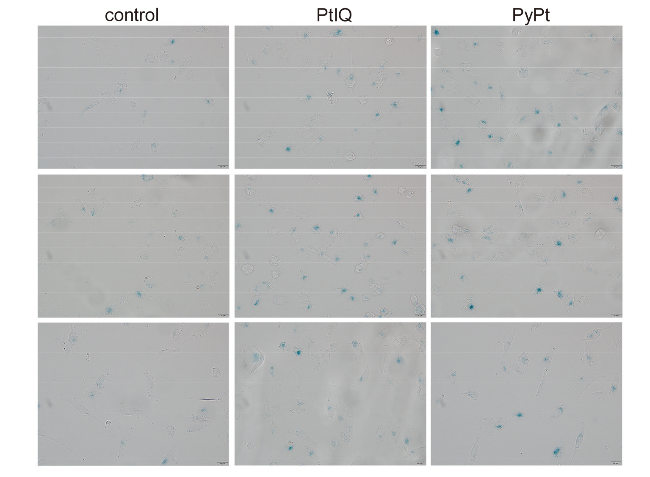
应流式细胞术和显微镜成像实验, 研究PyPt (0.05 μmol/L)和PtIQ (9.0 μmol/L)诱导MDA-MB-231细胞凋亡和衰老的情况. 图3是PyPt (0.05 μmol/L)和PtIQ (9.0 μmol/L)诱导MDA-MB-231细胞凋亡图; 其中Q1-UL区为自然死细胞, Q1-UR区为晚期凋亡细胞, Q1-LR区为早期凋亡细胞, Q1-LL区为活的细胞. 空白对照组(control), Q1-UR和Q1-LR区总和仅为(6.1±0.6)%, 说明MDA-MB-231细胞状态良好(图3). 而细胞经PyPt (0.05 μmol/L)和PtIQ (9.0 μmol/L)作用48.0 h后, Q1-UR和Q1-LR区凋亡细胞明显增大, 分别增大至(48.0±0.9)%和(44.2±0.6)%, 说明PyPt诱导MDA-MB-231细胞凋亡的能力明显高于PtIQ和文献报道的5,7-二碘-8-羟基喹啉铂配合物(27.8%[10b], HepG2细胞). 图4中MDA-MB-231细胞经β-半乳糖苷酶染色后, 呈蓝绿色, 说明癌细胞发生一定的衰老. 同样control组中, 细胞的蓝绿色区域较少(图4和支持信息表S1), IOD值仅仅为(2.1±0.1)×105, 而癌细胞经PyPt (0.05 μmol/L)和PtIQ (9.0 μmol/L)作用48.0 h后, MDA-MB-231中呈蓝绿色的区域明显增多, 其IOD值分别为(1.9±0.1)×106和(1.8±0.1)×106; 实验结果说明, PyPt诱导MDA-MB-231细胞衰老的能力明显高于PtIQ和文献报道的5,7-二碘-8-羟基喹啉Pt配合物(肝癌HepG2细胞)[10b]. 总之, 辅助配体Py的引入, 明显增大了铂配合物PyPt对MDA-MB- 231癌细胞的诱导细胞凋亡和衰老的能力.
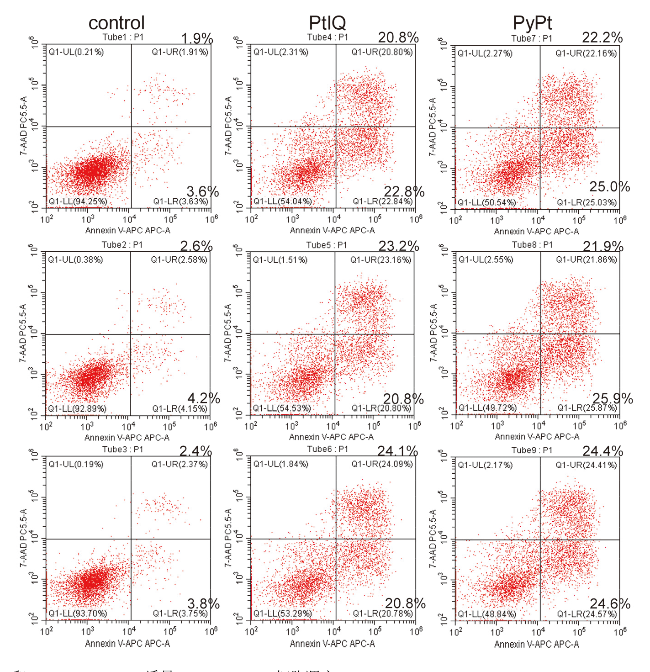
图3 PyPt(0.05 μmol/L)和PtIQ (9.0 μmol/L)诱导MDA-MB-231细胞凋亡Figure 3 Apoptosis of MDA-MB-231 cells induced by PyPt (0.05 μmol/L) and PtIQ (9.0 μmol/L) |
2.4 DNA损伤实验
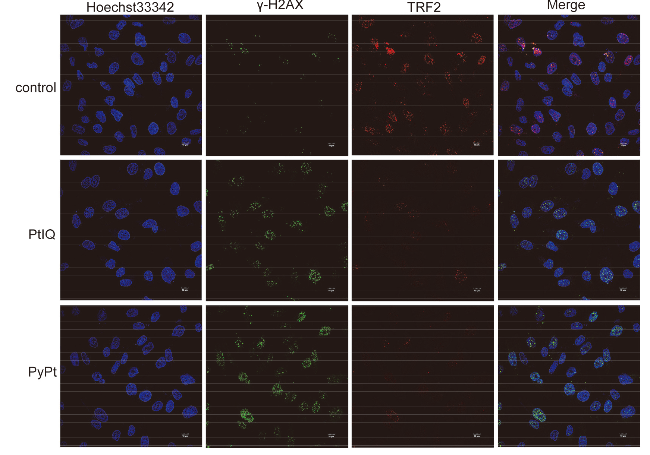
细胞中的尾部DNA (Tail DNA, %)、磷酸化组蛋白γ-H2AX和TRF2(端粒蛋白复合体)分别是DNA损伤和端粒损伤的重要指标[22-23], 它们与细胞凋亡和衰老密切相关[22-23]. 为了研究PyPt (0.05 μmol/L)和PtIQ (9.0 μmol/L)诱导MDA-MB-231癌细胞凋亡和衰老是否由DNA损伤所引发, 应用彗星电泳和免疫荧光实验研究的Tail DNA (%)、γ-H2AX和TRF2在MDA-MB-231癌细胞中的变化情况. 空白对照组(control), MDA-MB-231癌细胞的Tail DNA(%)仅为(2.5±1.5)%, 说明MDA- MB-231细胞中的DNA损伤少、细胞生长状态良好(图5和支持信息表S2). 而细胞经PyPt (0.05 μmol/L)和PtIQ (9.0 μmol/L)作用48.0 h后, 细胞中的Tail DNA(%)明显增大, 分别增大至(66.2±2.5)%和(62.4±3.5)%, 说明PyPt诱导DNA损伤的能力明显高于PtIQ. 此外, 图6和支持信息图S8~S10显示, 癌细胞孵育48.0 h后, PyPt (0.05 μmol/L)和PtIQ (9.0 μmol/L)组中的绿色荧光明显增强, 说明经PyPt和PtIQ作用后, MDA-MB-231细胞中的γ-H2AX明显增加, 而TRF2则变化很小, 进一步说明了PyPt和PtIQ通过DNA损伤来诱导MDA- MB-231细胞凋亡, 而不是通过诱导端粒DNA损伤引起的.
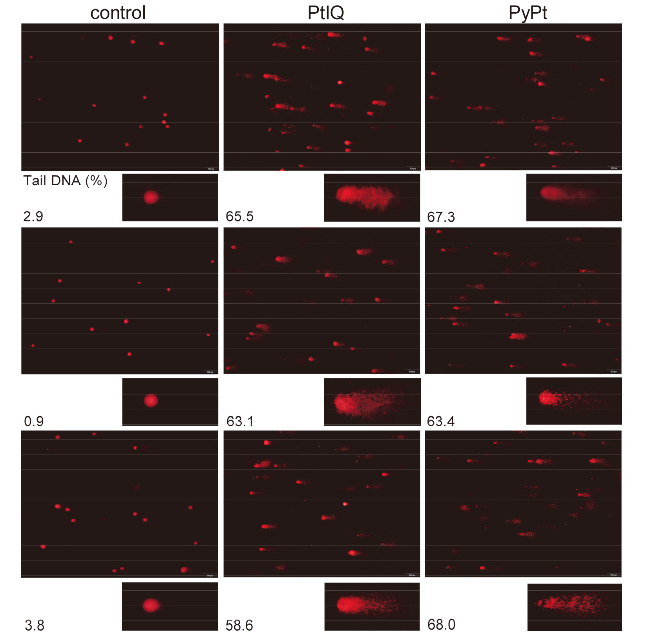
图5 采用彗星试验检测PyPt (0.05 μmol/L)和PtIQ (9.0 μmol/L)作用MDA-MB-231细胞48 h后DNA损伤的情况Figure 5 Induction of DNA damage in MDA-MB-231 cells by PyPt (0.05 μmol/L) and PtIQ (9.0 μmol/L) for 48 h using neutral comet assay Image multiple: 100 μm. |
2.5 分子对接与RT-qPCR实验
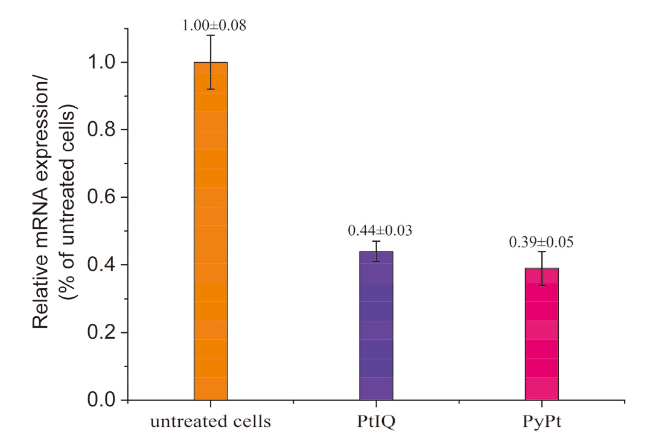
约85.0%癌细胞中的hTERT是过表达的, 它参与维持癌细胞的生存, 一旦被抑制, 端粒酶和端粒DNA合成均被阻断[24-25], 最终会引发细胞凋亡和衰老. 首先, 通过分子对接确定, PyPt和PtIQ与hTERT中DNA的相互结合强度与作用位点[25-26], 其中hTERT蛋白的PDB ID为6d6v[25]. 据Autodock软件[25-26]计算结果显示, PyPt和PtIQ与hTERT中DNA分子间的结合能分别为–53.0和–30.2 kJ/mol(图7), 说明PyPt和PtIQ与hTERT中DNA能稳定结合. 由图7可见, PtIQ能够稳定嵌合于hTERT DNA的B链中碱基A50(B)、A51(B)、C46(B)、C48(B)、C49(B)及C链的DT14(C)、DT15(C)、DG16(C)、DG11(C)共同构成的空腔区域; 上述相互作用主要依赖于两种非共价作用力: (1) PtIQ与DT15(C)之间形成稳定的氢键(H)相互作用, 有助于提高PtIQ与hTERT结合的选择性与特异性; (2) PtIQ的疏水性结构域与hTERT邻近的8个碱基之间存在显著的疏水相互作用, 有效减少外界水分子的干扰, 从而增强了PtIQ与hTERT的热力学稳定性. 而PyPt能够稳定地结合hTERT DNA中B链碱基A113、A115、G114、C152、U151、U153、U154、C109、A112、A111、G107和A108共同形成的空腔中. PyPt与hTERT DNA中的碱基A113间形成了氢键, 有助于增强PyPt在靶点hTERT定位的精确性; 同时, PyPt的疏水区域与该腔体内11个碱基之间存在良好的疏水相互作用(图7), 能够有效隔绝水分子, 进一步提升PyPt与hTERT结合的稳定性. 总体来看, 辅助配体Py的引入, 明显增大PyPt的平面, 增强了PyPt与hTERT的氢键与疏水协同作用(图7), 使其被牢固地结合在hTERT蛋白质内部DNA的结合位点中, 其作用明显强于PtIQ, 为其后续靶点研究提供了理论基础. 其次, 通过RT-qPCR实验探究了癌细胞经PyPt (0.05 μmol/L)和PtIQ (9.0 μmol/L)作用48.0 h后, hTERT RNA的表达情况. 相对于空白组细胞(untreated cells, 1.00±0.08), PyPt在MDA-MB-231癌细胞中能抑制hTERT RNA转录(支持信息表S3、S4和图8), 表达值均为0.39±0.05, 高于PtIQ (0.44±0.03), 说明了PyPt和PtIQ通过hTERT抑制来诱导MDA-MB-231细胞衰老和凋亡, 其诱导能力遵循PyPt>PtIQ, 与分子对接结果、免疫荧光、活性实验等结果一致.
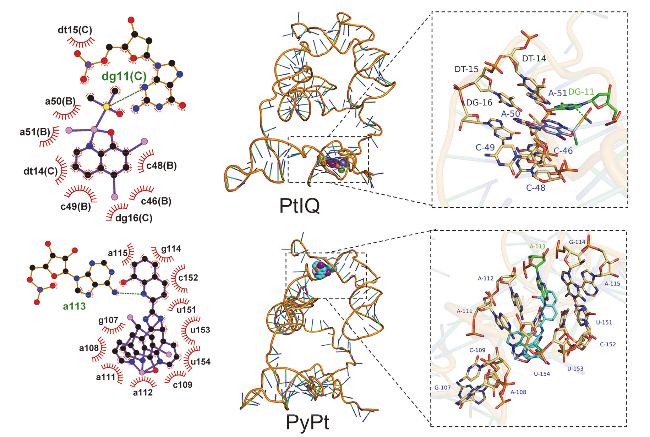
图7 分子对接研究PyPt和PtIQ与目标蛋白hTERT中DNAFigure 7 Molecular docking analysis of PyPt and PtIQ against the target hTERT DNA |
2.6 调控DNA损伤的相关蛋白
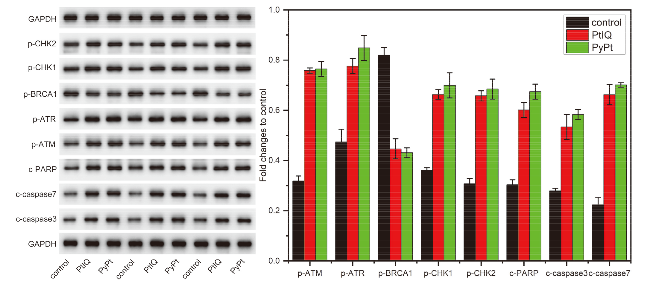
在肿瘤或癌症的治疗中, DNA损伤在金属类抗癌药中被广泛视为“首要且重要的靶向分子”[24,27]. 如图5和6所示, 已经证实PyPt和PtIQ能明显诱导MDA- MB-231癌细胞中的DNA损伤. 随后, 应用Western blotting检测MDA-MB-231癌细胞中的DNA损伤诱导相关蛋白和蛋白激酶p-BRCA1、p-ATR、c-PARP、p-CHK1、p-ATM和p-CHK2的表达情况, 从而明确PyPt (0.05 μmol/L)和PtIQ (9.0 μmol/L)诱导MDA-MB-231细胞DNA损伤的机制. 图9所示, 经PyPt (0.05 μmol/L)和PtIQ (9.0 μmol/L)作用48.0 h后, MDA-MB-231细胞中p-BRCA1表达明显降低, 而p-ATR、c-PARP、p-CHK1、p-ATM和p-CHK2的表达明显激活, 其诱导能力遵循PyPt>PtIQ, 说明PyPt和PtIQ通过调控DNA关键蛋白和激酶来诱导MDA-MB-231细胞的DNA损伤, 并引发凋亡.
2.7 激活caspase3/7蛋白
图3说明了PyPt和PtIQ能明显诱导MDA-MB-231细胞产生凋亡, 而caspase家族蛋白又与细胞凋亡密切相关[28], 为了研究PyPt (0.05 μmol/L)和PtIQ (9.0 μmol/L)与caspase家族蛋白的作用情况, 我们选择了c-caspase3和c-caspase7两种蛋白进行了研究. 图9中的实验结果说明, MDA-MB-231癌细胞经PyPt (0.05 μmol/L)和PtIQ (9.0 μmol/L)孵育48 h后, c-caspase3和c-caspase7的表达量明显高于对照组(control), 说明PyPt和PtIQ通过激活caspase3/7蛋白来诱导MDA- MB-231细胞凋亡, 且辅助配体Py的引入, 明显增大了铂配合物PyPt诱导MDA-MB-231癌细胞凋亡的能力, 与上述实验结果均一致.
2.8 PyPt体内抑瘤实验
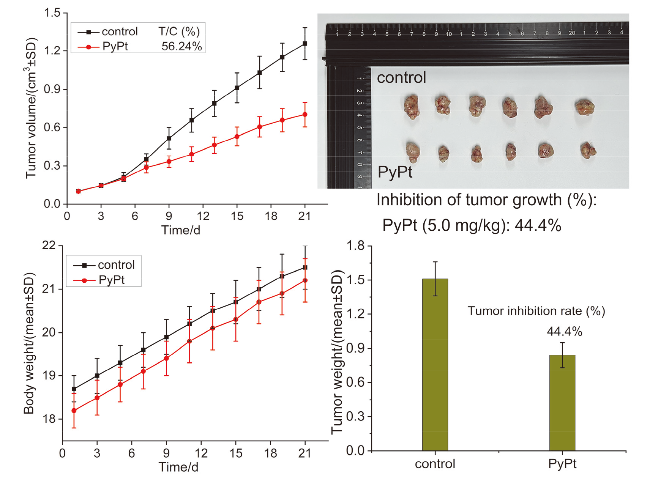
当肿瘤MDA-MB-231生长至0.1 cm3左右时, 将动物按6只随机分3组, 加药组按PyPt (5.0 mg/kg)隔天给药, 21天后, 空白对照组(control)的肿瘤体积增长至(1.3±0.1) cm3, 而PyPt对MDA-MB-231肿瘤有明显的抑制作用(ca. 44.4%), 其肿瘤体积仅为(0.7±0.1) cm3. 如图10和支持信息表S5~S7, 加药组PyPt (5.0 mg/kg)在21天用药后, 体重为(21.2±0.5) g, 与control组的体重相当[m=(21.5±0.5) g], 且加药组PyPt (5.0 mg/kg)中的裸鼠没有死亡和食欲不振的现象, 说明PyPt的体内毒性小且对MDA-MB-231肿瘤具有很好的选择性抑制作用.


3 结论
本研究以8-羟基喹啉IQ-OH为配体, 与铂盐cis- [PtCl2(DMSO)2]反应, 得到中间体PtIQ, 经辅助配体Py修饰, 合成出新型铂(II)多吡啶配合物PyPt. 配合物PyPt和PtIQ经NMR、UV-vis、IR和元素分析手段进行表征. PyPt和PtIQ选择性抑制MDA-MB-231癌细胞生长, 其IC50值为(0.05±0.04) μmol/L和(9.0±0.1) μmol/L, 优于配体和铂盐. PyPt通过抑制hTERT表达、激活caspase3/7蛋白、诱导DNA损伤及相关蛋白来引发MDA-MB-231癌细胞凋亡和衰老, 其诱导能力强于PtIQ. 辅助配体Py的引入, 明显增大了铂配合物PyPt的平面, 增大其与靶点的相互作用, 从而提高诱导MDA-MB-231细胞凋亡和衰老的能力. 更重要的是, PyPt具有很好的体内抗癌作用(ca. 44.4%), 毒性小, 是一种高效、低毒性以DNA和hTERT为靶点的新型8-羟基喹啉修饰铂(II)多吡啶抗癌金属药物.
4 实验部分
4.1 激活caspase家族蛋白
按照文献报道的方法制备辅助配体Py[19].
配合物PtIQ的合成: 称取0.1 mmol的IQ-OH (39.7 mg)和0.1 mmol铂盐cis-[PtCl2(DMSO)2] (42.2 mg), 加入到约为15.0 cm的厚壁耐药管中, 随后加入CH3OH (2.0 mL)和DMSO (0.1 mL), 盖上盖子后, 于68.0 ℃反应3 d, 冷却后, 过滤, 真空干燥, 得到63.0 mg黄色中间体PtIQ.
配合物PyPt的合成: 在约为15.0 cm的厚壁耐药管中, 称取0.1 mmol的PtIQ (70.4 mg)、0.1 mmol的辅助配体Py (36.3 mg), 加入甲醇(2.0 mL)和丙酮(0.2 mL)后, 盖上盖子, 于68.0 ℃反应3 d, 冷却后, 过滤, 用三氯甲烷洗涤3次, 每次10.0 mL, 真空干燥后, 得到深黄色目标产物PyPt.
配合物PyPt和PtIQ的测试数据见支持信息.
4.2 配合物的表征数据
配合物PtIQ: 黄色固体63.0 mg, 产率89.5%; 1H NMR (400 MHz, DMSO-d6) δ: 9.44 (d, J=5.4 Hz, 1H), 8.54 (d, J=8.6 Hz, 1H), 8.35 (s, 1H), 7.85 (dd, J=8.6, 5.4 Hz, 1H); 13C NMR (101 MHz, DMSO-d6) δ: 166.91, 149.10, 146.33, 143.89, 131.65, 129.68, 123.93, 84.40, 79.56; IR (KBr) ν: 3430, 3091, 3063, 3028, 3010, 2923, 1983, 1745, 1629, 1587, 1567, 1500, 1460, 1444, 1423, 1400, 1383, 1372, 1316, 1293, 1251, 1235, 1207, 1199, 1129, 1062, 1035, 979, 938, 917, 891, 876, 815, 772, 765, 749, 699, 680, 653, 611, 514, 502, 454 cm–1. Anal. calcd for PtC11H10O2ClI2NS: C 18.75, H 1.43, N 1.99; found C 18.73, H 1.48, N 2.02.
配合物PyPt: 深黄色固体92.3 mg, 产率93.3 %; 1H NMR (400 MHz, DMSO-d6) δ: 14.03 (s, 1H), 9.83 (s, 1H), 9.10 (d, J=7.5 Hz, 2H), 8.91~9.01 (m, 2H), 8.56 (d, J=8.6 Hz, 2H), 8.48 (d, J=8.5 Hz, 1H), 8.34 (d, J=11.5 Hz, 1H), 7.99~7.82 (m, 3H), 7.61~7.48 (m, 2H), 7.24 (d, J=6.9 Hz, 1H); IR (KBr) ν: 3867, 3851, 3835, 3818, 3800, 3746, 3689, 3672, 3634, 3321, 3083, 3014, 3002, 2916, 2363, 2334, 2320, 2244, 1966, 1763, 1635, 1607, 1595, 1572, 1547, 1525, 1500, 1486, 1448, 1435, 1410, 1391,1375, 1363, 1319, 1295, 1273, 1242, 1228, 1194, 1164, 1128, 1117, 1075, 1058, 1030, 982, 946, 922, 885, 851, 841, 804, 762, 742, 723, 704, 689, 673, 662, 649, 623, 584, 551, 510, 484, 462, 453 cm–1. Anal. calcd for PtC31H17O2ClI2N6: C 37.62, H 1.73, N 8.49; found C 37.64, H 1.78, N 8.47.
4.3 设备与其他实验方法
实验所用的设备与生物实验方法见支持信息.
(Cheng, F.)