


1 引言
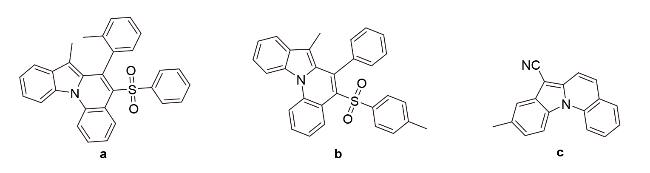
含氮杂环化合物广泛存在于具有生物活性的天然产物和合成化合物中[1-3]. 其中, 吲哚并[1,2-a]喹啉因独特的含氮四环骨架, 广泛存在于多种天然产物、生物活性物质和功能材料中[4-11]. 如陈晓岚等[12-13]报道的磺酰化吲哚并[1,2-a]喹啉化合物a(图1), 荧光性能优异, 可作为脂滴靶向探针, 与尼罗红共染细胞时信号重叠度高(皮尔逊相关系数0.92)且毒性低; Kuhakarn团队[14]合成的6-芳磺酰基衍生物b(图1), 对肺癌A549细胞抑制活性媲美阿法替尼, 对正常细胞毒性更低; Ngernmeesri 等[10]制备的化合物c, 对结直肠癌HCT-116细胞IC50达6.21 μmol/L, 展现出抗肿瘤潜力. 这些具有重要药理活性的吲哚并[1,2-a]喹啉受到越来越多的关注, 但是, 吲哚并[1,2-a]喹啉的合成方法仍较少.
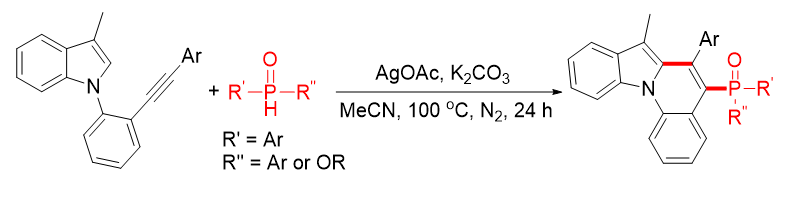
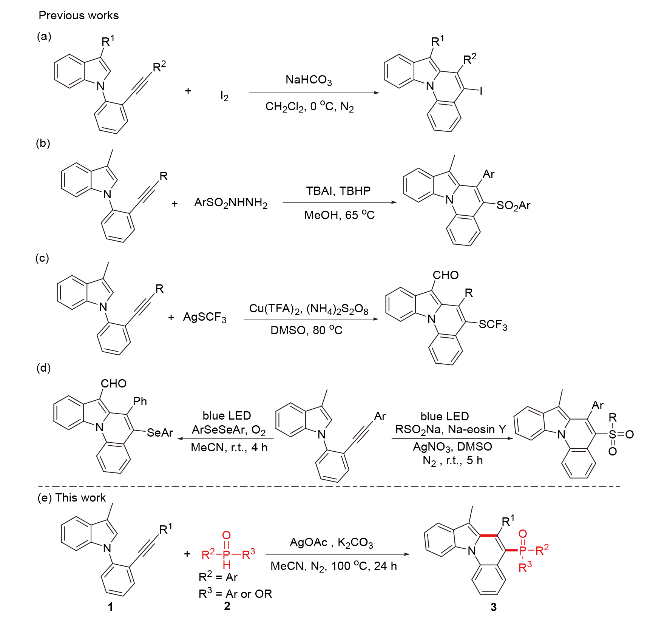
2011年, Verma等[15]设计了一种碘参与的亲电环化反应, 用于合成一系列吲哚并[1,2-a]喹啉化合物(Scheme 1, a). 随后, 2019年陈晓岚课题组[12]提出了一种新型高效的磺酰基自由基引发的串联环化策略, 成功制备了一系列5位芳基磺酰基、6位芳基的吲哚并[1,2-a]喹啉类化合物(Scheme 1, b). 2023年, Kuhakarn等[16]报道了使用AgSCF3对3-烷基-1-[2-(炔基)苯基]吲哚进行自由基串联三氟甲基硫基化反应(Scheme 1, c), 该反应通过铜催化形成C—SCF3和C—C键, 并伴随苄基碳的氧化, 为合成CF3S取代的吲哚并[1,2-a]喹啉-7-甲醛和CF3S取代的吲哚并[1,2-a]喹啉-7-酮衍生物提供了新途径. 同年, 袁金伟课题组[17]报道了一种简便高效的可见光诱导方法, 在温和条件下, 通过磺酰基或硒基自由基引发惰性炔烃与亚硫酸钠或二芳基二硒醚的串联环化, 构建磺化和硒化吲哚并[1,2-a]喹啉(Scheme 1, d). 尽管取得了这些显著进展, 但从易得底物出发, 在温和条件下合成多官能化吲哚并[1,2-a]喹啉的简单有效方法仍面临巨大挑战, 尤其是对于膦酰基吲哚并[1,2-a]喹啉的合成[18].
2 结果与讨论
2.1 反应条件优化
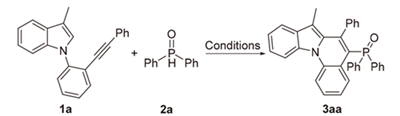
表1 反应条件优化aTable 1 Optimization of reaction conditions |
| Entry | Oxidant | Base | Solvent | Temp./℃ | Yieldb/% |
|---|---|---|---|---|---|
| 1 | K2S2O8 | K2CO3 | MeCN | 100 | 32 |
| 2 | TBHP | K2CO3 | MeCN | 100 | 42 |
| 3 | Mn(OAc)2•4H2O | K2CO3 | MeCN | 100 | 36 |
| 4 | Ag2CO3 | K2CO3 | MeCN | 100 | 40 |
| 5 | AgOAc | K2CO3 | MeCN | 100 | 53 |
| 6 | — | K2CO3 | MeCN | 100 | 0 |
| 7 | AgOAc | NaH | MeCN | 100 | 46 |
| 8 | AgOAc | K3PO4 | MeCN | 100 | 73 |
| 9 | AgOAc | Na2CO3 | MeCN | 100 | 59 |
| 10 | AgOAc | t-BuOK | MeCN | 100 | 42 |
| 11 | AgOAc | Et3N | MeCN | 100 | 45 |
| 12 | AgOAc | K3PO4 | Toluene | 100 | 52 |
| 13 | AgOAc | K3PO4 | DMSO | 100 | 27 |
| 14 | AgOAc | K3PO4 | 1,4-Dioxane | 100 | 30 |
| 15 | AgOAc | K3PO4 | MeCN | 80 | 56 |
| 16 | AgOAc | K3PO4 | MeCN | 120 | 47 |
| 17c | AgOAc | K3PO4 | MeCN | 100 | 14 |
| 18d | AgOAc | K3PO4 | MeCN | 100 | 78 |
| 19e | AgOAc | K3PO4 | MeCN | 100 | 62 |
a Conditions: 1a (0.2 mmol), base (0.5 mmol), 2a (0.4 mmol), oxidant (0.6 mmol), MeCN, N2, 100 ℃, 24 h. b Yield of isolated product. c 12 h. d 36 h. e AgOAc (2.5 equiv.) was adopted. |
2.2 底物范围考察
确定优化条件后, 对多种1-(2-(芳基乙炔基)苯基)-1H-吲哚衍生物(1)和二苯基氧化膦(2a)进行了考察, 以确定底物范围(Scheme 2).
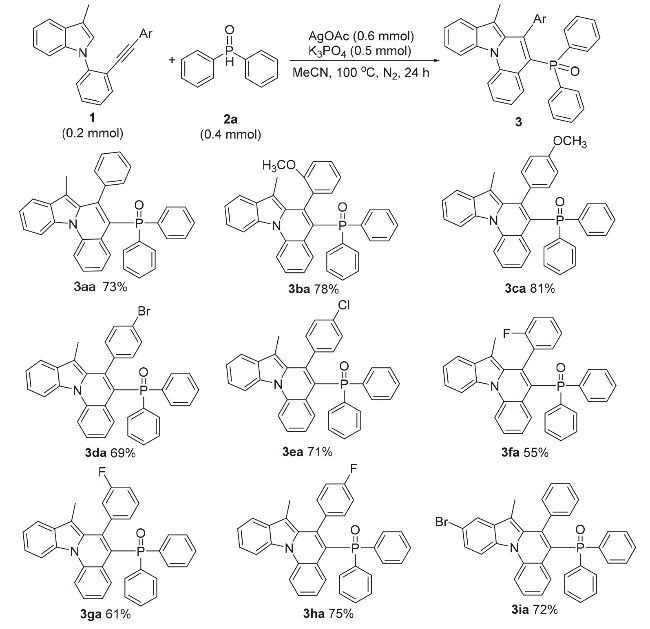
结果表明, 1-[2-(芳基乙炔基)苯基]-1H-吲哚衍生物(1)中, 不管Ar属于富电子还是属于缺电子芳基, 均具有良好的兼容性, 生成相应产物3aa~3ha的产率为55%~81%. 值得注意的是, 在这些转化中未观察到显著的电子效应对反应产率的影响.
此外, Ar为邻位取代的1-(2-(芳基乙炔基)苯基)-1H-吲哚衍生物1也能够实现该反应, 生成带甲氧基产物3ba~3ca的产率范围为78%~81%. 这一结果表明, Ar的苯环上的甲氧基取代基的位阻对反应的空间效应影响不显著. 然而, 底物邻、间或对位氟取代的位阻效应对反应结果有不同程度的影响. 有趣的是, 产率随邻(3fa)、间(3ga)、对位(3ha)依次逐渐升高, 其中, 对位受位阻影响最小, 产率最高(3ha).
此外, 值得注意的是, 当1-(2-(芳基乙炔基)苯基)-1H-吲哚衍生物1的5位存在取代基时, 反应仍能顺利进行, 目标产物(3ia)的产率高达72%.
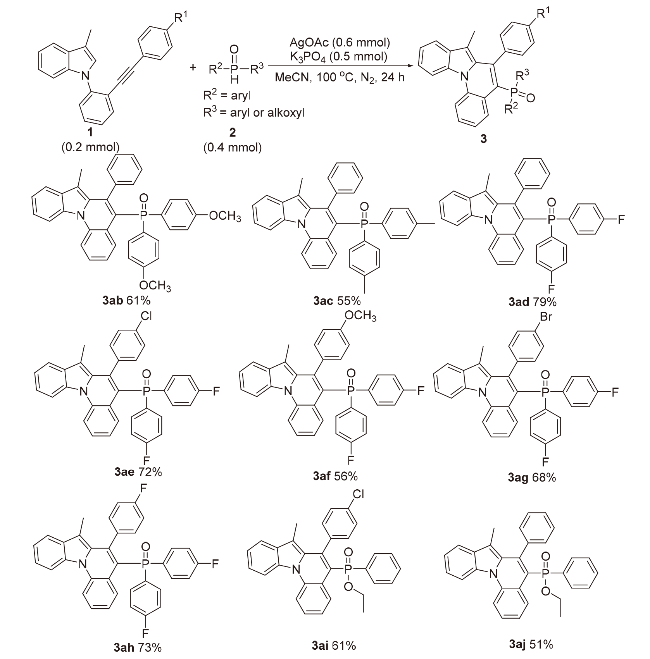
随后, 在相同条件下, 将多种二级氧化膦与3-甲基- 1-(2-(苯基乙炔基)苯基)-1H-吲哚1a反应(Scheme 3). 总体而言, 带有吸电子基团(F)的二级氧化膦反应效果良好, 目标产物(3ad)的产率为79%. 令人满意的是, 对于带给电子基团(Me和OMe)的二芳基氧化膦, 在该条件下也能生成目标产物(3ab、3ac), 产率为55%~61%. 二(4-氟苯基)氧磷和R1取代基不同的底物1反应, 得到中等到良好产率(56%~79%)的目标产物(3ad~3ah). 最后, 对苯基膦酸乙酯作为磷源也进行了考察, 得到目标产物(3ai~3aj)的产率为51%~61% (Scheme 3).
2.3 克级实验
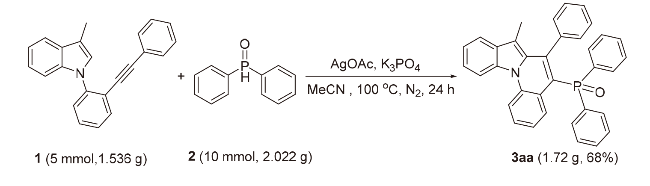
为考察这些产物的大量制备可行性, 在优化条件下进行了克级实验(Scheme 4). 结果显示, 该克级反应的目标产物产率为68%.
2.4 控制实验与反应机理
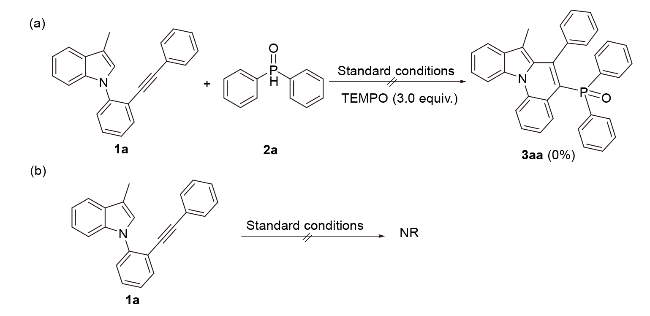
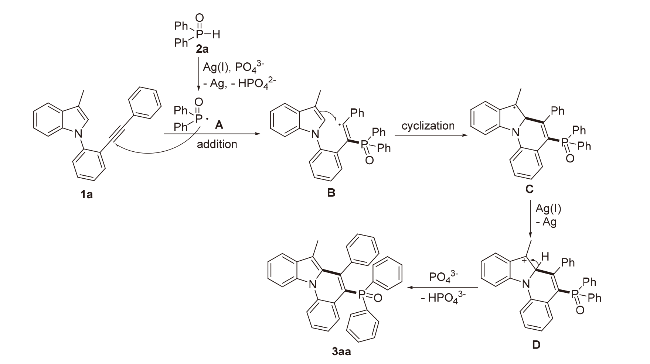
为更全面地了解反应路径, 在上述研究基础上进行了控制实验(Scheme 5). 在对照实验中, 向模型反应中加入自由基抑制剂2,2,6,6-四甲基哌啶氧化物(TEMPO) (Scheme 5, a), 反应不进行, 无预期产物3a生成. 这是因为自由基抑制剂TEMPO抑制了该反应活泼中间体自由基的生成. 因此, 该结果表明, 该反应涉及自由基反应机理. 在没有2a的情况下, 仅将1a在优化条件下反应, 后处理后1a被定量回收(Scheme 5, b). 这表明1a在优化条件下不能发生自反应.
2.5 单晶结构分析
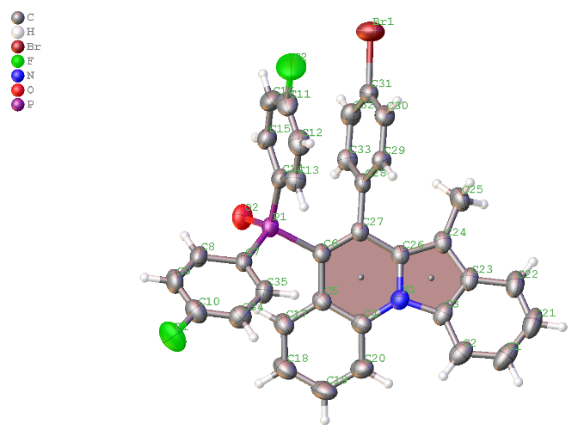
为全面了解该类化合物的三维结构, 对3ag进行了单晶X射线衍射分析. 3ag的单晶X射线衍射图显示, N连接的两个内部芳香环之间的夹角(平面法向-平面法向)为14.899° (CCDC 2403895)(图2), 表明四个芳香环非共平面. 芳香环的这种明显非共平面性归因于二芳基膦酰基的显著位阻. 然而, 这些产物具有良好的稳定性(研究过程中未观察到明显降解), 表明其芳香性保持完整.


3 结论
综上所述, 本工作开发了一种高效、创新的方法, 用于合成多种非共平面二芳基膦酰基吲哚并[1,2-a]喹啉, 且该产物结构的正确性通过单晶衍射得到验证. 该方法采用银介导的具有较大位阻的二芳基膦酰基自由基的串联加成以及自由基分子内环化/氧化/去质子化过程, 在温和条件下实现了C—P和C—C键的形成. 该方法具有操作简单及反应条件温和等显著优势. 值得注意的是, 通过一锅反应依次引入二芳基膦酰基和吲哚基团来构建二芳基膦酰基吲哚并[1,2-a]喹啉, 凸显了其在合成化学和药物化学领域的广泛应用前景. 总体而言, 本工作为二芳基膦酰基吲哚并[1,2-a]喹啉的合成做出了重要贡献, 提供了一种新颖、温和且通用的策略, 在有机化学和药物化学领域具有广阔的应用潜力.
(Zhao, C.)