

Acta Chimica Sinica ›› 2026, Vol. 84 ›› Issue (2): 189-195.DOI: 10.6023/A25080283 Previous Articles Next Articles
Communication
王禾林a,b, 曾庆乐a,b,*( )
)
投稿日期:2025-08-20
发布日期:2025-10-10
基金资助:
Helin Wanga,b, Qingle Zenga,b,*()
Received:2025-08-20
Published:2025-10-10
Contact:
*E-mail: qinglezeng@hotmail.com
Supported by:Share
Helin Wang, Qingle Zeng. Cascade Addition and Cyclization of Indoloalkynes with Phosphine Oxides for the Synthesis of Diarylphosphinoyl Indolo[1,2-a]quinolines[J]. Acta Chimica Sinica, 2026, 84(2): 189-195.
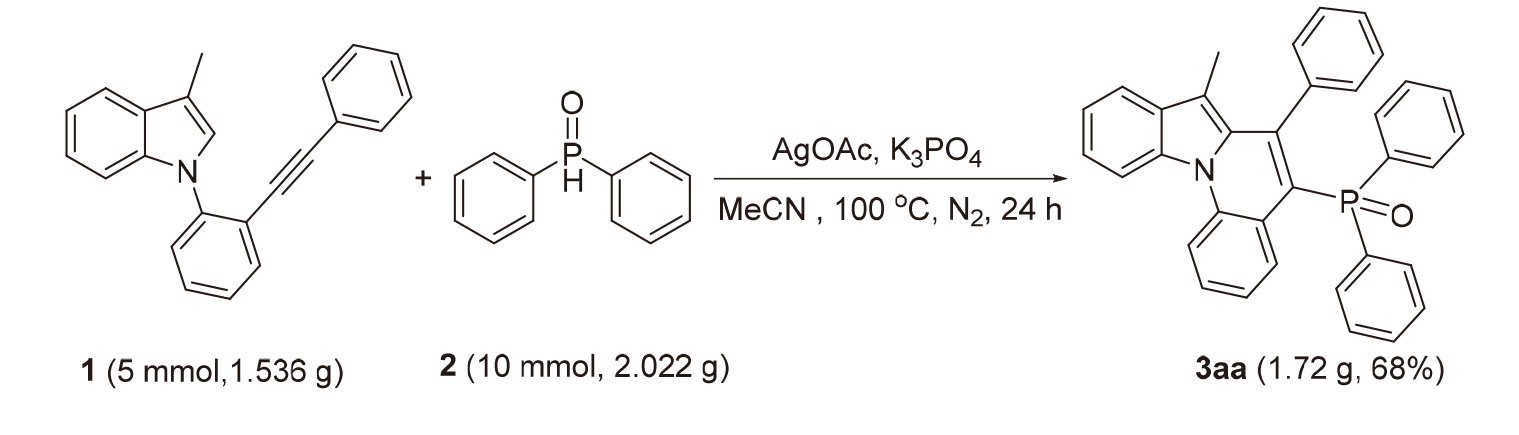
| Entry | Oxidant | Base | Solvent | Temp./℃ | Yieldb/% |
|---|---|---|---|---|---|
| 1 | K2S2O8 | K2CO3 | MeCN | 100 | 32 |
| 2 | TBHP | K2CO3 | MeCN | 100 | 42 |
| 3 | Mn(OAc)2•4H2O | K2CO3 | MeCN | 100 | 36 |
| 4 | Ag2CO3 | K2CO3 | MeCN | 100 | 40 |
| 5 | AgOAc | K2CO3 | MeCN | 100 | 53 |
| 6 | — | K2CO3 | MeCN | 100 | 0 |
| 7 | AgOAc | NaH | MeCN | 100 | 46 |
| 8 | AgOAc | K3PO4 | MeCN | 100 | 73 |
| 9 | AgOAc | Na2CO3 | MeCN | 100 | 59 |
| 10 | AgOAc | t-BuOK | MeCN | 100 | 42 |
| 11 | AgOAc | Et3N | MeCN | 100 | 45 |
| 12 | AgOAc | K3PO4 | Toluene | 100 | 52 |
| 13 | AgOAc | K3PO4 | DMSO | 100 | 27 |
| 14 | AgOAc | K3PO4 | 1,4-Dioxane | 100 | 30 |
| 15 | AgOAc | K3PO4 | MeCN | 80 | 56 |
| 16 | AgOAc | K3PO4 | MeCN | 120 | 47 |
| 17c | AgOAc | K3PO4 | MeCN | 100 | 14 |
| 18d | AgOAc | K3PO4 | MeCN | 100 | 78 |
| 19e | AgOAc | K3PO4 | MeCN | 100 | 62 |
| Entry | Oxidant | Base | Solvent | Temp./℃ | Yieldb/% |
|---|---|---|---|---|---|
| 1 | K2S2O8 | K2CO3 | MeCN | 100 | 32 |
| 2 | TBHP | K2CO3 | MeCN | 100 | 42 |
| 3 | Mn(OAc)2•4H2O | K2CO3 | MeCN | 100 | 36 |
| 4 | Ag2CO3 | K2CO3 | MeCN | 100 | 40 |
| 5 | AgOAc | K2CO3 | MeCN | 100 | 53 |
| 6 | — | K2CO3 | MeCN | 100 | 0 |
| 7 | AgOAc | NaH | MeCN | 100 | 46 |
| 8 | AgOAc | K3PO4 | MeCN | 100 | 73 |
| 9 | AgOAc | Na2CO3 | MeCN | 100 | 59 |
| 10 | AgOAc | t-BuOK | MeCN | 100 | 42 |
| 11 | AgOAc | Et3N | MeCN | 100 | 45 |
| 12 | AgOAc | K3PO4 | Toluene | 100 | 52 |
| 13 | AgOAc | K3PO4 | DMSO | 100 | 27 |
| 14 | AgOAc | K3PO4 | 1,4-Dioxane | 100 | 30 |
| 15 | AgOAc | K3PO4 | MeCN | 80 | 56 |
| 16 | AgOAc | K3PO4 | MeCN | 120 | 47 |
| 17c | AgOAc | K3PO4 | MeCN | 100 | 14 |
| 18d | AgOAc | K3PO4 | MeCN | 100 | 78 |
| 19e | AgOAc | K3PO4 | MeCN | 100 | 62 |

| [1] |
doi: 10.1021/np049935+ |
| [2] |
doi: 10.1039/c005345g pmid: 20838695 |
| [3] |
doi: 10.1039/D1CC02415A |
| [4] |
pmid: 16193159 |
| [5] |
doi: 10.1016/j.tet.2019.02.006 |
| [6] |
doi: 10.1016/S0040-4020(01)87108-8 |
| [7] |
pmid: 20491639 |
| [8] |
pmid: 3184121 |
| [9] |
pmid: 10354398 |
| [10] |
doi: 10.1016/j.tetlet.2021.153365 |
| [11] |
doi: 10.1016/j.ejmech.2011.02.035 |
| [12] |
doi: 10.1039/C9CC06924K |
| [13] |
doi: 10.6023/cjoc201900002 |
|
(王峥, 何卫民, 有机化学, 2019, 39, 3594.)
doi: 10.6023/cjoc201900002 |
|
| [14] |
doi: 10.1039/d4ra07467j pmid: 39885850 |
| [15] |
doi: 10.1021/jo200638k |
| [16] |
doi: 10.1021/acs.joc.2c03045 |
| [17] |
doi: 10.1021/acs.joc.3c00997 |
| [18] |
doi: 10.6023/cjoc201708023 |
|
(高玉珍, 唐果, 赵玉芬, 有机化学, 2018, 38, 62.)
doi: 10.6023/cjoc201708023 |
|
| [19] |
doi: 10.1021/cr020049i |
| [20] |
doi: 10.1021/cr1004293 pmid: 21456523 |
| [21] |
doi: 10.1021/cr0782729 pmid: 18831570 |
| [22] |
doi: 10.1021/cr2004212 pmid: 22530923 |
| [23] |
Topics in Heterocyclic Chemistry, Ed.: Bansal, R. K., Vol 21, Springer, Berlin, 2010.
|
| [24] |
doi: 10.1021/jm070488f |
| [25] |
doi: 10.1039/C7QO00746A |
| [26] |
doi: 10.6023/cjoc202209025 |
|
(肖潜, 佟庆笑, 钟建基, 有机化学, 2022, 42, 3979.)
doi: 10.6023/cjoc202209025 |
|
| [27] |
doi: 10.6023/cjoc202211003 |
|
(任志军, 罗维纬, 周俊, 有机化学, 2023, 43, 2026.)
doi: 10.6023/cjoc202211003 |
|
| [28] |
|
|
(曾庆乐, 宓爱巧, 蒋耀忠, 化学进展, 2004, 16, 603.)
|
|
| [29] |
doi: 10.1055/s-0040-1707319 |
| [30] |
doi: 10.1002/cjoc.v26:8 |
| [31] |
doi: 10.1039/D5QO00681C |
| [32] |
doi: 10.1007/s11426-019-9499-5 |
| [33] |
doi: 10.1039/C7QO00766C |
| [34] |
pmid: 27779415 |
| [35] |
doi: 10.1021/ol403256e pmid: 24320135 |
| [36] |
doi: 10.1021/ja407373g |
| [1] | Huang Jun, Yin Rong, Cao Tingting. Total Synthesis of Complex Natural Products Via Radical-Mediated Formal Diels-Alder Reaction [J]. Acta Chimica Sinica, 2025, 83(11): 1424-1434. |
| [2] | Cheng Zekai, Wen Ziyang, Li Hongwei, Li Na, Wang Huan. Rotational Diffusion Kinetics of Copper (I) Catalyzed Alkyne-Azide Cycloaddition Reactions★ [J]. Acta Chimica Sinica, 2025, 83(11): 1293-1299. |
| [3] | Zhao Yachen, Yu Biao. Application of Michael/Aldol Cascade Cyclization Reactions in Natural Product Synthesis [J]. Acta Chimica Sinica, 2025, 83(11): 1397-1413. |
| [4] | Qi Gao, Lirong Chen, Jinyi Qian, Ruifeng Fan, Weiqing Sun, Yafei Guo, Baomin Fan. Asymmetric Hydrophosphination of Diarylphosphine Oxides to α,β-Unsaturated Bifunctional Compounds Catalyzed by Chiral Oxazaborolidine [J]. Acta Chimica Sinica, 2024, 82(7): 742-747. |
| [5] | Haoning Zheng, Jinyu Liu. Research Progress on Organocatalytic Functionalization of Indole in the Carbocyclic Ring [J]. Acta Chimica Sinica, 2024, 82(6): 641-657. |
| [6] | Jianghao Luo, Haowen Ma, Jiehao Zhang, Wei Zhou, Qian Cai. Synthesis of Pyrrolo[3,2-d]pyrimidin-4-ones via Cascade Alkyne−isocyanide [3+2] Cycloaddition/Boulton-Katritzky Rearrangement/Ring Expansion Process★ [J]. Acta Chimica Sinica, 2023, 81(8): 898-904. |
| [7] | Shuang Yang, Ningyi Wang, Qingqing Hang, Yuchen Zhang, Feng Shi. Advances in Catalytic Asymmetric Reactions Involving o-Hydroxyphenyl Substituted p-Quinone Methides★ [J]. Acta Chimica Sinica, 2023, 81(7): 793-808. |
| [8] | Rui-Xiang Wang, Qing-Ru Zhao, Qing Gu, Shu-Li You. Gold/Iridium Catalyzed Alkynylamide Cyclization/Asymmetric Allylic Benzylation Cascade Reaction★ [J]. Acta Chimica Sinica, 2023, 81(5): 431-434. |
| [9] | Yang Gao, Xuexin Zhang, Jinsheng Yu, Jian Zhou. Recent Advances in Catalytic Enantioselective Synthesis of α-Chiral Tertiary Azides★ [J]. Acta Chimica Sinica, 2023, 81(11): 1590-1608. |
| [10] | Zitao Wang, Yaozu Liu, Yujie Wang, Qianrong Fang. A New Covalent Organic Framework Modified with Sulfonic Acid for CO2 Uptake and Selective Dye Adsorption [J]. Acta Chimica Sinica, 2022, 80(1): 37-43. |
| [11] | Liang Wu, Hanlin Wei, Jiefeng Shen, Jianzhong Chen, Wanbin Zhang. Development of Earth-Abundant Metals-Catalyzed Enantioselective Alkenylations Using Alkenyl Metal Reagents [J]. Acta Chimica Sinica, 2021, 79(11): 1331-1344. |
| [12] | Yang Shang, Jian Xiao, Yawen Wang, Yu Peng. Advances on Asymmetric Construction of Diarylmethine Stereocenters [J]. Acta Chimica Sinica, 2021, 79(11): 1303-1319. |
| [13] | Zhang Ronghua, Xu Bing, Zhang Zhanming, Zhang Junliang. Ming-Phos/Copper(I)-Catalyzed Asymmetric[3+2] Cycloaddition of Azomethine Ylides with Nitroalkenes [J]. Acta Chimica Sinica, 2020, 78(3): 245-249. |
| [14] | Cheng Lei, Zhou Qilin. Advances on Nickel-Catalyzed C(sp3)-C(sp3) Bond Formation [J]. Acta Chimica Sinica, 2020, 78(10): 1017-1029. |
| [15] | Xu, Jian, Zhang, Shifan, Luo, Ying, Zhang, Li, Zhang, Fan, Huang, Tingjing, Song, Qiuling. Radical Promoted Annulation of Alkynones for the Construction of 2,3-Disubstituted Thiochromones [J]. Acta Chimica Sinica, 2019, 77(9): 932-938. |
| Viewed | ||||||
|
Full text |
|
|||||
|
Abstract |
|
|||||
