o-Quinone Methide-Involved Chemoselective and Diastereoselective [2+3] Annulation

  • Zi-Qi Zhu ,
  • Le-Hua Ye ,
  • Yi Wu ,
  • Zi-Qi Guo ,
  • Feng Shi
Expand
  • aSchool of Petrochemical Engineering, Institute of Functional Heterocycles, Changzhou University, Changzhou, Jiangsu 213164;
    bSchool of Chemistry and Materials Science, Jiangsu Normal University, Xuzhou, Jiangsu 221116
# Equally contributed to this work

Received date: 2025-07-30

  Online published: 2025-10-11

Supported by

National Natural Science Foundation of China (22125104 and 22401020) and Natural Science Foundation of Jiangsu Province (BK20230624).

Abstract

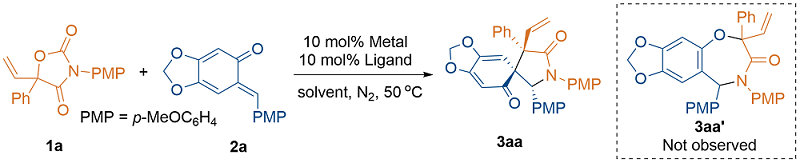
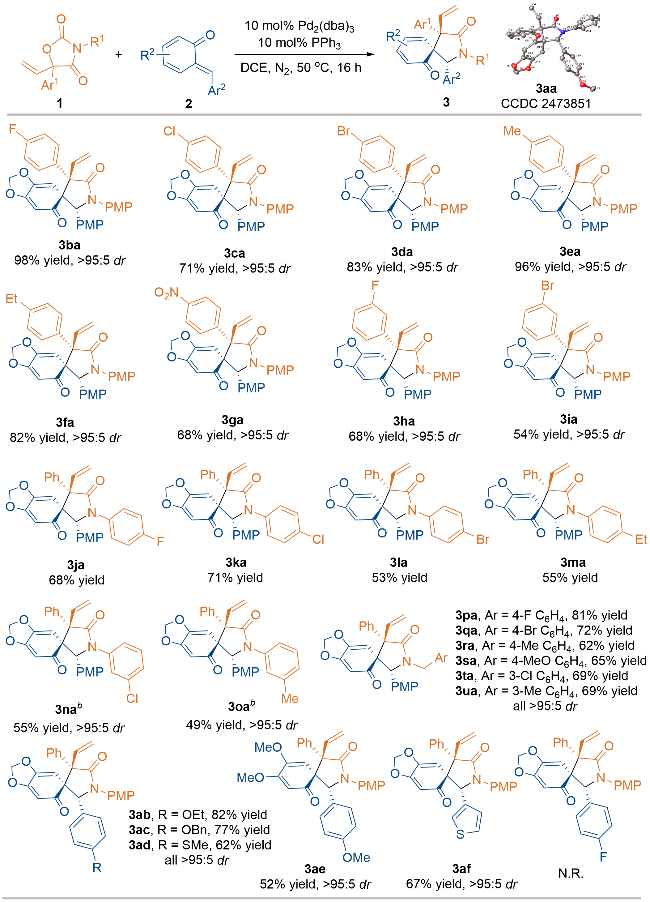
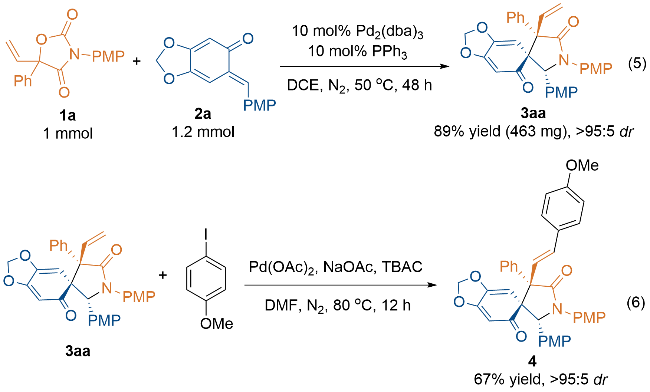
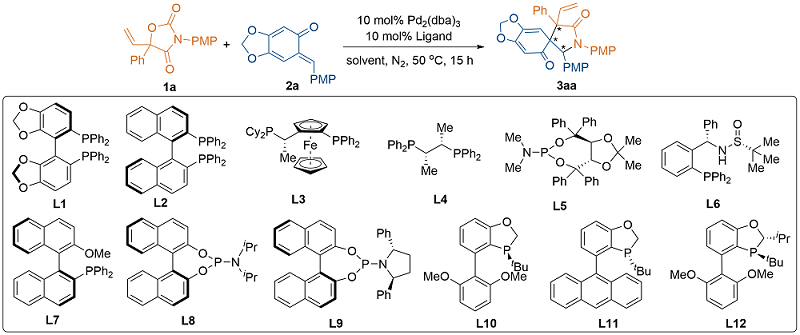
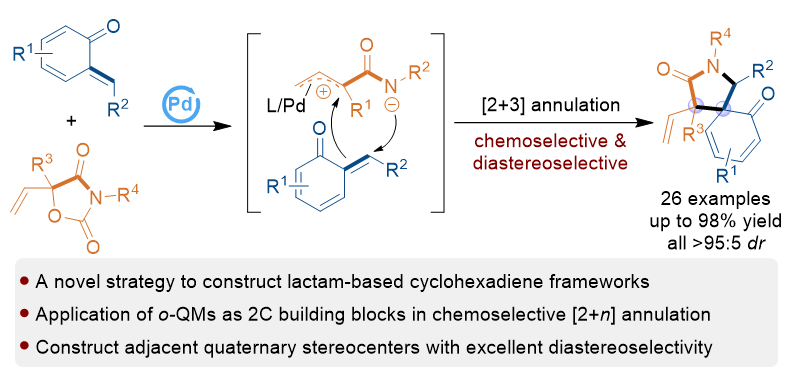
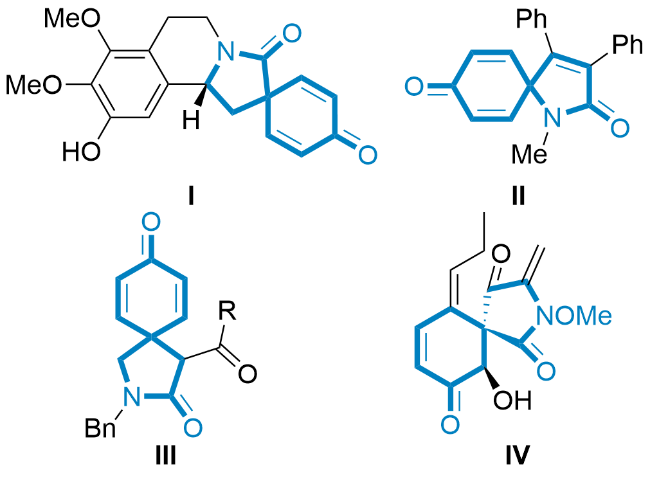
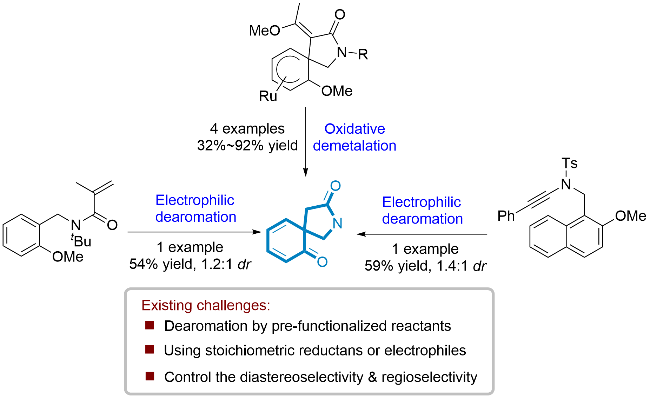
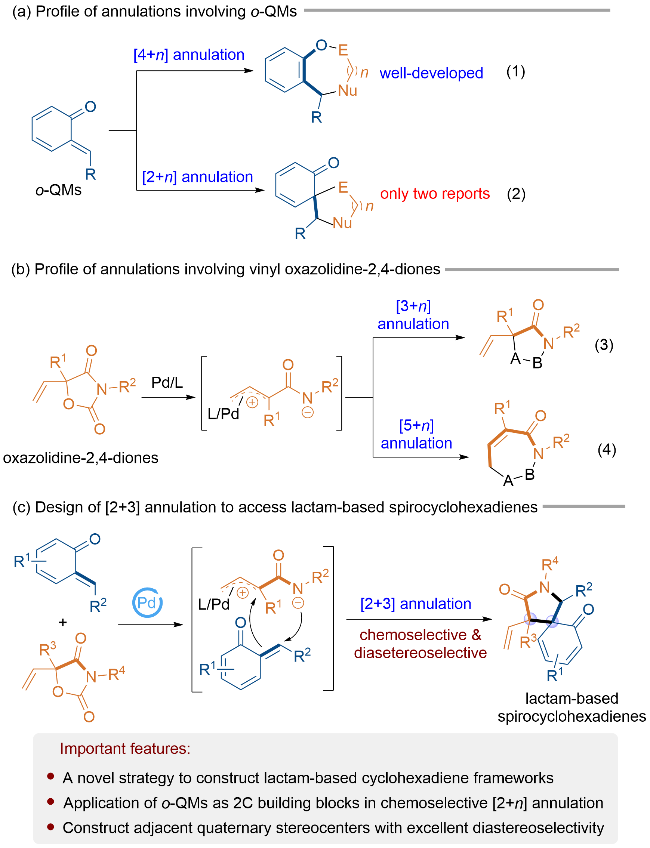
Due to their structural rigidity, spirocyclic compounds have attracted considerable attention from chemists. Among them, five-membered lactam-based spirocyclohexadiene belongs to an important spiro-skeleton, which is found in many bioactive molecules. However, the strategy to construct this class of spiro-skeletons is very limited. Meanwhile, it is challenging to achieve good control over the diastereoselectivity when constructing spirocyclic frameworks with adjacent stereocenters. To solve these challenging issues, in this work, a Pd-catalyzed regioselective [2+3] annulation of o-quinone methides with vinyloxazolidines was established, constructing five-membered lactam-based spirocyclohexadiene skeletons with adjacent quaternary carbon centers in moderate to good yields (48% to 98%) with excellent diastereoselectivities (all >95:5 dr). After establishing the optimal reaction condition, we evaluated the substrate scope of vinyloxazolidine and o-quinone methides in the [2+3] annulation. In general, all tested substrates exhibit good reaction efficiency to generate lactam-based spirocyclohexadienes in moderate to excellent yields with excellent diastereoselectivities. The successful one-mmol-scale reaction and downstream transformation demonstrated the potential synthetic applications of this transformation. Furthermore, preliminary studies on the catalytic asymmetric [2+3] cyclization reaction demonstrate that the catalytic system of Pd-chiral phosphine ligand could achieve some extent of enantiocontrol of the transformation. This transformation not only expands the application of o-quinone methides as two-atom synthons in annulation reactions but also provides a novel strategy for the efficient and highly diastereoselective construction of five-membered lactam-based spirocyclohexadiene architectures. The general procedure of the [2+3] annulation is as follows: To an oven-dried Schlenk-tube, vinyloxazolidine (30.9 mg, 0.1 mmol), o-quinone methide (30.7 mg, 0.12 mmol), Pd2(dba)3 (9.1 mg, 0.01 mmol), PPh3 (2.6 mg, 0.01 mmol) and DCE (1.0 mL) were added under N2 atmosphere. The reaction mixture was stirred at 50 oC for 16 h. After completion of the reaction, the reaction mixture was concentrated by vacuum, purified by silica gel chromatography (petroleum ether/ethyl acetate) to yield pure products.

Cite this article

Zi-Qi Zhu , Le-Hua Ye , Yi Wu , Zi-Qi Guo , Feng Shi . o-Quinone Methide-Involved Chemoselective and Diastereoselective [2+3] Annulation[J]. Acta Chimica Sinica, 0 : 0 . DOI: 10.6023/A25070265

References

[1] For reviews: (a) Rios, R. Chem. Soc. Rev. 2012, 41, 1060.(b) Hong, L.; Wang, R. Adv. Synth. Catal. 2013, 355, 1023. (c) Cheng, D.; Ishihara, Y.; Tan, B.; Barbas, C. F. ACS Cat. 2014, 4, 743. 2017, 50, 2621.
[2] For recent examples: (a) Zhu, S.; Mao, J.-H.; Cheng, J. K.; Xiang, S.-H.; Tan, B. Chem 2022, 8, 2529.(b) Zhao, K.; Kohnke, P.; Yang, Z.; Cheng, X.; You, S.-L.; Zhang, L. Angew. Chem. Int. Ed. 2022, 61, e202207518. (c) Yu, X.; Wang, F.; Du, J.; Tan, J.-P.; Pan, J.; Zhu, L.; Wang, T. Org. Chem. Front. 2024, 11, 6666. (d) Liu, Y.-Z.; Zheng, C.; You, S.-L. ACS Catal. 2024, 14, 15743. (e) Wang, J.-Y.; Sun, J. Angew. Chem. Int. Ed. 2025, 64, e202424773. (f) Zhao, H.-W.; Jiang, F.; Chen, S.; Hu, J.; Xiang, S.-H.; Ding, W.-Y.; Lu, W.; Tan, B. Angew. Chem. Int. Ed. 2025, 64, e202422951. (g) Cheng, G.; Cheng, D.; Nie, G.; Li, L.; Yao, H.; Wang, N.; Huang, N. Chin. J. Org. Chem. 2025, 45, 2139. (h) Ge, D.; Shi, F. Chin. J. Org. Chem. 2025, 45, 717. (i) Yang, X.; Xu, Y.; Zhang, X.; Fan, X. Chin. J. Org. Chem. 2025, 45, 694. (j) Zhang, J.; Xu, M.; Gu, M.; Ma, H.; Cai, Q. Acta Chim. Sinica 2025, 83, 667. (k) Wang, Y.; Yu, C.; Xia, Y.; Lin, L.; Chen, Q.; Wang, X. Acta Chim. Sinica 2024, 82, 914.
[3] (a) Hallock, Y. F.; Lu, H. S. M.; Clardy, J.; Strobel, G. A.; Sugawara, F.; Samsoedin, R.; Yoshida, S. J. Nat. Prod. 1993, 56, 747.(b) Yang, Y.-L.; Chang, F.-R.; Wu Y.-C. Helv. Chim. Acta 2004, 87, 1392. 2015, 13, 2064.(d) Yugandhar, D.; Nayak, V. L.; Archana, S.; Shekar, K. C.; Srivastava, A. K. Eur. J. Med. Chem. 2015, 101, 348.
[4] (a) Pigge, F. C.; Coniglio, J. J.; Rath, N. P. Org. Lett. 2003, 5, 2011.(b) Pigge, F. C.; Coniglio, J. J.; Rath, N. P. J. Org. Chem. 2004, 69, 1161.
[5] (a) Ito, M.; Kawasaki, R.; Kanyiva, K. S.; Shibata, T. Chem. Eur. J. 2018, 24, 3721.(b) Zhang, Z.; Zhang, W.; Hou, Z.-W.; Li, P.; Wang, L. J. Org. Chem. 2023, 88, 13610.
[6] For reviews: (a) Amouri, H.; Le Bras, J. Acc. Chem. Res. 2002, 35, 501.(b) Pathak, T. P.; Sigman, M. S. J. Org. Chem. 2011, 76, 9210. 2012, 18, 9160.(d) Yang, B.; Gao, S. Chem. Soc. Rev. 2018, 47, 7926.(e) Qin, W.; Liu, Y.; Yan, H. Acc. Chem. Res. 2022, 55, 2780.
[7] For reviews: (a) Bai, W.-J.; David, J. G.; Feng, Z.-G.; Weaver, M. G.; Wu, K.-L.; Pettus, T. R. R. Acc. Chem. Res. 2014, 47, 3655.(b) Caruana, L.; Fochi, M.; Bernardi, L. Molecules 2015, 20, 11733. (c) Li, X.; Li, Z.; Sun, J. Nat. Synth. 2022, 1, 426. 2023, 43, 974 (in Chinese) . (e) Yang, S.; Wang, N.; Hang, Q.; Zhang, Y.; Shi, F. Acta Chim. Sinica 2023, 81, 793.
[8] For early examples: (a) Alden-Danforth, E.; Scerba, M. T.; Lectka, T. Org. Lett. 2008, 10, 4951.(b) Lv, H.; You, L.; Ye, S. Adv. Synth. Catal. 2009, 351, 2822.
[9] For recent examples: (a) Yang, W.-L.; Shang, X.-Y.; Luo, X.; Deng, W.-P. Angew. Chem. Int. Ed. 2022, 61, e202203661.(b) Yang, W.-L.; Shang, X.-Y.; Ni, T.; Yan, H.; Luo, X.; Zheng, H.; Li, Z.; Deng, W.-P. Angew. Chem. Int. Ed. 2022, 61, e202210207. 2024, 11, 2911.(g) Lai, B.-W.; Qu, S.-Y.; Yin, Y.-X.; Li, R.; Dong, K.; Shi, F. J. Org. Chem. 2024, 89, 10197.(h) Luan, W.-Y.; Fang, T.-Y.; Wu, Y.-F.; Xiang, X.-Y.; Ma, C.; Shi, F. Org. Lett. 2025, 27, 7406.
[10] (a) Zhang, X.; Zhang, C.; Jiang, B.; Gao, Y.; Xu, X.; Miao, Z. Org. Lett. 2022, 24, 3097.(b) Yu, T.; Zhao, X.; Nie, Z.; Qin, L.; Ding, Z.; Xu, L.; Li, P. Angew. Chem. Int. Ed. 2025, 64, e202420831.
[11] (a) Dong, Y.; Liu, J.; Li, K.; Han, S.; Liang, B.; Yang, F.; Yu, S.; Wu, Y.; Zhang, C.; Guo, H. Org. Lett. 2023, 25, 6328.(b) Roblin, A.; Casaretto, N.; Archambeau, A. Org. Lett. 2023, 25, 6453. (c) Scuiller, A.; Casaretto, N.; Archambeau, A. J. Org. Chem. 2023, 88, 9941. 2024, 26, 3310.
[12] Li K.; Zhen S.; Wang W.; Du J.; Yu S.; Wu Y.; Guo H. Chem.Sci. 2023, 14, 3024.
[13] For reviews: (a) Pandey, G.; Banerjee, P.; Gadre, S. R. Chem. Rev. 2006, 106, 4484.(b) Wei, L.; Chang, X.; Wang, C.-J. Acc. Chem. Res. 2020, 53, 1084. For recent examples: (c) Hang, Q.-Q.; Liu, S.-J.; Yu, L.; Sun, T.-T.; Zhang, Y.-C.; Mei, G.-J.; Shi, F. Chin. J. Chem. 2020, 38, 1612. 2025, 90, 4690.
[14] For reviews: (a) Tan, W.; Zhang, J.-Y.; Gao, C.-H.; Shi, F. Sci. China Chem. 2023, 66, 966.(b)Zhu, Z.-Q.; Li, T.-Z.; Liu, S.-J.; Shi, F. Org. Chem. Front. 2024, 11, 5573.
[15] For recent examples: (a) Wu, P.; Yu, L.; Gao, C.-H.; Cheng, Q.; Deng, S.; Jiao, Y.; Tan, W.; Shi, F. Fundam. Res. 2023, 3, 237.(b)Shi, Y.-C.; Yan, X.-Y.; Wu, P.; Jiang, S.; Xu, R.; Tan, W.; Shi, F. Chin. J. Chem. 2023, 41, 27. 2024, 67, 2629.(d) Guo, X.; Yu, H.; Wan, H.; Lu, Y.; Tan, W.; Shi, F. Chin. J. Org. Chem. 2024, 44, 3727.(e) Wang, N.-Y.; Gao, S.; Shu, Z.-D.; Cheng, B.-B.; Ma, C.; Zhang, Y.-C.; Shi, F. Sci. China Chem. 2025, 68, 3130.
[16] (a) You, S.; Zhu, X.; Hou X.; Dai L. Acta Chim. Sinica, 2001, 59, 1667.(b) Trost, B. M.; Crawley, M. L. Chem. Rev. 2003, 103, 2921. (c) Butt, N. A.; Zhang, W. Chem. Soc. Rev. 2015, 44, 7929. (d) Deng, Y.; Yang, W.; Yang, X.; Yang, D. Chin. J. Org. Chem. 2017, 37, 3039. (e) Zhang, M.-M.; Luo, Y.-Y.; Lu, L.-Q.; Xiao, W.-J. Acta Chim. Sinica, 2018, 76, 838.
[17] CCDC 2473851 for compound 3aa.
[18] (a) Xu, G.; Fu, W.; Liu, G.; Senanayake, C. H.; Tang, W. J. Am. Chem. Soc. 2014, 136, 570.(b) Xu, G.; Senanayake, C. H.; Tang, W. Acc. Chem. Res. 2019, 52, 1101.
Outlines

/