

Chinese Journal of Organic Chemistry ›› 2025, Vol. 45 ›› Issue (7): 2367-2388.DOI: 10.6023/cjoc202410023 Previous Articles Next Articles
REVIEWS
沈一鸣a, 邹东b,*( )
)
收稿日期:2024-10-29
修回日期:2024-11-29
发布日期:2025-01-17
Yiming Shena, Dong Zoub,*()
Received:2024-10-29
Revised:2024-11-29
Published:2025-01-17
Contact:
*E-mail: zoudong16@zju.edu.cn
Share
Yiming Shen, Dong Zou. Recent Advances in the Transformation Reactions of Aryl Ethers via C—OMe Bond Cleavage[J]. Chinese Journal of Organic Chemistry, 2025, 45(7): 2367-2388.
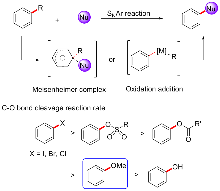


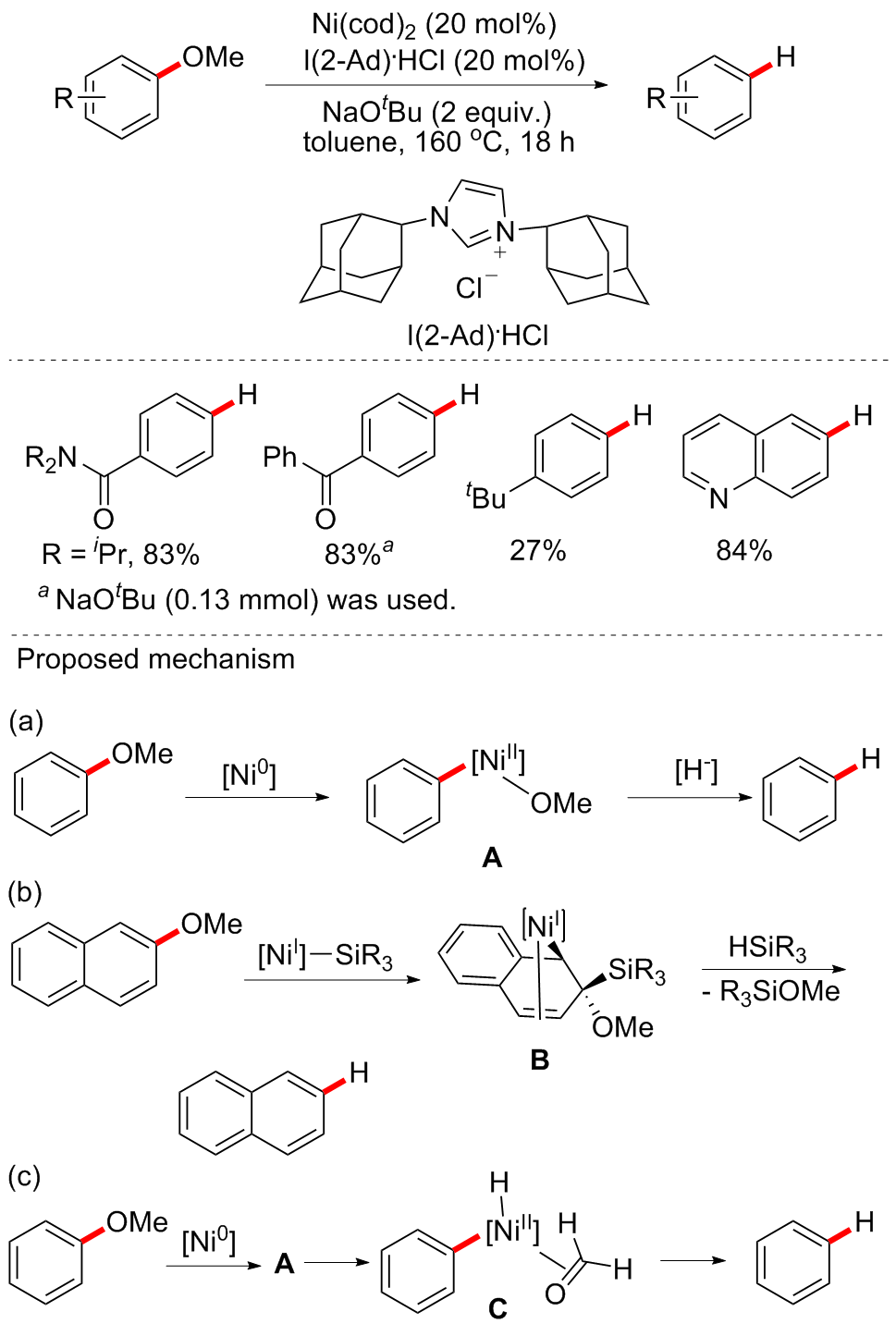


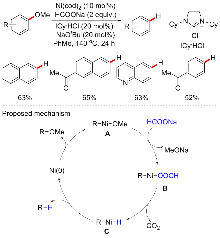


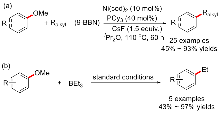














| [1] |
(a)
|
|
(b)
|
|
| [2] |
|
| [3] |
|
| [4] |
(a)
|
|
(b)
|
|
| [5] |
|
|
( 王一丁, 李福海, 曾庆乐, 化学学报, 2022, 80, 386.)
doi: 10.6023/A21110536 |
|
| [6] |
(a)
pmid: 21133429 |
|
(b)
doi: 10.1021/cr100259t pmid: 21133429 |
|
|
(c)
pmid: 21133429 |
|
|
(d)
pmid: 21133429 |
|
| [7] |
(a)
|
|
(b)
doi: 10.1139/cjc-2018-0357 |
|
|
(c)
|
|
| [8] |
(a)
pmid: 37161968 |
|
(b)
pmid: 37161968 |
|
|
(c)
pmid: 37161968 |
|
|
(d)
pmid: 37161968 |
|
|
(e)
doi: 10.1021/ja210249h pmid: 37161968 |
|
|
(f)
pmid: 37161968 |
|
|
(g)
doi: 10.1039/d3ob00260h pmid: 37161968 |
|
| [9] |
(a)
doi: 10.1039/c4cs00206g pmid: 25157613 |
|
(b)
pmid: 25157613 |
|
| [10] |
(a)
|
|
(b)
|
|
|
(c)
|
|
| [11] |
|
| [12] |
|
| [13] |
|
| [14] |
|
| [15] |
(a)
pmid: 23316793 |
|
(b)
pmid: 23316793 |
|
|
(c)
doi: 10.1021/ja311940s pmid: 23316793 |
|
| [16] |
|
| [17] |
|
| [18] |
doi: 10.1021/ja300326t pmid: 22394331 |
| [19] |
|
| [20] |
(a)
pmid: 21512027 |
|
(b)
doi: 10.1126/science.1200437 pmid: 21512027 |
|
|
(c)
pmid: 21512027 |
|
| [21] |
|
| [22] |
|
| [23] |
|
| [24] |
|
| [25] |
|
| [26] |
|
| [27] |
|
| [28] |
|
| [29] |
|
| [30] |
doi: 10.1021/jacs.7b04279 pmid: 28675702 |
| [31] |
doi: 10.1021/acs.orglett.5b03151 pmid: 26624568 |
| [32] |
|
| [33] |
|
| [34] |
|
| [35] |
|
| [36] |
(a)
doi: 10.1002/chem.201505106 pmid: 22894704 |
|
(b)
pmid: 22894704 |
|
|
(c)
pmid: 22894704 |
|
|
(d)
pmid: 22894704 |
|
|
(e)
doi: 10.1021/ol302112q pmid: 22894704 |
|
| [37] |
|
| [38] |
|
| [39] |
|
| [40] |
|
| [41] |
|
| [42] |
|
| [43] |
|
| [44] |
|
| [45] |
(a)
|
|
(b)
|
|
|
(c)
|
|
|
(d)
|
|
| [46] |
(a)
|
|
(b)
|
|
| [47] |
|
| [48] |
|
| [49] |
(a)
|
|
(b)
|
|
| [50] |
|
| [51] |
|
| [52] |
doi: 10.1021/acs.orglett.9b02504 pmid: 31453706 |
| [53] |
|
| [54] |
|
| [55] |
|
| [56] |
doi: 10.1039/c6ob02352e pmid: 28071775 |
| [57] |
|
| [58] |
|
| [59] |
|
| [60] |
pmid: 16637663 |
| [61] |
|
| [62] |
|
| [63] |
|
| [64] |
|
| [65] |
doi: 10.1021/acs.orglett.9b02678 pmid: 31418275 |
| [66] |
|
| [67] |
|
| [68] |
|
| [69] |
|
| [70] |
|
| [71] |
|
| [72] |
|
| [73] |
pmid: 22830349 |
| [74] |
|
| [75] |
(a)
|
|
(b)
|
|
|
(c)
|
|
|
(d)
|
|
|
(e)
|
|
| [76] |
|
| [1] | Chen Pingliang, Lu Shijie, Hu Xingen, Xu Qing. CsOH/DMSO Promoted Reactions of Aryl Halides with Phenols: A Convenient Method for the Synthesis of Diaryl Ethers [J]. Chin. J. Org. Chem., 2014, 34(1): 112-117. |
| [2] | Yuan Yanqin, Guo Shengrong, Mo Jianjun, Qian Li, Shi Zefeng. Rapid and Highly Efficient Microwave-Assisted C—N, C—O and C— S Coupling Reactions without a Transition-Metal Catalyst [J]. Chin. J. Org. Chem., 2012, 32(04): 732-741. |
| Viewed | ||||||
|
Full text |
|
|||||
|
Abstract |
|
|||||
