

Chinese Journal of Organic Chemistry ›› 2025, Vol. 45 ›› Issue (11): 4227-4233.DOI: 10.6023/cjoc202502013 Previous Articles Next Articles
ARTICLES
刘金波, 郭倩, 杨成*( ), 伍晚花*()
收稿日期:2025-02-15
修回日期:2025-03-17
发布日期:2025-04-08
基金资助:
Jinbo Liu, Qian Guo, Cheng Yang*(), Wanhua Wu*()
Received:2025-02-15
Revised:2025-03-17
Published:2025-04-08
Contact:
*E-mail: yangchengyc@scu.edu.cn; wuwanhua@scu.edu.cn
Supported by:Share
Jinbo Liu, Qian Guo, Cheng Yang, Wanhua Wu. Anion-Induced 3MMLCT Emission of Tripyridine-Platinum Complex: Efficient Identification of Nucleotides[J]. Chinese Journal of Organic Chemistry, 2025, 45(11): 4227-4233.



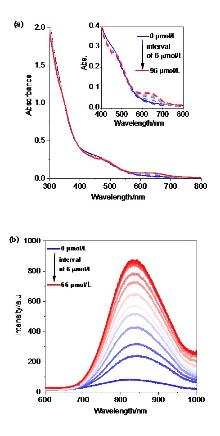

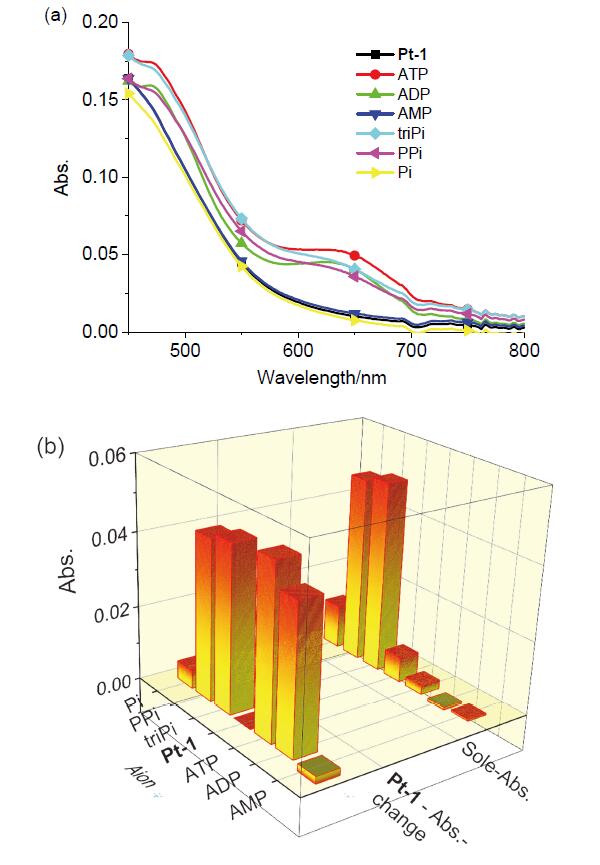
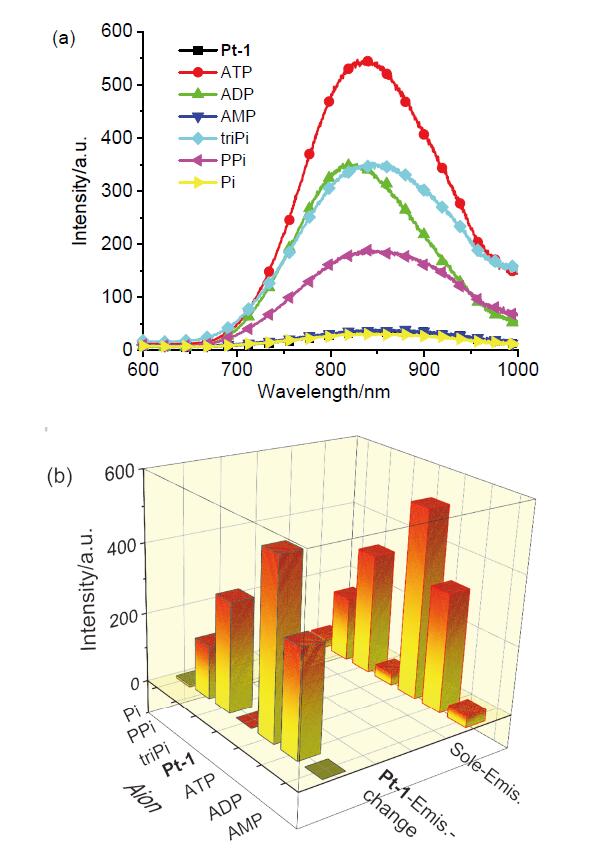
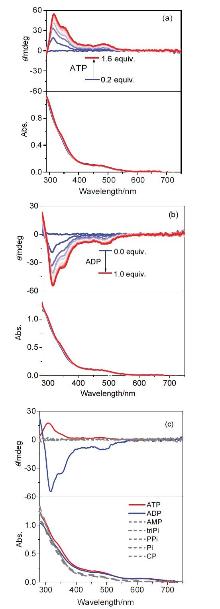
| Compd. | λabs/nm | Absb | A/A0c | λemd/nm | I/I0e |
|---|---|---|---|---|---|
| P-1 | 472 | 0.011 | 1.0 | 859 | 1.0 |
| P-1+ATP | 472/640 | 0.052 | 4.5 | 836 | 14.1 |
| P-1+ADP | 472/640 | 0.044 | 3.8 | 821 | 9.1 |
| P-1+AMP | 472 | 0.013 | 1.1 | 859 | 1.0 |
| P-1+triPPi | 476/642 | 0.044 | 3.8 | 844 | 9.2 |
| P-1+PPi | 476/642 | 0. 039 | 3.4 | 848 | 4.8 |
| P-1+Pi | 476 | 0.009 | 0.8 | 859 | 0.9 |
| Compd. | λabs/nm | Absb | A/A0c | λemd/nm | I/I0e |
|---|---|---|---|---|---|
| P-1 | 472 | 0.011 | 1.0 | 859 | 1.0 |
| P-1+ATP | 472/640 | 0.052 | 4.5 | 836 | 14.1 |
| P-1+ADP | 472/640 | 0.044 | 3.8 | 821 | 9.1 |
| P-1+AMP | 472 | 0.013 | 1.1 | 859 | 1.0 |
| P-1+triPPi | 476/642 | 0.044 | 3.8 | 844 | 9.2 |
| P-1+PPi | 476/642 | 0. 039 | 3.4 | 848 | 4.8 |
| P-1+Pi | 476 | 0.009 | 0.8 | 859 | 0.9 |

| [1] |
doi: 10.1039/D1TC04194K |
| [2] |
doi: 10.1039/D1MH00552A |
| [3] |
doi: 10.1016/j.dyepig.2022.110582 |
| [4] |
|
| [5] |
doi: 10.1039/C9TC01905G |
| [6] |
doi: 10.1016/j.tetlet.2023.154427 |
| [7] |
doi: 10.1021/acssuschemeng.3c02096 |
| [8] |
doi: 10.1021/jacs.9b05824 |
| [9] |
doi: 10.1039/D2DT01373H |
| [10] |
doi: 10.1021/acs.jpca.5b11233 |
| [11] |
doi: 10.1039/C8CC01652F |
| [12] |
doi: 10.1039/C7QM00424A |
| [13] |
|
| [14] |
doi: 10.1021/om990256h |
| [15] |
doi: 10.1039/c0cc02631j |
| [16] |
doi: 10.1073/pnas.1301252110 |
| [17] |
doi: 10.1021/acsami.7b11807 |
| [18] |
doi: 10.1002/chem.v24.45 |
| [19] |
doi: 10.1021/acs.inorgchem.7b02736 pmid: 29336558 |
| [20] |
doi: 10.1021/jacs.9b04447 |
| [21] |
doi: 10.1021/acsami.8b18739 |
| [22] |
doi: 10.1021/ja510048b |
| [23] |
doi: 10.1039/C2SC20897K |
| [24] |
pmid: 6250450 |
| [25] |
pmid: 7356164 |
| [26] |
doi: 10.1111/jfds.1982.47.issue-4 |
| [27] |
doi: 10.3390/chemosensors11070417 |
| [28] |
doi: 10.1021/jacs.4c01621 |
| [29] |
pmid: 7859285 |
| [30] |
doi: 10.1016/j.cclet.2023.108360 |
| [31] |
doi: 10.1016/j.isci.2020.100927 |
| [32] |
doi: 10.1039/D4CC05494F |
| [33] |
doi: 10.1016/j.jphotochem.2017.10.043 |
| [34] |
doi: 10.1016/j.snb.2023.133764 |
| [35] |
doi: 10.1002/anie.v56.43 |
| [36] |
doi: 10.1021/jacs.6b12845 |
| [37] |
doi: 10.3390/molecules29102203 |
| [38] |
doi: 10.1016/j.cclet.2024.110103 |
| [39] |
|
| [40] |
doi: 10.1038/s41467-021-22880-z |
| [41] |
doi: 10.1016/j.cclet.2024.109927 |
| [42] |
doi: 10.1021/jacs.1c13210 |
| [43] |
|
| [44] |
doi: 10.1002/anie.v58.18 |
| [45] |
doi: 10.1002/anie.v59.42 |
| [46] |
doi: 10.1021/ic300061u pmid: 22656070 |
| [47] |
doi: 10.1002/chem.v24.46 |
| [48] |
doi: 10.1021/ic9001913 pmid: 19757854 |
| [1] | Cao Hongzhi;Li Zuyi. Enzymatic synthesis of non-natural oligosaccharides [J]. Chin. J. Org. Chem., 2002, 22(1): 11-21. |
| [2] | Zhao Yufen;Xiao Qiang;Ju Yong;Li Yanmei. Bioorganic phosphorus chemistry [J]. Chin. J. Org. Chem., 2001, 21(11): 869-877. |
| [3] | CHEN HAIBAO. The role of organic chemical research on nucleic acids in the development of molecular biology [J]. Chin. J. Org. Chem., 1990, 10(4): 298-327. |
| [4] | ZENG FUJIN;LU YUNHUA. Chromatography of nucleosides and nucleotides [J]. Chin. J. Org. Chem., 1986, 6(1): 51-54. |
| Viewed | ||||||
|
Full text |
|
|||||
|
Abstract |
|
|||||
