

Chinese Journal of Organic Chemistry ›› 2025, Vol. 45 ›› Issue (10): 3873-3884.DOI: 10.6023/cjoc202502009 Previous Articles Next Articles
ARTICLES
李颖a, 胡硕真a, 方卫b, 肖星b, 张新胜a,*( )
)
收稿日期:2025-02-10
修回日期:2025-04-14
发布日期:2025-05-06
Ying Lia, Shuozhen Hua, Wei Fangb, Xing Xiaob, Xinsheng Zhanga,*()
Received:2025-02-10
Revised:2025-04-14
Published:2025-05-06
Contact:
Share
Ying Li, Shuozhen Hu, Wei Fang, Xing Xiao, Xinsheng Zhang. Study on Synthesis of Glycine by Electrooxidation of Ethanolamine[J]. Chinese Journal of Organic Chemistry, 2025, 45(10): 3873-3884.




| Anode | Gly yield/% | Gly selectivity/% | MEA conversion/% | Faraday efficiency/% |
|---|---|---|---|---|
| Pt | 27.02 | 45.40 | 59.52 | 21.62 |
| PbO2 | 70.28 | 78.50 | 89.54 | 56.25 |
| Pt-PbO2 | 80.99 | 81.45 | 99.43 | 64.81 |
| Anode | Gly yield/% | Gly selectivity/% | MEA conversion/% | Faraday efficiency/% |
|---|---|---|---|---|
| Pt | 27.02 | 45.40 | 59.52 | 21.62 |
| PbO2 | 70.28 | 78.50 | 89.54 | 56.25 |
| Pt-PbO2 | 80.99 | 81.45 | 99.43 | 64.81 |


| Acid-base environment | Gly yield/% | Gly selecti- vity/% | MEA con- version/% |
|---|---|---|---|
| Acidic media | 79.22 | 88.61 | 89.40 |
| Alkaline media | 3.09 | 5.25 | 58.99 |
| Acid-base environment | Gly yield/% | Gly selecti- vity/% | MEA con- version/% |
|---|---|---|---|
| Acidic media | 79.22 | 88.61 | 89.40 |
| Alkaline media | 3.09 | 5.25 | 58.99 |


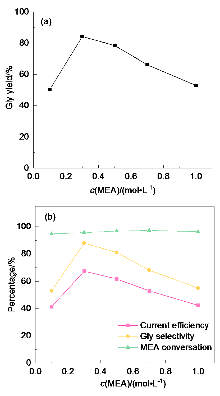
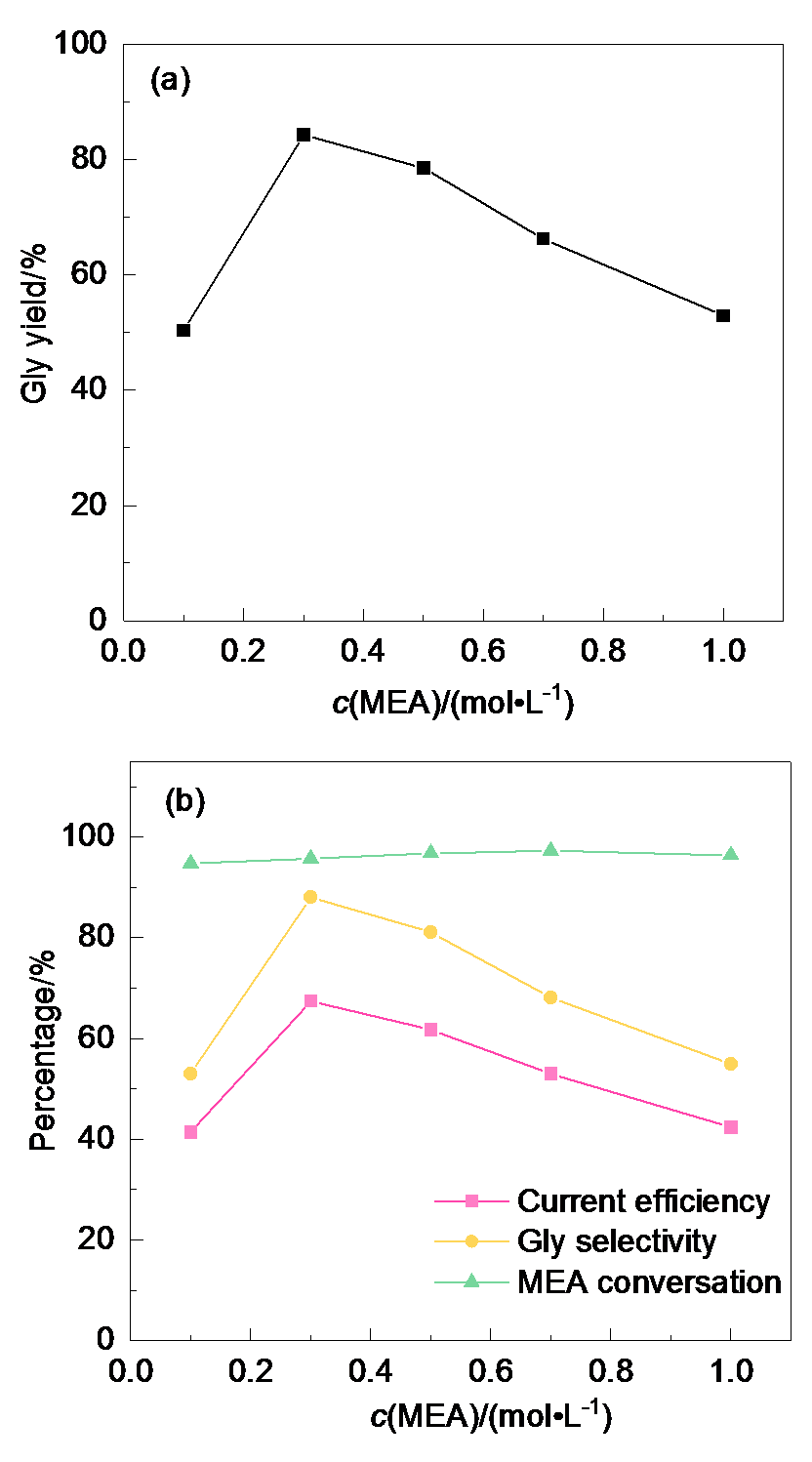


| Serial number | Gly yield/% | Gly selecti- vity/% | MEA con- version/% | Faraday efficiency/% |
|---|---|---|---|---|
| 1 | 84.23 | 88.03 | 95.69 | 67.28 |
| 2 | 86.30 | 90.16 | 95.73 | 69.53 |
| 3 | 85.57 | 88.43 | 96.77 | 68.50 |
| Serial number | Gly yield/% | Gly selecti- vity/% | MEA con- version/% | Faraday efficiency/% |
|---|---|---|---|---|
| 1 | 84.23 | 88.03 | 95.69 | 67.28 |
| 2 | 86.30 | 90.16 | 95.73 | 69.53 |
| 3 | 85.57 | 88.43 | 96.77 | 68.50 |
| [1] |
|
| [2] |
|
| [3] |
|
| [4] |
|
|
(郭浩, 钮东方, 胡硕真, 电化学, 2021, 27, 498.)
doi: 10.13208/j.electrochem.201203 |
|
| [5] |
|
|
(王振华, 马聪, 方萍, 徐海超, 梅天胜, 化学学报, 2022, 80, 1115.)
doi: 10.6023/A22060260 |
|
| [6] |
|
| [7] |
|
| [8] |
|
| [9] |
|
|
(热孜古丽•玉努斯, 卡迪尔亚•阿布都外力, 罗时玮, 阿布都热西提•阿布力克木, 化学学报, 2024, 82, 843.)
|
|
| [10] |
|
|
(坎比努尔•努尔买买提, 王超, 罗时玮, 阿布都热西提•阿布力克木, 化学学报, 2023, 81, 582.)
|
|
| [11] |
|
| [12] |
|
| [13] |
|
| [14] |
|
|
(李娟, 姚玉妮, 中国饲料添加剂, 2010, (9), 26.)
|
|
| [15] |
|
|
(柯轲, 张紫微, 康会芳, 方热军, 孔祥峰, 饲料研究, 2017 (10), 20.)
|
|
| [16] |
|
| [17] |
|
| [18] |
|
|
(钱益斌, 杨利民, 安徽农业科学, 2009, 37, 5828.)
|
|
| [19] |
|
| [20] |
|
|
(程明立, 史建公, 张毅, 苑志伟, 袁立焕, 沈小宁, 中外能源, 2022, 27, 70.)
|
|
| [21] |
|
|
(黄平, 李云政, 张青山, 化学研究, 2004, 15, 77.)
|
|
| [22] |
|
|
(朱志华, 李燕, 赫崇衡, 于筛成, 徐佩若, 石油化工, 2005, 34, 279.)
|
|
| [23] |
|
| [24] |
|
|
(李鑫, 张伟, 赵广, 赫瑞元, 韩萌, 杨仁俊, 毋楠, 龚文照, 农药, 2019, 58, 788.)
|
|
| [25] |
|
| [26] |
|
| [27] |
|
|
(段正康, 杨运泉, 刘文英, 熊鹰, 李国龙, 精细化工, 2000, 17, 345.)
|
|
| [28] |
|
|
(卢祖国, 博士论文, 浙江大学, 杭州, 2003.)
|
|
| [29] |
doi: 10.1021/acs.nanolett.3c05064 pmid: 38334492 |
| [30] |
|
| [31] |
|
| [32] |
|
| [33] |
|
| [34] |
|
| [35] |
doi: 10.1021/cr9000995 pmid: 19606907 |
| [36] |
|
| [37] |
|
| [38] |
|
| [39] |
|
| [40] |
|
|
(曾燕真, 硕士论文, 福州大学, 福州, 2015.)
|
|
| [41] |
|
| [42] |
|
| [43] |
|
| [44] |
|
| [45] |
|
| [46] |
|
| [47] |
|
| [48] |
|
| [1] | Xiaoqin You, Kejin Huang, Shiyi Zhuang, Chenjiang Liu, Weiwei Jin. Electrochemically Promoted Transesterification Reaction of Glycine Derivatives [J]. Chinese Journal of Organic Chemistry, 2025, 45(4): 1360-1368. |
| [2] | Liangming Xuan, Wei Zhao, Rundong Fan, Qiongjiao Yan, Wei Wang, Fen'er Chen. Recent Advances of the Catalysis Systems in the α-C(sp3)—H Functionalization of Glycine Derivatives [J]. Chinese Journal of Organic Chemistry, 2024, 44(9): 2700-2721. |
| [3] | Kejin Huang, Jinbo Cai, Ruige Wang, Yonghong Zhang, Bin Wang, Yu Xia, Weiwei Jin, Xinyong Li, Chenjiang Liu. Electrochemical C(sp2)—H Bromination of Glycine Derivatives Enabled by Boron [J]. Chinese Journal of Organic Chemistry, 2024, 44(3): 989-996. |
| [4] | Zhu Zhiqiang, Xiao Lijin, Xie Zongbo, Le Zhanggao. Recent Advances in the α-C(sp3)-H Bond Functionalization of Glycine Derivatives [J]. Chin. J. Org. Chem., 2019, 39(9): 2345-2364. |
| [5] | Zhao Liang, Zhou Shengbin, Tong Junhua, Wang Jiang, Liu Hong. Asymmetric Synthesis of 3, 5-Disubstituted Prolines [J]. Chin. J. Org. Chem., 2018, 38(6): 1437-1446. |
| [6] | Zhu Hualing, Ban Litong, Shi Jun, Chen Chen, Wei Zhen. Synthesis, Structure and Biological Activities of New 1-Phenyl-3-methyl-4-acyl-2-pyrzolin-5-one Derivatives Modified with Glycylglycine Methyl Ester [J]. Chin. J. Org. Chem., 2013, 33(12): 2631-2636. |
| [7] | Chen Jinquan, Kang Tairan, Liu Jinglin, He Long, Liu Quanzhong. Phase Transfer Catalyzed Enantioselective and Diastereoselective Conjugate Additions of Glycinate Imine to Unsaturated Imines Formed in situ from Sulfonylindoles [J]. Chin. J. Org. Chem., 2013, 33(07): 1483-1489. |
| [8] | Hui Ailing, Wu Zeyu, Yuan Yuan, Zhou An, Pan Jian. Progress in Synthesis and Antagonistic Activities towards PAFR and GlyR of Ginkgolide Derivatives and Analogs [J]. Chin. J. Org. Chem., 2013, 33(06): 1263-1272. |
| [9] | Jin Yingxue, Wang Jiachang, Yue Qunfeng, Qu Fengyu, Wei Shuquan, Tan Guanghui. Photoinduced Single Electron Transfer Cyclization Reaction of N-(Amidosilane terminated polybenzylglycine peptide chain)-2,3-naphthalimide [J]. Chin. J. Org. Chem., 2012, 32(07): 1290-1295. |
| [10] | LIAO Ben-Ren, AN Guo-Cheng, ZHU Jun-Ru, YANG Fan, TANG Jie. Crystallization-Induced Dynamic Kinetic Resolution of Phenylglycine Amide [J]. Chin. J. Org. Chem., 2011, 31(9): 1495-1498. |
| [11] | Zhou, Jiadong; Cao, Fei*; Zhang, Xiaolong; Yang, Ying; Ying, Hanjie; Wei, Ping. A Novel Method for the Synthesis of Glutathione Based on a Co-protection Strategy [J]. Chin. J. Org. Chem., 2009, 29(08): 1272-1277. |
| [12] |
Li, Yingjun* ; Liu, Jun; Xu, Yongting; Jin, Kun; Sun, Shuqin; Ding, Wangang; Liu, Lijun . Synthesis and Characterization of N,N-Disubstituted Glycine Tetraacetyl Glucosyl Esters [J]. Chin. J. Org. Chem., 2009, 29(02): 302-306. |
| [13] | PENG, Ru-Fang*,a JIN, Boa CAO, Kuia SHU, Yuan-Jieb CHU, Shi-Jina. Study on the Synthetic Technology of Nitrofulleropyrrolidine [J]. Chin. J. Org. Chem., 2007, 27(02): 276-278. |
| [14] |
LI Zhen-Jiang*,WAN Hong-Gui,WEI Ping,SHI Yu-Hu OUYANG Ping-Kai. Asymmetric Synthesis of Tailor-made α-Amino Acids by ChiralAuxiliaries: Glycine Equivalent Approach [J]. Chin. J. Org. Chem., 2005, 25(08): 881-892. |
| [15] | ZHANG, Xin, ZHU, Hua-Ling, XU, Hai-Zhen, WANG, Jin-Ling. Synthesis, Characterization and Crystal Structure of the Compound Derivedfrom 1-Phenyl-3-methyl-4-benzoyl-5-pyrazolone (HPMBP) and Glycine Methyl Ester [J]. Chinese Journal of Organic Chemistry, 2004, 24(2): 195-198. |
| Viewed | ||||||
|
Full text |
|
|||||
|
Abstract |
|
|||||
