
Chinese Journal of Organic Chemistry >
Self-Assembly of Polymer-Functionalized Carbon Nanotubes Induced by Polymer Microphase Separation
Received date: 2013-01-24
Revised date: 2013-02-20
Online published: 2013-02-22
Supported by
Project supported by the National Natural Science Foundation of China (No. 20976017) and the 2011 Foundation of Key Laboratory of Organoflurine Chemistry, Shanghai Institute of Organic Chemistry, Chinese Academy of Sciences.
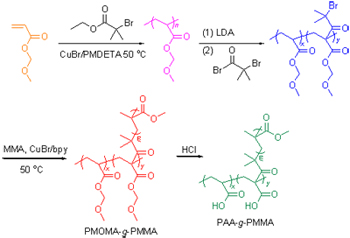
It is of importance for the application of carbon nanotubes in composite materials via supramolecular self-assembly of surface-functionalized carbon nanotubes. Here the self-assembly of the mixture of poly(4-vinylpyridine) functionalized multi-walled carbon nanotubes and carboxyl-containing graft copolymer, poly(acrylic acid)-g-poly(methyl methacrylate) is reported. Because of the hydrogen bond between the pyridine nitrogen and the carboxyl of the graft copolymer, carbon nanotubes were induced to form organized structure during the polymer microphase separation process, which afforded a kind of honeycomb suprastructure containing carbon nanotubes.
Key words: carbon nanotube; self-assemble; microphase separation; composite materials
Zheng Xingliang , Gao Hongsheng , Ding Aishun , Li Yongjun . Self-Assembly of Polymer-Functionalized Carbon Nanotubes Induced by Polymer Microphase Separation[J]. Chinese Journal of Organic Chemistry, 2013 , 33(07) : 1509 -1513 . DOI: 10.6023/cjoc201301063
/
| 〈 |
|
〉 |

