
Chinese Journal of Organic Chemistry >
Synthesis and Study of Performance for An Enhanced Formaldehyde Fluorescent Probe
Received date: 2021-10-10
Revised date: 2021-12-06
Online published: 2021-12-22
Supported by
National Natural Science Foundation of China(21672083); National Natural Science Foundation of China(21877048); National Natural Science Foundation of China(22077048); National Natural Science Foundation of China(22104019); Natural Science Foundation of Guangxi Province(2021GXNSFDA075003); Natural Science Foundation of Guangxi Province(2019GXNSFBA245068); Natural Science Foundation of Guangxi Province(AD21220061); Startup Fund of Guangxi University(A3040051003)
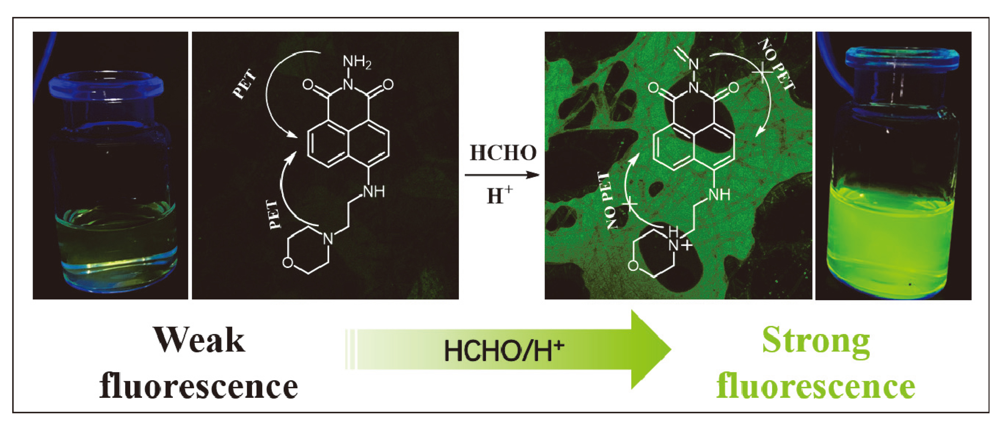
Formaldehyde (FA) is closely related to the environment and people’s health. For example, when FA is absorbed by the human body after exposure to the environment, it will cause discomfort such as headache and throat inflammation, or damage the vital organs of the human body and then cause diseases such as leukemia and Alzheimer's disease. For the rapid detection of FA in the environment, a fluorescent enhanced FA probe HSU-FA was developed. The probe uses naphthalimide dye as the fluorescent platform and hydrazine group as the site of FA recognition. The FA recognition effect is achieved by the condensation reaction between hydrazine group and carbonyl group condensation to form hydrazone. According to the optimization of test conditions, under the test condition of 30% acetic acid content, the probe HSU-FA has the best identification effect on FA. According to the UV-vis absorption spectrum, the absorption spectrum of the probe was significantly enhanced under the action of FA. The fluorescence spectrum test shows that the probe has outstanding recognition ability and response speed to FA. In addition, the probe has a strong resistance to photobleaching and can be stable in solution. The interaction between the probe and FA in solution showed different fluorescence intensities, showing a strong concentration dependence. More importantly, the rapid detection of FA in the environment by using the FA detection card prepared from non-woven fabrics was realized.
Huixu Lu , Yonghe Tang , Hongmei Zhou , Weiying Lin . Synthesis and Study of Performance for An Enhanced Formaldehyde Fluorescent Probe[J]. Chinese Journal of Organic Chemistry, 2022 , 42(4) : 1163 -1169 . DOI: 10.6023/cjoc202110012
| [1] | Manoj, K.; Joseph, S. J. Phys. Chem. A 2015, 119, 9821. |
| [2] | Yang, Z.; Yan, J; Zhang, N.; Li, D.; Xiao, S.; Zheng, K. Sens. Actuators, B 2018, 114, 162 |
| [3] | He, R.; Tong, Z. Q.; Zhang, J. L.; Luo, W. H.; Li, H.; Luo, H. J.; Wang, W. S.; Liu, Y. Biophys. J. 2009, 96, 89. |
| [4] | Kim, K. H.; Jahan, S. A.; Lee, J. T. J. Environ. Sci. Health, Part C: Environ. Carcinog. Ecotoxicol. Rev. 2011, 9, 4. |
| [5] | Kim, J.; Han, Y.; Ahn, J. H.; Kim, S. W.; Lee, S. I.; Lee, K. H.; Ahn, K. Br. J. Dermatol. 2016, 175, 357. |
| [6] | Bruemmer, K. J.; Walvoord, R. R.; Brewer, T. F.; Burgos-Barragan, G.; Wit, N.; Pontel, L. B.; Patel, K. J.; Chang, C. J. J. Am. Chem. Soc. 2017, 139, 5338. |
| [7] | He, L.; Yang, X.; Ren, M.; Kong, X.; Liu, Y.; Lin, W. Chem. Commun. 2016, 52, 9582. |
| [8] | Yu, W.; Jin, H.; Tang, C.; Du, J.; Zhang, Z. Br. J. Pharmacol. 2018, 175, 1114. |
| [9] | Tong, Z.; Wang, W.; Luo, W.; Lv, J.; Li, H.; Luo, H.; Jia, J.; He, R. J. Alzheimer’s Dis. 2017, 55, 1031. |
| [10] | Pisoschi, A. M.; Pop, A.; Gajaila, I.; Iordache, F.; Serban, A. I. Microchem. J. 2020, 155, 104681. |
| [11] | Xie, W. Q.; Chai, X. S. J. Chromatogr. A 2016, 1468, 241. |
| [12] | Sun, Q.; Yang, S. H.; Wu, L.; Dong, Q. J.; Yang, W. C.; Yang, G. F. Anal. Chem. 2016, 88, 6084. |
| [13] | Wahed, P.; Razzaq, M. A.; Dharmapuri, S.; Corrales, M. Food Chem. 2016, 202, 476. |
| [14] | Tian, Y.; Xin, F.; Gao, C.; Jing, J.; Zhang, X. J. Mater. Chem. B 2017, 5, 6890. |
| [15] | Tang, Y.; Ma, Y.; Yin, J.; Lin, W. Chem. Soc. Rev. 2019, 48, 4036. |
| [16] | Tang, L.; Tian, M.; Chen, H.; Yan, X.; Zhong, K.; Bian, Y. Dyes Pigm. 2018, 158, 482. |
| [17] | Bi, A.; Liu, M.; Huang, S.; Zheng, F.; Ding, J.; Wu, J.; Tang, G.; Zeng, W. Chem. Commun. 2021, 57, 3496. |
| [18] | Zhou, Y.; Yan, J.; Zhang, N.; Li, D.; Xiao, S.; Zheng, K. Sens. Actuators, B 2018, 258, 156. |
| [19] | Bi, A.; Gao, T.; Cao, X.; Dong, J.; Liu, M.; Ding, N.; Liao, W.; Zeng, W. Sens. Actuators, B 2018, 255, 3292. |
| [20] | Hao, Y.; Zhang, Y.; Zhang, A.; Sun, Q.; Zhu, J.; Qu, P.; Chen, S.; Xu, M. Spectrochim. Acta, Part A 2020, 229, 117988. |
| [21] | Wu, S.-Z.; Zeng, F.; Lin, M.-G.; Wang, C.; Huang, J. Acta Chim. Sinica 2021, 79, 331. (in Chinese) |
| [21] | ( 吴水珠, 曾钫, 林敏刚, 王超, 黄靖, 化学学报, 2021, 79, 331.) |
| [22] | Chen, D.-G.; Li, J.-B.; Chen, L. Chin J. Org. Chem. 2021, 41, 611. (in Chinese) |
| [22] | ( 陈杜刚, 黎俊波, 陈莉, 有机化学, 2021, 41, 611.) |
| [23] | Tang, B.; Zhang, J.; Xie, X.-L; Wang, X.; Li, Y. Chin J. Org. Chem. 2021, 79, 36. (in Chinese) |
| [23] | ( 唐波, 张建, 解希雷, 王栩, 李勇, 有机化学, 2021, 79, 36.) |
| [24] | Yu, Z.; Xiang, L.; Yang, S.; Qu, S.; Zeng, X.; Zhou, Y.; Yang, R. Spectrochim. Acta, Part A 2021, 245, 118887. |
| [25] | Sabina, K.; Shayeri, B.; Anupama, B.; Arup, P.; Nandita, M. J. Photochem. Photobiol., B 2020, 209, 111943. |
| [26] | Koji, N.; Kenjiro, H.; Takayuki, I.; Honami, E.; Tomoe, I.; Masakazu, M.; Toru, K.; Tasuku, U.; Yuji, I.; Tetsuo, N.; Yasuteru, U. Analyst 2020, 145, 7736. |
| [27] | Sebastian, R.; Eva, M. B.; Stephan, D.; Carmen, S.; Martin, Z.; Antonio, S.; Luiz, H. C. Mater. Sci. Eng., C 2021, 129, 112409. |
| [28] | Liu, X.; Li, N.; Li, M.; Chen, H.; Zhang, N.; Wang, Y.; Zheng, K. Coord. Chem. Rev. 2020, 404, 213109. |
| [29] | Bi, A.; Yang, S.; Liu, M.; Wang, X.; Liao, W.; Zeng, W. RSC Adv. 2017, 7, 36421. |
| [30] | Cai, S.; Liu, C.; Jiao, X.; Zhao, L.; Zeng, X. Tetrahedron 2020, 76, 131617. |
| [31] | Jana, A.; Baruah, M.; Munan, S.; Samanta, A. Chem. Commun. 2021, 57, 6380. |
| [32] | Nasirian, A.; Tikum, A. F.; Fortibui, M. M.; Lee, S.; Kim, J. Dyes Pigm. 2021, 188, 109156. |
| [33] | Xu, Q.-S.; Guo, Z.-Q. East China Uni. Sci. Technol. 2019, 364, 4357. (in Chinese) |
| [33] | ( 徐清爽, 郭志前, 华东理工大学学报, 2019, 364, 4357.) |
| [34] | Yin, J.; Huang, L.; Wu, L.; Li, J.; James, T. D.; Lin, W. Chem. Soc. Rev. 2021, 50, 12098. |
| [35] | Kucheryavy, P.; Li, G.; Vyas, S.; Hadad, C.; Glusac, K. D. J. Phys. Chem. A 2009, 113, 6453. |
| [36] | Brana, M.; Ramos, A. Curr. Med. Chem.: Anti-Cancer Agents 2001, 13, 1. |
| [37] | Mcadam, C. J.; Morgan, J. L.; Robinson, B. H.; Simpson, J.; Rieger, P. H.; Rieger, A. L. Organometallics 2003, 22, 5126. |
| [38] | Ma, C.; Wei, C.; Li, X.; Zheng, X.; Chen, B.; Wang, M.; Zhang, P.; Li, X. Dyes Pigm. 2019, 162, 624. |
| [39] | Qu, D.; Zhang, F.; Gao, H.; Wang, Q.; Bai, Y.; Liu, H. Chem. Res. Chin. Univ. 2019, 35, 345. |
| [40] | Ye, Z.; Zhang, R.; Song, B.; Dai, Z.; Jin, D.; Goldys, E. M.; Yuan, J. Dalton Trans. 2014, 43, 8414. |
| [41] | Zakharko, M. A.; Panchenko, P. A.; Ignatov, P. A.; Fedorov, Y. V.; Fedorova, O. A. Mendeleev Commun. 2020, 30, 332. |
/
| 〈 |
|
〉 |

