Chinese Journal of Organic Chemistry >
Cobalt-Catalyzed Electrochemical Reductive Coupling of Alkynes and Alkenes
Received date: 2022-09-29
Revised date: 2022-10-31
Online published: 2022-11-15
Supported by
National Key Research and Development Program of China(2021YFF0701600); National Natural Science Foundation of China(22031004); National Natural Science Foundation of China(21921003); National Natural Science Foundation of China(21901043); National Natural Science Foundation of China(22271053); Science and Technology Commission of Shanghai Municipality(21ZR1445900); Shanghai Municipal Education Commission(20212308); Henan Provincial Science and Technology Research and Development Project(192102210025)
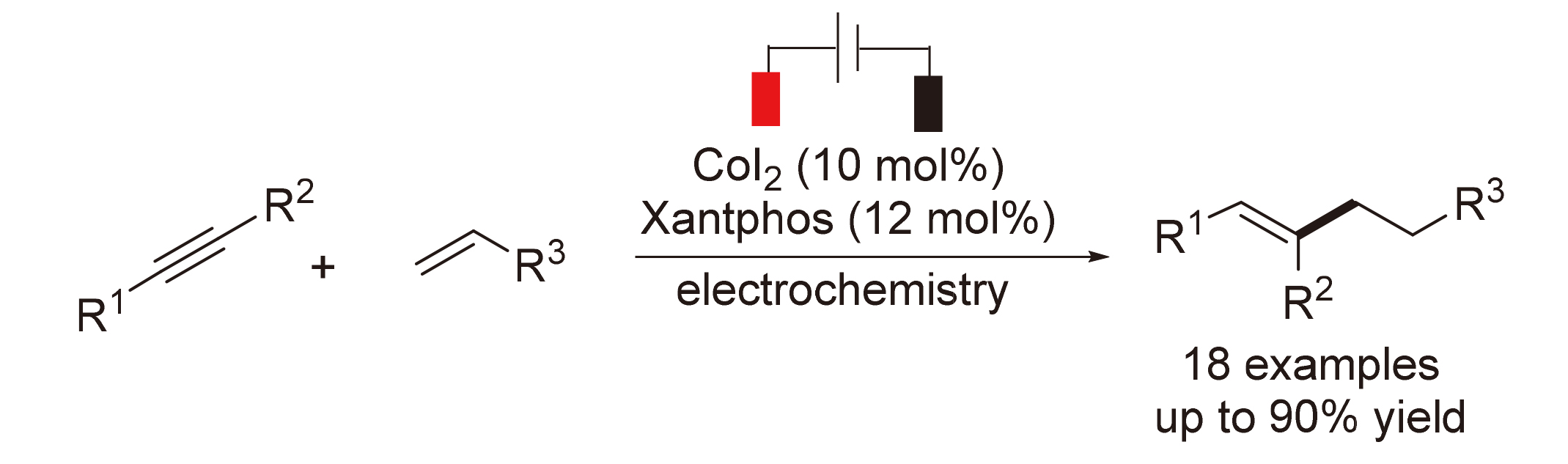
Transition-metal-catalyzed coupling reactions have now been extensively studied. However, the traditional reaction generally requires the addition of excessive amount of oxidant or reductive reagent. The new reaction mode of electro-organic synthesis avoids the usage of stoichiometric amount of redox reagent, which is more in line with the concept of green chemistry and atom economy. Recently cobalt catalysis has been discovered to be a cheap and low toxic alternative to noble transition-metal catalysts. In this paper, the reductive coupling reaction between alkynes and alkenes has been developed via electrochemistry by cobalt catalysis. The product could be delivered up to 90% yield with excellent regioselectivity.
Key words: electro-organic synthesis; cobalt catalysis; reductive coupling; alkyne; alkene
Shiquan Gao , Chuangjun Liu , Junfeng Yang , Junliang Zhang . Cobalt-Catalyzed Electrochemical Reductive Coupling of Alkynes and Alkenes[J]. Chinese Journal of Organic Chemistry, 2023 , 43(4) : 1559 -1565 . DOI: 10.6023/cjoc202209036
| [1] | (a) Yan, M.; Kawamata, Y.; Baran, P. S. Chem. Rev. 2017, 117, 13230. |
| [1] | (b) Horn, E. J.; Rosen, B. R.; Baran, P. S. ACS Cent. Sci. 2016, 2, 302. |
| [2] | Novaes, L. F. T.; Liu, J.; Shen, Y.; Lu, L.; Meinhardt, J. M.; Lin, S. Chem. Soc. Rev. 2021, 50, 7941. |
| [3] | (a) Pollok, D.; Waldvogel, S. R. Chem. Sci. 2020, 12386. |
| [3] | (b) Francke, R.; Little, R. D. Chem. Soc. Rev. 2014, 43, 2492. |
| [4] | (a) Wang, T.; Guo, W.-S. Chin. J. Org. Chem. 2022, 42, 2259. |
| [4] | (b) Guo, H.-J.; Liu, Y.-Y.; Wen, C.-P.; Wan, J.-P. Green Chem. 2022, 24, 5058. |
| [4] | (c) Wu, Z.-L.; Chen, J.-Y.; Tian, X.-Z.; Ouyang, W.-T.; Zhang, Z.-T.; He, W.-M. Chin. Chem. Lett. 2022, 33, 1501. |
| [4] | (d) Lin, Y.; Jin, J.; Wang, C.-L.; Wan, J.-P.; Liu, Y.-Y. J. Org. Chem. 2021, 86, 12378. |
| [5] | (a) Ackermann, L. Acc. Chem. Res. 2020, 53, 84. |
| [5] | (b) Jiao, K.-J.; Xing, Y.-K.; Yang, Q.-L.; Qiu, H.; Mei, T.-S. Acc. Chem. Res. 2020, 53, 300. |
| [5] | (c) Malapit, C. A.; Prater, M. B.; Cabrera-Pardo, J. R.; Li, M.; Pham, T. D.; McFadden, T. P.; Blank, S.; Minteer, S. D. Chem. Rev. 2022, 122, 3180. |
| [6] | Hapke, M.; Hilt, G. In Cobalt Catalysis in Organic Synthesis: Methods and Reactions, John Wiley & Sons, Weinheim, Germany, 2020. |
| [7] | (a) Gomes, P.; Gosmini, C.; Nédélec, J.-Y.; Périchon, J. Tetrahedron Lett. 2000, 41, 3385. |
| [7] | (b) Le Gall, E.; Gosmini, C.; Nédélec, J.-Y.; Périchon, J. Tetrahedron Lett. 2001, 42, 267. |
| [7] | (c) Gomes, P.; Gosmini, C.; Périchon, J. J. Org. Chem. 2003, 68, 1142. |
| [7] | (d) Gomes, P.; Gosmini, C.; Périchon, J. Tetrahedron 2003, 59, 2999. |
| [8] | (a) Wang, C. C.; Lin, P. S.; Cheng, C. H. J. Am. Chem. Soc. 2002, 124, 9696. |
| [8] | (b) Mannathan, S.; Cheng, C. H. Chem. Commun. 2010, 46, 1923. |
/
| 〈 |
|
〉 |