


1 Introduction
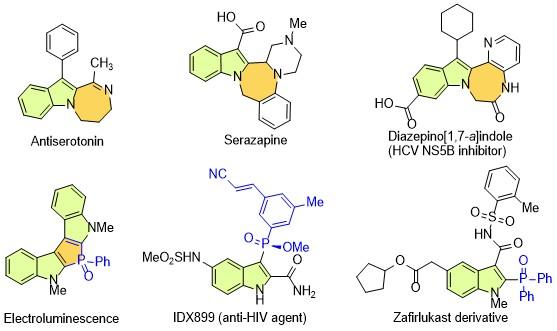
Indole skeletons are widely exit in biologically active molecules and are useful moieties in drug design and functional materials, the exploration of indole functiona- lization strategy to new scaffolds, chemical space expan- sion and biological discoveries has obtained considerable interest in chemistry and biology.[1] Among which, indole- fused medium-sized N-heterocycles represent an important skeleton of indole derivatives in pharmaceutics.[2] For exa- mple, azepino[2,1-a]indoles show antagonistic potency against MT1 and MT2 melatonin receptors and can be used to treat insomnia.[3] The indole-fused diazepines are also identified as flexible subunits to adapt differential targets in drug discovery, and there are a vast of candidates derived from this heterocycle, such as azepindole, serazapine (Figure 1).[4] However, methodologies for the construction of valuable indole-fused medium-sized N- heterocycles are relatively under-researched, largely because of their inherently unfavorable enthalpic and entropic nature.[5]
In the past decades, many efforts have been devoted to develop more versatile and efficient strategies for indole- fused medium-sized N-heterocycles. The synthetic me- thods using functionalized indoles as starting materials to construct a fused medium-sized ring can be roughly classified into four categories: (1) 1,2-fused tricyclic in- doles,[6] (2) 2,3-fused tricyclic indoles,[7] (3) 3,4-fused tri- cyclic indoles,[8] and (4) 1,7-fused tricyclic indoles.[9] Although the synthesis of indole-fused medium-sized N-heterocycles has achieved great success so far, some limitations of these methodologies are ineluctable, such as limited substrate scopes, tedious manipulation to prepare indole precursors, high reaction temperature, and the involvement of noble metals (e.g., Au and Rh) and extra additives. Thus, the development of new and practical approaches for their synthesis is still critical to advancing both fundamental organic chemistry and drug discovery efforts.
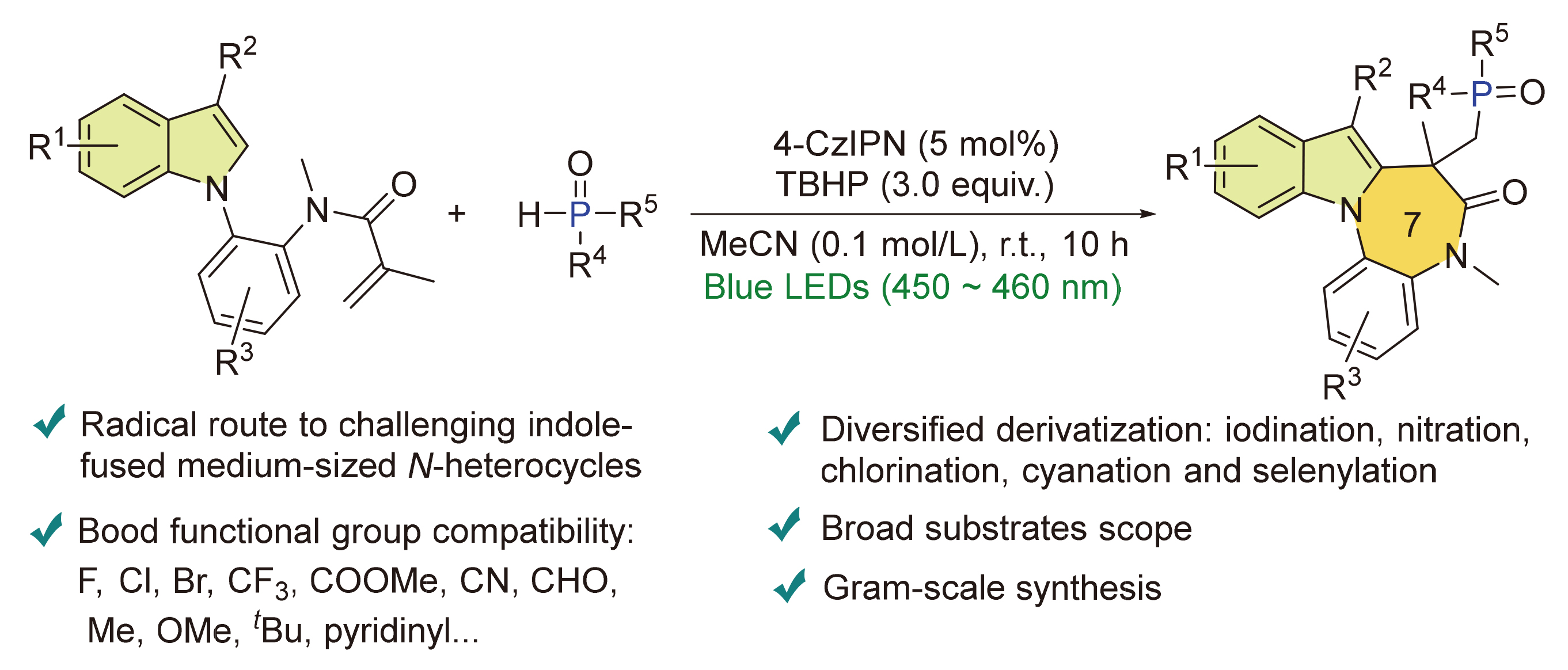
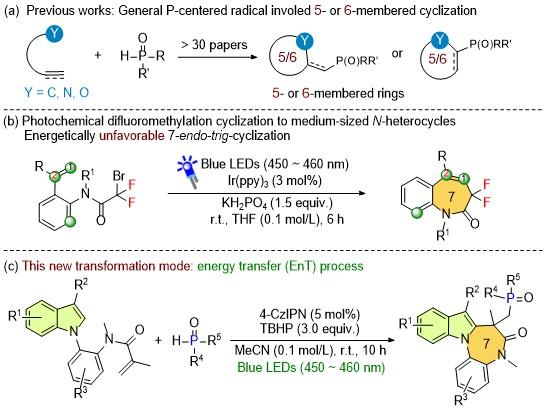
Recently, the fusion of burgeoning photocatalytic tech- nology[10] and radical chemistry[11] furnish opportunities for exploring the potential to highly functionalized N- heterocycles under mild conditions. On the other hand, owing to the broad applications in pharmaceuticals, pesti- cides and materials science, organophosphorus compounds have attracted increasing attention over last decades,[12] and various synthetic strategies, including Ag, Cu, Mn, etc. or strong oxidants mediated routes via P-centered radicals have been eatablished for the synthesis of phosphorylated heterocycles (Scheme 1a).[13] Recently, the boom of photocatalytic organic synthesis has opened new avenues for achieving phosphorus-containing molecules under sustainable conditions. As our particular interest in radical chemistry,[14] we successively realized the radical mediated cascade cyclization to medium-sized difluorobenzo[b]- azepines (Scheme 1b).[15] Herein, we disclose a novel visible-light-induced cascade cyclization to phosphorylated indole-fused medium-sized N-hetero- cycles via energy transfer (EnT) process. To the best of our knowledge, this is the first report for the synthesis of phosphorylated indole-fused medium-sized diazepines, which could be further applied as an efficient skeleton for rapid deriva- tization via nitration, chlorination and cyanation (Scheme 1c).
2 Results and discussion
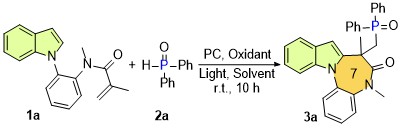
To initiate our studies, the model substrate N-(2-(1H- indol-1-yl)phenyl)-N-methylmethacrylamide (1a) and di- phenylphosphine oxide (2a) were selected for condition optimization (Table 1). We were pleased to find that product 3a could be isolated in 21% yield with Eosin Y as a photocatalyst and tert-butyl hydroperoxide (TBHP) (TBHP) as an oxidant in acetonitrile (MeCN) under irradiation with 30 W Blue LEDs at room temperature for 10 h (Table 1, Entry 1). Photocatalyst screening showed that Ru(bpy)3Cl2•6H2O, Ir(ppy)3 and 4-CzIPN were effi- cient under the same conditions, affording the target product 3a in 39%, 75% and 84% yields (Table 1, Entries 2~4). Several commonly used solvents, such as dichloro- methane (DCM), ethyl acetate (EtOAc), tetrahydrofuran (THF), dimethyl sulfoxide (DMSO), and methanol (Me- OH), were also examined, and the results revealed that the reaction worked well in most polar solvents, giving 3a with appreciable yields (Table 1, Entries 5~9). Then, other oxidants such as benzoyl peroxide (BPO), K2S2O8, and O2 were examined, and failed to give a better result (Table 1, Entries 10~12). Finally, control experiment showed that product 3a was not detected in the absence of photocatalyst or oxidant (Table 1, Entries 13 and 14).
Table 1 Optimization of reaction conditionsa |
| Entry | PC | Solvent | Oxidant | Yieldb/% |
|---|---|---|---|---|
| 1 | Eosin Y | MeCN | TBHP | 21 |
| 2 | Ru(bpy)3Cl2•6H2O | MeCN | TBHP | 39 |
| 3 | Ir(ppy)3 | MeCN | TBHP | 75 |
| 4 | 4-CzIPN | MeCN | TBHP | 84 |
| 5 | 4-CzIPN | DCM | TBHP | 40 |
| 6 | 4-CzIPN | EtOAc | TBHP | 65 |
| 7 | 4-CzIPN | THF | TBHP | 63 |
| 8 | 4-CzIPN | DMSO | TBHP | 69 |
| 9 | 4-CzIPN | MeOH | TBHP | 58 |
| 10 | 4-CzIPN | MeCN | O2 | 0 |
| 11 | 4-CzIPN | MeCN | K2S2O8 | 52 |
| 12 | 4-CzIPN | MeCN | BPO | 43 |
| 13 | — | MeCN | TBHP | 0 |
| 14 | 4-CzIPN | MeCN | — | Trace |
a Reaction conditions: 1a (0.5 mmol), 2a (0.75 mmol), solvent (5 mL), radiated with 30 W LED (450~460 nm) chimney at room temperature (r.t.) for 10 h. b Isolated yield. |
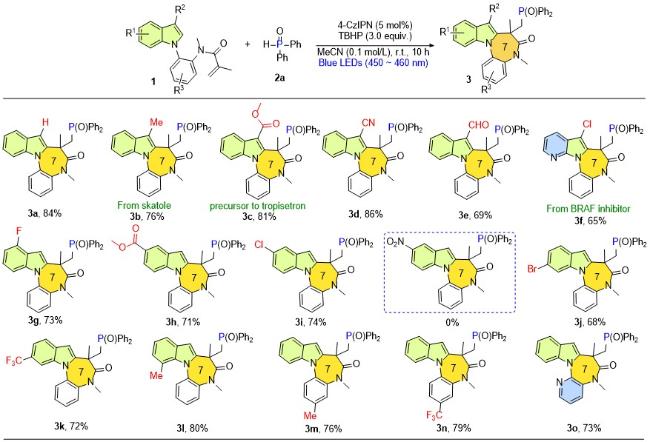
With the optimized conditions, the substrate scope of this photoinduced cascade phosphorylation cyclization was explored (Scheme 2). Indoles bearing diversified Me, COOMe, CN, Cl, and CHO on C3 position and pyridine containing skeleton were all compatible with this procedure, and compounds 3b~3f could be isolated in moderate to good yields (65%~86%). It is worth noting that 3-methyl-indole, namely skatole, is an important pharmaceutical and pesticide reagent due of the unique chemical structure. 3-Methyl-indole can be used as anti- ischemic drugs, prostate disease therapy andmemory enhancer analgesics, Moreover, it is also the raw material for the preparation of spices. Indoles bearing electron- donating and electron-withdrawing substituents (4-F, 5-COOMe, 5-Cl, 6-Br and 6-CF3, 7-Me) were all good candidates in this transformation, giving the indole-fused diazepinones 3g~3l in 68%~80% yields. While the substrate bearing NO2 on C5 position failed to give the desired phosphorylation cyclization product. Other functionalized substrates with Me, CF3 and pyridine connected to arylamine moiety were then examined. Pleasingly, the phosphorylation proceeded smoothly to give 3m~3o in good yields (73%~79%).
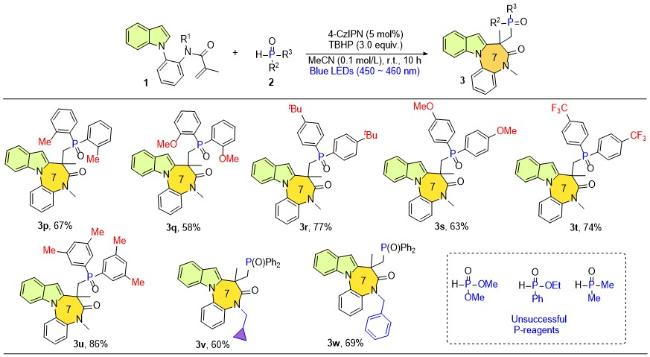
Having established the scope of indoles 1, our attention was turned to examine the P-reagents under the optimal conditions (Scheme 3). The electronic effect was not an important factor for this photoinduced phosphorylation cyclization. Both electron-donating groups (Me, OMe, tBu) and electron-withdrawing groups (CF3) on the phenyl ring were well tolerated, and the expected phosphorylated indole-fused medium-sized diazepinones 3p~3u were generated in moderate to good yields. However, no desired phosphorylation cyclization occured when dimethyl phos- phonate and ethyl phenylphosphinate were used as P- reagents. Furtherfore, when replacing the protecting group (R1) on the N atom with cyclopropylmethyl or Bn, this transformation also proceeded well and the corresponding products 3v and 3w were isolated in 60% and 69% yields.
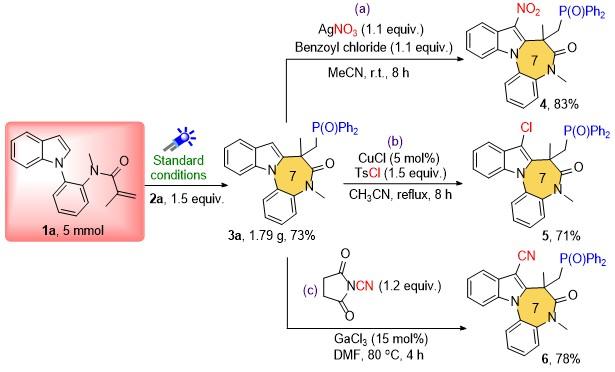
Subsequently, gram-scale operation with 5 mmol 1a was conducted to demonstrate the synthetic utility of this photoinduced phosphorylation cyclization strategy. Pleasingly, the desired indole-fused medium-sized diazepi- none 3a could be isolated in satisfactory 73% yield. Furthermore, synthetic transformation of the obtained 3a was subsequently examined. As shown in Scheme 4, the C-3 nitration, chlorination and cyanation products 4~6 can be easily prepared, which further expand the modified space of indole skeletons.
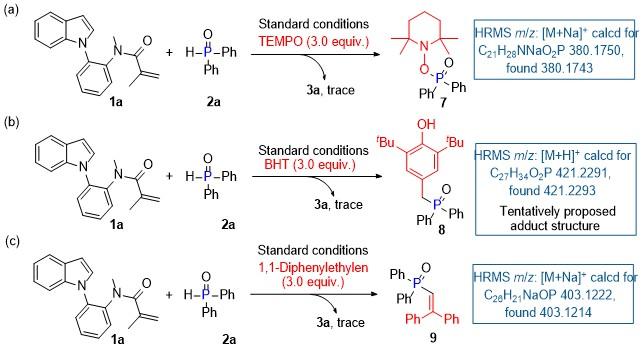
To explore the reaction mechanism, some control experiments were conducted. When radical scavenger 2,2, 6,6-tetramethyl-1-piperidinyloxy (TEMPO, 3.0 equiv.), 2,6-di-tert-butyl-4-methylphenol (BHT, 3.0 equiv.) or 1,1- diphenylethylene (3.0 equiv.) was added to the standard reaction, the expected phosphorylation cyclization was inhibited, and radical-trapping adducts 7, 8, and 9 were detected by HRMS analysis (Schemes 5a~5c). These results demonstrate that the phosphorylation cyclization maybe proceeds via a radical pathway, and the P-centered radical was involved in the reaction.
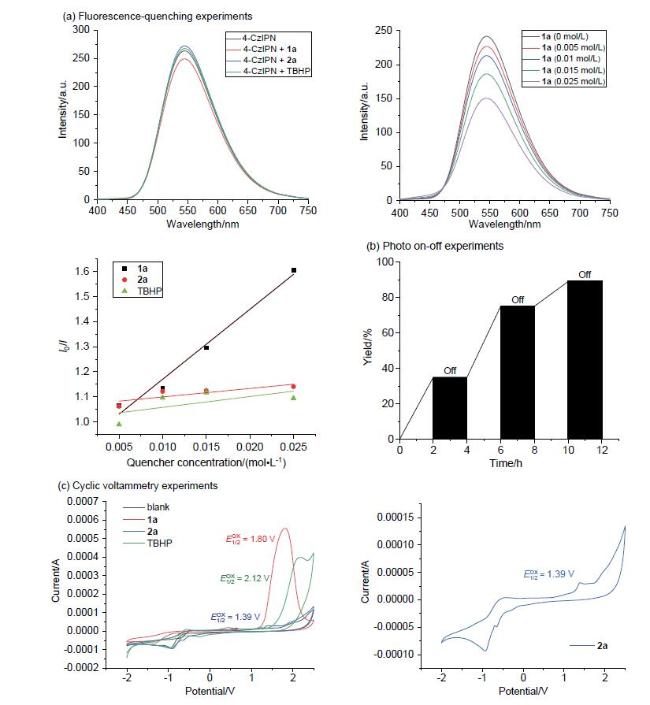
Besides, the Stern-Volmer fluorescence quenching studies were conducted. As shown in Figure 2a, when the solution of 1a was added to the irradiated 4-CzIPN solution, the fluorescence intensity of the excited 4-CzIPN decreased significantly, while 2a or TBHP did not show significant quenching effects. The results revealed that there was a clear linear relationship between the fluore- scence intensities of excited 4-CzIPN and the concen- trations of 1a. All the results showed that the excited 4-CzIPN was quenched by 1a. Furthermore, the visible- light irradiation on-off experiments of the present trans- formation revealed that the continuous blue-light irra- diation is essential for this reaction (Figure 2b). The calculated apparent quantum efficiency (AQE) for this transformation is 1.38%, which indicates that a radical- chain pathway might not be involved during this phos- phorylation cyclization. Finally, the measured oxidation potential of 1a (E=1.80 V vs SCE), 2a (E=1.39 V vs SCE), and TBHP (E=2.12 V vs SCE) by cyclic voltammetry (CV) (Figure 2c), while the oxidation potential of 4-CzIPN was E1/2(*p/p-)=+1.35 V vs SCE.[16] The redox potentials demonstrated that the single electron transfer (SET) process could not occur between 4-CzIPN and 1a.
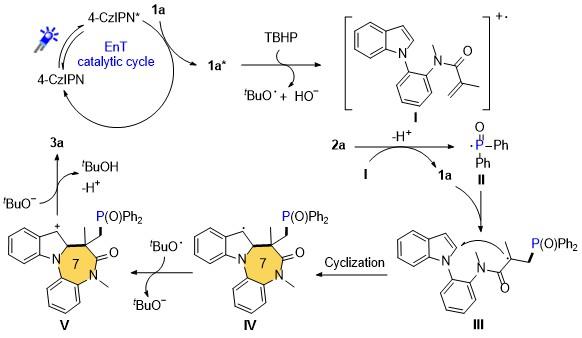
Based on above mechanism study and previous literature reports,[17] especially the Cu(OTf)2/K2S2O8 mediated cascade cyclization strategy to generate indole-fused diazepine derivatives, a plausible energy transfer (EnT) process was proposed to illustrate mechanism (Scheme 6). Initially, the excited 1a* was generated by an EnT process between the excited 4-CzIPN* and 1a. Next, the radical cation I derived from 1a* under the oxidant TBHP via a single electron transfer (SET) process, together with the release of tBuO radical and hydroxyl anion. And then, the P-centered radical II was formed via another SET process from 2a to radical cation I. The regioselectively addition of P-centered radical II on carbon-carbon double bond of 1a leads to the formation of radical intermediate III, which then undergoes intramolecular cyclization to deliver the radical intermediate IV. Finally, the desired product 3a formed via successive one-electron oxidation with tBuO radical and deprotonation process.


3 Conclusions
In summary, a novel visible light induced phosphor- ylation cyclization strategy for the facile construction of valuable indole-fused medium-sized diazepines has been developed. Broad substrates scope, good functional group compatibility (F, Cl, Br, CF3, COOMe, CN, CHO, Me, OMe, tBu, pyridine), scalability reaction and synthetic transformation via C-3 nitration, chlorination and cyana- tion demonstrate that this strategy has good potential for further industrial application. The reaction mechanism is proposed on the basis of radical inhibition experiments, visible-light irradiation on-off test, AQE calculation, UV- vis absorption spectroscopic studies and cyclic voltam- metry experiments.
4 Experimental section
4.1 Instruments and reagents
1H NMR, 13C NMR and 19F NMR, 31P NMR spectra were recorded on a Bruker Ascend™ 400 or Bruker Ascend™ 500 spectrometer in deuterated solvents containing TMS as an internal reference standard. All high-resolution mass spectra (HRMS) were measured on a mass spectrometer by using electrospray ionization orthogonal acceleration time-of-flight (ESI-OA-TOF), and the purity of all samples used for HRMS (>95%) was confirmed by 1H NMR, 13C NMR and 19F NMR, 31P NMR spectroscopic analysis. Melting points were measured on a melting point apparatus equipped with a thermometer and were uncorrected (Haineng Future Technology Group Co., LTD, MP450). All the reactions were monitored by thin-layer chromatography (TLC) using GF254 silica gel-coated TLC plates. Purification by flash column chromatography was performed over SiO2 (silica gel 200~300 mesh). All reagents were purchased from commercial sources and used without further purification.
4.2 General procedure for the synthesis of products 3a~3w
In a 10 mL glass bottle equipped with a magnetic stirring bar, substrates 1 (0.5 mmol), 2 (0.75 mmol) and MeCN (0.1 mol/L) were charged sequentially. The mixture was then stirred in air under Blue LEDs (450~460 nm) irradiation for 10 h and then monitored by TLC. Upon the reaction completed, the reaction mixture was concentrated in vacuo. The residue obtained was purified by column chromatography on silica gel to afford the final products 3a~3w.
7-((Diphenylphosphoryl)methyl)-5,7-dimethyl-5H-benzo[2,3][1,4]diazepino[1,7-a]indol-6(7H)-one (3a): Flash column chromatography [V(petroleum ether)∶V(EtOAc)=1∶1→1∶2], 84% yield (0.206 g), white solid, m.p. 235~237 ℃; Rf [V(petroleum ether)∶V(EtO- Ac)=1∶2] 0.3; 1H NMR (400 MHz, CDCl3) δ: 7.56 (dd, J=19.6, 7.6 Hz, 2H), 7.47 (s, 2H), 7.37~7.31 (m, 10H), 7.21~7.16 (m, 4H), 6.50 (s, 1H), 3.28 (s, 3H), 2.55 (t, J=15.6 Hz, 1H), 2.34 (dd, J=15.2, 9.6 Hz, 1H), 1.98 (s, 3H); 13C NMR (101 MHz, CDCl3) δ: 170.8, 170.7, 143.2, 143.1, 137.3, 135.8, 134.1, 133.1, 133.0, 132.4, 132.0, 131.7 (d, J=2.4 Hz), 131.5 (d, J=2.9 Hz), 131.0 (d, J=9.2 Hz), 130.6 (d, J=9.1 Hz), 129.0, 128.4, 128.3 (d, J=4.6 Hz), 128.2, 126.8, 125.7, 124.4, 124.0, 122.5, 121.1 (d, J=10.8 Hz), 110.6, 101.8, 44.9 (d, J=3.5 Hz), 38.5, 34.7 (d, J=66.7 Hz), 24.1; 31P NMR (162 MHz, CDCl3) δ: 26.24; HRMS (ESI) calcd for C31H27NaN2O2P [M+Na]+ 490.1810, found 490.1806.
7-((Diphenylphosphoryl)methyl)-5,7,8-trimethyl-5H-benzo[2,3][1,4]diazepino[1,7-a]indol-6(7H)-one (3b): Flash column chromatography [V(petroleum ether)∶V(EtOAc)=1∶1→1∶2], 76% yield (0.192 g), white solid, m.p. 221~223 ℃; Rf [V(petroleum ether)∶V(EtO- Ac)=1∶2] 0.3; 1H NMR (400 MHz, CDCl3) δ: 7.46~7.44 (m, 1H), 7.35~7.31 (m, 3H), 7.23~7.16 (m, 10H), 7.08~7.01 (m, 4H), 3.23 (s, 3H), 2.43~2.39 (m, 2H), 2.33 (s, 3H), 2.09 (s, 3H); 13C NMR (101 MHz, CDCl3) δ: 171.1, 171.0, 137.5, 136.5, 136.4, 135.0, 134.5, 133.5, 133.1, 132.9, 132.1, 131.6 (d, J=2.8 Hz), 131.3 (d, J=2.9 Hz), 131.2, 130.8 (d, J=9.5 Hz), 130.4 (d, J=8.8 Hz), 128.4 (d, J=11.6 Hz), 128.0 (d, J=11.7 Hz), 126.8, 125.6, 125.2, 123.3, 122.7, 120.6, 119.0, 110.8, 110.4, 47.3 (d, J=3.7 Hz), 38.4, 35.9 (d, J=66.5 Hz), 26.1 (d, J=105.3 Hz), 11.1; 31P NMR (162 MHz, CDCl3) δ: 26.09; HRMS (ESI) calcd for C32H29NaN2O2P [M+Na]+ 504.1967, found 504.1966.
Methyl 7-((diphenylphosphoryl)methyl)-5,7-dimeth- yl-6-oxo-6,7-dihydro-5H-benzo[2,3][1,4]diazepino-[1, 7-a]indole-8-carboxylate (3c): Flash column chromatography [V(petroleum ether)∶V(EtOAc)=1∶1→1∶2], 81% yield (0.223 g), white solid, m.p. 226~228 ℃; Rf [V(petroleum ether)∶V(EtOAc)=1∶2] 0.3; 1H NMR (400 MHz, CDCl3) δ: 7.60~7.48 (m, 6H), 7.44~7.30 (m, 10H), 7.24~7.21 (m, 2H), 3.91 (s, 3H), 3.36 (s, 3H), 2.55 (t, J=15.6 Hz, 1H), 2.43 (dd, J=15.6, 9.5 Hz, 1H), 1.88 (s, 3H); 13C NMR (101 MHz, CDCl3) δ: 169.9, 169.8, 167.4, 140.6, 140.5, 137.8, 134.8, 134.4, 133.4, 133.2, 132.2, 131.7 (d, J=3.1 Hz), 131.0 (d, J=9.4 Hz), 130.4 (d, J=8.9 Hz), 128.5, 128.4 (d, J=2.6 Hz), 128.3, 127.9, 127.8, 125.5, 125.1, 124.1, 123.7, 122.1, 120.1, 110.9, 109.9, 52.3, 46.5 (d, J=2.9 Hz), 38.2, 35.2 (d, J=66.5 Hz), 24.3; 31P NMR (162 MHz, CDCl3) δ: 25.70; HRMS (ESI) calcd for C33H29NaN2O4P [M+Na]+ 548.1865, found 548.1862.
7-((Diphenylphosphoryl)methyl)-5,7-dimethyl-6-oxo-6,7-dihydro-5H-benzo[2,3][1,4]diazepino[1,7-a]indole-8-carbonitrile (3d): Flash column chromatography [V(petroleum ether)∶V(EtOAc)=1∶1→1∶2], 86% yield (0.222 g), white solid, m.p. 233~235 ℃; Rf [V(petroleum ether)∶V(EtOAc)=1∶2] 0.3; 1H NMR (400 MHz, CDCl3) δ: 7.73~7.66 (m, 2H), 7.58~7.55 (m, 1H), 7.50~7.28 (m, 15H), 3.40 (s, 3H), 2.43 (d, J=11.6 Hz, 2H), 2.14 (s, 3H); 13C NMR (101 MHz, CDCl3) δ: 169.6, 169.5, 146.8, 146.7, 137.6, 134.9, 133.8, 132.8, 132.7, 131.9 (d, J=2.8 Hz), 131.9 (d, J=2.9 Hz), 131.7, 130.7 (d, J=8.9 Hz), 130.4 (d, J=9.4 Hz), 129.3, 128.7, 128.6, 128.5, 125.9, 125.1, 124.8, 124.1, 123.3, 119.8, 115.6, 111.5, 87.1, 46.6 (d, J=3.0 Hz), 38.4, 34.3 (d, J=66.3 Hz), 24.7; 31P NMR (162 MHz, CDCl3) δ: 25.20; HRMS (ESI) calcd for C32H26N3O2P [M+H]+ 515.1763, found 515.1760.
7-((Diphenylphosphoryl)methyl)-5,7-dimethyl-6-oxo-6,7-dihydro-5H-benzo[2,3][1,4]diazepino[1,7-a]indole-8-carbaldehyde (3e): Flash column chromatography [V(petroleum ether)∶V(EtOAc)=1∶1→1∶2], 69% yield (0.179 g), white solid, m.p. 215~217 ℃; Rf [V(petroleum ether)∶V(EtOAc)=1∶2] 0.3; 1H NMR (400 MHz, CDCl3) δ: 10.60 (s, 1H), 8.53 (d, J=8.4 Hz, 1H), 7.45~7.26 (m, 16H), 3.39 (s, 3H), 2.53 (d, J=12 Hz, 2H), 2.23 (s, 3H); 13C NMR (101 MHz, CDCl3) δ: 188.2, 169.6, 169.5, 147.6, 147.5, 137.6, 135.6, 133.9, 133.0, 132.8, 132.0 (d, J=2.8 Hz), 131.9 (d, J=2.9 Hz), 131.8, 131.1, 130.7 (d, J=9.9 Hz), 130.3 (d, J=8.9 Hz), 128.6 (d, J=5.1 Hz), 128.5, 128.4, 127.6, 125.8, 125.7, 124.4, 124.0, 123.5, 117.7, 110.7, 48.5 (d, J=3.3 Hz), 38.3, 34.7 (d, J=66.1 Hz), 27.3; 31P NMR (162 MHz, CDCl3) δ: 25.35; HRMS (ESI) calcd for C32H27NaN2O3P [M+Na]+ 518.1759, found 518.1751.
8-Chloro-7-((diphenylphosphoryl)methyl)-5,7-dimethyl-5H-benzo[b]pyrido[3',2':4,5]pyrrolo[1,2-d][1,4]diazepin-6(7H)-one (3f): Flash column chromatography [V(petroleum ether)∶V(EtOAc)=1∶1→1∶2], 65% yield (0.172 g), white solid, m.p. 226~228 ℃; Rf [V(petroleum ether)∶V(EtOAc)=1∶2] 0.3; 1H NMR (400 MHz, CDCl3) δ: 8.35 (d, J=4.8 Hz, 1H), 7.89~7.84 (m, 2H), 7.42~7.13 (m, 14H), 3.36 (s, 3H), 2.61 (dd, J=15.6, 9.2 Hz, 1H), 2.44 (t, J=15.2 Hz, 1H), 2.26 (s, 3H); 13C NMR (101 MHz, CDCl3) δ: 170.2, 170.1, 145.1, 144.8, 137.4, 134.8, 134.7, 134.0, 133.0, 132.6, 131.8 (d, J=2.9 Hz), 131.6, 131.4 (d, J=3.1 Hz), 130.7 (d, J=9.7 Hz), 130.5, 130.4 (d, J=8.9 Hz), 128.5 (d, J=11.6 Hz), 128.0 (d, J=11.8 Hz), 127.8, 127.1 (d, J=17.3 Hz), 125.6, 123.2, 120.8, 118.0, 104.8, 47.0 (d, J=3.6 Hz), 38.6, 35.1 (d, J=66.8 Hz), 24.9; 31P NMR (162 MHz, CDCl3) δ: 25.55; HRMS (ESI) calcd for C30H25ClNaN3O2P [M+ Na]+ 525.1373, found 525,1370.
7-((Diphenylphosphoryl)methyl)-9-fluoro-5,7-dimethyl-5H-benzo[2,3][1,4]diazepino[1,7-a]indol-6(7H)-one (3g): Flash column chromatography [V(petroleum ether)∶V(EtOAc)=1∶1→1∶2], 73% yield (0.187 g), white solid, m.p. 208~210 ℃; Rf [V(petroleum ether)∶V(EtO- Ac)=1∶2] 0.3; 1H NMR (400 MHz, CDCl3) δ: 7.50~7.31 (m, 13H), 7.22~7.18 (m, 2H), 7.12~7.06 (m, 1H), 6.84~6.79 (t, J=10 Hz, 1H), 6.54 (s, 1H), 3.30 (s, 3H), 2.54~2.46 (t, J=15.2 Hz, 1H), 2.37~2.30 (dd, J=15.6, 9.6 Hz, 1H), 1.96 (s, 3H); 13C NMR (101 MHz, CDCl3) δ: 170.7, 170.6, 157.4, 154.9, 143.1 (d, J=8.8 Hz), 138.2 (d, J=10.9 Hz), 137.4, 134.0, 133.0 (d, J=14.7 Hz), 132.1, 131.9, 131.8 (d, J=2.8 Hz), 131.5 (d, J=2.8 Hz), 130.9 (d, J=9.3 Hz), 130.5 (d, J=9.3 Hz), 128.5, 128.3 (d, J=6.0 Hz), 128.2, 127.3, 125.8, 124.4, 124.1, 123.0 (d, J=7.5 Hz), 118.1 (d, J=22.7 Hz), 106.8 (d, J=3.6 Hz), 106.0 (d, J=18.9 Hz), 97.6, 44.9 (d, J=3.5 Hz), 38.5, 34.5 (d, J=66.8 Hz), 24.1; 31P NMR (162 MHz, CDCl3) δ: 26.10; 19F NMR (376 MHz, CDCl3) δ: -121.89; HRMS (ESI) calcd for C31H26FNaN2O2P [M+Na]+ 508.1716, found 508.1713.
Methyl 7-((diphenylphosphoryl)methyl)-5,7-dimethyl-6- oxo-6,7-dihydro-5H-benzo[2,3][1,4]diazepino[1,7-a]indole-10-carboxylate (3h): flash column chromatography [V(petroleum ether)∶V(EtOAc)=1∶1→1∶2], 71% yield (0.196 g), white solid, m.p. 227~229 ℃; Rf [V(petroleum ether)∶V(EtOAc)=1∶2] 0.3; 1H NMR (400 MHz, CDCl3) δ: 8.32 (d, J=1.6 Hz, 1H), 7.90~7.87 (m, 1H), 7.51 (d, J=8.8 Hz, 1H), 7.42~7.29 (m, 12H), 7.19~7.15 (m, 2H), 6.56 (s, 1H), 3.93 (s, 3H), 3.30 (s, 3H), 2.50 (t, J=15.6 Hz, 1H), 2.34 (dd, J=15.6, 9.6 Hz, 1H), 1.97 (s, 3H); 13C NMR (101 MHz, CDCl3) δ: 170.7, 170.6, 167.8, 144.5, 144.5, 138.2, 137.5, 134.1, 133.1, 132.9, 131.9, 131.8, 131.8 (d, J=2.8 Hz), 131.5 (d, J=3.0 Hz), 130.9 (d, J=9.4 Hz), 130.5 (d, J=9.3 Hz), 128.5 (d, J=2.9 Hz), 128.4, 128.3, 128.2, 127.5, 125.9, 124.5, 124.1, 123.8, 123.2, 110.4, 102.9, 52.0, 45.0 (d, J=3.2 Hz), 38.6, 34.5 (d, J=66.4 Hz), 24.1; 31P NMR (162 MHz, CDCl3) δ: 25.97; HRMS (ESI) calcd for C33H29NaN2O4P [M+Na]+ 548.1865, found 548.1863.
10-Chloro-7-((diphenylphosphoryl)methyl)-5,7-dimeth-yl-5H-benzo[2,3][1,4]diazepino[1,7-a]indol-6(7H)-one (3i): Flash column chromatography [V(petroleum ether)∶V(EtOAc)=1∶1→1∶2], 74% yield (0.196 g), white solid, m.p. 233~235 ℃; Rf [V(petroleum ether)∶V(EtO- Ac)=1∶2] 0.3; 1H NMR (400 MHz, CDCl3) δ: 7.51~7.31 (m, 14H), 7.20~7.08 (m, 3H), 6.40 (s, 1H), 3.28 (s, 3H), 2.48 (t, J=15.6 Hz, 1H), 2.32 (dd, J=15.2, 9.6 Hz, 1H), 1.94 (s, 3H); 13C NMR (101 MHz, CDCl3) δ: 170.7, 170.6, 144.4, 144.3, 137.3, 134.2, 134.0, 133.0, 132.9, 131.9, 131.8 (d, J=2.8 Hz), 131.6 (d, J=2.8 Hz), 130.9 (d, J=9.4 Hz), 130.5 (d, J=9.3 Hz), 130.0, 128.5, 128.4 (d, J=6.2 Hz), 128.2, 127.3, 126.6, 125.9, 124.3, 124.0, 122.6, 120.3, 111.8, 101.3, 44.9 (d, J=3.5 Hz), 38.5, 34.4 (d, J=66.4 Hz), 24.1; 31P NMR (162 MHz, CDCl3) δ: 26.21; HRMS (ESI) calcd for C31H26ClNaN2O2P [M+ Na]+ 5424.1420, found 524.1416.
11-Bromo-7-((diphenylphosphoryl)methyl)-5,7-dimeth-yl-5H-benzo[2,3][1,4]diazepino[1,7-a]indol-6(7H)-one (3j): Flash column chromatography [V(petroleum ether)∶V(EtOAc)=1∶1→1∶2], 68% yield (0.194 g), white solid, m.p. 216~218 ℃; Rf [V(petroleum ether)∶V(EtO- Ac)=1∶2] 0.3; 1H NMR (400 MHz, CDCl3) δ: 7.77~7.72 (m, 1H), 7.67 (s, 1H), 7.44~7.29 (m, 15H), 6.44 (s, 1H), 3.29 (s, 3H), 2.50 (t, J=15.6 Hz, 1H), 2.33 (dd, J=16, 10 Hz, 1H), 1.93 (s, 3H); 13C NMR (101 MHz, CDCl3) δ: 170.6, 170.6, 143.8, 143.7, 137.4, 136.5, 133.9, 132.9 (d, J=8.7 Hz), 132.3 (d, J=2.9 Hz), 131.8, 131.6 (d, J=2.9 Hz), 130.9 (d, J=2.1 Hz), 130.8 (d, J=2.8 Hz), 130.5 (d, J=9.4 Hz), 128.9, 128.8, 128.5, 128.4 (d, J=3.8 Hz), 128.2, 127.8, 127.3, 126.0, 124.4 (d, J=12.0 Hz), 124.1, 122.2, 116.0, 113.6, 101.8, 44.9 (d, J=3.2 Hz), 38.5, 34.5 (d, J=66.8 Hz), 24.1; 31P NMR (162 MHz, CDCl3) δ: 26.28; HRMS (ESI) calcd for C31H26BrNaN2O2P [M+ Na]+ 568.0915, found 568.0911.
7-((Diphenylphosphoryl)methyl)-5,7-dimethyl-11-(tri-fluoromethyl)-5H-benzo[2,3][1,4]diazepino[1,7-a]indol-6(7H)-one (3k): flash column chromatography [V(petro- leum ether)∶V(EtOAc)=1∶1→1∶2], 72% yield (0.203 g), white solid, m.p. 234~236 ℃; Rf [V(petroleum ether)∶V(EtOAc)=1∶2] 0.3; 1H NMR (400 MHz, CDCl3) δ: 7.80 (s, 1H), 7.66 (d, J=8.4 Hz, 1H), 7.44~7.31 (m, 13H), 7.21~7.16 (m, 2H), 6.56 (s, 1H), 3.31 (s, 3H), 2.52 (t, J=13.6 Hz, 1H), 2.35 (dd, J=15.2, 9.6 Hz, 1H), 1.98 (s, 3H); 13C NMR (101 MHz, CDCl3) δ: 170.6, 170.5, 145.8, 145.7, 137.4, 134.8, 134.0, 133.0, 132.0, 131.8 (d, J=2.8 Hz), 131.6, 131.6 (d, J=2.6 Hz), 131.4, 130.9 (d, J=9.5 Hz), 130.5 (d, J=8.9 Hz), 128.5, 128.4, 128.3, 128.2, 127.6, 126.1, 124.4, 124.1, 121.4, 117.8 (d, J=3.7 Hz), 108.2 (d, J=4.6 Hz), 101.9, 45.1 (d, J=3.6 Hz), 38.5, 34.4 (d, J=66.7 Hz), 24.1; 31P NMR (162 MHz, CDCl3) δ: 25.91; 19F NMR (376 MHz, CDCl3) δ: -60.49; HRMS (ESI) calcd for C32H26F3Na- N2O2P [M+Na]+ 558.1684, found 558.1683.
7-((Diphenylphosphoryl)methyl)-5,7,12-trimethyl-5H-benzo[2,3][1,4]diazepino[1,7-a]indol-6(7H)-one (3l): flash column chromatography [V(petroleum ether)∶V(EtO- Ac)=1∶1→1∶2], 80% yield (0.203 g), white solid, m.p. 229~231 ℃; Rf [V(petroleum ether)∶V(EtOAc)=1∶2] 0.3; 1H NMR (400 MHz, CDCl3) δ: 7.47~7.26 (m, 15H), 7.09 (t, J=7.6 Hz, 1H), 6.98 (d, J=7.2 Hz, 1H), 6.91 (d, J=8.4 Hz, 1H), 6.51 (s, 1H), 3.32 (s, 3H), 2.34 (dd, J=28.4, 16 Hz, 1H), 2.21 (dd, J=15.6, 10.4 Hz, 1H), 2.08 (s, 3H), 1.91 (s, 3H); 13C NMR (101 MHz, CDCl3) δ: 170.9, 170.9, 146.0, 145.9, 137.4, 135.7, 134.1, 133.5, 133.3, 133.1, 132.3, 131.7 (d, J=2.8 Hz), 131.7 (d, J=2.8 Hz), 131.0 (d, J=9.4 Hz), 130.6 (d, J=9.3 Hz), 130.1, 128.4 (d, J=11.8 Hz), 127.4, 126.9, 126.0, 125.1, 123.3, 121.9, 121.6, 118.7, 103.2, 45.0 (d, J=3.4 Hz), 37.8, 34.8 (d, J=66.2 Hz), 24.6, 21.1; 31P NMR (162 MHz, CDCl3) δ: 26.32; HRMS (ESI) calcd for C32H29NaN2O2P [M+Na]+ 504.1967, found 504.1962.
7-((Diphenylphosphoryl)methyl)-3,5,7-trimethyl-5H-benzo[2,3][1,4]diazepino[1,7-a]indol-6(7H)-one (3m): Fla- sh column chromatography [V(petroleum ether)∶V(EtO- Ac)=1∶1→1∶2], 76% yield (0.192 g), white solid, m.p. 212~214 ℃; Rf [V(petroleum ether)∶V(EtOAc)=1∶2] 0.3; 1H NMR (400 MHz, CDCl3) δ: 7.53 (dd, J=15.2, 8 Hz, 2H), 7.43~7.39 (m, 4H), 7.32~7.10 (m, 12H), 6.44 (s, 1H), 3.27 (s, 3H), 2.55 (t, J=15.6 Hz, 1H), 2.42 (s, 3H), 2.31 (dd, J=17.2, 9.6 Hz, 1H), 1.92 (s, 3H); 13C NMR (101 MHz, CDCl3) δ: 170.8, 170.7, 143.2, 143.1, 137.1 (d, J=8.7 Hz), 135.8, 134.3, 133.4, 133.0, 132.1, 131.7 (d, J=2.9 Hz), 131.5 (d, J=2.8 Hz), 131.0, 130.9, 130.5 (d, J=9.3 Hz), 130.0, 128.9, 128.4 (d, J=4.5 Hz), 128.3 (d, J=4.5 Hz), 126.5, 124.4, 124.1, 122.3, 121.0, 110.6, 101.3, 44.9 (d, J=3.5 Hz), 38.4, 34.7 (d, J=66.8 Hz), 24.1, 21.2; 31P NMR (162 MHz, CDCl3) δ: 26.44; HRMS (ESI) calcd for C32H29NaN2O2P [M+Na]+ 504.1967, found 504.1962.
7-((Diphenylphosphoryl)methyl)-5,7-dimethyl-3-(tri-fluoromethyl)-5H-benzo[2,3][1,4]diazepino[1,7-a]indol-6(7H)-one (3n): flash column chromatography [V(petro- leum ether)∶V(EtOAc)=1∶1→1∶2], 79% yield (0.221 g), white solid, m.p. 207~209 ℃; Rf [V(petroleum ether)∶V(EtOAc)=1∶2] 0.3; 1H NMR (400 MHz, CDCl3) δ: 7.68 (d, J=8 Hz, 2H), 7.61 (d, J=7.6 Hz, 1H), 7.53 (t, J=8 Hz, 2H), 7.48~7.42 (m, 4H), 7.34~7.20 (m, 8H), 6.55 (s, 1H), 3.34 (s, 3H), 2.45 (t, J=15.6 Hz, 1H), 2.29 (dd, J=15.6, 10 Hz, 1H), 1.90 (s, 3H); 13C NMR (101 MHz, CDCl3) δ: 170.5, 170.5, 143.5, 143.4, 137.8, 135.9, 135.3, 133.9, 132.9 (d, J=3.1 Hz), 131.9 (d, J=2.8 Hz), 131.8 (d, J=2.9 Hz), 130.9 (d, J=8.9 Hz), 130.3 (d, J=8.9 Hz), 129.2, 128.6, 128.5, 128.5, 128.4, 124.8, 123.0, 121.8, 121.3, 110.5, 102.6, 44.9 (d, J=3.5 Hz), 38.6, 35.5 (d, J=66.1 Hz), 24.3; 31P NMR (162 MHz, CDCl3) δ: 25.66; 19F NMR (376 MHz, CDCl3) δ: -62.23; HRMS (ESI) calcd for C32H26F3NaN2O2P [M+Na]+ 558.1684, found 558.1683.
7-((Diphenylphosphoryl)methyl)-5,7-dimethyl-5H-pyrido[2',3':2,3][1,4]diazepino[1,7-a]indol-6(7H)-one (3o): flash column chromatography [V(petroleum ether)∶V(Et- OAc)=1∶1→1∶2] in 73% yield (0.181 g), white solid, m.p. 218~220 ℃; Rf [V(petroleum ether)∶V(EtOAc)=1∶2] 0.3; 1H NMR (400 MHz, CDCl3) δ: 8.45 (dd, J=4.4, 1.2 Hz, 1H), 8.09 (d, J=9.3 Hz, 1H), 7.68 (dd, J=8.1, 1.7 Hz, 1H), 7.59~7.51 (m, 3H), 7.43~7.27 (m, 10H), 7.19 (d, J=8.0 Hz, 1H), 6.42 (s, 1H), 3.32 (s, 3H), 2.46 (t, J=15.1 Hz, 1H), 2.32 (dd, J=15.7, 8.5 Hz, 1H), 1.81 (s, 3H); 13C NMR (101 MHz, CDCl3) δ: 170.5, 170.5, 145.2, 144.6, 142.5, 142.4, 136.3, 134.5, 133.5, 132.7, 132.5 (d, J=3.4 Hz), 131.7, 131.0, 130.9, 130.3, 130.2, 128.9, 128.5 (d, J=5.6 Hz), 128.4 (d, J=5.5 Hz), 123.1, 121.9, 121.3, 120.6, 113.3, 102.9, 44.7 (d, J=3.2 Hz), 38.3, 36.5 (d, J=66.1 Hz), 24.3; 31P NMR (162 MHz, CDCl3) δ: 25.44; HRMS (ESI) calcd for C30H26NaN3O2P [M+Na]+ 491.1763, found 491.1761.
7-((Di-o-tolylphosphoryl)methyl)-5,7-dimethyl-5H-benzo[2,3][1,4]diazepino[1,7-a]indol-6(7H)-one (3p): Fla- sh column chromatography [V(petroleum ether)∶V(EtOAc)=1∶1→1∶2] in 67% yield (0.175 g), white solid, m.p. 224~226 ℃; Rf [V(petroleum ether)∶V(EtOAc)=1∶2] 0.3; 1H NMR (400 MHz, CDCl3) δ: 7.62 (dd, J=7.6, 3.6 Hz, 1H), 7.54 (d, J=6.8 Hz, 1H), 7.50~7.43 (m, 2H), 7.25~6.98 (m, 12H), 6.58 (s, 1H), 3.33 (s, 3H), 2.82 (t, J=14 Hz, 1H), 2.42 (dd, J=15.2, 9.1 Hz, 1H), 2.01 (s, 3H), 1.94 (s, 3H), 1.87 (s, 3H); 13C NMR (101 MHz, CDCl3) δ: 171.0, 171.0, 143.5 (d, J=9.5 Hz), 141.9 (d, J=8.1 Hz), 140.7 (d, J=9.5 Hz), 137.2, 135.9, 133.3, 132.7, 132.4 (d, J=9.9 Hz), 132.2 (d, J=9.5 Hz), 132.1, 132.0, 131.8, 131.7, 131.6, 131.4 (d, J=2.8 Hz), 130.6 (d, J=10.0 Hz), 129.0, 126.8, 125.6 (d, J=3.4 Hz), 125.5, 125.3 (d, J=11.6 Hz), 124.2 (d, J=19.5 Hz), 122.4, 121.1 (d, J=9.4 Hz), 110.7, 102.0, 45.0 (d, J=2.8 Hz), 38.7, 32.4 (d, J=67.4 Hz), 24.1, 21.1 (d, J=3.8 Hz), 21.1 (d, J=4.4 Hz); 31P NMR (162 MHz, CDCl3) δ: 25.92; HRMS (ESI) calcd for C33H31NaN2O2P [M+Na]+ 518.2123, found 518.2120.
7-((Bis(2-methoxyphenyl)phosphoryl)methyl)-5,7-dimethyl-5H-benzo[2,3][1,4]diazepino[1,7-a]indol-6(7H)-one (3q): Flash column chromatography [V(petroleum ether)∶V(EtOAc)=1∶1→1∶2], 58% yield (0.160 g), white solid, m.p. 221~223 ℃; Rf [V(petroleum ether)∶V(EtOAc)=1∶2] 0.3; 1H NMR (400 MHz, CDCl3) δ: 7.66~7.54 (m, 4H), 7.36 (d, J=7.2 Hz, 2H), 7.22~7.15 (m, 5H), 6.95~6.83 (m, 3H), 6.74~6.67 (m, 2H), 6.51 (s, 1H), 3.46 (s, 3H), 3.40 (s, 3H), 3.35 (s, 3H), 2.85 (t, J=15.6 Hz, 1H), 2.63 (dd, J=15.2, 10.8 Hz, 1H), 1.89 (s, 3H); 13C NMR (101 MHz, CDCl3) δ: 171.5, 171.5, 160.4 (d, J=2.9 Hz), 159.7 (d, J=4.0 Hz), 144.5, 144.4, 137.5, 135.9, 134.1 (d, J=6.4 Hz), 133.0, 132.9, 132.7, 132.6, 132.3, 129.1, 126.5, 125.1, 124.1 (d, J=5.9 Hz), 122.1, 120.9 (d, J=4.5 Hz), 120.8, 120.7, 120.3, 120.2, 111.1 (d, J=6.6 Hz), 110.8 (d, J=6.4 Hz), 101.5, 55.2, 55.0, 45.1 (d, J=3.4 Hz), 38.6, 33.1 (d, J=70.4 Hz), 23.9; 31P NMR (162 MHz, CDCl3) δ: 24.40; HRMS (ESI) calcd for C33H31NaN2O4P [M+Na]+ 550.2021, found 550.2020.
7-((Bis(4-(tert-butyl)phenyl)phosphoryl)methyl)-5,7-dimethyl-5H-benzo[2,3][1,4]diazepino[1,7-a]indol-6(7H)- one (3r): Flash column chromatography [V(petroleum ether)∶V(EtOAc)=1∶1→1∶2], 77% yield (0.234 g), white solid, m.p. 216~218 ℃; Rf [V(petroleum ether)∶V(EtOAc)=1∶2] 0.3; 1H NMR (400 MHz, CDCl3) δ: 7.61 (dd, J=12, 8.4 Hz, 1H), 7.51~7.49 (m, 1H), 7.43~7.39 (m, 2H), 7.27~7.03 (m, 13H), 6.45 (s, 1H), 3.20 (s, 3H), 2.38 (t, J=15.2 Hz, 1H), 2.29 (dd, J=16.4, 9.2 Hz, 1H), 2.00 (s, 3H), 1.21 (s, 9H), 1.11 (s, 9H); 13C NMR (101 MHz, CDCl3) δ: 171.1, 171.0, 155.0 (d, J=2.8 Hz), 154.7 (d, J=2.8 Hz), 142.9, 142.9, 137.3, 135.8, 132.3, 130.9 (d, J=9.7 Hz), 130.5 (d, J=9.3 Hz), 129.0, 126.8, 125.9, 125.7, 125.5, 125.4, 125.3, 125.1, 125.0, 124.6, 123.7, 122.4, 121.1, 110.5, 102.1, 45.0 (d, J=3.5 Hz), 38.5, 34.8 (d, J=15.4 Hz), 31.1, 31.0, 24.0; 31P NMR (162 MHz, CDCl3) δ: 26.21; HRMS (ESI) calcd for C39H43NaN2O2P [M+Na]+ 602.3062, found 602.3060.
7-((Bis(4-methoxyphenyl)phosphoryl)methyl)-5,7-dimethyl-5H-benzo[2,3][1,4]diazepino[1,7-a]indol-6(7H)-one (3s): Flash column chromatography [V(petroleum ether)∶V(EtOAc)=1∶1→1∶2], 63% yield (0.175 g), white solid, m.p. 224~226 ℃; Rf [V(petroleum ether)∶V(EtOAc)=1∶2] 0.3; 1H NMR (400 MHz, CDCl3) δ: 7.58~7.51 (m, 3H), 7.41~7.33 (m, 3H), 7.23~7.16 (m, 6H), 6.83 (dd, J=8.8, 2.3 Hz, 2H), 6.64 (dd, J=8.9, 2.3 Hz, 2H), 6.46 (s, 1H), 3.79 (s, 3H), 3.67 (s, 3H), 3.30 (s, 3H), 2.48 (t, J=15.2 Hz, 1H), 2.28 (dd, J=14.5, 5.0 Hz, 1H), 1.98 (s, 3H); 13C NMR (101 MHz, CDCl3) δ: 171.0, 170.9, 162.1 (d, J=3.2 Hz), 162.0 (d, J=2.9 Hz), 143.2, 143.1, 137.4, 135.8, 132.8, 132.7, 132.4, 132.3, 129.1, 126.8, 125.6, 124.5, 124.0, 122.3, 121.1, 121.0, 113.9, 113.8, 113.7, 113.6, 110.6, 101.8, 55.3 (d, J=12.9 Hz), 45.0 (d, J=3.6 Hz), 38.6, 34.9 (d, J=67.6 Hz), 29.7, 24.0; 31P NMR (162 MHz, CDCl3) δ: 26.26; HRMS (ESI) calcd for C33H31NaN2O4P [M+Na]+ 550.2021, found 550.2020.
7-((Bis(4-(trifluoromethyl)phenyl)phosphoryl)methyl)-5,7-dimethyl-5H-benzo[2,3][1,4]diazepino[1,7-a]indol-6(7H)-one (3t): Flash column chromatography [V(petro- leum ether)∶V(EtOAc)=1∶1→1∶2], 74% yield (0.233 g), white solid, m.p. 206~208 ℃; Rf [V(petroleum ether)∶V(EtOAc)=1∶2] 0.3; 1H NMR (400 MHz, CDCl3) δ: 7.62 (d, J=8.6 Hz, 2H), 7.55~7.40 (m, 12H), 7.21~7.14 (m, 2H), 6.44 (s, 1H), 3.32 (s, 3H), 2.57~2.47 (m, 2H), 2.00 (s, 3H); 13C NMR (101 MHz, CDCl3) δ: 170.5, 170.4, 142.0, 141.9, 137.2, 135.6, 132.3, 131.4, 131.3, 131.0, 130.9, 128.8, 127.0, 126.0, 125.5 (d, J=3.7 Hz), 125.4 (d, J=3.7 Hz), 125.2 (d, J=3.7 Hz), 125.1 (d, J=4.0 Hz), 124.3, 124.0, 122.9, 121.5, 121.1, 110.6, 102.3, 44.8 (d, J=3.5 Hz), 38.6, 34.3 (d, J=67.6 Hz), 24.2; 31P NMR (162 MHz, CDCl3) δ: 24.39; 19F NMR (376 MHz, CDCl3) δ: -63.25; HRMS (ESI) calcd for C33H25F6NaN2O2P [M+Na]+ 626.1558, found 626.1555.
7-((Bis(3,5-dimethylphenyl)phosphoryl)methyl)-5,7-dimethyl-5H-benzo[2,3][1,4]diazepino[1,7-a]indol-6(7H)-one (3u): Flash column chromatography [V(petroleum ether)∶V(EtOAc)=1∶1→1∶2], 86% yield (0.236 g), white solid, m.p. 219~221 ℃; Rf [V(petroleum ether)∶V(EtOAc)=1∶2] 0.3; 1H NMR (400 MHz, CDCl3) δ: 7.50 (d, J=5.6 Hz, 1H), 7.42 (d, J=7.0 Hz, 1H), 7.33~7.28 (m, 2H), 7.22 (dd, J=5.8, 1.9 Hz, 2H), 7.09 (td, J=4.9, 2.1 Hz, 2H), 6.97 (s, 1H), 6.84~6.72 (m, 5H), 6.42 (s, 1H), 3.23 (s, 3H), 2.38~2.28 (m, 2H), 2.18 (s, 6H), 2.00 (s, 3H), 1.94 (s, 6H); 13C NMR (101 MHz, CDCl3) δ: 171.2, 171.1, 142.8, 142.7, 138.1, 137.9 (d, J=3.2 Hz), 137.8, 137.4, 135.7, 134.1, 133.3 (d, J=2.9 Hz), 133.1, 133.0 (d, J=2.9 Hz), 132.6, 132.4, 131.6, 129.1, 128.5 (d, J=9.6 Hz), 128.1 (d, J=8.7 Hz), 126.8, 125.5, 124.6, 123.7, 122.4, 121.2 (d, J=5.7 Hz), 110.6, 102.2, 45.0 (d, J=3.9 Hz), 38.6, 34.4 (d, J=66.3 Hz), 24.0, 21.3, 20.9; 31P NMR (162 MHz, CDCl3) δ: 26.84; HRMS (ESI) calcd for C35H35NaN2O2P [M+Na]+ 546.2436, found 546.2433.
5-(Cyclopropylmethyl)-7-((diphenylphosphoryl)meth-yl)-7-methyl-5H-benzo[2,3][1,4]diazepino[1,7-a]indol-6-(7H)-one (3v): Flash column chromatography [V(petro- leum ether)∶V(EtOAc)=1∶1→1∶2], 60% yield (0.160 g), white solid, m.p. 215~217 ℃; Rf [V(petroleum ether)∶V(EtOAc)=1∶2] 0.3; 1H NMR (400 MHz, CDCl3) δ: 7.67 (d, J=7.4 Hz, 1H), 7.61 (d, J=7.8 Hz, 1H), 7.56~7.53 (m, 3H), 7.44~7.35 (m, 10H), 7.24 (s, 3H), 6.57 (s, 1H), 4.14 (dd, J=14.1, 7.0 Hz, 1H), 3.49 (dd, J=14.1, 6.6 Hz, 1H), 2.62~2.48 (m, 2H), 2.10 (s, 3H), 0.95~0.89 (m, 1H), 0.28~0.21 (m, 2H), 0.05~0.02 (m, 2H); 13C NMR (101 MHz, CDCl3) δ: 170.3, 170.2, 143.2, 143.1, 136.5, 135.8, 133.8, 131.7, 131.4, 131.0, 130.9, 130.6, 130.5, 129.1, 128.4, 128.3, 128.2, 128.1, 126.7, 126.2, 125.5, 124.6, 122.4, 121.0, 110.4, 102.1, 54.9, 45.2 (d, J=3.5 Hz), 34.5 (d, J=66.8 Hz), 24.1, 9.8, 4.1, 3.3; 31P NMR (162 MHz, CDCl3) δ: 26.26; HRMS (ESI) calcd for C34H31NaN2O2P [M+Na]+ 530.2123, found 530.2121.
5-Benzyl-7-((diphenylphosphoryl)methyl)-7-methyl-5H-benzo[2,3][1,4]diazepino[1,7-a]indol-6(7H)-one (3w): Flash column chromatography [V(petroleum ether)/ V(EtOAc)=1∶1→1∶2], 69% yield (0.197 g), white solid, m.p. 211~213 ℃; Rf [V(petroleum ether)∶V(EtOAc)=1∶2] 0.3; 1H NMR (400 MHz, CDCl3) δ: 7.52~7.49 (m, 1H), 7.32~7.29 (m, 4H), 7.27~7.24 (m, 4H), 7.18~7.14 (m, 4H), 7.11~7.07 (m, 4H), 6.94~6.87 (m, 4H), 6.74 (d, J=7.5 Hz, 2H), 6.42 (s, 1H), 5.30 (d, J=15.8 Hz, 1H), 4.71 (d, J=15.7 Hz, 1H), 2.51~2.40 (m, 2H), 1.95 (s, 3H); 13C NMR (101 MHz, CDCl3) δ: 170.9, 170.8, 142.7, 142.7, 137.1, 136.1, 135.8, 134.4, 133.6, 133.4, 133.0, 132.0, 131.7, 131.4 (d, J=2.8 Hz), 131.0, 130.9, 130.5, 130.4, 128.4, 128.2 (d, J=11.8 Hz), 126.8, 126.7, 126.4, 124.9, 124.5, 122.5, 121.2, 121.0, 110.4, 102.3, 53.5, 45.3 (d, J=3.5 Hz), 34.6 (d, J=67.0 Hz), 24.1; 31P NMR (162 MHz, CDCl3) δ: 26.17; HRMS (ESI) calcd for C37H31NaN2O2P [M+Na]+ 566.2123, found 566.2121.
4.3 General procedure for the synthesis of product 4
In a 10 mL glass bottle equipped with a magnetic stirring bar, 3a (0.5 mmol, 0.245 g), AgNO3 (0.55 mmol, 0.093 g), benzoyl chloride (0.55 mmol, 0.064 mL) and MeCN (5 mL) were charged sequentially. The mixture was allowed to stir at room temperature for 8 h and then monitored by TLC. Upon the reaction completed, the reaction mixture was concentrated in vacuo. The residue obtained was purified by column chromatography on silica gel [V(petroleum ether)∶V(EtOAc)=10∶2] to afford 7- ((diphenylphos-phoryl)methyl)-5,7-dimethyl-8-nitro-5H- benzo[2,3][1,4]diazepino[1,7-a]indol-6(7H)-one (4), 83% yield (0.223 g), white solid, m.p. 215~217 ℃; Rf [V(pe- troleum ether)∶V(EtOAc)=1∶2] 0.3; 1H NMR (400 MHz, CDCl3) δ: 7.71~7.68 (m, 1H), 7.61~7.54 (m, 3H), 7.51~7.48 (m, 2H), 7.46~7.40 (m, 4H), 7.38~7.30 (m, 8H), 3.42 (s, 3H), 2.51 (d, J=10.9 Hz, 2H), 1.83 (s, 3H); 13C NMR (101 MHz, CDCl3) δ: 169.1, 169.1, 137.8, 136.5, 136.4, 134.1, 133.1 (d, J=2.7 Hz), 132.8, 132.1, 131.8 (t, J=3.2 Hz), 130.9, 130.9, 130.8 (d, J=2.5 Hz), 130.4, 130.3, 128.7, 128.7, 128.5 (d, J=3.1 Hz), 128.4, 125.7, 125.7, 125.0, 124.0, 123.6, 122.8, 118.9, 111.2, 46.7 (d, J=2.9 Hz), 38.4, 34.8 (d, J=66.1 Hz), 23.6; 31P NMR (162 MHz, CDCl3) δ: 25.09; HRMS (ESI) calcd for C31H26NaN3O4P [M+Na]+ 535.1661, found 535.1660.
4.4 General procedure for the synthesis of product 5
In a 10 mL pressure-resistant pipe equipped with a magnetic stirring bar, 3a (0.5 mmol, 0.245 g), TsCl (0.75 mmol, 0.143 g), CuCl (5 mol%, 0.025 mmol, 0.002 g) and MeCN (5 mL) were charged sequentially. The mixture was allowed to stir at 100 ℃ for 8 h. Upon the reaction completed, the mixture was concentrated in vacuo. The residue obtained was purified by column chromatography on silica gel [V(petroleum ether)∶V(EtOAc)=10∶3] to afford 8- chloro-7-((diphenylphosphoryl)methyl)-5,7-dimethyl-5H-benzo[2,3][1,4]diazepino[1,7-a]indol-6(7H)-one (5), 71% yield (0.188 g), white solid, m.p. 206~208 ℃; Rf [V(petroleum ether)∶V(EtOAc)=1∶2] 0.3; 1H NMR (400 MHz, CDCl3) δ: 7.62~7.59 (m, 1H), 7.50~7.39 (m, 9H), 7.32~7.28 (m, 4H), 7.24~7.20 (m, 4H), 3.37 (s, 3H), 2.50~2.44 (m, 2H), 2.20 (s, 3H); 13C NMR (101 MHz, CDCl3) δ: 170.4, 170.3, 137.7, 134.6, 134.5, 134.3, 133.9, 133.4, 133.0, 132.1, 132.0, 131.7 (d, J=2.9 Hz), 131.5 (d, J=2.6 Hz), 130.8 (d, J=9.4 Hz), 130.4 (d, J=9.3 Hz), 128.5, 128.3, 128.3, 128.2 (d, J=4.4 Hz), 127.5, 125.6, 125.2, 124.0, 123.8, 121.7, 119.0, 110.7, 106.9, 46.8 (d, J=3.5 Hz), 38.4, 35.5 (d, J=66.6 Hz), 25.1; 31P NMR (162 MHz, CDCl3) δ: 25.46; HRMS (ESI) calcd for C31H26ClNaN2O2P [M+Na]+ 524.1420, found 524.1415.
4.5 General procedure for the synthesis of product 6
In a 10 mL pressure-resistant pipe equipped with a magnetic stirring bar, 3a (0.5 mmol, 0.245 g), 2,5-dioxo- pyrrolidine-1-carbonitrile (0.6 mmol, 0.074 g), CaCl3 (15 mol%, 0.075 mmol, 0.013 g) and DMF (5 mL) were charged sequentially. The mixture was allowed to stir at 80 ℃ for 4 h and then monitored by TLC. Upon the reaction completed, the reaction mixture was concentrated in vacuo. The residue obtained was purified by column chromatography on silica gel [V(petroleum ether)∶ V(EtOAc)=10∶3] to afford 7-((diphenylphosphoryl)- methyl)-5,7-dimethyl-6-oxo-6,7-dihydro-5H-benzo[2,3]-[1,4]diazepino[1,7-a]indole-8-carbonitrile (6), 78% yield (0.201 g), white solid, m.p. 233~235 ℃; Rf [V(petroleum ether)∶V(EtOAc)=1∶2] 0.3; 1H NMR (400 MHz, CDCl3) δ: 7.73~7.66 (m, 2H), 7.58~7.55 (m, 1H), 7.50~7.28 (m, 15H), 3.40 (s, 3H), 2.43 (d, J=11.6 Hz, 2H), 2.14 (s, 3H); 13C NMR (101 MHz, CDCl3) δ: 169.6, 169.5, 146.8, 146.7, 137.6, 134.9, 133.8, 132.8, 132.7, 131.9 (d, J=2.8 Hz), 131.9 (d, J=2.9 Hz), 131.7, 130.7 (d, J=8.9 Hz), 130.4 (d, J=9.4 Hz), 129.3, 128.7, 128.6, 128.5, 125.9, 125.1, 124.8, 124.1, 123.3, 119.8, 115.6, 111.5, 87.1, 46.6 (d, J=3.0 Hz), 38.4, 34.3 (d, J=66.3 Hz), 24.7; 31P NMR (162 MHz, CDCl3) δ: 25.20; HRMS (ESI) calcd for C32H26N3O2P [M+H]+ 515.1763, found 515.1760.
Supporting Information Characterization data, and copies of 1H, 13C and 19F NMR spectra of compounds 3~6. The Supporting Information is available free of charge via the Internet at http://sioc-journal.cn/.
(Cheng, F.)