


1 Introduction
Transition-metal-catalyzed cross-couplings are impor- tant methods to construct C—C bonds.[1] Among these, protocols[2] for the formation of C(sp2)—C(sp2) bonds have been widely employed in the synthesis of natural products,[3] pharmaceuticals,[4] and organic optoelectronic materials.[5] However, the traditional nucleophiles, such as boronic acid,[6] organotin,[7] Grignard reagent,[8] are unstable or toxic, which hinders the development of this field. Therefore, the development of novel nucleophiles is highly desirable..[9] Recently, emerging nucleophiles, such as carboxylic acids[10] and sulfonyl hydrazides[9a] have attracted increasing attention due to their broad availability and easy handling. However, the limited functional group tolerance in these coupling reactions has restricted their further advancement, highlighting the need to develop more efficient nucleophilic reagents.
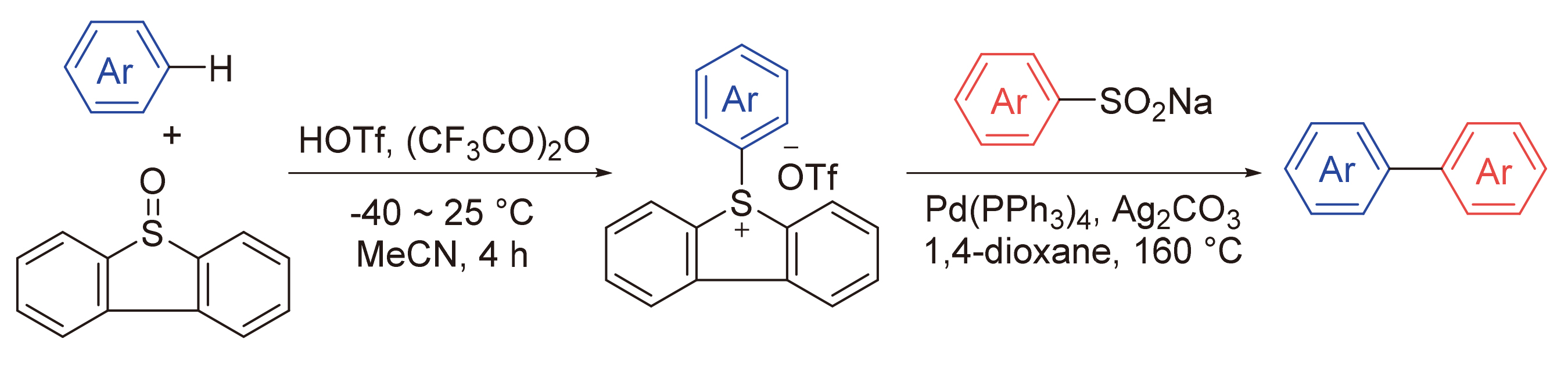
Since sodium sulfinate is commercially available as a nucleophile and non-toxic,[11] desulfurization cross coupling with aryl halides via C—X bond (X=Br, OTf) cleavage has become a good means to construct C(sp2)—C(sp2) bonds (Scheme 1a).[12] To achieve an atom-economy pathway, Liuʼs group[13] achieved the cross-coupling of sodium sulfinates with aryl compounds using palladium catalysts and mild oxidants, affording biaryls via direct arylation (Scheme 1b). However, the poor selectivity of C—H bond activation lead to narrow substrate scope, thereby restraining their applications.[14] In comparison, interrupted Pummerer activation is a highly selective method for converting arenes to aryl sulfonium salts, which has become one of the most popular radical cross- coupling partners to construct C(sp2)—C(sp2) bonds.[15]
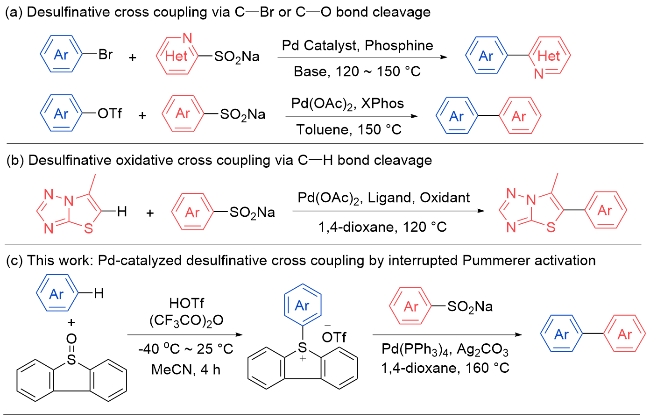
Herein, an efficient and highly regioselective, palladium-catalyzed cross coupling method between aryl sodium sulfinates and aryl sulfonium salts mediated by interrupted Pummerer activation was developed (Scheme 1c). Moreover, a wide variety of sodium sulfinates and sulfonium salts were screened to reveal the robustness of this method. Finally, a late-stage modification on drugs exemplified their potential applications.
2 Results and discussion
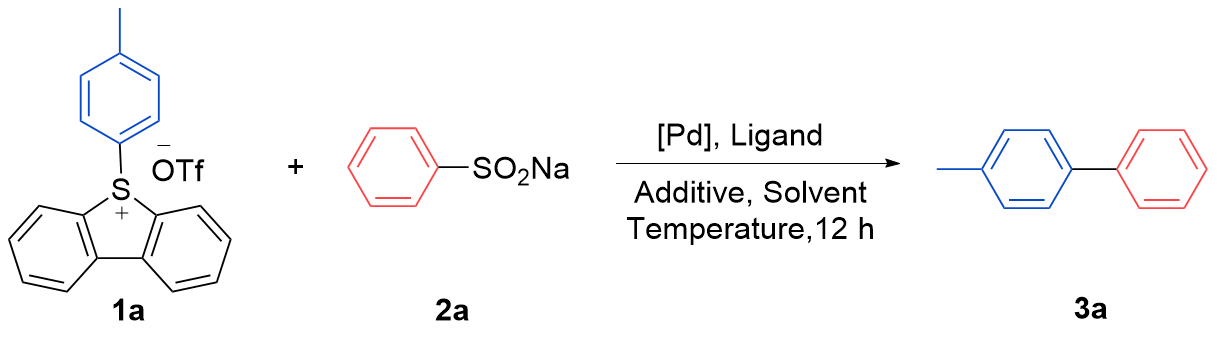
The commercially available sodium benzenesulfinate 2a was firstly selected as the nucleophile and alongside 5-(p- tolyl)-5H-dibenzo[b,d]thiophen-5-ium trifluoromethane- sulfonate (5-tolyl-DBT salt) 1a as an electrophile. The optimization of a model cross-coupling reaction between 1a and 2a was shown in Table 1. Initially, the most commonly used Pd(OAc)2/PCy3 catalytic system for desulfinative coupling reactions was performed[16] to produce 4-methyl- 1,1'-biphenyl 3a in 67% yield using K2CO3 as the additive in 1,4-dioxane solvent at 160 ℃. Next, a couple of monodentate phosphine ligands, including tri-tert-butylphos- phine tetrafluoroborate (P(t-Bu)3H+BF4-), and triphenyl- phosphine (PPh3)4 were screened, the PPh3 favored the production of 3a in 72% yield (Entry 3). Then a couple of bidentate phosphine ligands, including 1,1'-bis(di-tert- butylphosphino)ferrocene (dtbpf) and 1,1'-bis(diphenyl- phosphino)ferrocene (dppf) were screened, producing slightly low yields of 3a (Entries 4~5). Moreover, various additives were screened (Entries 6~10), resulting 3a in a high yield of 78% when adding Ag2CO3 (Entry 10), which may accelerate the step of transmetalation.[16b] Not surprisingly, low reaction temperature sharply decreased the yield (Entry 11), suggesting that the release of SO2 needs high temperature.[16b] Finally, the screen on the solvent such as dimethyl sulfoxide (DMSO) barely improved the yield of 3a (Entry 12),[17] and the yield reduced to 67% when using 5 mol% Pd(PPh3)4. After extensive screening, the catalytic system comprising Pd(PPh3)4 and Ag2CO3 as the additive in 1,4-dioxane at 160 ℃ (Entry 10) was identified as the optimal condition for this desulfinative cross- coupling reactions.
Table 1 Optimization of the Pd-catalyzed desulfinative cross coupling of phenylsulfonium salts with sodium benzenesulfinate a |
| Entry | [Pd] (10 mol%) | Ligand (20 mol%) | Additive (2.0 equiv.) | Solvent | Temperature/℃ | Yieldb/% |
|---|---|---|---|---|---|---|
| 1 | Pd(OAc)2 | PCy3 | K2CO3 | 1,4-dioxane | 160 | 67 |
| 2 | Pd(OAc)2 | P(t-Bu)3H+BF4- | K2CO3 | 1,4-dioxane | 160 | 42 |
| 3 | Pd(PPh3)4 | — | K2CO3 | 1,4-dioxane | 160 | 72 |
| 4 | Pd(OAc)2 | dtbpf | K2CO3 | 1,4-dioxane | 160 | 63 |
| 5 | Pd(OAc)2 | dppf | K2CO3 | 1,4-dioxane | 160 | 61 |
| 6 | Pd(PPh3)4 | — | KOt-Bu | 1,4-dioxane | 160 | 16 |
| 7 | Pd(PPh3)4 | — | KF | 1,4-dioxane | 160 | 71 |
| 8 | Pd(PPh3)4 | — | Cs2CO3 | 1,4-dioxane | 160 | 16 |
| 9 | Pd(PPh3)4 | — | AgOAc | 1,4-dioxane | 160 | 68 |
| 10 | Pd(PPh3)4 | — | Ag2CO3 | 1,4-dioxane | 160 | 78 (72)c |
| 11 | Pd(PPh3)4 | — | Ag2CO3 | 1,4-dioxane | 110 | 31 |
| 12 | Pd(PPh3)4 | — | Ag2CO3 | DMSO | 160 | 72 |
a Reaction conditions: 1a (0.1 mmol), 2a (0.2 mmol), [Pd] catalyst (10 mol%), ligand (bidentate: 10 mol%, monodentate: 20 mol%), additive (2.0 equiv.), solvent (2.0 mL), temperature, in 12 h. b Yield based on GC analysis using anthracene as the internal standard. c Isolated yield. |
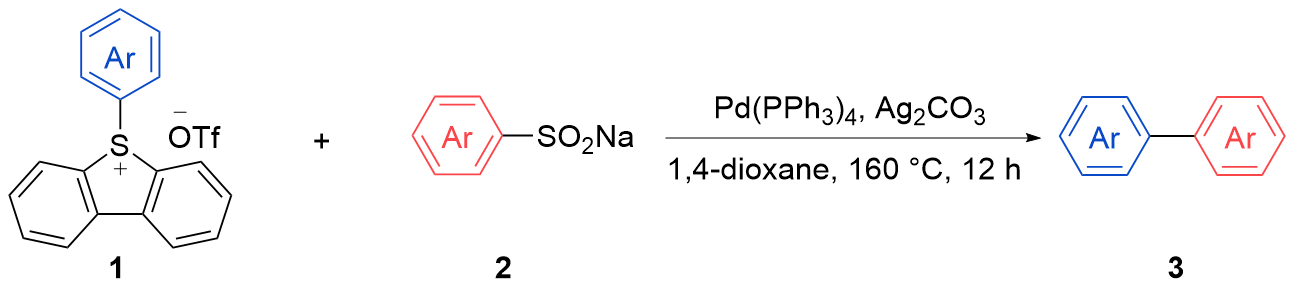
Considering the limitation in synthesizing sodium heteroaryl-2-sulfinate, various phenyl electrophiles were screened (Table 2). First, a series of para-substituted benzyl sulfonium salts, including 4-isopropyl, 4-tert-butyl, 4-butanoate, 4-chloro and 4-fluorine benzyl sulfonium salts were screened to afford corresponding products 3b~3f in yields ranging from 75% to 62%. Apparently, the electron- donating substituents in a phenyl ring reduced the reactivities of desulfinative cross coupling. The screen of chlorine disubstituted or methyl trisubstituted phenyl DBT salts as the electrophiles afforded cross coupling products (3g~3h) in moderate yields of 69% and 68%, respectively, which indicated that the different electronic properties of methyl and chlorine groups barely affect the desulfinative reaction. Next, a series of disubstituted phenyl-derived DBT salts were investigated, including 3-ester-4-methoxy, 3-triflate-4-methoxy, 3-nitrile-4-ethoxy, 3-aldehyde-4- methoxy, 3,4-dimethoxy, 2-methoxy-5-trifluoromethyl and 2-methoxy-5-nitrile groups; the corresponding products 3i~3o were obtained in yields ranging from 41% to 81%. A phenyl DBT salt (2p) reacted with 1a to produce 3p in a low yield of 39%, probably due to the instability of the product. Electronic-rich thiophene DBT salt (2q) reacted with 1a to produce 3q in a low yield of 31%. Subsequently, various sodium sulfinates were also scrutinized with electrophile 1i (Table 2). Initially, sodium 4-methyl- benzenesulfinate (1b) and sodium 2-methylbenzenesul- finate (1c) were chosen as nucleophiles to investigate the effect of methyl substitution position on the phenyl ring. The para-substituted sulfinate 2b reacted with 1i to afford product 3A in 83% yield, whereas the ortho-substituted sulfinate 2c only gave product 3B in 65% yield, which was attributed to steric hindrance. Then, a series of para-sub- stituted sodium benzenesulfinates, including those bearing 4-trifluoromethoxy, 4-n-butyl, 4-tert-butyl, 4-trifluoro- methyl and 4-chloro substituents, were screened to afford corresponding products 3C~3G in yields ranging from 76% to 46%. Finally, the dimethyl-substituted sodium benzenesulfinate as the nucleophile afforded cross coupling product (3H) in moderate yield of 59%. Obviously, electron-donating substituents in phenyl ring reduced the reactivities of desulfinative reactions.
Table 2 Scope of aryl electrophiles and aryl nucleophilesa |
| Scope of aryl electrophiles |
|---|
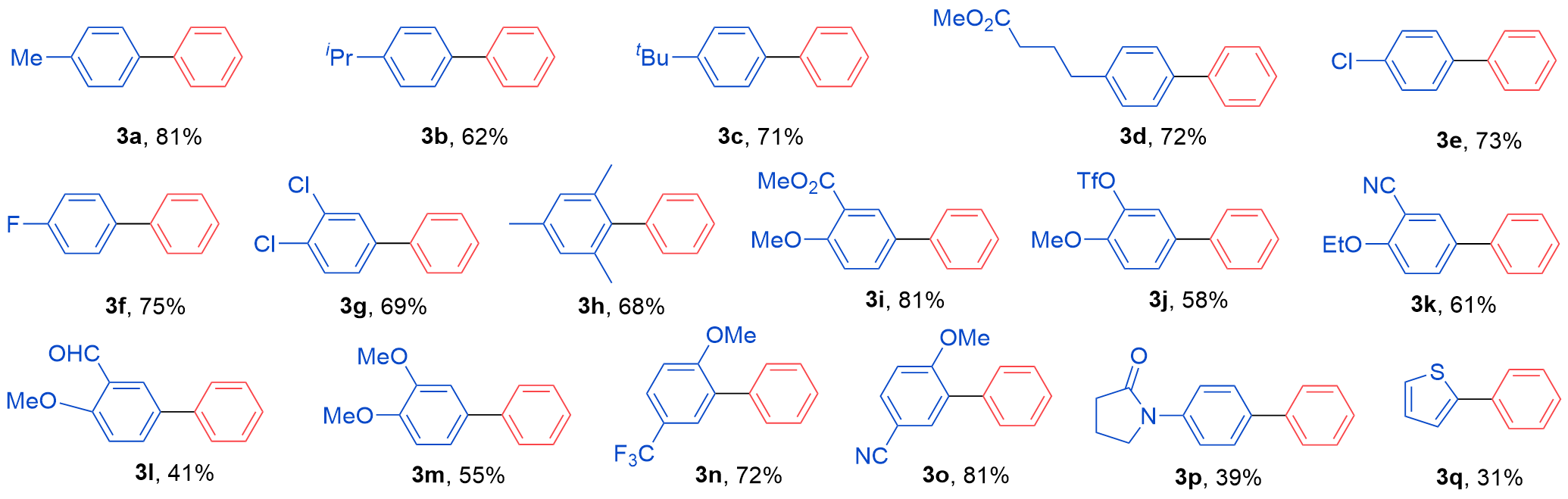 |
| Scope of aryl nucleophiles |
 |
a Reaction conditions: 1 (0.1 mmol), 2 (0.2 mmol), Pd(PPh3)4 (10 mol%), Ag2CO3 (2.0 equiv.), 1,4-dioxane (2.0 mL), 160 ℃, and 12 h. Isolated yield. |
To probe the reaction mechanism, radical trapping experiment was performed (Scheme 2a), considering that sulfur salts might generate radicals under light conditions.[15g] Radical scavengers including 2,2,6,6-tetra- methylpiperidin-1-yl)oxyl (TEMPO) and 1,1-diphenyleth- ylene (DPE) were added to the model reaction, respectively. The yield of 3a only decreased slightly, indicating that this reaction does not involve a radical process.. Moreover, a scalable reaction produced 1.4 g of 3i in 73% isolated yield, indicating the robustness and scalability of this cross-coupling reaction (Scheme 2b). Late stage functionalization has great advantages in the synthesis of drugs, natural products and functional materials.[18] To functionalize the important drugs Clofibrate and Fenofibrate, our method was performed to synthesize drug candidates 4~5 in high yields (Scheme 2c), as well as exhibiting excellent site selectivity, which suggest that our method provides a new approach for the late-stage functionalization of the drugs.
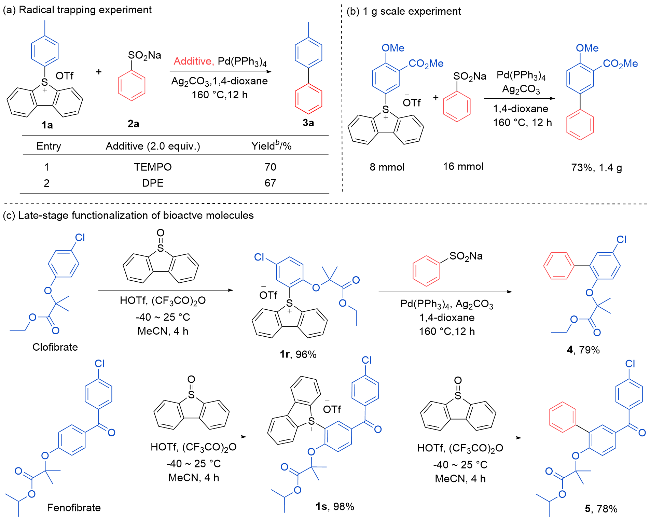


Scheme 2 (a) Radical trapping experiments; (b) 1 g scale experiment; (c) Late-stage functionalization of bioactive moleculeReaction conditions: (a) 1a (0.1 mmol), 2a (0.2 mmol), Pd(PPh3)4 (10 mol%), Ag2CO3 (2.0 equiv.), radical inhibitors (2.0 equiv.), 1,4-dioxane (2.0 mL), 160 ℃ and 12 h. (b) 1a (8.0 mmol), 2a (12.0 mmol), Pd(PPh3)4 (10 mol%), Ag2CO3 (2.0 equiv.), 1,4-dioxane (40.0 mL), 160 ℃ and 12 h. |
3 Conclusions
In summary, an efficient cross-coupling reaction between aryl sodium sulfinates and aryl sulfonium salts has been developed via the interrupted Pummerer activation. This protocol exhibits broad substrate generality, as demonstrated by the coupling with diverse phenyl sodium sulfinate nucleophiles and aryl sulfonium salt electrophiles. Furthermore, Furthermore, late-stage drug functionalization offers novel strategies for the practical application of this method.
4 Experimental section
4.1 General experimental information
1H NMR and 13C NMR were obtained on a JNM-ECZ 500 MHz nuclear magnetic resonance spectrometer. Chemical shifts are downfield from tetramethylsilane using the residual solvent signal (CDCl3 δ 7.26, or TMS δ 0.00) as internal standard. 13C NMR spectra are relative to residual CHCl3 (δ 77.16). ESI MS spectra were obtained on a Q Exactive Focus LCMS (Thermo Scientific Company, USA). Gas-chromatographic mass spectrometry was tested by SHIMADZU GCMS-QP2020 NX, which was using helium as carrier gas and using anthracene as standard substance.
Pd(PPh3)4 and Pd(OAc)2 were purchased from Sigma- Aldrich. The anhydrous dimethylacetamide (DMAc), anhydrous dioxane and anhydrous dimethyl sulfoxide (DM- SO) were obtained from JK-Medical. Anthracene, PPh3, P(t-Bu)3•H+BF4- and PCy3 were purchased from Aladdin. dppf, dippf, K2HPO4, KF, K3PO4, and Xphos were obtained from Bidepharmatech. Sodium benzenesulfinate, KOt-Bu, KI, dtbpf, dppp, dppe, Cs2CO3, Ag2CO3, AgOAc, and NH4Cl were obtained from Energy-Chemical. Other compounds ware prepared based on previous literature. Unless otherwise stated, all reactants or reagents (including dry solvents) were purchased from commercial suppliers and used as received.
4.2 General procedures
Under nitrogen, a dry oven-dried pressure tube (25.0 mL) equipped with a stir bar was charged with trifluoromethanesulfonate (0.1 mmol), sodium arylsulfinate (0.2 mmol), Pd(PPh3)4 (11.6 mg, 0.01 mmol), and Ag2CO3 (41.4 mg, 0.15 mmol). The mixture was dissolved in anhydrous 1,4-dioxane (2.0 mL), which was stirred at 160 ℃ for 12 h. After the mixture was cooled to room temperature and quenched with 2.0 mol/L NaCl aqueous solution (4.0 mL), the organic layer was extracted with dichloromethane (4.0 mL×3) and passed through a pad of Na2SO4. The solution was concentrated by rotary evaporator, which was purified by chromatography on silica gel with dichloromethane and hexane as eluent to afford products 3~5.
4-Methyl-1,1'-biphenyl (3a):[19] White solid, 12.8 mg, 76% yield. 1H NMR (500 MHz, CDCl3) δ: 7.66 (d, J=7.5 Hz, 2H), 7.57 (d, J=8.0 Hz, 2H), 7.51 (t, J=7.5 Hz, 2H), 7.40 (t, J=7.5 Hz, 1H), 7.32 (d, J=8.0 Hz, 2H), 2.46 (s, 3H); 13C NMR (126 MHz, CDCl3) δ: 141.28, 138.48, 137.14, 129.62, 128.85, 127.28, 127.13, 127.11, 21.23.
4-Isopropyl-1,1'-biphenyl (3b):[20] Colorless liquid, 12.2 mg, 62% yield. 1H NMR (500 MHz, CDCl3) δ: 7.62 (d, J=7.0 Hz, 2H), 7.58 (d, J=8.0 Hz, 2H), 7.48 (t, J=7.5 Hz, 2H)), 7.38~7.34 (m, 3H), 3.02~2.97 (m, 1H), 1.34 (d, J=7.0 Hz, 6H); 13C NMR (126 MHz, CDCl3) δ: 148.13, 141.31, 138.88, 128.84, 127.22, 127.17, 127.10, 126.99, 33.94, 24.16.
4-(tert-Butyl)-1,1'-biphenyl (3c):[21] White solid, 14.9 mg, 71% yield. 1H NMR (500 MHz, CDCl3) δ: 7.61 (d, J=7.0 Hz 2H), 7.56 (d, J=8.5 Hz, 2H), 7.49 (d, J=7.0 Hz, 2H), 7.43 (t, J=7.5 Hz, 2H), 7.33 (t, J=7.5 Hz, 1H), 1.38 (s, 9H); 13C NMR (126 MHz, CDCl3) δ: 150.41, 141.22, 138.48, 128.84, 127.18, 127.12, 126.94, 125.86, 34.68, 31.52.
Methyl 4-([1,1'-biphenyl]-4-yl)butanoate (3d):[22] White solid, 18.3 mg, 72% yield. 1H NMR (500 MHz, CDCl3) δ: 7.59 (d, J=7.5 Hz, 2H), 7.53 (d, J=8.0 Hz, 2H), 7.45 (t, J=7.5 Hz, 2H)), 7.34~7.25 (m, 3H), 3.68 (s, 3H), 2.71 (t, J=7.0 Hz, 2H), 2.39 (t, J=7.5 Hz, 2H), 2.03~1.98 (m, 2H); 13C NMR (126 MHz, CDCl3) δ: 174.11, 141.17, 140.63, 139.11, 129.06, 128.87, 127.28, 127.14, 51.71, 34.88, 33.55, 29.47, 26.60.
4-Iodo-1,1'-biphenyl (3e):[23] White solid, 13.7 mg, 73% yield. 1H NMR (500 MHz, CDCl3) δ: 7.79 (d, J=8.5 Hz, 2H), 7.57 (d, J=8.0 Hz, 2H), 7.47 (t, J=7.5 Hz, 2H), 7.40 (t, J=7.5 Hz, 1H), 7.35 (d, J=8.5 Hz, 2H); 13C NMR (126 MHz, CDCl3) δ: 140.83, 140.16, 137.96, 129.14, 129.04, 127.83, 127.02, 93.19.
4-Fluoro-1,1'-biphenyl (3f):[24] White solid, 13.3 mg, 68% yield. 1H NMR (500 MHz, CDCl3) δ: 7.58~7.55 (m, 4H), 7.47 (t, J=7.5 Hz, 2H), 7.38 (t, J=7.0 Hz, 1H), 7.16 (t, J=9.0 Hz, 2H); 13C NMR (126 MHz, CDCl3) δ: 163.59, 161.63, 140.39, 137.46, 128.96, 127.16, 115.84, 115.67.
3,4-Dichloro-1,1'-biphenyl (3g):[25] White solid, 15.3 mg, 69% yield. 1H NMR (500 MHz, CDCl3) δ: 7.68 (s, 1H), 7.55 (d, J=7.5 Hz, 2H), 7.52 (d, J=8.5 Hz, 1H), 7.48 (t, J=7.5 Hz, 2H), 7.43~7.40 (m, 2H); 13C NMR (126 MHz, CDCl3) δ: 141.34, 138.86, 132.94, 131.53, 130.80, 129.13, 129.08, 128.25, 127.07, 126.48.
2,4,6-Trimethyl-1,1'-biphenyl (3h):[26] Colorless liquid, 13.3 mg, 68% yield. 1H NMR (500 MHz, CDCl3) δ: 7.45 (t, J=7.5 Hz, 2H), 7.36 (t, J=7.5 Hz, 1H), 7.17 (d, J=8.0 Hz, 2H), 6.97 (s, 2H), 2.36 (s, 3H), 2.03 (s, 6H); 13C NMR (126 MHz, CDCl3) δ: 141.21, 139.19, 136.69, 136.11, 129.43, 128.50, 128.18, 126.63, 21.16, 20.88.
Methyl 4-methoxy-[1,1'-biphenyl]-3-carboxylate (3i):[27] White solid, 19.6 mg, 81% yield. 1H NMR (500 MHz, CDCl3) δ: 8.10 (s, 1H), 7.72 (d, J=7.5 Hz, 1H), 7.57 (d, J=7.5 Hz, 2H), 7.45 (t, J=7.5 Hz, 2H), 7.35 (t, J=7.5 Hz, 1H), 7.07 (d, J=8.5 Hz, 1H), 3.96 (s, 3H), 3.92 (s, 3H); 13C NMR (126 MHz, CDCl3) δ: 166.78, 158.69, 139.86, 133.41, 132.06, 130.42, 128.96, 127.27, 126.85, 120.33, 112.57, 56.32, 52.27.
4-Methoxy-[1,1'-biphenyl]-3-yl trifluoromethanesulfo- nate (3j): White solid, 19.2 mg, 58% yield. 1H NMR (500 MHz, CDCl3) δ: 7.55 (d, J=8.5 Hz, 1H), 7.51 (d, J=7.0 Hz, 2H), 7.45~7.42 (m, 3H), 7.36 (t, J=7.5 Hz, 1H), 7.11 (d, J=8.5 Hz, 1H) 3.95 (s, 3H); 13C NMR (126 MHz, CDCl3) δ: 150.77, 139.09, 134.78, 129.13, 127.74, 126.93, 121.24, 120.18, 117.63, 113.50, 56.48, 29.47; HRMS calcd for C14H12- F3O4S [M+H]+ 332.0330, found 332.0332.
Ethoxy-[1,1'-biphenyl]-3-carbonitrile (3k):[28] Light yellow solid, 13.6 mg, 61% yield. 1H NMR (500 MHz, CDCl3) δ: 7.78 (s, 1H), 7.74 (d, J=9.0 Hz, 1H), 7.52 (d, J=7.5 Hz, 2H), 7.46 (t, J=7.5 Hz, 2H), 7.38 (t, J=7.5 Hz, 1H), 7.03 (d, J=9.0 Hz, 1H), 4.22~4.18 (m, 2H), 1.53 (t, J=7.0 Hz, 3H); 13C NMR (126 MHz, CDCl3) δ: 160.11, 138.87, 134.15, 133.01, 132.28, 129.17, 127.77, 126.78, 116.71, 112.68, 102.55, 65.00, 14.72.
4-Methoxy-[1,1'-biphenyl]-3-carbaldehyde (3l):[29] White solid, 8.7 mg, 41% yield. 1H NMR (500 MHz, CDCl3) δ: 10.52 (s, 1H), 8.09 (s, 1H), 7.82 (d, J=9.0 Hz, 1H), 7.59 (d, J=7.5 Hz, 2H), 7.45 (t, J=7.5 Hz, 2H), 7.36 (t, J=7.5 Hz, 1H), 7.09 (d, J=8.5 Hz, 1H), 3.98 (s, 3H); 13C NMR (126 MHz, CDCl3) δ: 189.95, 161.42, 139.63, 134.49, 133.95, 129.02, 127.45, 127.01, 126.84, 125.03, 112.28, 56.00.
2-Methoxy-5-(trifluoromethyl)-1,1'-biphenyl (3n):[30] Colorless liquid, 18.1 mg, 72% yield. 1H NMR (500 MHz, CDCl3) δ: 7.59~7.57 (m, 2H), 7.52 (d, J=7.0 Hz, 2H), 7.45 (t, J=7.0 Hz, 2H), 7.38 (t, J=8.5 Hz, 1H), 7.05 (d, J=8.5 Hz, 1H), 3.87 (s, 3H); 13C NMR (126 MHz, CDCl3) δ: 159.00, 137.30, 131.25, 129.59, 128.33, 128.07, 128.05, 127.74, 126.01, 111.03, 55.94, 29.47.
6-Methoxy-[1,1'-biphenyl]-3-carbonitrile (3o):[31] Light yellow solid, 16.9 mg, 81% yield. 1H NMR (500 MHz, CDCl3) δ: 7.65 (d, J=8.5 Hz, 1H), 7.60 (s, 1H), 7.48 (d, J=8.0 Hz, 2H), 7.45 (t, J=7.5 Hz, 2H), 7.40 (t, J=7.0 Hz, 1H), 7.04 (d, J=8.0 Hz, 1H), 3.88 (s, 3H); 13C NMR (126 MHz, CDCl3) δ: 159.93, 136.38, 134.57, 133.31, 132.08, 129.49, 128.41, 128.03, 119.32, 111.68, 104.36, 56.00.
1-([1,1'-Biphenyl]-4-yl)pyrrolidin-2-one (3p):[32] White solid, 8.8 mg, 39% yield. 1H NMR (500 MHz, CDCl3) δ: 7.71 (d, J=9.0 Hz, 2H), 7.61~7.58 (m, 4H), 7.45 (d, J=7.5 Hz, 2H), 7.35 (t, J=7.5 Hz, 1H), 3.93 (t, J=7.0 Hz, 2H), 2.66 (t, J=8.0 Hz, 2H), 2.23~2.16 (m, 2H); 13C NMR (126 MHz, CDCl3) δ: 140.65, 138.82, 137.42, 128.95, 127.59, 127.31, 127.05, 120.31, 48.92, 32.91, 18.18.
2-Phenylthiophene (3q):[33] Colorless liquid, 5.0 mg, 31% yield. 1H NMR (500 MHz, CDCl3) δ: 7.64 (d, J=8.0 Hz, 2H), 7.41 (t, J=8.0 Hz, 2H), 7.34~7.29 (m, 3H), 7.11 (t, J=5.0 Hz, 1H); 13C NMR (126 MHz, CDCl3) δ: 144.57, 134.54, 129.02, 128.14, 127.60, 126.09, 124.94, 123.21.
Methyl 4-methoxy-4'-methyl-[1,1'-biphenyl]-3-carboxy-late (3A):[34] White solid, 21.2 mg, 83% yield. 1H NMR (500 MHz, CDCl3) δ: 8.02 (s, 1H), 7.69 (d, J=9.0 Hz, 1H), 7.47 (d, J=8.0 Hz, 2H), 7.25 (d, J=8.0 Hz, 2H), 7.05 (d, J=8.5 Hz, 1H), 3.95 (s, 3H), 3.92 (s, 3H), 2.39 (s, 3H); 13C NMR (126 MHz, CDCl3) δ: 166.86, 158.49, 137.05, 136.99, 133.40, 131.86, 130.20, 129.68, 126.69, 120.32, 112.56, 56.34, 52.26, 21.22.
Methyl 4-methoxy-2'-methyl-[1,1'-biphenyl]-3-carboxy-late (3B):[34] White solid, 16.6 mg, 65% yield. 1H NMR (500 MHz, CDCl3) δ: 7.77 (s, 1H), 7.47~7.41 (m, 3H), 7.24~7.22 (m, 2H), 7.04 (d, J=9.0 Hz, 1H), 3.96 (s, 3H), 3.89 (s, 3H), 2.27 (s, 3H); 13C NMR (126 MHz, CDCl3) δ: 166.78, 158.21, 135.61, 134.27, 132.48, 130.51, 129.95, 129.67, 128.64, 127.53, 126.01, 119.75, 111.90, 56.29, 52.22, 20.61.
Methyl 4-methoxy-4'-(trifluoromethyl)-[1,1'-biphenyl]-3-carboxylate (3C): White solid, 24.8 mg, 76% yield. 1H NMR (500 MHz, CDCl3) δ: 8.01 (s, 1H), 7.68 (d, J=8.5 Hz, 1H), 7.57 (d, J=8.5 Hz, 2H), 7.28 (d, J=8.0 Hz, 2H), 7.07 (d, J=9.0 Hz, 1H) 3.96 (s, 3H), 3.92 (s, 3H); 13C NMR (126 MHz, CDCl3) δ: 166.63, 158.97, 148.67, 138.68, 132.02, 130.44, 128.19, 121.49, 120.51, 119.63, 112.69, 62.45, 56.34, 52.32; HRMS calcd for C16H14F3O4 [M+H]+ 326.0766, found 326.0765.
Methyl 4'-butyl-4-methoxy-[1,1'-biphenyl]-3-carboxy-late (3D): White solid, 16.7 mg, 56% yield. 1H NMR (500 MHz, CDCl3) δ: 8.03 (s, 1H), 7.70 (d, J=9.0 Hz, 1H), 7.49 (d, J=8.0 Hz, 2H), 7.25 (d, J=8.0 Hz, 2H), 7.05 (d, J=8.5 Hz, 1H) 3.95 (s, 3H), 3.92 (s, 3H), 2.66 (t, J=7.5 Hz, 2H), 1.66~1.60 (m, 2H), 1.42~1.36 (m, 2H), 0.96 (t, J=7.5 Hz, 3H); 13C NMR (126 MHz, CDCl3) δ: 166.85, 158.48, 142.10, 137.19, 133.43, 131.89, 130.25, 129.04, 126.69, 120.28, 112.54, 56.32, 52.25, 35.40, 33.79, 22.52, 14.11; HRMS calcd for C19H23O3 [M+H]+ 298.1569, found 298.1566.
Methyl 4'-(tert-butyl)-4-methoxy-[1,1'-biphenyl]-3-carboxylate (3E): White solid, 17.0 mg, 57% yield. 1H NMR (500 MHz, CDCl3) δ: 8.04 (s, 1H), 7.71 (d, J=9.0 Hz, 1H), 7.52 (d, J=8.0 Hz, 2H), 7.46 (d, J=8.0 Hz, 2H), 7.05 (d, J=8.5 Hz, 1H), 3.95 (s, 3H), 3.92 (s, 3H), 1.36 (s, 9H); 13C NMR (126 MHz, CDCl3) δ: 166.87, 158.52, 150.31, 136.99, 133.32, 131.92, 130.31, 126.57, 125.92, 114.87, 112.56, 56.33, 52.25, 34.66, 31.49; HRMS calcd for C19H23O3 [M+H]+ 298.1569, found 298.1567.
Methyl 4-methoxy-4'-(trifluoromethyl)-[1,1'-biphenyl]-3-carboxylate (3F): White solid, 18.9 mg, 61% yield. 1H NMR (500 MHz, CDCl3) δ: 8.06 (s, 1H), 7.72~7.65 (m, 5H), 7.09 (d, J=8.5 Hz, 1H), 3.96 (s, 3H), 3.93 (s, 3H); 13C NMR (126 MHz, CDCl3) δ: 166.57, 159.33, 143.34, 132.18, 131.83, 130.63, 129.45, 127.07, 125.95, 123.32, 120.62, 112.74, 56.36, 52.38; HRMS calcd for C16H14F3O3 [M+H]+ 310.0817, found 310.0815.
Methyl 4'-chloro-4-methoxy-[1,1'-biphenyl]-3-carboxy-late (3G): White solid, 13.5 mg, 49% yield. 1H NMR (500 MHz, CDCl3) δ: 8.00 (s, 1H), 7.67 (d, J=8.5 Hz, 1H), 7.50 (d, J=8.5 Hz, 2H), 7.40 (d, J=8.5 Hz, 2H), 7.06 (d, J=8.5 Hz, 1H), 3.95 (s, 3H), 3.92 (s, 3H); 13C NMR (126 MHz, CDCl3) δ: 166.67, 158.89, 138.34, 133.36, 132.18, 131.89, 130.28, 129.12, 128.10, 120.51, 112.68, 56.36, 52.33; HRMS calcd for C15H14ClO3 [M+H]+ 276.0553, found 276.0551.
Methyl 4-methoxy-2',6'-dimethyl-[1,1'-biphenyl]-3-carboxylate (3H): White solid, 15.9 mg, 59% yield. 1H NMR (500 MHz, CDCl3) δ: 7.59 (s, 1H), 7.26 (d, 1H), 7.16 (t, J=8.5 Hz, 1H), 7.10 (d, J=7.5 Hz, 2H), 7.05 (d, J=8.5 Hz, 1H), 3.95 (s, 3H), 3.86 (s, 3H), 2.02 (s, 6H); 13C NMR (126 MHz, CDCl3) δ: 158.17, 140.47, 139.52, 136.58, 134.33, 132.98, 132.47, 127.50, 127.41, 120.04, 112.26, 56.22, 52.17, 21.06; HRMS calcd for C17H19O3 [M+H]+ 270.1256, found 270.1254.
Ethyl 2-((5-chloro-[1,1'-biphenyl]-2-yl)oxy)-2-methyl-propanoate (4): Light yellow solid, 25.1 mg, 79% yield. 1H NMR (500 MHz, CDCl3) δ: 7.53 (d, J=7.0 Hz, 2H), 7.41 (t, J=7.0 Hz, 2H), 7.31~7.19 (m, 2H), 7.17 (d, J=8.5 Hz, 1H), 6.85 (d, J=8.5 Hz, 1H), 4.23~4.20 (m, 2H), 1.39 (s, 6H), 1.28~1.24 (m, 3H); 13C NMR (126 MHz, CDCl3) δ: 174.26, 151.40, 137.81, 136.20, 130.88, 129.80, 128.08, 127.82, 127.48, 120.19, 80.56, 61.63, 29.47, 25.23, 14.23; HRMS calcd for C18H20ClO3 [M+H]+ 318.1023, found 318.1027.
Isopropyl 2-methyl-2-((5-(4-methylbenzoyl)-[1,1'-biphenyl]-2-yl)oxy)propanoate (5): Light yellow solid, 34.0 mg, 78% yield. 1H NMR (500 MHz, CDCl3) δ: 7.81 (s, 1H), 7.75 (d, J=8.5 Hz, 2H), 7.69 (d, J=8.5 Hz, 1H), 7.56 (d, J=7.5 Hz, 2H), 7.46 (d, J=8.5 Hz, 2H), 7.43 (t, J=7.5 Hz, 2H), 7.36 (t, J=7.5 Hz, 1H), 6.86 (d, J=8.5 Hz, 1H), 5.10~5.06 (m, 1H), 1.57 (s, 6H), 1.22 (d, J=6.5 Hz, 6H); 13C NMR (126 MHz, CDCl3) δ: 194.49, 173.27, 156.92, 138.59, 137.86, 136.48, 133.60, 132.95, 131.35, 130.66, 130.62, 129.76, 128.74, 128.09, 127.44, 115.88, 80.27, 69.48, 25.47, 21.70; HRMS calcd for C26H26ClO4 [M+H]+ 436.1441, found 436.1444.
Supporting Information The supporting information includes the 1H NMR and 13C NMR spectra of compounds 3a~3q, 3A~3H, 4, and 5. The Supporting Information is available free of charge via the Internet at http://sioc-journal.cn/.
(Cheng, F.)