


1 Introduction
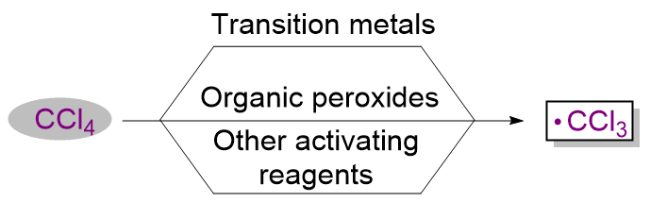
The trichloromethyl group, an important structural motif, is ubiquitously found in both natural products and synthetic compounds, such as pharmaceuticals, agrochemicals, and functional organic materials.[1] Thus, the incorporation of this group into organic frameworks has attracted increasing attention from synthetic chemists. Classical methods include halogenase-enabled C(sp3)—H bond trichloromethylation,[2] Ti-Ru cooperative system-catalyzed selective chloroalkylation of N-acyl oxazolidinones,[3] and others.[4,1f] The difunctionalization of alkenes stands out as a powerful method for simultaneously introducing both the trichloromethyl group and an additional functional group into parent molecules in a single step. Chemists have developed various trichloromethyl sources, including HCCl3,[5] CCl4,[5c,6] BrCCl3,[6b,7] TMSCCl3,[8] and Cl3C- CN,[9] etc.[6b,6d,6g,9,10] to enable such reactions. Notably, the direct utilization of CCl4 for difunctionalization of alkenes via radical C—Cl bond cleavage remains challenging, due to its symmetrical molecular structure and relatively strong bond energy (compared with other C—X bonds, X=Br, I), which inherently diminish its reactivity.[11] Despite the fact that some strategies are available for this transformation, they predominantly rely on transition metal catalysts (e.g., Cu), organic peroxides [e.g., tert-butyl hydroperoxide (TBHP) and di-tert-butyl peroxide (DTBP)], or other environmentally unfriendly activating reagents (Scheme 1).[5c,6] Therefore, more practical and eco-friendly synthetic strategies for radical generation from inert CCl4 to access trichloromethylated molecules through difunctionalization are still highly desirable.
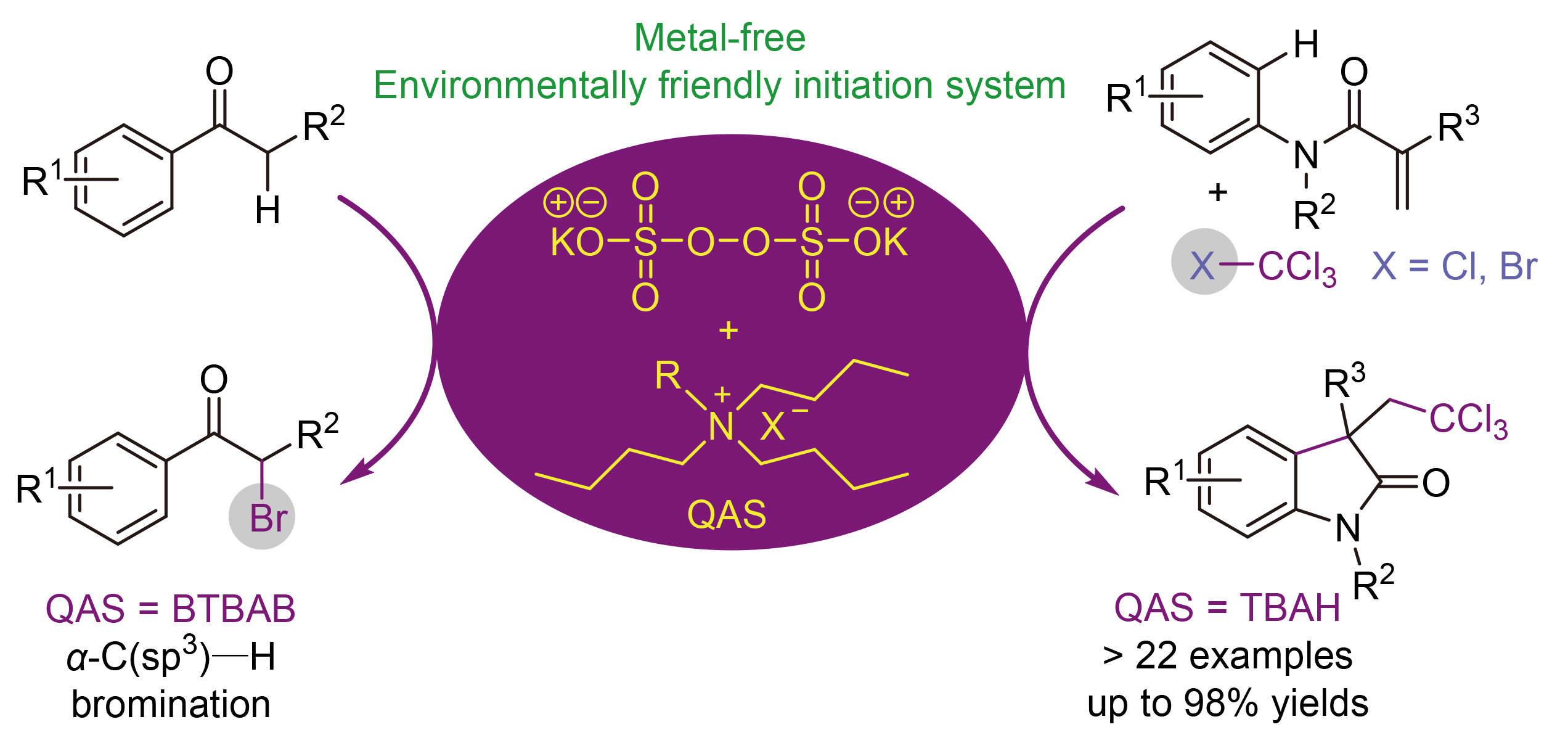
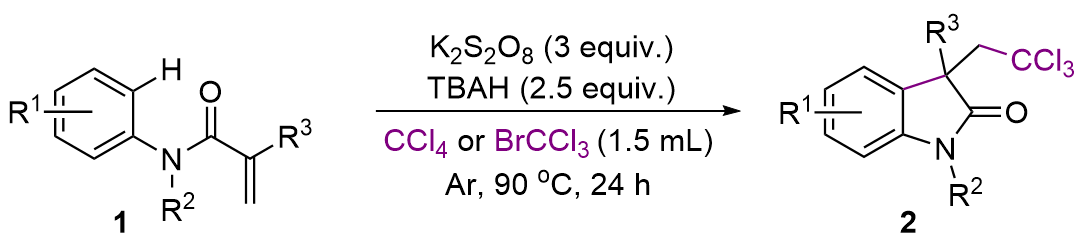
Recently, radical reactions capitalizing on the unique reactivity of the potassium persulfate (K2S2O8)/quaternary ammonium salt (QAS) trigger system have been demonstrated by several groups.[12-13] We developed the radical cascade cyclization of alkenes to synthesize functionalized oxindoles via in situ generation of C-, S-, and O-centered radicals using the combination of K2S2O8 and QAS [i.e., tetra-n-butyl-ammonium hydrogen sulfate (TBAHS) and tetra-n-butylammonium iodide (TBAI), Scheme 2a].[14] Inspired by these works and recent advances in radical reactions,[15] we herein describe a new strategy for generating the •CCl3 radical from inert CCl4 by employing K2S2O8 and low-toxic QAS (tetrabutylammonium hydroxide, TBAH), which allows the efficient and practical synthesis of trichloromethylated oxindoles from activated alkenes (Scheme 2b).
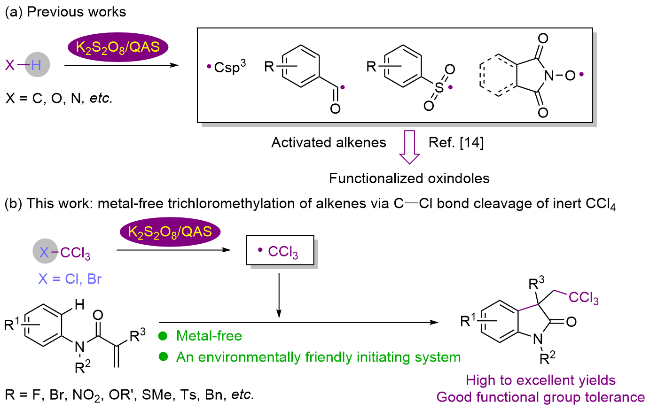
The radical cascade cyclization of alkenes is a valuable method for producing functionalized oxindoles. Over the past few years, many elegant reactions have been developed.[16] The radical trichloromethylation of alkenes with CCl4 to yield trichloromethylated oxindoles was also reported. However, the practicability of these reactions is impeded by the use of toxic or expensive metal reagents (e.g., Cu, Ir, and Mn) and overstoichiometric environmentally unfriendly oxidants or additives (e.g., 2.0 equiv. of Ph2IOTf, N,N-diisopropylethylamine (DIPEA), and o-tol- ylboronic acid).[17] Additionally, substrates with sterically hindered adjacent substituents on the benzene ring do not work well in most cases. In 2021, Sun, Liu, and Wang’s groups[18] described a metal-free intermolecular Heck-type alkyl radical addition and annulation towards alkylated oxindoles, where reactions of CCl4 and CBr4 with an acylamide provided the corresponding halomethylated oxindoles in 51% and 52% yields, respectively.[19] In 2022, Zhang and coauthors[20] reported a novel electrochemical synthesis of halomethylated oxindoles using carbon felt as the anode and a foam Ni plate as the cathode in an undivided cell containing DMF and n-Bu4NBF4 at 100 ℃. However, this reaction mainly deals with the cleavage of C—X bonds in freon-type methanes to generate •CHX1X2 (X1, X2=F, Cl, Br, I) radicals, while symmetrical haloalkanes are difficult to be activated under these conditions. For example, only a 19% yield of trichloromethylated oxindole was obtained by reacting the acylamide with CCl4.
We report herein the first K2S2O8/QAS-promoted radical C—Cl bond cleavage of inert CCl4 and subsequent cyclization of alkenes (Scheme 2b). The current reaction obviates the need for transition metals and other environmentally unfriendly reagents, well overcoming the limitations existing in previous works.[17-20] Notably, the employment of a K2S2O8/QAS system not only ensures broad functional group compatibility but also delivers consistently high reaction yields, especially for substrates containing sterically hindered ortho-substituents, which are usually not reactive in established methods but are productive under the current reaction conditions. Furthermore, the K2S2O8/QAS system was applied to the radical α-C(sp3)—H bromination of ke- tones.[21-22]
2 Results and discussion
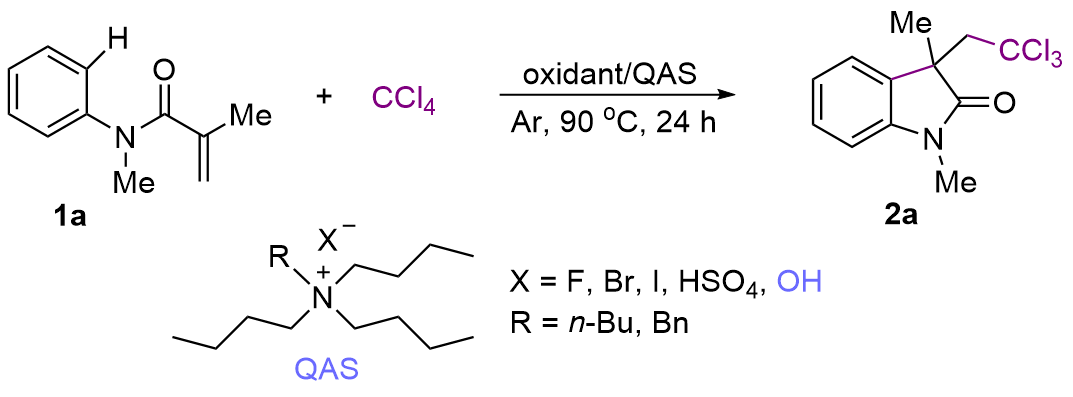
By heating a mixture of N-methyl-N-phenylmethacryl- amide (1a, 0.2 mmol) in anhydrous CCl4 (1.5 mL) at 90 ℃ under Ar in the presence of potassium persulfate (K2S2O8, 2.0 equiv.) and tetra-n-butylammonium iodide (TBAI, 2.0 equiv.) for 24 h, the trichloromethylated oxindole 2a was produced in 45% yield (Table 1, Entry 1). Both K2S2O8 and QAS are essential to this reaction. In the absence of either species, no reaction was observed (Table 1, Entries 2 and 3). A series of QAS were investigated subsequently. Upon addition of 2.0 equiv. of tetra-n-butyl- ammonium hydrogen sulfate (TBAHS), the yield of 2a increased to 47% (Table 1, Entry 4). However, employment of 2.0 equiv. of tetra-n-butylammonium bromide (TBAB) or benzyl tributyl ammonium bromide (BTBAB) afforded a low yield (Table 1, Entries 5 and 6). The results could be ascribed to the facile oxidation of bromide anion (Br-) in the reaction system.[23] Under similar reaction con- ditions, tetra-n-butylammonium fluoride (TBAF) could also promote the reaction with a good yield of 65% (Table 1, Entry 7). To our delight, using tetra-n-butylammonium hydroxide (TBAH) improved the yield of 2a to 73% (Table 1, Entry 8). The loadings of both QAS and the oxidant were also screened, indicating that the use of 2.5 equiv. of TBAH and 3.0 equiv.of K2S2O8 is more suitable for this reaction (Table 1, Entry 12 vs Entries 8~11). When the reaction was carried out at 100 ℃, the yield of 2a decreased to 83% (Table 1, Entry 13). With the continued use of the K2S2O8/TBAH system, the reaction of 1a in CCl4 at 90 ℃ for 36 h afforded the desired 2a in 91% yield (Table 1, Entry 14). Thus, the optimal reaction conditions were found to be 3.0 equiv. of K2S2O8 and 2.5 equiv. of TBAH in anhydrous CCl4 at 90 ℃ under Ar for 24 h.[24]
Table 1 Optimization of the reaction conditionsa |
| Entry | Oxidant (equiv.) | QAS (equiv.) | Yieldb/% |
|---|---|---|---|
| 1 | K2S2O8 (2.0) | TBAI (n-Bu4NI, 2.0) | 45 |
| 2 | K2S2O8 (2.0) | None | 0 |
| 3 | None | TBAI (n-Bu4NI, 2.0) | 0 |
| 4 | K2S2O8 (2.0) | TBAHS (n-Bu4NHSO4, 2.0) | 47 |
| 5 | K2S2O8 (2.0) | TBAB (n-Bu4NBr, 2.0) | 10 |
| 6 | K2S2O8 (2.0) | BTBAB (n-Bu3NBnBr, 2.0) | 13 |
| 7 | K2S2O8 (2.0) | TBAF (n-Bu4NF, 2.0) | 65 |
| 8 | K2S2O8 (2.0) | TBAH (n-Bu4NOH, 2.0) | 73 |
| 9 | K2S2O8 (2.0) | TBAH (n-Bu4NOH, 1.5) | 80 |
| 10 | K2S2O8 (2.0) | TBAH (n-Bu4NOH, 2.5) | 85 |
| 11 | K2S2O8 (2.5) | TBAH (n-Bu4NOH, 2.5) | 92 |
| 12 | K2S2O8 (3.0) | TBAH (n-Bu4NOH, 2.5) | 95 |
| 13c | K2S2O8 (3.0) | TBAH (n-Bu4NOH, 2.5) | 83 |
| 14d | K2S2O8 (3.0) | TBAH (n-Bu4NOH, 2.5) | 91 |
a General reaction conditions: 1a (0.2 mmol), CCl4 (extra dry, 1.5 mL). b Isolated yields. c 100 ℃. d 36 h. |
With the optimized conditions in hand, the substrate scope of the trichloromethylation reaction was explored, and the results are summarized in Table 2. A variety of N-arylacrylamides can be used in the present reaction to give the corresponding trichloromethylated oxindoles in high to excellent yields. Both electron-donating and electron-withdrawing groups on the benzene rings are tolerated under the current reaction conditions (2b~2j, 2l and 2m). Notably, the para-NO2-substituted N-arylacylamide, which is usually inert in radical cyclizations, afforded the desired product in 67% yield (2b).[14b,18,25] A meta-substituted substrate was found to be reactive to give a mixture of regioisomers in 91% yield (the ratio of 2e/2e' was ca. 1∶3.3). The ortho-substituted N-arylacylamides did not work well in the established reactions using transition-metal-catalysts and/or environmentally unfriendly oxidants due to their steric hindrance.[17] However, to our delight, a range of ortho-substituted derivatives bearing different functional groups, such as ethoxy, (cyclopropyl)methoxy, phenoxy, methylthio, and fluoro groups, are also workable and selectively give the desired products in excellent yields (2f~2j). N-Methyl-N-(naphthalen-1-yl)methacrylamide also worked well (2k). The N-substituent was also investigated, and all selected derivatives could be converted into the corresponding cyclized oxindoles in good yields (2l~2p). Substrates bearing CH2OAc and 1,3-dioxoisoindolin-2-yl groups at the α-position of the olefin moiety also showed good reactivity in this reaction (2q and 2r). However, the α-CH2OH derivative gave a complex mixture of unidentified products (2s). The result is perhaps ascribed to the facile oxidation of the hydroxyl group in the current reaction system. It is worth noting that a three-cyclic product was produced in good yield when tetrahydrobenzo[b]aze- pine derivative was used under the reaction conditions (2t). When a substrate bearing a quinoline ring on the N-atom was used, the desired 2u was not generated, while the difunctionalized product 2u' was obtained in 41% yield. An N-pyridine derivative remained unreacted under the reaction conditions (2v). Under similar reaction conditions, the trichloromethylation of N-arylacrylamides with readily available bromotrichloromethane (BrCCl3) via selective C—Br bond cleavage was also explored, and all selected substrates were converted into the expected cyclized products in excellent yields (2a, 2g, 2l, 2q and 2r).
Table 2 Scope of the trichloromethylation reactiona,b |
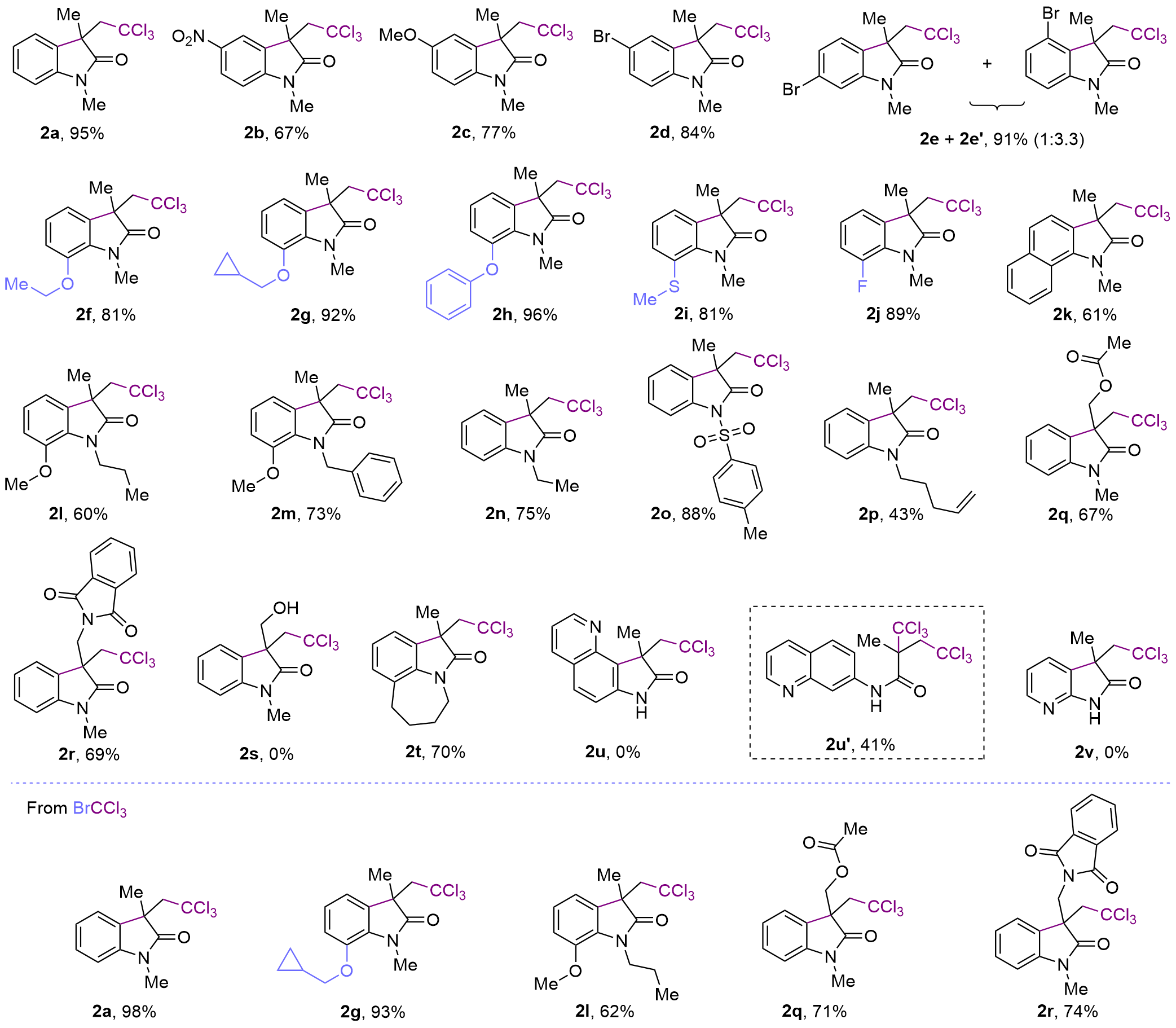 |
a General reaction conditions: N-arylacrylamides 1 (0.2 mmol), K2S2O8 (3.0 equiv.), and TBAH (2.5 equiv.) in CCl4 or BrCCl3 (extra dry, 1.5 mL) under Ar at 90 ℃ for 24 h. b Isolated yields. |
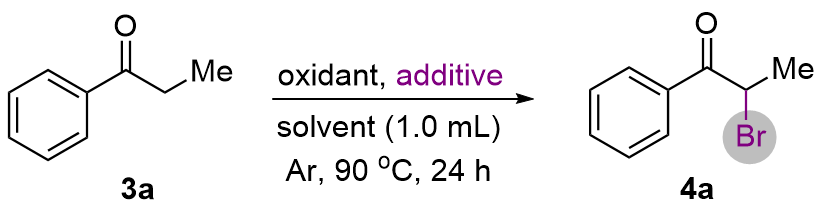
Encouraged by the reaction results mentioned above, we decided to expand the substrate scope to ketones. However, the reaction of propiophenone (3a) progressed sluggishly under the trichloromethylation conditions. After extensive evaluation, it was found that treating 3a with the combination of K2S2O8 (2.0 equiv.) and BTBAB (2.0 equiv.) in PhCF3 under Ar at 90 ℃ for 24 h afforded the α-brominated product (4a) in 78% yield (Table 3, Entry 1). Thus, further optimization of the conditions for α-bromi- nation of ketones was conducted.[24] Elevating the temperature to 100 ℃ resulted in a decreased yield of 4a (Table 3, Entry 2). Screening of various solvents revealed that the reaction performed in PhCF3 was significantly better than in others (Table 3, Entry 1 vs Entries 3~6). Further scree- ning of the loadings of both the oxidant and QAS showed that 2.0 equiv. of K2S2O8 and 2.0 equiv. of BTBAB were adequate for this reaction (Table 3, Entry 1 vs Entries 7~9). Among the brominating reagents screened, TBAB also showed reactivity in PhCF3 solvent, albeit with a yield of 39% (Table 3, Entry 10). However, displacement of BTBAB with KBr (2.0 equiv.) almost completely inhibited the reaction (Table 3, Entry 11). Finally, other inorganic oxidants such as (NH4)2S2O8 and Na2S2O8 were tested, and K2S2O8 was found to be the best choice (Table 3, Entry 1 vs Entries 12 and 13).
Table 3 Optimization of the reaction conditions for the synthesis of α-bromoketones from ketonesa |
| Entry | Oxidant (equiv.) | Additive (equiv.) | Solvent | Yieldb/% |
|---|---|---|---|---|
| 1 | K2S2O8 (2.0) | BTBAB (2.0) | PhCF3 | 78 |
| 2c | K2S2O8 (2.0) | BTBAB (2.0) | PhCF3 | 65 |
| 3 | K2S2O8 (2.0) | BTBAB (2.0) | DMF | 0 |
| 4 | K2S2O8 (2.0) | BTBAB (2.0) | MeCN | Trace |
| 5d | K2S2O8 (2.0) | BTBAB (2.0) | MeCN/H2O | 0 |
| 6 | K2S2O8 (2.0) | BTBAB (2.0) | MeNO2 | 19 |
| 7 | K2S2O8 (2.0) | BTBAB (1.5) | PhCF3 | 71 |
| 8 | K2S2O8 (2.0) | BTBAB (2.5) | PhCF3 | 79 |
| 9 | K2S2O8 (2.5) | BTBAB (2.0) | PhCF3 | 74 |
| 10 | K2S2O8 (2.0) | TBAB (2.0) | PhCF3 | 39 |
| 11 | K2S2O8 (2.0) | KBr (2.0) | PhCF3 | Trace |
| 12 | (NH4)2S2O8 (2.0) | BTBAB (2.0) | PhCF3 | 55 |
| 13 | Na2S2O8 (2.0) | BTBAB (2.0) | PhCF3 | 23 |
a General reaction conditions: 3a (0.5 mmol), solvent (1.0 mL); BTBAB, n-Bu3NBnBr; TBAB, n-Bu4NBr. b Isolated yields. c 100 ℃. d MeCN/H2O (V∶V=1∶1). |
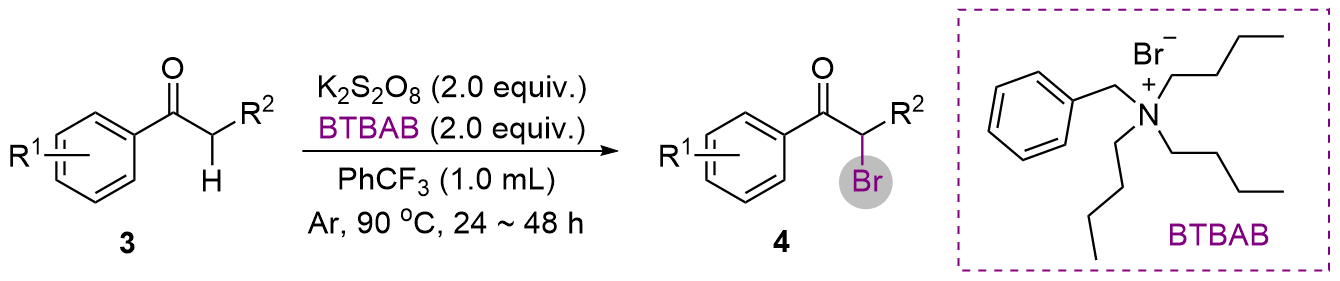
Next, the versatility of the protocol was tested by subjecting various substrates to the optimized conditions for bromination and found that the reaction tolerates a range of ketones. As shown in Table 4, substrates with an electron- donating group (Me) or an electron-withdrawing group (CF3) on the benzene ring all perform well under the current reaction conditions (4b and 4c). Valerophenone also worked well (4d). 1,2-Diphenylethanone with steric hindrance was also amenable to this reaction, albeit in 33% yield (4e). Notably, 2-bromoacetophenone was also a suitable substrate to give the desired product 4f in high yield. It is worth noting that the dibrominated product 4g was produced in good yield when the symmetrical dibenzoylmethane was used. This reaction is also applicable to benzoylcyclohexane (4h). Under similar reaction conditions, the reaction of 1-indanone gave a mixture of carbonyl α-brominated 4i and benzyl dibrominated 4i' in 87% total yield. Heteroaromatic ketones and compounds bearing an ester group are not suitable partners for this reaction. It should be noted that in a NH4Br/oxone-promoted bromination, the reaction of phenylacetone 3a afforded the corresponding α-bromoketone 4a in moderate yield.[26] However, the substrate exhibited excellent reactivity in this K2S2O8/BTBAB bromination system, thus highlighting the distinct advantages of our protocol.
Table 4 Scope of the α-C(sp3)—H bromination of ketonesa,b |
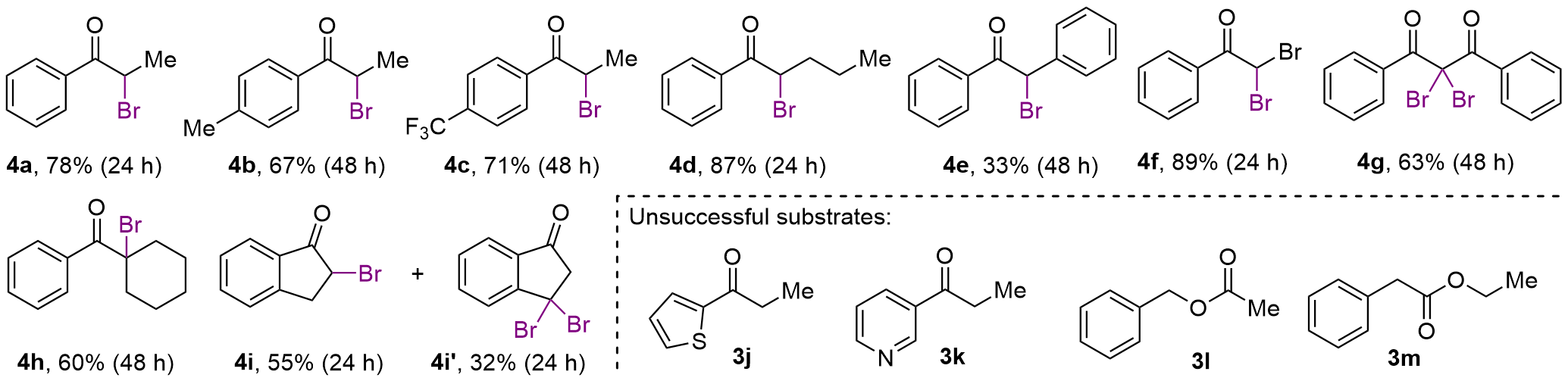 |
a General reaction conditions: ketones 3 (0.5 mmol), K2S2O8 (2.0 equiv.), and BTBAB (2.0 equiv.) in PhCF3 (extra dry, 1.0 mL) under Ar at 90 ℃ for 24~48 h. b Isolated yields. |
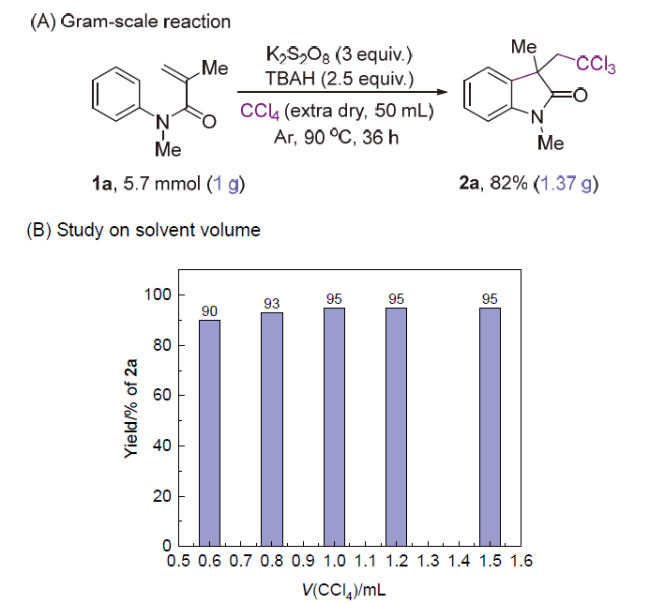
The current K2S2O8/QAS-mediated trichloromethylation reaction can be performed on a gram scale. As shown in Scheme 3, treatment of 1.0 g (5.7 mmol) of 1a in CCl4 under the optimized reaction conditions afforded the corresponding 2a in 82% yield (Scheme 3A, 1.37 g), clearly demonstrating the preparative practicality of this new protocol. It should be noted that the present reaction can proceed well with a relatively small volume of CCl4. For instance, when the volume of CCl4 was reduced to 0.8 mL, the reaction still provided the desired product 2a in high yield; further reducing the volume of CCl4 to 0.6 mL led to a slightly decreased yield (2a, 90%; Scheme 3B).
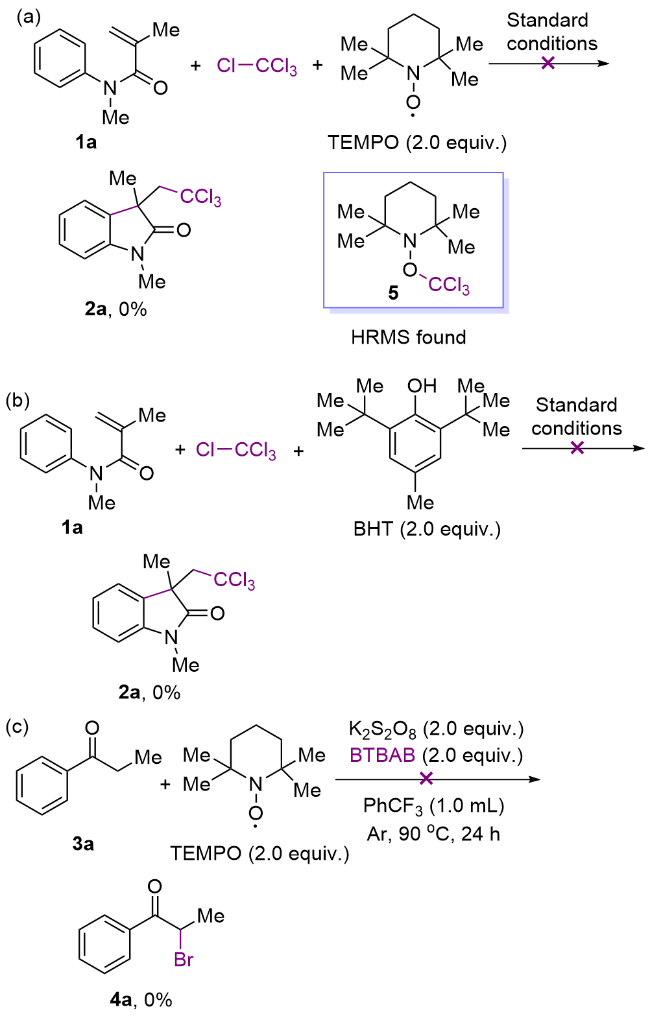
To verify that the reaction follows a radical pathway, quenching experiments were carried out. As shown in Scheme 4, the addition of 2.0 equiv. of radical scavenger 2,2,6,6-tetramethyl-1-piperidinyloxy (TEMPO) completely quenched the reaction, and the corresponding radical adduct 5 was detected by high-resolution mass spectrometry (HRMS) analysis (Scheme 4a). With 2,6-di-tert-butyl-4- methylphenol (BHT), the desired reaction was also inhibited (Scheme 4b). Moreover, when 2.0 equiv. of TEMPO was added to the bromination reaction of 3a, a similar result was obtained (Scheme 4c). The above results indicate that both the trichloromethylation of alkenes and the α-bromination of ketones are radical processes.
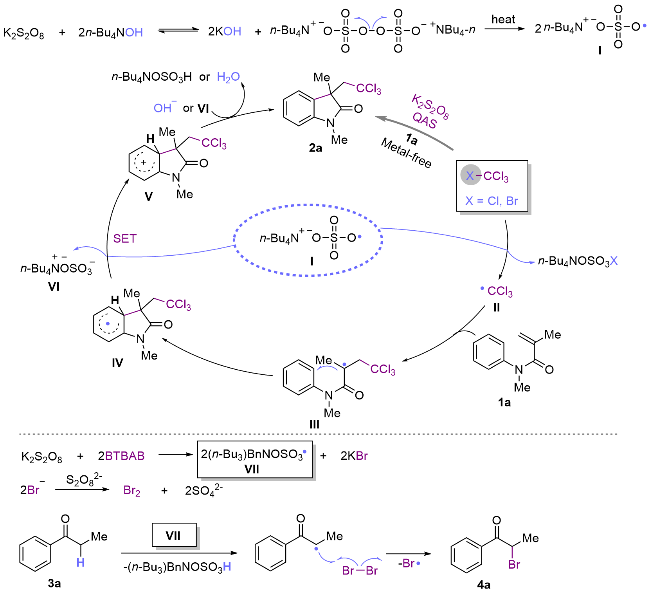
On the basis of these observations and previous literature,[12-14,17,23] two mechanistic scenarios are depicted in Scheme 5. Initially, the reaction of K2S2O8 with TBAH produces bis(tetrabutylammonium) peroxydisulfate inter- mediate, which is further converted into the active tetrabutylammonium sulfate radical anions (n-Bu4N+$\mathrm{SO}_{4}^{-\cdot}$, I) through homolytic O—O bond cleavage under the heating conditions.[14] Then, the radical anions I selectively abstract a halogen atom from CCl4 or BrCCl3, affording the corresponding •CCl3 radical (II).[17a] A similar process was also proposed in the radical addition of alkenes with polyhalomethanes using TBHP.[6f] The subsequent addition of •CCl3 radical to the carbon-carbon double bond of alkene 1a produces an alkyl radical (III).[17a] The resulting radical III then undergoes intramolecular radical cyclization to give the aryl radical (IV).[14,17a] Finally, single-electron oxidation of IV by I gives rise to a carbocation V, which is deprotonated by the generated sulfate dianion (n-Bu4N+\mathrm{SO}_{4}^{2-}, VI) or hydroxide anion (OH-) to give the desired oxindole 2a.[14a] We cannot exclude that the n-Bu4NO- SO3X generated via the aforementioned halogen atom abstraction may undergo reverse O—X bond dissociation to produce the corresponding halogen radicals (e.g., Cl• radical), as this process is kinetically feasible. However, since the reaction of 1a under the optimized reaction conditions gave a 95% yield of the desired 2a (Table 1, Entry 12), we can confirm that even if this process occurs, it exerts no adverse effect on the current reaction. On the other hand, the reaction between K2S2O8 and benzyltri-n-butylammo- nium bromide (BTBAB) produces benzyltributylammonium sulfate radical anions (n-Bu3BnN+$\mathrm{SO}_{4}^{-\cdot}$, VII) and molecular bromine (Br2).[23] The α-C-centered radical, likely generated via hydrogen atom abstraction from the α-C—H bond of ketone (3a) by radical anions VII, then reacts with Br2 to form the corresponding α-bromoketone (4a) along with the formation of bromide radical (Br•), which can also couple with the α-C-centered radical intermediate.[14a-14b] The reaction of QAS with K2S2O8 produces the bis(tetrabutylammonium) peroxydisulfate, which might increase the solubility of the persulfate anion ($\mathrm{S}_{2} \mathrm{O}_{8}^{2-}$) in organic solvent and thus enhance its reactivity, thereby facilitating the above reactions.[12-14]


3 Conclusions
In conclusion, a practical and environmentally friendly K2S2O8/QAS-promoted protocol for generating the trichloromethyl radical (•CCl3) from inert carbon tetrahalides has been developed, which enables the efficient synthesis of trichloromethylated oxindoles through cascade cyclization of activated alkenes. The combination of safe K2S2O8 and low-toxic QAS overcomes the limitations associated with the use of toxic or expensive transition-metal catalysts, overstoichiometric environmentally unfriendly oxidants, and/or other activating reagents in existing protocols. The reaction demonstrates both good functional group tolerance and excellent yields. Moreover, the selective radical α-C(sp3)—H bromination of ketones was also realized by the combination of K2S2O8/QAS. These results clearly demonstrate the potential synthetic value of this eco-friendly protocol in organic synthesis.
4 Experimental section
4.1 General experimental information
All reagents were used in analytical grades and were obtained from common commercial sources. Alkenes 1a~1v were synthesized according to the literature.[27] Potassium persulfate and quaternary ammonium salts were purchased from Sigma-Aldrich. Solvents were purified by standard methods. Products were purified by flash chromatography on silica gel (300~400 mesh, Qingdao Haiyang Chemical Co. Ltd. Gel). 1H and 13C NMR spectra were recorded on 400 MHz or 500 MHz spectrometer (Bruker ADVANCE III). Chemical shifts are reported relative to the residual solvent peak. HRMS were obtained by the ESI model from an ab sciex 500R QTOF or microTOF-Q II instrument.
4.2 General procedure for trichloromethylation reaction
To a 50 mL Schlenk tube were added alkene 1 (0.2 mmol), K2S2O8 (164 mg, 0.6 mmol), TBAH (131 mg, 0.5 mmol), and CCl4 (extra dry, 1.5 mL). Then, the tube was charged with Argon and stirred at 90 ℃ in an oil bath for 24 h. Upon completion, the reaction mixture was extracted with dichloromethane (DCM). The obtained organic layers were dried over Na2SO4, filtered, and concentrated in vacuo. The resulting residue was purified by silica gel column chromatography (petroleum ether/ethyl acetate, V∶V= 16∶1~12∶1) to afford the desired trichloromethylated oxindoles 2.
1,3-Dimethyl-3-(2,2,2-trichloroethyl)indolin-2-one (2a): Colorless oil (55.6 mg, 95% yield). 1H NMR (400 MHz, CDCl3) δ: 7.36~7.29 (m, 2H), 7.06 (t, J=8.1 Hz, 1H), 6.88 (d, J=7.7 Hz, 1H), 3.70 (d, J=15.3 Hz, 1H), 3.34 (d, J=16.3 Hz, 1H), 3.24 (s, 3H), 1.40 (s, 3H); 13C NMR (100 MHz, CDCl3) δ: 178.6, 143.2, 129.5, 128.5, 125.6, 122.0, 108.4, 96.1, 59.8, 48.0, 26.8, 26.6. Data were consistent with those reported in the literature.[17a]
1,3-Dimethyl-5-nitro-3-(2,2,2-trichloroethyl)indolin-2-one (2b): Yellow oil (45 mg, 67% yield). 1H NMR (400 MHz, CDCl3) δ: 8.31~8.27 (m, 2H), 6.97 (d, J=8.6 Hz, 1H), 3.74 (d, J=15.4 Hz, 1H), 3.42 (d, J=15.4 Hz, 1H), 3.31 (s, 3H), 1.46 (s, 3H); 13C NMR (100 MHz, CDCl3) δ: 178.7, 148.8, 143.0, 130.3, 125.8, 121.6, 108.1, 95.5, 59.6, 47.8, 27.0, 26.6; HRMS (ESI) calcd for C12H12Cl3N2O3 [M+H]+ 336.9913, found 336.9910.
5-Methoxy-1,3-dimethyl-3-(2,2,2-trichloroethyl)indolin-2-one (2c): Colorless oil (49.7 mg, 77% yield). 1H NMR (400 MHz, CDCl3) δ: 7.17 (s, 1H), 7.10 (d, J=8.1 Hz, 1H), 6.76 (d, J=7.9 Hz, 1H), 3.68 (d, J=15.2 Hz, 1H), 3.31 (d, J=15.3 Hz, 1H), 3.21 (s, 3H), 2.34 (s, 3H), 1.38 (s, 3H); 13C NMR (100 MHz, CDCl3) δ: 178.5, 140.8, 131.4, 129.5, 128.7, 126.4, 108.1, 96.2, 59.8, 48.0, 26.8, 26.6, 21.1. Data were consistent with those reported in the literature.[17a]
5-Bromo-1,3-dimethyl-3-(2,2,2-trichloroethyl)indolin-2-one (2d): Colorless oil (62.4 mg, 84% yield). 1H NMR (400 MHz, CDCl3) δ: 7.47 (d, J=1.9 Hz, 1H), 7.43 (dd, J=8.3, 2.0 Hz, 1H), 6.76 (d, J=8.3 Hz, 1H), 3.68 (d, J=15.3 Hz, 1H), 3.31 (d, J=15.3 Hz, 1H), 3.21 (s, 3H), 1.39 (s, 3H); 13C NMR (100 MHz, CDCl3) δ: 177.9, 142.3, 131.6, 131.3, 128.8, 114.7, 109.8, 95.8, 59.7, 48.0, 26.7, 26.7. Data were consistent with those reported in the literature.[17a]
6-Bromo-1,3-dimethyl-3-(2,2,2-trichloroethyl)indolin-2-one and 4-Bromo-1,3-dimethyl-3-(2,2,2-trichloroethyl)in- dolin-2-one (2e+2e'): Colorless oil (67.6 mg, 91% yield). 1H NMR (500 MHz, CDCl3) δ: 7.21~7.14 (m, 2.53H), 7.03 (s, 0.31H), 6.83 (dd, J=7.0, 1.8 Hz, 1H), 3.85 (d, J=15.0 Hz, 1H), 3.69 (d, J=15.0 Hz, 0.32H), 3.46 (d, J=15.0 Hz, 1H), 3.32 (d, J=15.0 Hz, 0.38H), 3.22 (d, J=4.9 Hz, 4H), 1.56 (s, 3H), 1.37 (s, 1H); 13C NMR (125 MHz, CDCl3) δ: 178.4, 177.7, 145.2, 144.6, 130.0, 128.4, 128.2, 126.9, 126.7, 124.8, 122.1, 121.2, 112.0, 107.5, 96.0, 95.9, 59.7, 57.0, 49.6, 47.7, 26.7, 26.7, 22.8; HRMS (ESI) calcd for C12H12BrCl3NO [M+H]+ 369.9168, found 369.9163.
7-Ethoxy-1,3-dimethyl-3-(2,2,2-trichloroethyl)indolin-2-one (2f): Colorless oil (54.5 mg, 81% yield). 1H NMR (500 MHz, CDCl3) δ: 6.98~6.94 (m, 2H), 6.84 (dd, J=7.1, 2.2 Hz, 1H), 4.14~4.03 (m, 2H), 3.67 (d, J=15.2 Hz, 1H), 3.52 (s, 3H), 3.30 (d, J=15.3 Hz, 1H), 1.45 (t, J=7.0 Hz, 3H), 1.37 (s, 3H); 13C NMR (125 MHz, CDCl3) δ: 178.8, 144.9, 131.2, 131.2, 122.4, 118.1, 112.8, 96.1, 64.4, 60.0, 48.0, 30.0, 27.0, 14.8; HRMS (ESI) calcd for C14H17- Cl3NO2 [M+H]+ 336.0325, found 336.0322.
7-Cyclopropylmethoxy-1,3-dimethyl-3-(2,2,2-trichloro- ethyl)indolin-2-one (2g): Colorless oil (66.7 mg, 92% yield). 1H NMR (400 MHz, CDCl3) δ: 6.94 (dd, J=4.7, 0.8 Hz, 2H), 6.80 (p, J=3.7 Hz, 1H), 3.92~3.82 (m, 2H), 3.67 (d, J=15.2 Hz, 1H), 3.55 (s, 3H), 3.29 (d, J=15.2 Hz, 1H), 1.37 (s, 3H), 1.27 (dddd, J=13.2, 6.9, 3.2, 2.1 Hz, 1H), 0.67~0.62 (m, 2H), 0.37~0.34 (m, 2H); 13C NMR (100 MHz, CDCl3) δ: 178.8, 145.0, 131.5, 131.3, 122.4, 118.2, 113.3, 96.1, 73.8, 60.0, 48.0, 30.0, 27.1, 10.2, 3.1; HRMS (ESI) calcd for C16H19Cl3NO2 [M+H]+ 362.0481, found 362.0477.
1,3-Dimethyl-7-phenoxy-3-(2,2,2-trichloroethyl)indolin-2-one (2h): Colorless oil (73.9 mg, 96% yield). 1H NMR (400 MHz, CDCl3) δ: 7.35~7.30 (m, 2H), 7.17 (dd, J=7.4, 1.2 Hz, 1H), 7.09~6.99 (m, 2H), 6.93~6.90 (m, 3H), 3.70 (d, J=15.2 Hz, 1H), 3.34 (d, J=15.2 Hz, 1H), 3.35 (m, 3H), 1.43 (s, 3H); 13C NMR (100 MHz, CDCl3) δ: 178.6, 158.4, 140.0, 134.8, 132.2, 129.9, 122.8, 122.7, 121.9, 121.8, 116.8, 96.0, 60.1, 48.0, 29.2, 26.9; HRMS (ESI) calcd for C18H17Cl3NO2 [M+H]+ 384.0325, found 384.0323.
1,3-Dimethyl-7-(methylthio)-3-(2,2,2-trichloroethyl)-indolin-2-one (2i): Colorless oil (54.9 mg, 81% yield). 1H NMR (400 MHz, CDCl3) δ: 7.28 (dd, J=8.0, 1.2 Hz, 1H), 7.19 (dd, J=7.4, 1.2 Hz, 1H), 7.00 (dd, J=8.0, 7.4 Hz, 1H), 3.67 (d, J=15.3 Hz, 1H), 3.68 (s, 3H), 3.29 (d, J=15.3 Hz, 1H), 2.46 (s, 3H), 1.38 (s, 3H); 13C NMR (100 MHz, CDCl3) δ: 179.2, 142.2, 131.8, 130.9, 123.9, 122.5, 119.8, 96.0, 60.0, 47.3, 30.6, 27.0, 19.3; HRMS (ESI) calcd for C13H15Cl3NOS [M+H]+ 337.9940, found 337.9936.
7-Fluoro-1,3-dimethyl-3-(2,2,2-trichloroethyl)indolin-2-one (2j): Colorless oil (55.3 mg, 89% yield). 1H NMR (500 MHz, CDCl3) δ: 7.13 (dd, J=7.2, 1.3 Hz, 1H), 7.04~6.96 (m, 2H), 3.68 (d, J=15.3 Hz, 1H), 3.44 (d, J=2.7 Hz, 3H), 3.32 (d, J=15.3 Hz, 1H), 1.39 (s, 3H); 13C NMR (125 MHz, CDCl3) δ: 178.2, 148.0 (d, J=242.5 Hz), 132.4 (d, J=3.75 Hz), 130.0 (d, J=8.75 Hz), 122.4 (d, J=6.25 Hz), 121.4 (d, J=3.75 Hz), 116.3 (d, J=18.75 Hz), 95.9, 60.0, 48.2 (d, J=2.5 Hz), 29.1 (d, J=6.25 Hz), 27.0. Data were consistent with those reported in the literature.[17a]
1,3-Dimethyl-3-(2,2,2-trichloroethyl)-1,3-dihydro-2H-benzo[g]indol-2-one (2k): Colorless oil (41.8 mg, 61% yield). 1H NMR (400 MHz, CDCl3) δ: 7.77~7.73 (m, 1H), 7.53~7.51 (m, 3H), 7.46~7.40 (m, 1H), 6.95 (dd, J=7.7, 1.0 Hz, 1H), 4.11 (d, J=15.1 Hz, 1H), 3.53 (s, 3H), 3.34 (d, J=15.1 Hz, 1H), 1.85 (s, 3H); 13C NMR (100 MHz, CDCl3) δ: 171.5, 136.3, 133.8, 133.4, 126.9, 126.4, 126.4, 125.0, 122.8, 120.0, 108.7, 96.7, 65.0, 46.9, 33.6, 29.9; HRMS (ESI) calcd for C16H15Cl3NO [M+H]+ 342.0219, found 342.0216.
7-Methoxy-3-methyl-1-propyl-3-(2,2,2-trichloroethyl)-indolin-2-one (2l): Colorless oil (42 mg, 60% yield). 1H NMR (500 MHz, CDCl3) δ: 7.00~6.96 (m, 2H), 6.86 (dd, J=7.3, 2.0 Hz, 1H), 3.97~3.85 (m, 5H), 3.68 (d, J=15.3 Hz, 1H), 3.30 (d, J=15.3 Hz, 1H), 1.71~1.63 (m, 2H), 1.36 (s, 3H), 0.94 (t, J=7.4 Hz, 3H); 13C NMR (125 MHz, CDCl3) δ: 178.5, 145.2, 131.5, 130.9, 122.2, 118.3, 111.9, 96.2, 59.8, 55.7, 48.0, 44.1, 27.6, 22.4, 11.2; HRMS (ESI) calcd for C15H19Cl3NO2 [M+H]+ 350.0481, found 350.0477.
1-Benzyl-7-methoxy-3-methyl-3-(2,2,2-trichloroethyl)-indolin-2-one (2m): Colorless oil (58.2 mg, 73% yield). 1H NMR (500 MHz, CDCl3) δ: 7.34 (d, J=7.2 Hz, 2H), 7.28~7.25 (m, 2H), 7.22~7.19 (m, 1H), 7.01~6.95 (m, 2H), 6.85~6.82 (m, 1H), 5.29 (d, J=14.8 Hz, 1H), 5.11 (d, J=14.9 Hz, 1H), 3.76 (s, 3H), 3.69 (d, J=15.2 Hz, 1H), 3.32 (d, J=15.2 Hz, 1H), 1.40 (s, 3H); 13C NMR (125 MHz, CDCl3) δ: 178.8, 145.2, 138.0, 131.3, 130.7, 128.1, 127.8, 127.0, 122.5, 118.4, 112.1, 96.0, 59.8, 55.6, 48.1, 46.0, 27.7; HRMS (ESI) calcd for C19H19Cl3NO2 [M+H]+ 398.0481, found 398.0479.
1-Ethyl-3-methyl-3-(2,2,2-trichloroethyl)indolin-2-one(2n): Colorless oil (46 mg, 75% yield). 1H NMR (400 MHz, CDCl3) δ: 7.35 (dd, J=7.4, 1.2 Hz, 1H), 7.29 (td, J=7.7, 1.2 Hz, 1H), 7.04 (td, J=7.5, 1.0 Hz, 1H), 6.89 (d, J=7.8 Hz, 1H), 3.89 (dq, J=14.4, 7.2 Hz, 1H), 3.73~3.64 (m, 2H), 3.34 (d, J=15.3 Hz, 1H), 1.38 (s, 3H), 1.25 (t, J=7.2 Hz, 3H); 13C NMR (100 MHz, CDCl3) δ: 178.1, 142.3, 129.8, 128.4, 125.8, 121.7, 108.5, 96.2, 59.7, 47.9, 34.8, 27.1, 12.1. Data were consistent with those reported in the literature.[17a]
3-Methyl-1-tosyl-3-(2,2,2-trichloroethyl)indolin-2-one(2o): Colorless oil (76.2 mg, 88% yield). 1H NMR (400 MHz, CDCl3) δ: 7.38~7.35 (m, 4H), 7.29 (d, J=8.2 Hz, 1H), 7.21 (d, J=8.2 Hz, 2H), 7.11~7.07 (m, 1H), 4.14 (d, J=15.7 Hz, 1H), 3.48 (d, J=15.6 Hz, 1H), 2.37 (s, 3H), 2.04 (s, 3H); 13C NMR (100 MHz, CDCl3) δ: 173.3, 147.7, 138.3, 137.9, 137.5, 129.7, 129.0, 127.2, 124.6, 119.9, 109.8, 97.5, 60.2, 52.1, 22.4, 21.0; HRMS (ESI) calcd for C18H17Cl3NO3S [M+H]+ 431.9994, found 431.9989.
3-Methyl-1-(pent-4-en-1-yl)-3-(2,2,2-trichloroethyl)-indolin-2-one (2p): Colorless oil (29.8 mg, 43% yield). 1H NMR (400 MHz, CDCl3) δ: 7.36 (dd, J=7.5, 1.2 Hz, 1H), 7.31~7.27 (m, 1H), 7.05 (td, J=7.5, 1.0 Hz, 1H), 6.88 (d, J=7.8 Hz, 1H), 5.83 (ddt, J=16.9, 10.2, 6.6 Hz, 1H), 5.09~5.00 (m, 2H), 3.81~3.62 (m, 3H), 3.34 (d, J=15.3 Hz, 1H), 2.17~2.11 (m, 2H), 1.80~1.72 (m, 2H), 1.38 (s, 3H); 13C NMR (100 MHz, CDCl3) δ: 178.4, 142.7, 137.3, 129.7, 128.4, 125.8, 121.8, 115.6, 108.6, 96.2, 59.7, 47.9, 39.8, 31.1, 27.3, 26.2; HRMS (ESI) calcd for C16H19Cl3NO [M+H]+ 346.0532, found 346.0535.
(1-Methyl-2-oxo-3-(2,2,2-trichloroethyl)indolin-3-yl)-methyl acetate (2q): Colorless oil (47 mg, 67% yield). 1H NMR (400 MHz, CDCl3) δ: 7.42 (dd, J=7.5, 1.2 Hz, 1H), 7.35 (td, J=7.8, 1.3 Hz, 1H), 7.06 (td, J=7.6, 1.0 Hz, 1H), 6.89 (d, J=7.8 Hz, 1H), 4.36 (d, J=10.8 Hz, 1H), 4.02 (d, J=10.8 Hz, 1H), 3.71 (d, J=15.2 Hz, 1H), 3.53 (d, J=15.2 Hz, 1H), 3.25 (s, 3H), 1.99 (s, 3H); 13C NMR (100 MHz, CDCl3) δ: 175.3, 170.1, 144.0, 129.3, 127.0, 125.1, 122.0, 108.5, 95.7, 67.9, 55.6, 51.8, 26.7, 20.6; HRMS (ESI) calcd for C14H15Cl3NO3 [M+H]+ 350.0117, found 350.0114.
2-((1-Methyl-2-oxo-3-(2,2,2-trichloroethyl)indolin-3-yl)methyl)isoindoline-1,3-dione (2r): Colorless oil (60 mg, 69% yield). 1H NMR (400 MHz, CDCl3) δ: 7.88~7.82 (m, 2H), 7.78~7.70 (m, 2H), 7.37~7.30 (m, 2H), 7.00 (td, J=7.6, 1.0 Hz, 1H), 6.89~6.87 (m, 1H), 4.01 (d, J=14.1 Hz, 1H), 3.84 (d, J=14.1 Hz, 1H), 3.76 (d, J=15.5 Hz, 1H), 3.25 (s, 3H); 13C NMR (100 MHz, CDCl3) δ: 175.7, 168.0, 143.8, 134.3, 131.6, 129.3, 126.9, 125.1, 123.7, 121.8, 108.6, 95.8, 56.9, 52.0, 45.0, 26.8; HRMS (ESI) calcd for C20H16Cl3N2O3 [M+H]+ 437.0226, found 437.0221.
7-Methyl-7-(2,2,2-trichloroethyl)-1,2,3,4-tetrahydroaze-pino[3,2,1-hi]indol-6(7H)-one (2t): Colorless oil (47 mg, 70% yield). 1H NMR (300 MHz, CDCl3) δ: 7.16 (d, J=5.9 Hz, 1H), 7.00 (d, J=7.6 Hz, 1H), 6.92 (t, J=7.5 Hz, 1H), 3.98~3.94 (m, 2H), 3.67 (d, J=15.2 Hz, 1H), 3.30 (d, J=15.2 Hz, 1H), 3.07~2.87 (m, 2H), 2.08~1.94 (m, 4.8 Hz, 4H), 1.38 (s, 3H); 13C NMR (75 MHz, CDCl3) δ: 178.9, 142.0, 129.7, 125.6, 123.4, 121.8, 96.2, 60.0, 48.1, 41.0, 30.4, 27.1, 26.3, 25.8; HRMS (ESI) calcd for C15H17Cl3NO [M+H]+ 332.0375, found 332.0371.
4,4,4-Trichloro-2-methyl-N-(quinolin-7-yl)-2-(trichloro-methyl)butanamide (2u'): Colorless oil (36.8 mg, 41% yield). 1H NMR (300 MHz, CDCl3) δ: 11.07 (s, 1H), 8.87 (dd, J=4.2, 1.7 Hz, 1H), 8.76 (dd, J=5.9, 3.1 Hz, 1H), 8.20 (d, J=8.2 Hz, 1H), 7.58~7.56 (m, 2H), 7.50 (dd, J=8.3, 4.3 Hz, 1H), 4.12 (d, J=15.4 Hz, 1H), 3.89 (d, J=15.4 Hz, 1H), 2.43 (s, 3H); 13C NMR (75 MHz, CDCl3) δ: 167.6, 148.6, 136.5, 133.9, 128.0, 127.3, 122.5, 121.8, 116.7, 97.0, 95.4, 62.7, 59.9, 29.7; HRMS (ESI) calcd for C15H13Cl6N2O [M+H]+446.9159, found 446.9155.
4.3 General procedure for α-C(sp3)—H bromination of ketones
To a 50 mL Schlenk tube were added ketone 3 (0.5 mmol), K2S2O8 (272 mg, 1.0 mmol), BTBAB (358 mg, 1.0 mmol), and PhCF3 (extra dry, 1.0 mL). Then, the tube was charged with Argon and stirred at 90 ℃ in an oil bath for the time indicated. Upon completion, the reaction mixture was extracted with DCM. The obtained organic layers were dried over Na2SO4, filtered, and concentrated in vacuo. The resulting residue was purified by silica gel column chromatography [V(petroleum ether)∶V(ethyl acetate)=150∶1~80∶1] to afford the desired α-bromoketones 4.
2-Bromo-1-phenylpropan-1-one (4a): Colorless oil (83 mg, 78% yield). 1H NMR (500 MHz, CDCl3) δ: 8.03~8.01 (m, 2H), 7.61~7.59 (m, 1H), 7.52~7.48 (m, 3H), 5.26 (q, J=6.7 Hz, 1H), 1.75 (d, J=6.7 Hz, 3H); 13C NMR (125 MHz, CDCl3) δ: 193.6, 134.1, 133.7, 129.0, 128.8, 41.4, 20.0. Data were consistent with those reported in the literature.[21g-21h]
2-Bromo-1-(p-tolyl)propan-1-one (4b): Colorless oil (76 mg, 67% yield). 1H NMR (400 MHz, CDCl3) δ: 7.93 (d, J=8.3 Hz, 2H), 7.29 (d, J=7.9 Hz, 2H), 5.28 (q, J=6.7 Hz, 1H), 2.43 (s, 3H), 1.89 (d, J=6.6 Hz, 3H); 13C NMR (100 MHz, CDCl3) δ: 193.0, 144.7, 131.5, 129.4, 129.0, 41.5, 21.7, 20.2. Data were consistent with those reported in the literature.[21i-21j]
2-Bromo-1-(4-(trifluoromethyl)phenyl)propan-1-one(4c): Colorless oil (100 mg, 71% yield). 1H NMR (400 MHz, CDCl3) δ: 8.13 (d, J=8.1 Hz, 2H), 7.76 (d, J=8.1 Hz, 2H), 5.26 (q, J=6.6 Hz, 1H), 1.93 (d, J=6.6 Hz, 3H); 13C NMR (100 MHz, CDCl3) δ: 192.3, 134.9 (d, J=33.0 Hz), 129.3, 125.8 (dd, J=7.0, 4.0 Hz), 123.5 (d, J=271.0 Hz), 41.3, 19.9. Data were consistent with those reported in the literature.[21k]
2-Bromo-1-phenylpentan-1-one (4d): Colorless oil (105 mg, 87% yield). 1H NMR (500 MHz, CDCl3) δ: 8.03~8.01 (m, 2H), 7.61~7.58 (m, 1H), 7.51~7.47 (m, 2H), 5.15 (dd, J=7.9, 6.4 Hz, 1H), 2.22~2.08 (m, 2H), 1.57 (dddd, J=12.9, 9.5, 7.4, 5.4 Hz, 1H), 1.45 (dddd, J=13.3, 9.8, 7.4, 6.0 Hz, 1H), 0.99 (t, J=7.4 Hz, 3H); 13C NMR (125 MHz, CDCl3) δ: 193.3, 134.5, 133.6, 128.8, 128.7, 47.0, 35.4, 20.7, 13.6. Data were consistent with those reported in the literature.[21l]
2-Bromo-1,2-diphenylethan-1-one (4e): Colorless oil (45.4 mg, 33% yield). 1H NMR (500 MHz, CDCl3) δ: 8.00~7.98 (m, 2H), 7.58~7.52 (m, 3H), 7.47~7.44 (m, 2H), 7.39~7.33 (m, 3H), 6.38 (s, 1H); 13C NMR (125 MHz, CDCl3) δ: 191.1, 135.9, 134.2, 133.7, 129.1, 129.0, 128.8, 51.0. Data were consistent with those reported in the literature.[21g-21h]
2,2-Dibromo-1-phenylethan-1-one (4f): Colorless oil (123.7 mg, 89% yield). 1H NMR (300 MHz, CDCl3) δ: 8.08 (d, J=7.2 Hz, 2H), 7.64 (t, J=7.4 Hz, 1H), 7.51 (t, J=7.6 Hz, 2H), 6.72 (s, 1H); 13C NMR (75 MHz, CDCl3) δ: 185.9, 134.4, 130.8, 129.7, 128.9, 39.7; Data were consistent with those reported in the literature.[21h]
2,2-Dibromo-1,3-diphenylpropane-1,3-dione (4g): Colorless oil (120 mg, 63% yield). 1H NMR (300 MHz, CDCl3) δ: 7.95 (d, J=9.0 Hz, 4H), 7.49 (t, J=7.5 Hz, 2H), 7.36 (t, J=7.5 Hz, 4H); 13C NMR (75 MHz, CDCl3) δ: 185.0, 134.9, 134.1, 130.5, 128.6, 69.9; Data were consistent with those reported in the literature.[21b]
(1-Bromocyclohexyl)(phenyl)methanone (4h): Colorless oil (80 mg, 60% yield). 1H NMR (300 MHz, CDCl3) δ: 8.08~8.05 (m, 2H), 7.52 (t, J=7.4 Hz, 1H), 7.42 (dd, J=8.3, 6.7 Hz, 2H), 2.37~2.30 (m, 2H), 2.22~2.13 (m, 2H), 1.79 (dtd, J=12.6, 8.7, 4.1 Hz, 2H), 1.54 (tdd, J=9.3, 7.3, 3.4 Hz, 4H); 13C NMR (75 MHz, CDCl3) δ: 197.5, 135.8, 132.0, 129.8, 128.1, 67.9, 38.2, 24.9, 23.5; Data were consistent with those reported in the literature.[21m]
2-Bromo-2,3-dihydro-1H-inden-1-one (4i): Colorless oil (58 mg, 55% yield). 1H NMR (300 MHz, CDCl3) δ: 7.84 (d, J=7.6 Hz, 1H), 7.69~7.64 (m, 1H), 7.43 (t, J=7.5 Hz, 2H), 4.65 (dd, J=7.5, 3.2 Hz, 1H), 3.88~3.80 (m, 1H), 3.45~3.38 (m, 1H); 13C NMR (75 MHz, CDCl3) δ: 199.6, 151.1, 136.0, 133.5, 128.3, 126.4, 125.1, 44.0, 37.9; Data were consistent with those reported in the literature.[21d]
3,3-Dibromo-2,3-dihydro-1H-inden-1-one (4i'): Colorless oil (46 mg, 32% yield). 1H NMR (300 MHz, CDCl3) δ: 7.94 (d, J=7.7 Hz, 1H), 7.73 (t, J=7.5 Hz, 1H), 7.50 (t, J=7.5 Hz, 1H), 7.40 (d, J=7.7 Hz, 1H), 4.28 (s, 2H); 13C NMR (75 MHz, CDCl3) δ: 192.7, 147.1, 136.9, 129.0, 126.6, 126.0, 56.8, 52.3; HRMS (ESI) calcd for C9H7Br2O [M+H]+ 288.8863, found 288.8859.
4.4 Experimental procedure for the gram-scale reaction of alkene 1a in CCl4
To a 100 mL Schlenk tube were added alkene 1a (1.0 g, 5.7 mmol), K2S2O8 (4.6 g, 17.1 mmol), TBAH (3.7 g, 14.25 mmol) and CCl4 (extra dry, 50 mL). Then, the tube was charged with Argon and stirred at 90 ℃ in an oil bath for 36 h. Upon completion, the reaction mixture was extracted with DCM (50 mL×3). The combined organic layers were washed with brine (30 mL), dried over Na2SO4, filtered, and concentrated in vacuo. The resulting residue was purified by silica gel column chromatography [V(petroleum ether)∶V(ethyl acetate)=15∶1~12∶1) to afford the desired product 2a in 82% yield (1.37 g).
Supporting Information High-resolution mass spectrometry (HRMS) data of 5, 1H NMR and 13C NMR spectra of products 2a~2r, 2t, 2u', 4a~4i and 4i'. The Supporting Information is available free of charge via the Internet at http://sioc-journal.cn/.
(Cheng, F.)