ARTICLES

Chiral P-N-O Ligands for Iridium-Catalyzed Asymmetric Hydrogenation of Aromatic Ketones

  • Wenjie Zhang a, b ,
  • Zhengchao Duan , a, * ,
  • Xiangping Hu , b, *
Expand
  • a School of Chemistry and Environmental Engineering, Hubei Minzu University, Enshi, Hubei 445000
  • b Dalian Institute of Chemical Physics, Chinese Academy of Sciences, Dalian, Liaoning 116023

Received date: 2025-11-03

  Revised date: 2025-12-18

  Online published: 2026-02-02

Supported by

National Natural Science Foundation of China(21267009)

National Natural Science Foundation of China(21262011)

Abstract

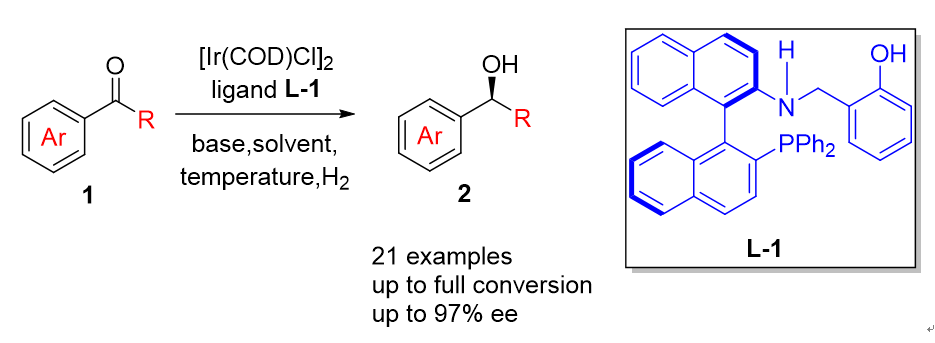
A catalytic system comprising a readily available chiral binaphthyl-based P-N-O tridentate ligand and iridium has been developed for the highly efficient asymmetric hydrogenation of simple aromatic ketones. Using prochiral aromatic ketones as substrates, this system gives the corresponding chiral alcohols in up to >99% yield and 97% enantioselectivity under mild conditions. Systematic optimization of reaction conditions revealed that (R)-2-(((2'-(diphenylphosphaneyl)-[1,1'-binaph- thalen]-2-yl)amino)methyl)phenol (L1) as the ligand, Ba(OH)2 as the base additive, and 95% (ϕ) ethanol as the solvent were critical for achieving excellent performance. The catalytic system exhibits good substrate generality, being applicable to various aromatic ketones and heteroaromatic ketones with different substituents. Furthermore, this method was successfully applied to the synthesis of (S)-3-(dimethylamino)-1-(thiophen-2-yl)propan-1-ol, a key chiral intermediate of the antidepressant (S)-duloxetine, affording the target product with 98% yield and 90% ee, which fully demonstrates its great application potential in practical synthesis.

Cite this article

Wenjie Zhang , Zhengchao Duan , Xiangping Hu . Chiral P-N-O Ligands for Iridium-Catalyzed Asymmetric Hydrogenation of Aromatic Ketones[J]. Chinese Journal of Organic Chemistry, 2026 , 46(5) : 2129 -2137 . DOI: 10.6023/cjoc202511002

1 Introduction

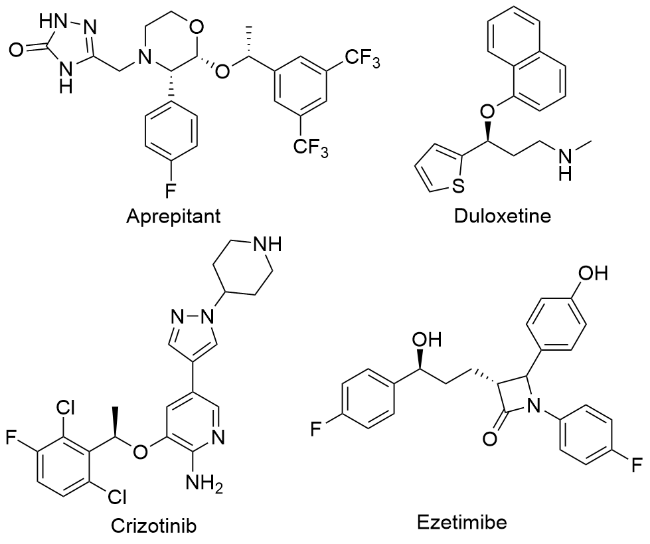
Chiral alcohols are key structural units in many pharmaceutical molecules and fine chemicals. For instance, aprepitant (a drug used to treat chemotherapy-induced nausea and vomiting), duloxetine (a drug for depression), crizotinib (a drug for non-small cell lung cancer), and ezetimibe (a drug for hypercholesterolemia) all contain chiral alcohol structures (Figure 1).[1-3] In recent years, a series of synthetic strategies for chiral alcohols, including asymmetric oxidation,[4-5] have been developed. Among various approaches to chiral alcohol synthesis, asymmetric catalytic hydrogenation of prochiral ketones has been recognized as one of the most attractive methods due to its high atom economy and straightforward, efficient reaction pathway.
Figure 1 Representative chiral alcohol-structured drugs
Within this research domain, catalysts formed by tridentate chiral ligands and transition metals demonstrate excellent chiral induction capability. In the 1990s, the Ru/ diphosphine-diamine catalytic system developed by Noyori et al.[6-8] enabled the highly efficient asymmetric hydrogenation of ketones, which has since become a landmark contribution to this field. Following this breakthrough, a range of tridentate ligands featuring novel structural motifs have been developed in succession. In 1998, Zhang et al.[9] reported the Ru complex of the N-N-N tridentate ligand ambox, which could facilitate the asymmetric hydrogenation of simple ketones under relatively elevated temperatures, achieving an enantiomeric excess (ee) value of 98%. In 2010, the same group[10] further designed the Ru-Indan- ambox catalyst, optimizing the reaction conditions to ambient temperature while maintaining an ee value of 97%. In 2011, Zhou et al.[11] developed a class of chiral tridentate phosphine-nitrogen-nitrogen ligands (SpiroPAP). The complex formed by these ligands with Ir exhibited ultrahigh catalytic activity in the hydrogenation of acetophenone, with a turnover number (TON) reaching up to 4550000, thus establishing a record within this domain. In 2020, the group[12] further designed sterically hindered SpiroPNP ligands, which successfully enabled the highly stereoselective synthesis of various chiral dialkyl alcohols with an ee value exceeding 99%.
Despite the notable successes of the aforementioned systems, chiral P-N-O tridentate ligands that possess structural diversity, facile synthesis, and both high activity and high enantioselectivity still remain relatively scarce, with relatively limited reports on systematic investigations in this regard.[13-17] Between 2009 and 2010, the Liu group[18-20] reported a series of P-N-O ligands with novel structures, which demonstrated favorable catalytic performance in asymmetric Baylis-Hillman reactions. Nevertheless, systematic studies exploring the application of such high-performance P-N-O ligands in the hydrogenation of simple aromatic ketone substrates have yet to be reported.
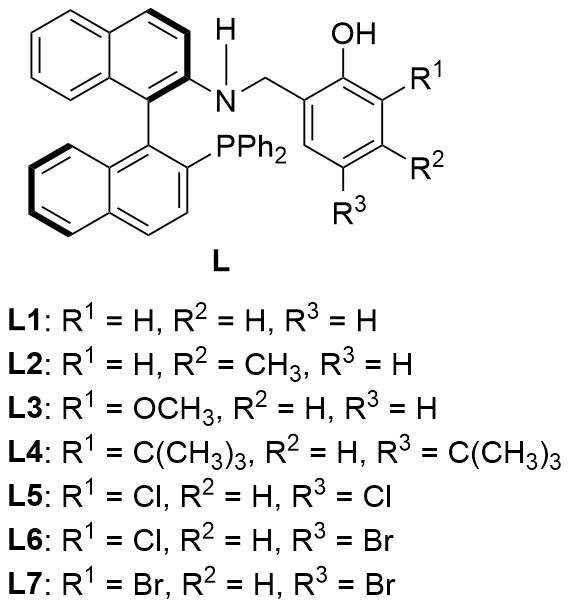
Building upon this background, the present study performed structural modifications on this class of P-N-O ligands, resulting in the development of a series of P-N-O tridentate ligands (Figure 2), which were subsequently applied to the Ir-catalyzed asymmetric hydrogenation of simple aromatic ketones. The influences of the electronic effects and steric hindrance of the ligands on catalytic performance were systematically examined, while the substrate scope of the catalytic system was assessed—with the goal of providing a new catalytic system for the green and highly efficient synthesis of chiral aryl alcohols.
Figure 2 P-N-O tridentate ligand developed in this work

2 Results and discussion

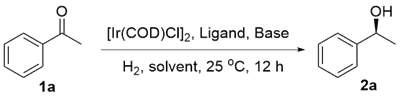
Ligands L1~L7 were first synthesized, and subsequently, with acetophenone (1a) as the model substrate, the performance of the catalytic systems formed by these ligands with iridium in asymmetric hydrogenation reactions was systematically evaluated, while the reaction conditions were optimized.
Initially, the ligand structures were screened. As shown in Entry 1 of Table 1, the unmodified ligand L1 afforded the best reaction performance, achieving 99% conversion and 93% enantioselectivity. Subsequently, different substituents were introduced onto the benzene ring of the phenolic hydroxyl group to investigate electronic and steric hindrance effects. The results indicated that none of the modifications—whether introducing electron-withdrawing groups (e.g., L5, L6, L7), electron-donating groups (e.g., L2, L3), or increasing the steric hindrance of substituents (e.g., L4)—resulted in catalytic performance superior to that of L1 (Entries 2~6). In particular, introducing a methoxy group (L3) resulted in a significant decrease in both catalytic activity (76% conversion) and enantioselectivity (82% ee, Entry 3). This suggests that slight changes in ligand structure exert a significant impact on catalyst performance, with L1 being the optimal structure among this series of ligands.
Table 1 Effect of ligand and basea

Entry Ligand Solvent Base Conv.b/% eec/%
1 L1 EtOH Ba(OH)2 >99 93
2 L2 EtOH Ba(OH)2 >99 92
3 L3 EtOH Ba(OH)2 76 82
4 L4 EtOH Ba(OH)2 >99 73
5 L5 EtOH Ba(OH)2 >99 80
6 L6 EtOH Ba(OH)2 >99 62
7 L7 EtOH Ba(OH)2 >99 73
8 L1 EtOH t-BuONa >99 81
9 L1 EtOH Na2CO3 6 16
10 L1 EtOH Cs2CO3 >99 52
11 L1 EtOH t-BuOK >99 65
12 L1 EtOH LiOH >99 82
13 L1 EtOH KOH >99 62
14 L1 EtOH NaOH >99 87
15 L1 EtOH CH3ONa >99 80

a Reaction conditions: 1a (0.5 mmol, 1 equiv.), [Ir(COD)Cl]2 (0.2 mol%), ligand (0.44 mol%), base (0.2 equiv.), 2 mL of solvent, H2 (5 MPa), room temperature, 12 h, unless otherwise noted. b Determined by 1H NMR analysis. c Determined by chiral HPLC analysis.

After L1 was identified as the dominant ligand, base additives were further screened. The results (Entries 8~15) revealed that the nature of the base is crucial to both reaction activity and enantioselectivity. When Na2CO3 was used, the reaction barely proceeded (only 6% conversion, Entry 9). In contrast, with t-BuONa, t-BuOK, Cs2CO3, LiOH, KOH, NaOH, or CH3ONa, most systems maintained high conversion, but enantioselectivity decreased to varying degrees (ee values ranging from 52% to 87%).
Ultimately, Ba(OH)2 was identified as the optimal base additive, as it could simultaneously ensure high reaction activity and high enantioselectivity.
In solvent screening (Table 2, Entries 1~13), it was found that alcoholic solvents are critical for achieving efficient hydrogenation. Aprotic solvents such as dichloromethane (DCM), 1,2-dichloroethane (DCE), toluene, dimethylformamide (DMF), and tetrahydrofuran (THF) all led to catalyst deactivation (Table 2, Entries 1~3, 5~6). Among alcoholic solvents, 95% ethanol exhibited the best performance, increasing the ee value to 94.4% while maintaining conversion at >99% (Table 2, Entry 9). The use of methanol or isopropanol resulted in a slight decrease in enantioselectivity (Table 2, Entries 4, 7). Notably, the addition of an appropriate amount of water to ethanol facilitated the improvement of enantioselectivity; however, excessively high content of water (e.g., ≥15%) led to significant decreases in both activity and selectivity (Table 2, Entries 11~13). This underscores the practical advantage of employing inexpensive and readily available 95% ethanol as the solvent.
Table 2 Effect of solvent and other conditionsa
Entry Ligand Solvent Base Conv.b/% eec/%
1 L1 DCM Ba(OH)2 — —
2 L1 DCE Ba(OH)2 — —
3 L1 Toluene Ba(OH)2 — —
4 L1 1-Propanol Ba(OH)2 >99 85
5 L1 DMF Ba(OH)2 — —
6 L1 THF Ba(OH)2 — —
7 L1 MeOH Ba(OH)2 >99 93
8 L1 98% EtOH Ba(OH)2 >99 93.8
9 L1 95% EtOH Ba(OH)2 >99 94.4
10 L1 90% EtOH Ba(OH)2 >99 94.2
11 L1 85% EtOH Ba(OH)2 96 91
12 L1 80% EtOH Ba(OH)2 72 86
13 L1 75% EtOH Ba(OH)2 67 81
14d L1 95% EtOH Ba(OH)2 >99 93.8
15e L1 95% EtOH Ba(OH)2 >99 91.3
16f L1 95% EtOH Ba(OH)2 >99 95
17g L1 95% EtOH Ba(OH)2 >99 93
18h L1 95% EtOH Ba(OH)2 80 88
19i L1 95% EtOH Ba(OH)2 >99 (99) 95

a Reaction conditions: 1a (0.5 mmol, 1 equiv.), [Ir(COD)Cl]2 (0.2 mol%), ligand (0.44 mol%), base (0.2 equiv.), 2 mL of solvent [concentrations of ethanol are expressed as percentage by volume], H2 (5 MPa), room temperature, 12 h, unless otherwise noted. b Determined by 1H NMR analysis. c Determined by chiral HPLC analysis. d H2 (6 MPa). e H2 (3 MPa). f 0 ℃. g S/C=1000. h S/C=2000. i 8 mmol of 1a, S/C=500, 0 ℃. Isolated yield was obtained in parentheses.

The influence of hydrogen pressure was then investigated (Entries 14~15). The reaction performed best under a hydrogen pressure of 5.0 MPa; either increasing (6.0 MPa) or decreasing (3.0 MPa) the pressure resulted in a slight decrease in enantioselectivity. Further decreasing the reaction temperature to 0 ℃ (Entry 16) increased the ee value to 95% without affecting catalytic activity. Exploration of catalyst loading (Entries 17~18) showed that when the substrate-to-catalyst molar ratio (S/C) was increased to 1000, no significant decrease in catalytic activity and en-antioselectivity was observed. However, when the S/C was further increased to 2000, both conversion and enantioselectivity decreased significantly. Finally, a gram-scale experiment conducted under optimized conditions (Entry 19, substrate: 0.96 g) successfully afforded the target product with a 99% isolated yield and 95% ee, demonstrating the potential of this catalytic system for practical applications.
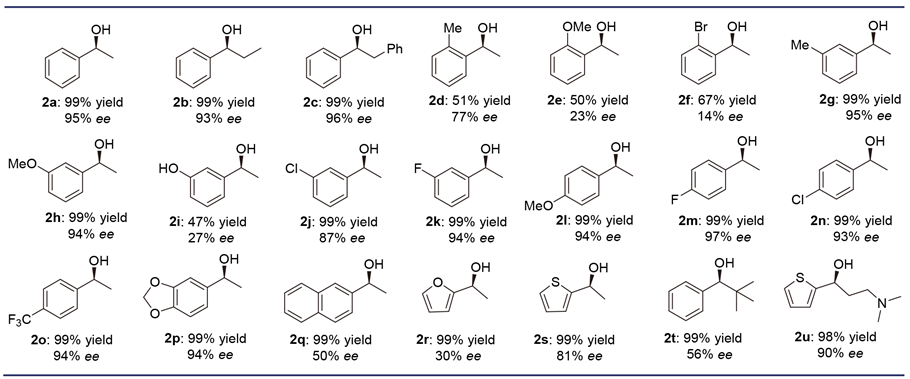
After establishing the optimal conditions for the model substrate acetophenone (1a), we sought to investigate the substrate generality of this catalytic system. To establish a unified and efficient protocol for evaluating various substrates while ensuring high conversion, the conditions were fine-tuned. It was found that increasing the catalyst loading to 1.0 mol% (while maintaining the reaction temperature at 0 ℃) could significantly enhance the reaction efficiency, affording excellent conversion for the vast majority of substrates. Accordingly, a catalyst loading of 1.0 mol% and a temperature of 0 ℃ were adopted as the standard conditions for investigating the substrate scope. The reaction results are summarized in Table 3.
Table 3 Substrate scope a

a Reaction conditions: [Ir(COD)Cl]2 (1 mol%), L1 (2.2 mol%), Ba(OH)2, 95% (ϕ) EtOH, H2 (5.0 MPa), 0 ℃. Yields are isolated yields. ee values were determined by chiral HPLC or GC.

It was demonstrated that the system exhibited excellent catalytic activity and enantioselectivity for aromatic ketones with different alkyl chain lengths (yields>99%, ee values of 93%~96%). Both the position and electronic nature of substituents on the benzene ring significantly influenced the reaction outcomes. For substrates with ortho-substituents, both reaction activity and enantioselectivity decreased significantly (2d~2f), which may be attributed to the steric hindrance effect induced by the ortho substituents, hindering the effective coordination of the substrate to the chiral catalyst’s active site. In contrast, substrates with meta- or para-substituents—whether electron-donating groups (e.g., methyl, methoxy) or electron-withdrawing groups (e.g., fluoro, chloro, bromo, trifluoromethyl)—afforded good to excellent ee values (92%~97%). Among these, the para-fluorine-substituted substrate (2m) performed best with an ee value of 97%.
The catalytic system was also applicable to other heteroaromatic ketones, such as 2-acetonaphthone (2q), 2-acetylthiophene (2r), and 2-acetylfuran (2s). Although the enantioselectivities for the hydrogenation of 2-acetona- phthone and 2-acetylfuran were not satisfactory, the system exhibited high catalytic activity for 2-acetylthiophene (99% yield) and achieved an ee value of 81%.
Notably, 3-(dimethylamino)-1-(thiophen-2-yl)propan-1- one (2u) could also undergo hydrogenation smoothly, affording (S)-3-(dimethylamino)-1-(thiophen-2-yl)propan-1- ol—a key precursor of the drug duloxetine[21]—in 98% yield and 90% ee. The successful application of this method further highlighted its practical value and potential in the synthesis of important chiral pharmaceutical intermediates. It should be noted that the catalytic system exhibited poor performance when applied to the catalytic hydrogenation of non-aromatic ketone substrates. For instance, no significant catalytic activity was observed for any of the investigated substrates, such as 1-cyclohexylethan-1-one and 1-cyclohexylpropan-1-one.

3 Conclusions

An efficient catalytic system based on the chiral binaphthyl P-N-O tridentate ligand L1 and iridium was successfully developed in this study for the asymmetric hydrogenation of simple aromatic ketones. Through systematic optimization, optimal reaction conditions—emp- loying Ba(OH)2 as the base and cost-effective, green 95% ethanol as the solvent. For the acetophenone model substrate, this system exhibited a conversion rate of over 99% and an enantioselectivity of 95%. Ligand screening results indicated that the parent structure L1 showed the best performance, and any modification at the ortho-position of the phenolic hydroxyl group led to a decrease in catalytic efficiency. This reveals the critical role of ligand structural precision in determining catalytic performance. It also highlights the unique advantages of the ligand synthetic route adopted in this study, including its conciseness and the achievement of high enantioselectivity without complex modifications. Further substrate scope studies demonstrated that the catalytic system had good generality for a series of aromatic ketones and heteroaromatic ketones with different electronic properties and substitution positions, achieving a maximum enantioselectivity of 97%. Notably, the synthetic practicality and potential of this method were fully verified by the successful implementation of a gram- scale experiment and its application in the asymmetric synthesis of (S)-duloxetine precursor—a key pharmaceutical intermediate—with 98% yield and 90% ee, thereby directly confirming the system’s application potential in the synthesis of important drug intermediates.
In summary, this study not only provides a novel and practical catalytic system for the green and efficient synthesis of chiral aryl alcohols by utilizing an environmentally friendly, low-cost ethanol solvent and a concise ligand design, but also further highlights the great application prospects of chiral P-N-O tridentate ligands in the field of asymmetric catalysis.

4 Experimental section

4.1 Instruments and reagents

All reactions were performed under a nitrogen atmosphere using standard Schlenk techniques or in a glovebox (MIKROUNA). 1H NMR, 13C NMR, and 31P NMR spectra were recorded on a BRUKER DRX 400 MHz or 700 MHz NMR spectrometer, using tetramethylsilane (TMS) as the internal standard or referencing residual solvent peaks. High-resolution mass spectrometry (HRMS) data were acquired using an Agilent Q-TOF 6540 liquid chromatography-time-of-flight mass spectrometer. The enantiomeric excess (ee) values of products were determined using a Prominence-i LC-2030 high-performance liquid chromatography (HPLC) system equipped with a chiral column. Specific rotations were measured with a WZZ-2B polarimeter. Hydrogenation reactions were performed in a Parr 300 mL stainless steel autoclave, and hydrogen gas (purity 99.999%) was supplied directly from a gas cylinder.
Chemical reagents and substrates used in the reactions were purchased from suppliers including Alfa Aesar, Acros, TCI, Energy Chemical, Bide Pharmatech, Leyan Reagent and J&K Scientific. These materials were used directly without further purification. The silica gel for column chromatography was 100~200 mesh. All solvents were subjected to strict anhydrous and oxygen-free treatment following standard methods.

4.2 Experimental procedures

4.2.1 Characterization of chiral binaphthyl tridentate P-N-O ligands

The key characterization data for chiral ligands L1~L7 are listed below.
(R)-2-(((2'-(Diphenylphosphaneyl)-[1,1'-binaphthalen]-2-yl)amino)methyl)phenol (L1): Obtained as a yellow solid (470 mg, 0.85 mmol) with a yield of 85%. m.p. 183 ℃; 1H NMR (400 MHz, DMSO-d6) δ: 9.39 (s, 1H), 8.01 (t, J=8.0 Hz, 2H), 7.78 (d, J=8.0 Hz, 1H), 7.69 (d, J=8.0 Hz, 1H), 7.56 (t, J=8.0 Hz, 1H), 7.40~7.15 (m, 11H), 7.04~6.93 (m, 6H), 6.85 (t, J=8.0 Hz, 1H), 6.75 (d, J=8.0 Hz, 1H), 6.5~6.43 (m, 2H), 4.59 (t, J=6.1 Hz, 1H), 4.14 (qd, J=16.0, 6.0 Hz, 2H); 31P NMR (162 MHz, Chloroform-d) δ: -14.77; 13C NMR (101 MHz, DMSO- d6) δ: 155.1, 144.3, 142.6, 142.3, 138.4, 138.3, 137.8, 137.7, 137.1, 136.9, 134.5, 134.2, 133.6, 133.4, 133.2, 133.0, 132.9, 131.2, 129.6, 129.0, 128.9, 128.8, 128.5, 128.2, 128.0, 127.7, 127.2, 126.6, 126.4, 126.3, 126.1, 123.8, 121.2, 119.1, 115.2, 115.1, 114.2, 42.0; HRMS calcd for C39H31NOP [M+H]+ 559.2767, found 541.2775.
(R)-2-(((2'-(Diphenylphosphaneyl)-[1,1'-binaphthalen]-2-yl)amino)methyl)-5-methylphenol (L2): Obtained as a yellow solid (515 mg, 0.90 mmol) with a yield of 90%. m.p. 188 ℃; 1H NMR (400 MHz, DMSO-d6) δ: 9.25 (s, 1H), 8.00 (t, J=8.0 Hz, 2H), 7.78 (d, J=8.0 Hz, 1H), 7.68 (d, J=8.0 Hz, 1H), 7.55 (t, J=8.0 Hz, 1H), 7.39~7.13 (m, 11H), 7.05~6.98 (m, 4H), 6.83 (dd, J=16.0, 8.0 Hz, 2H), 6.56 (s, 1H), 6.39 (dd, J=16.0, 8.0 Hz, 2H), 4.51 (t, J=6.0 Hz, 1H), 4.18~4.03 (m, 2H), 2.13 (s, 3H); 31P NMR (162 MHz, DMSO-d6) δ: -14.86; 13C NMR (101 MHz, DMSO-d6) δ: 155.0, 144.3, 142.6, 142.3, 138.4, 138.3, 137.8, 137.6, 137.1, 137.0, 136.9, 134.5, 134.3, 134.2, 133.6, 133.4, 133.3, 133.1, 132.9, 132.8, 131.1, 129.5, 128.9, 128.8, 128.7, 128.5, 128.2, 128.1, 127.6, 127.2, 126.6, 126.3, 126.1, 123.7, 123.2, 121.2, 119.8, 115.8, 115.2, 115.0, 114.2, 41.9, 21.2; HRMS calcd for C40H33NOP [M+H]+ 573.3011, found 541.3002.
(R)-2-(((2'-(Diphenylphosphaneyl)-[1,1'-binaphthalen]-2-yl)amino)methyl)-6-methoxyphenol (L3): Obtained as a yellow solid (518 mg, 0.88 mmol) with a yield of 88%. m.p. 187 ℃; 1H NMR (400 MHz, Chloroform-d) δ: 7.86~7.76 (m, 3H), 7.67 (dd, J=8.0, 2.0 Hz, 1H), 7.48~7.41 (m, 2H), 7.29~7.20 (m, 7H), 7.18~7.02 (m, 7H), 6.89 (ddd, J=8.0, 6.0, 2.0 Hz, 1H), 6.61 (dt, J=12.0, 6.0 Hz, 4H), 6.14 (s, 1H), 4.20 (dd, J=16.0, 4.0 Hz, 1H), 4.00 (dd, J=16.0, 4.0 Hz, 1H), 3.72 (s, 3H); 31P NMR (162 MHz, Chloroform-d) δ: -14.28; 13C NMR (101 MHz, Chloroform-d) δ: 146.5, 143.8, 143.7, 141.9, 141.5, 138.2, 138.1, 137.7, 137.6, 137.5, 134.3, 134.1, 133.8, 133.7, 133.6, 133.2, 133.1, 130.8, 130.7, 129.7, 128.6, 128.5, 128.4, 128.3, 128.2, 128.1, 127.9, 127.5, 127.2, 127.0, 126.6, 126.5, 126.1, 125.2, 124.4, 121.9, 120.3, 119.4, 117.3, 117.2, 114.4, 109.6, 56.0, 43.9; HRMS calcd for C40H33NO2P [M+H]+ 589.2689, found 541.2673.
(R)-2,4-Di-tert-butyl-6-(((2'-(diphenylphosphaneyl)-[1,1'-binaphthalen]-2-yl)amino)methyl)phenol (L4): Obtained as a yellow solid (570 mg, 0.85 mmol) with a yield of 85%. m.p. 172 ℃; 1H NMR (400 MHz, DMSO-d6) δ: 8.03~7.98 (m, 1H), 7.80 (d, J=8.0 Hz, 1H), 7.68 (d, J=8.0 Hz, 1H), 7.63~7.47 (m, 1H), 7.39 (dd, J=8.0, 2.0 Hz, 1H), 7.33~7.17 (m, 10H), 7.08~6.95 (m, 6H), 6.80 (t, J=8.0 Hz, 1H), 6.41 (d, J=8.5 Hz, 1H), 4.73 (t, J=8.0 Hz, 1H), 4.29 (dd, J=16.0, 6.0 Hz, 1H), 4.16 (dd, J=16.0, 6.0 Hz, 1H), 1.35 (s, 9H), 1.08 (s, 9H); 31P NMR (162 MHz, DMSO-d6) δ: -14.16; 13C NMR (101 MHz, DMSO-d6) δ: 151.1, 144.1, 142.4, 142.0, 141.3, 138.5, 138.4, 137.3, 137.2, 137.1, 136.5, 134.5, 134.2, 133.7, 133.5, 133.3, 133.1, 133.0, 132.9, 131.0, 129.4, 128.8, 128.7, 128.5, 128.1, 127.5, 127.2, 127.0, 126.8, 126.1, 126.0, 123.8, 122.7, 121.5, 121.3, 115.6, 115.5, 114.5, 44.0, 35.0, 34.3, 31.9, 31.6, 31.4, 30.3, 29.6, 22.5; HRMS calcd for C47H47NOP [M+H]+ 671.2577, found 671.2568.
(R)-2,4-Dichloro-6-(((2'-(diphenylphosphaneyl)-[1,1'-binaphthalen]-2-yl)amino)methyl)phenol (L5): Obtained as a yellow solid (503 mg, 0.80 mmol) with a yield of 80%. m.p. 192 ℃; 1H NMR (400 MHz, DMSO-d6) δ: 9.61 (s, 1H), 8.03 (dd, J=12.0, 8.0 Hz, 2H), 7.79 (d, J=9.0 Hz, 1H), 7.68 (d, J=8.0 Hz, 1H), 7.57 (t, J=8.0 Hz, 1H), 7.41~7.13 (m, 13H), 7.06~6.98 (m, 3H), 6.90 (d, J=8.0 Hz, 1H), 6.82 (t, J=8.0 Hz, 1H), 6.39 (d, J=8.0 Hz, 1H), 4.98 (t, J=8.0 Hz, 1H), 4.30 (dd, J=17.6, 8.0 Hz, 1H), 4.16 (dd, J=17.6, 6.0 Hz, 1H); 31P NMR (162 MHz, DMSO-d6) δ: -14.45; 13C NMR (101 MHz, DMSO-d6) δ: 149.6, 143.4, 143.3, 142.3, 142.0, 138.4, 138.3, 137.4, 137.3, 137.2, 137.0, 134.5, 134.2, 133.7, 133.5, 133.3, 133.1, 133.0, 132.9, 131.9, 131.1, 129.8, 128.9, 128.8, 128.7, 128.5, 128.1, 127.6, 127.3, 127.1, 126.7, 126.3, 126.1, 126.0, 123.9, 123.8, 121.7, 121.4, 115.3, 115.2, 113.7, 42.0; HRMS calcd for C39H29Cl2NOP [M+H]+ 627.2897, found 627.2889.
(R)-4-Bromo-2-chloro-6-(((2'-(diphenylphosphaneyl)-[1,1'-binaphthalen]-2-yl)amino)methyl)phenol (L6): Obtained as a yellow solid (531 mg, 0.79 mmol) with a yield of 79%. m.p. 194 ℃; 1H NMR (400 MHz, DMSO-d6) δ: 9.61 (s, 1H), 8.02 (dd, J=12.0, 8.0 Hz, 2H), 7.79 (d, J=8.0 Hz, 1H), 7.67 (d, J=8.0 Hz, 1H), 7.57 (t, J=6.0 Hz, 1H), 7.41~7.11 (m, 13H), 7.07~6.97 (m, 3H), 6.91 (d, J=12.0 Hz, 1H), 6.83 (t, J=7.7 Hz, 1H), 6.40 (d, J=8.0 Hz, 1H), 4.97 (t, J=6.0 Hz, 1H), 4.31 (dd, J=18.0, 6.0 Hz, 1H), 4.15 (dd, J=18.0, 6.0 Hz, 1H); 31P NMR (162 MHz, DMSO-d6) δ: -14.47; 13C NMR (101 MHz, DMSO-d6) δ: 149.6, 143.4, 142.4, 142.0, 138.4, 138.3, 137.4, 137.2, 137.1, 134.5, 134.3, 134.2, 133.7, 133.5, 133.3, 133.1, 133.0, 132.9, 131.9, 131.1, 129.8, 128.9, 128.8, 128.7, 128.4, 128.1, 127.6, 127.3, 127.1, 126.7, 126.3, 126.1, 126.0, 123.9, 123.8, 121.7, 121.3, 115.3, 115.2, 113.7, 42.0; HRMS calcd for C39H29BrClNOP [M+H]+ 673.3118, found 673.3110.
(R)-2,4-Dibromo-6-(((2'-(diphenylphosphaneyl)-[1,1'-binaphthalen]-2-yl)amino)methyl)phenol (L7): Obtained as a yellow solid (551 mg, 0.77 mmol) with a yield of 77%. m.p. 195 ℃; 1H NMR (400 MHz, DMSO-d6) δ: 9.63 (s, 1H), 8.03 (dd, J=12.0, 8.0 Hz, 2H), 7.78 (d, J=8.0 Hz, 1H), 7.68 (d, J=8.0 Hz, 1H), 7.57 (t, J=8.0 Hz, 1H), 7.43~7.11 (m, 13H), 7.09~6.96 (m, 3H), 6.91 (d, J=8.0 Hz, 1H), 6.82 (t, J=8.0 Hz, 1H), 6.40 (d, J=8.0 Hz, 1H), 4.99 (t, J=6.0 Hz, 1H), 4.31 (dd, J=18.0, 6.0 Hz, 1H), 4.17 (dd, J=18.0, 6.0 Hz, 1H); 31P NMR (162 MHz, DMSO-d6) δ: -14.44; 13C NMR (101 MHz, DMSO-d6) δ: 149.6, 143.4, 143.4, 142.4, 142.0, 138.4, 138.3, 137.4, 137.2, 137.1, 134.5, 134.3, 134.2, 133.8, 133.5, 133.3, 133.1, 133.0, 132.9, 131.9, 131.1, 129.8, 128.8, 128.7, 128.7, 128.5, 128.1, 127.6, 127.3, 127.1, 126.7, 126.4, 126.3, 126.1, 126.0, 123.9, 123.8, 121.7, 121.4, 115.3, 115.3, 113.7, 42.0; HRMS calcd for C39H29Br2NOP [M+H]+ 717.3221, found 717.3213.

4.2.2 General procedure and condition screening for hydrogenation reactions

Inside a nitrogen-filled glovebox, [Ir(COD)Cl]2 (0.7 mg, 1 μmol, 1 mol%), chiral P-N-O ligand L1 (1.3 mg, 2.2 μmol, 2.2 mol%), Ba(OH)2, and ethanol (2 mL) as solvent were added to the liner of a high-pressure autoclave. Acetophenone (60 mg, 0.5 mmol) was then added. The autoclave was sealed, removed from the glovebox, and charged with hydrogen gas (5.0 MPa), followed by stirring at the set temperature for a specified time. After completion of the reaction, hydrogen gas was slowly released. The reaction mixture was filtered through a short silica gel column to remove metal species, and the filtrate was concentrated. The conversion was calculated by 1H NMR analysis, and the enantiomeric excess (ee) of the product was determined by chiral HPLC.

4.2.3 General procedure for substrate scope investigation

Under the optimal reaction conditions ([Ir(COD)Cl]2 (1 mol%), ligand L1 (2.2 mol%), Ba(OH)2, 95% (ϕ) ethanol, H2 (5.0 MPa)), hydrogenation reactions of simple aromatic ketone substrates with different structures were carried out to investigate the generality of the catalytic system. All products were purified by column chromatography, and their structures were confirmed by 1H NMR and 13C NMR, with enantioselectivity analyzed by chiral HPLC.

4.2.4 Analysis and characterization of hydrogenation products

(R)-1-Phenylethan-1-ol (2a): 60.8 mg, colorless oil, 95% ee, 99% yield.$ [\alpha]_{\mathrm{D}}^{20}$-54.0 (c 1, CHCl3). 1H NMR (400 MHz, CDCl3) δ: 7.34~7.31 (m, 4H), 7.26~7.24 (m, 1H), 4.83 (q, J=4.0 Hz, 1H), 2.35 (s, 1H), 1.45 (d, J=4.0 Hz, 3H); 13C NMR (101 MHz, CDCl3) δ: 145.9, 128.5, 127.5, 125.4, 70.4, 25.2. The enantiomeric analysis was determined by chiral HPLC on Chiralcel OJ-H column. Conditions: V(n-hexane)∶V(i-PrOH)=90∶10, flow rate=0.8 mL/min, UV detection at λ=254 nm, 40 ℃, t=6.9 min (minor), 8.7 min (major).
(S)-1-Phenylpropan-1-ol (2b): 67.6 mg, colorless oil, 93% ee, 99% yield.$ [\alpha]_{\mathrm{D}}^{20}$-38.3 (c 1, CHCl3). 1H NMR (400 MHz, CDCl3) δ: 7.26~7.16 (m, 5H), 4.49~4.47 (m, 1H), 2.03 (s, 1H), 1.74~1.63 (m, 2H), 0.82 (t, J=8.0 Hz, 3H); 13C NMR (101 MHz, CDCl3) δ: 144.7, 128.4, 127.5, 126.0, 76.0, 31.9, 10.2. The enantiomeric analysis was determined by chiral HPLC on Chiralcel OJ-H column. Conditions: V(n-hexane)∶V(i-PrOH)=95∶5, flow rate=0.8 mL/min, UV detection at λ=220 nm, 40 ℃, t=12.7 min (minor), 13.7 min (major).
(S)-1,2-Diphenylethan-1-ol (2c): 98.9 mg, colorless oil, 96% ee, 99% yield.$ [\alpha]_{\mathrm{D}}^{20}$-46.8 (c 1, CHCl3). 1H NMR (400 MHz, CDCl3) δ: 7.19~7.03 (m, 10H), 4.71 (q, J=8.0 Hz, 1H), 2.91~2.81 (m, 2H), 2.14 (s, 1H); 13C NMR (101 MHz, CDCl3) δ: 143.9, 138.1, 129.6, 128.6, 128.5, 127.7, 126.7, 126.0, 75.4, 46.1. The enantiomeric analysis was determined by chiral HPLC on Chiralcel OJ-H column. Conditions: V(n-hexane)∶V(i-PrOH)=95∶5, flow rate=0.8 mL/min, UV detection at λ=220 nm, 40 ℃, t=16.6 min (minor), 18.6 min (major).
(S)-1-(o-Tolyl)ethan-1-ol (2d): 33.4 mg, colorless oil, 77% ee, 51% yield.$ [\alpha]_{\mathrm{D}}^{20}$-40.3 (c 1, CHCl3). 1H NMR (400 MHz, CDCl3) δ: 7.44 (dd, J=8.0 Hz, 4.0 Hz, 1H), 7.21~7.07 (m, 3H), 5.03 (q, J=8.0 Hz, 1H), 2.39 (s, 1H), 2.29 (s, 3H), 1.38 (d, J=4.0 Hz, 3H); 13C NMR (101 MHz, CDCl3) δ: 144.0, 134.2, 130.4, 127.1, 126.4, 124.6, 66.7, 24.0, 18.9. The enantiomeric analysis was determined by chiral HPLC on Chiralpak AD-H column. Conditions: V(n-hexane)∶V(i-PrOH)=97∶3, flow rate=0.8 mL/min, UV detection at λ=220 nm, 40 ℃, t=8.5 min (minor), 9.3 min (major).
(S)-1-(2-Methoxyphenyl)ethan-1-ol (2e): 34.2 mg, colorless oil, 23% ee, 50% yield.$ [\alpha]_{\mathrm{D}}^{20}$-36.2 (c 1, CHCl3); 1H NMR (400 MHz, CDCl3) δ: 7.33 (dd, J=8.0, 4.0 Hz, 1H), 7.23 (td, J=8.0, 4.0 Hz, 1H), 6.95 (td, J=8.0, 4.0 Hz, 1H), 6.85 (dd, J=8.0, 4.0 Hz, 1H), 5.10~5.07 (m, 1H), 3.83 (s, 3H), 2.83 (s, 1H), 1.48 (d, J=4.0 Hz, 3H); 13C NMR (101 MHz, CDCl3) δ: 156.5, 133.6, 128.3, 126.1, 120.8, 110.4, 66.4, 55.3, 23.0. The enantiomeric analysis was determined by chiral HPLC on Chiralpak OD-H column. Conditions: V(n-hexane)∶V(i-PrOH)=99∶1, flow rate=0.8 mL/min, UV detection at λ=220 nm, 40 ℃, t=23.3 min (minor), 25.1 min (major).
(S)-1-(2-Bromophenyl)ethan-1-ol (2f): 67.2 mg, colorless oil, 14% ee, 67% yield.$ [\alpha]_{\mathrm{D}}^{20}$-54.0 (c 1, CHCl3); 1H NMR (400 MHz, CDCl3) δ: 7.49 (dd, J=8.0, 8.0 Hz, 1H), 7.41 (dd, J=8.0, 8.0 Hz, 1H), 7.24 (td, J=8.0, 4.0 Hz, 1H), 7.03 (td, J=8.0, 4.0 Hz, 1H), 5.15~5.12 (m, 1H), 2.31 (d, J=4.0 Hz, 1H), 1.38 (d, J=8.0 Hz, 3H); 13C NMR (101 MHz, CDCl3) δ: 143.6, 131.6, 127.7, 126.8, 125.6, 120.6, 68.1, 22.5. The enantiomeric analysis was determined by chiral HPLC on Chiralpak OD-H column. Conditions: V(n-hexane)∶V(i-PrOH)=99∶1, flow rate=0.8 mL/min, UV detection at λ=220 nm, 40 ℃, t=16.7 min (minor),18.4 min (major).
(S)-1-(m-Tolyl)ethan-1-ol (2g): 68.7 mg, colorless oil, 95% ee, 99% yield.$ [\alpha]_{\mathrm{D}}^{20}$-46.8 (c 1, CHCl3); 1H NMR (400 MHz, CDCl3) δ: 7.20 (t, J=8.0 Hz, 1H), 7.14~7.11 (m, 2H), 7.05 (d, J=8.0 Hz, 1H), 4.78 (q, J=8.0 Hz, 1H), 2.48 (s, 1H), 2.33 (s, 3H), 1.42 (d, J=8.0 Hz, 3H); 13C NMR (101 MHz, CDCl3) δ: 145.9, 138.1, 128.4, 128.3, 126.2, 122.5, 70.3, 25.2, 21.5. The enantiomeric analysis was determined by chiral HPLC on Chiralcel OJ-H column. Conditions: V(n-hexane)∶V(i-PrOH)=97∶3, flow rate=0.8 mL/min, UV detection at λ=220 nm, 40 ℃, t=12.0 min (minor), 13.1 min (major).
(S)-1-(3-Methoxyphenyl)ethan-1-ol (2h): 75.7 mg, colorless oil, 94% ee, 99% yield.$ [\alpha]_{\mathrm{D}}^{20}$-50.9 (c 1, CHCl3); 1H NMR (400 MHz, CDCl3) δ: 7.22 (t, J=8.0 Hz, 1H), 6.90~6.89 (m, 2H), 6.78~6.75 (m, 1H), 4.78 (q, J=4.0 Hz, 1H), 3.76 (s, 3H), 2.66 (s, 1H), 1.43 (d, J=8.0 Hz, 3H); 13C NMR (101 MHz, CDCl3) δ: 159.7, 147.7, 129.5, 117.8, 112.8, 111.0, 70.2, 55.2, 25.2. The enantiomeric analysis was determined by chiral GC (Beta DEX 225 Column (30 m×0.25 mm×0.25 μm), v(N2)=1.0 mL/min, 120 ℃ hold 10 min, heat 0.5 ℃/min till 140 ℃ hold 20 min), t=40.2 min (minor), 41.4 min (major).
(S)-3-(1-Hydroxyethyl)phenol (2i): 33 mg, colorless oil, 27% ee, 47% yield.$ [\alpha]_{\mathrm{D}}^{20}$-42.9 (c 1, CHCl3); 1H NMR (400 MHz, DMSO) δ: 9.24 (s, 1H), 7.08 (t, J=8.0 Hz, 1H), 6.78~6.72 (m, 2H), 6.61~6.59 (m, 1H), 5.06 (d, J=4.0 Hz, 1H), 4.65~4.59 (m, 1H), 1.28 (d, J=8.0 Hz, 3H); 13C NMR (101 MHz, DMSO) δ: 157.6, 149.8, 129.4, 116.4, 113.8, 112.6, 68.5, 26.4. The enantiomeric analysis was determined by chiral HPLC on Chiralpak IC column. Conditions: V(n-hexane)∶V(i-PrOH)=90∶10, flow rate=0.8 mL/min, UV detection at λ=220 nm, 40 ℃, t=20.4 min (minor), 27.8 min (major).
(S)-1-(m-Tolyl)ethan-1-ol (2j): 76.8 mg, colorless oil, 87% ee, 99% yield.$ [\alpha]_{\mathrm{D}}^{20}$-36.8 (c1, CHCl3); 1H NMR (400 MHz, CDCl3) δ: 7.33 (t, J=8.0 Hz, 1H), 7.25~7.21 (m, 2H), 7.19 (d, J=8.0 Hz, 1H), 4.80 (q, J=8.0 Hz, 1H), 2.58 (s, 1H), 1.43 (d, J=8.0 Hz, 3H); 13C NMR (101 MHz, CDCl3) δ: 147.9, 134.3, 129.8, 127.5, 125.6, 123.6, 69.7, 25.2. The enantiomeric analysis was determined by chiral HPLC on Chiralcel OJ-H column. Conditions: V(n-hexa- ne)∶V(i-PrOH)=97∶3, flow rate=0.8 mL/min, UV detection at λ=220 nm, 40 ℃, t=13.3 min (minor), 15.3 min (major).
(S)-1-(3-Fluorophenyl)ethan-1-ol (2k): 70.7 mg, colorless oil, 94% ee, 99% yield.$ [\alpha]_{\mathrm{D}}^{20}$-29.6 (c 1, CHCl3); 1H NMR (400 MHz, CDCl3) δ: 7.29~7.25 (m, 1H), 7.10~7.05 (m, 2H), 6.95~6.92 (m, 1H), 4.85 (q, J=4.0 Hz, 1H), 2.40 (s, 1H), 1.44 (s, 3H); 13C NMR (101 MHz, CDCl3) δ: 163.0 (d, J=246.4 Hz), 148.5 (d, J=7.1 Hz), 130.0 (d, J=9.1 Hz), 120.1 (d, J=3.0 Hz), 114.1 (d, J=21.2 Hz), 112.3 (d, J=22.2 Hz), 69.7, 25.1; 19F NMR (376 MHz, CDCl3) δ: -113.0. The enantiomeric analysis was determined by chiral GC (Beta DEX 225 Column (30 m×0.25 mm×0.25 μm), v(N2)=1.0 mL/min, 120 ℃ hold 10 min, heat 0.5 ℃/min till 140 ℃ hold 20 min), t=6.7 min (minor), 17.3 min (major).
(S)-1-(4-Methoxyphenyl)ethan-1-ol (2l): 75.6 mg, colorless oil, 94% ee, 99% yield.$ [\alpha]_{\mathrm{D}}^{20}$-44.0 (c 1, CHCl3); 1H NMR (400 MHz, CDCl3) δ: 7.29~7.27 (m, 2H), 6.88~6.86 (m, 2H), 4.82 (q, J=8.0 Hz, 1H), 3.79 (s, 3H), 2.02 (s, 1H), 1.46 (d, J=4.0 Hz, 3H); 13C NMR (101 MHz, CDCl3) δ: 159.0, 138.1, 126.7, 113.8, 69.9, 55.3, 25.0. The enantiomeric analysis was determined by chiral HPLC on Chiralcel OJ-H column. Conditions: V(n-hexane)∶V(i-Pr- OH)=90∶10, flow rate=0.8 mL/min, UV detection at λ=220 nm, 40 ℃, t=13.3 min (minor), 14.1 min (major).
(S)-1-(4-Fluorophenyl)ethan-1-ol (2m): 70.5 mg, colorless oil, 97% ee, 99% yield.$ [\alpha]_{\mathrm{D}}^{20}$-29.6 (c 1, CHCl3); 1H NMR (400 MHz, CDCl3) δ: 7.31~7.29 (m, 2H), 7.02~6.99 (m, 2H), 4.83 (q, J=4.0 Hz, 1H), 2.36 (s, 1H), 1.44 (dd, J=8.0, 4.0 Hz, 3H); 13C NMR (101 MHz, CDCl3) δ: 162.1 (d, J=246.4 Hz), 141.6 (d, J=3.0 Hz), 127.0 (d, J=8.1 Hz), 115.1 (d, J=21.2 Hz), 69.7, 25.2; 19F NMR (376 MHz, CDCl3) δ: -115.5. The enantiomeric analysis was determined by chiral GC (Beta DEX 225 Column (30 m×0.25 mm×0.25 μm), v(N2)=1.0 mL/min, 120 ℃ hold 10 min, heat 0.5 ℃/min till 140 ℃ hold 20 min), t=17.1 min (minor), 17.4 min (major).
(S)-1-(4-Chlorophenyl)ethan-1-ol (2n): 78.6 mg, colorless oil, 93% ee, 99% yield.$ [\alpha]_{\mathrm{D}}^{20}$-46.5 (c 1, CHCl3); 1H NMR (400 MHz, CDCl3) δ: 7.29~7.23 (m, 4H), 4.81 (q, J=4.0 Hz, 1H), 2.51 (s, 1H), 1.42 (d, J=4.0 Hz, 3H); 13C NMR (101 MHz, CDCl3) δ: 144.3, 133.0, 128.6, 126.8, 69.7, 25.2. The enantiomeric analysis was determined by chiral HPLC on Chiralpak OD-H column. Conditions: V(n-hexane)∶V(i-PrOH)=97∶3, flow rate=0.8 mL/min, UV detection at λ=220 nm, 40 ℃, t=24.7 min (minor), 26.3 min (major).
(S)-1-(4-(Trifluoromethyl)phenyl)ethan-1-ol (2o): 94.5 mg, colorless oil, 94% ee, 99% yield.$ [\alpha]_{\mathrm{D}}^{20}$-42.7 (c 1, CHCl3); 1H NMR (400 MHz, CDCl3) δ: 7.51 (d, J=8.0 Hz, 2H), 7.39~7.37(m, 2H), 4.85 (q, J=4.0 Hz, 1H), 2.27 (s, 1H), 1.40 (d, J=4.0 Hz, 3H); 13C NMR (101 MHz, CDCl3) δ: 149.7, 129.6 (q, J=32.3 Hz), 125.6, 125.3 (q, J=4.0 Hz), 124.2 (q, J=272.7 Hz), 12.1, 69.8, 25.3; 19F NMR (376 MHz, CDCl3) δ: -62.5. The enantiomeric analysis was determined by chiral GC (Beta DEX 225 Column (30 m×0.25 mm×0.25 μm), v(N2)=1.0 mL/min, 120 ℃ hold 10 min, heat 0.5 ℃/min till 140 ℃ hold 20 min), t=21.1 min (minor), 21.5 min (major).
(S)-1-(Benzo[d][1,3]dioxol-5-yl)ethan-1-ol (2p): 82.8 mg, colorless oil, 94% ee, 99% yield.$ [\alpha]_{\mathrm{D}}^{20}$-34.5 (c 1, CHCl3); 1H NMR (400 MHz, CDCl3) δ: 6.77 (d, J=2.0 Hz, 1H), 6.70~6.64 (m, 2H), 5.82 (s, 2H), 4.70~4.65 (m, 1H), 2.33 (s, 1H), 1.33 (d, J=8.0 Hz, 3H); 13C NMR (101 MHz, CDCl3) δ: 147.7, 146.8, 140.1, 118.7, 108.1, 106.1, 101.0, 70.1, 25.1. The enantiomeric analysis was determined by chiral HPLC on Chiralcel OJ-H column. Conditions: V(n-hexane)∶V(i-PrOH)=90∶10, flow rate=0.8 mL/min, UV detection at λ=220 nm, 40 ℃, t=12.7 min (minor), 13.6 min (major).
(S)-1-(Naphthalen-2-yl)ethan-1-ol (2q): 85.8 mg, colorless oil, 50% ee, 99% yield.$ [\alpha]_{\mathrm{D}}^{20}$-36.5 (c 0.54, CHCl3); 1H NMR (400 MHz, CDCl3) δ: 7.68~7.59 (m, 4H), 7.35~7.30 (m, 3H), 4.82 (q, J=8.0 Hz, 1H), 2.54 (s, 1H), 1.39 (d, J=4.0 Hz, 3H); 13C NMR (101 MHz, CDCl3) δ: 143.3, 133.4, 133.0, 128.3, 128.0, 127.8, 126.2, 125.8, 124.0, 123.9, 70.4, 25.2. The enantiomeric analysis was determined by chiral HPLC on Chiralcel OJ-H column. Conditions: V(n-hexane)∶V(i-PrOH)=70∶30, flow rate=0.8 mL/min, UV detection at λ=220 nm, 40 ℃, t=7.8 min (minor), 9.1 min (major).
(S)-1-(Furan-2-yl)ethan-1-ol (2r): 55.8 mg, colorless oil, 30% ee, 99% yield.$ [\alpha]_{\mathrm{D}}^{20}$-40.8 (c 1, CHCl3); 1H NMR (400 MHz, CDCl3) δ: 7.29 (m, 1H), 6.25~6.24 (m, 1H), 6.15~6.14 (m, 1H), 4.80 (q, J=8.0 Hz, 1H), 2.14 (s, 1H), 1.46 (d, J=8.0 Hz, 3H); 13C NMR (101 MHz, CDCl3) δ: 157.6, 141.9, 110.1, 105.1, 63.6, 21.3. The enantiomeric analysis was determined by chiral HPLC on Chiralcel OJ-H column. Conditions: V(n-hexane)∶V(i-PrOH)=95∶5, flow rate=0.8 mL/min, UV detection at λ=220 nm, 40 ℃, t=10.1 min (minor), 10.9 min (major).
(S)-1-(Thiophen-2-yl)ethan-1-ol (2s): 64.6 mg, colorless oil, 81% ee, 99% yield. $ [\alpha]_{\mathrm{D}}^{20}$-45.6 (c 1, CHCl3); 1H NMR (400 MHz, CDCl3) δ: 7.17~7.16 (m, 1H), 6.91~6.89 (m, 2H), 5.01 (q, J=8.0 Hz, 1H), 3.14 (s, 1H), 1.51 (d, J=8.0 Hz, 3H); 13C NMR (101 MHz, CDCl3) δ: 150.1, 126.7, 124.3, 123.2, 66.0, 25.3. The enantiomeric analysis was determined by chiral HPLC on Chiralcel OJ-H column. Conditions: V(n-hexane)∶V(i-PrOH)=70∶30, flow rate=0.8 mL/min, UV detection at λ=220 nm, 40 ℃, t=5.6 min (minor), 6.2 min (major).
(S)-2,2,2-Trifluoro-1-phenylethan-1-ol (2t): 70.5 mg, colorless oil, 56% ee, 78% yield. $ [\alpha]_{\mathrm{D}}^{20}$-44.2 (c 1, CHCl3); 1H NMR (400 MHz, CDCl3) δ: 7.48~7.46 (d, J=8.0 Hz, 2H), 7.41~7.40 (m, 3H), 5.00 (q, J=4.0 Hz, 1H), 2.85 (s, 1H); 13C NMR (101 MHz, CDCl3) δ: 134.1, 129.6 (q, J=32.3 Hz), 128.6, 127.5 (q, J=4.0 Hz), 125.1 (q, J=272.7 Hz), 123.5.1, 72.9, 72.7; 19F NMR (376 MHz, CDCl3) δ: -78.4. The enantiomeric analysis was determined by chiral HPLC on Chiralcel OJ-H column. Conditions: V(n-hexane)∶V(i-PrOH)=95∶5, flow rate=0.8 mL/min, UV detection at λ=220 nm, 40 ℃, t=15.5 min (minor), 20.0 min (major).
(S)-3-(Dimethylamino)-1-(thiophen-2-yl)propan-1-ol (2u): 81.2 mg, colorless oil, 90% ee, 98% yield. $ [\alpha]_{\mathrm{D}}^{20}$-44.6 (c 1, CHCl3); 1H NMR (400 MHz, CDCl3) δ: 7.20 (d, 1H), 6.97~6.91 (m, 2H), 5.18 (q, J=8.0 Hz, 1H), 2.67~2.51 (m, 2H), 2.28 (s, 6H), 1.99~1.86 (m, 2H); 13C NMR (101 MHz, CDCl3) δ: 149.8, 126.6, 123.7, 122.2, 72.1, 58.1, 45.3, 34.6. The enantiomeric analysis was determined by chiral HPLC on Chiralpak OD-H. Conditions: V(n-hexane)∶V(i-PrOH)=99∶1, flow rate=0.8 mL/min, UV detection at λ=220 nm, 40 ℃, t=19.0 min (minor), 21.9 min (major).
Supporting Information General procedure for the synthesis of ligands L1~L7, copies of NMR spectra for ligands L1~L7 and hydrogenation products 2a~2u, and HPLC or GC chromatograms for hydrogenation products 2a~2u. The Supporting Information is available free of charge via the Internet at http://sioc-journal.cn/.
(Cheng, F.)
[1]
Deeter J.; Frazier J.; Staten G.; Staszak M.; Weigel L. Tetrahedron Lett. 1990, 31, 7101.

DOI

[2]
(a) Garland M.; Kirkpatrick P. Nat. Rev. Drug Discovery 2004, 3, 385.

DOI

(b) Lin K.-S.; Ding Y.-S. Bioorg. Med. Chem. 2005, 13, 4658.

DOI

[3]
Clader J.-W. Curr. Top. Med. Chem. 2005, 5, 243.

PMID

[4]
Cao M.; Wang H.; Hou F.; Zhu Y.; Liu Q.; Tung C. H.; Liu L. J. Am. Chem. Soc. 2024, 146, 18396.

DOI

[5]
Wan Q.; Wang Z.; Sun H.; Song D.; Wang X.; Liu L. ChemCatChem 2024, 16, e202301757.

DOI

[6]
Doucet H.; Ohkuma T.; Murata K.; Yokozawa T.; Kozawa M.; Katayama E.; England A. F.; Ikariya T.; Noyori R. Angew. Chem., Int. Ed. 1998, 37, 1703.

DOI PMID

[7]
Ohkuma T.; Koizumi M.; Doucet H.; Pham T.; Kozawa M.; Murata K.; Katayama E.; Yokozawa T.; Ikariya T.; Noyori R. J. Am. Chem. Soc. 1998, 120, 13529.

DOI

[8]
Ohkuma T.; Ooka H.; Hashiguchi S.; Ikariya T.; Noyori R. J. Am. Chem. Soc. 1995, 117, 2675.

DOI

[9]
Jiang Y.-T.; Jiang Q.-Z.; Zhang X.-M. J. Am. Chem. Soc. 1998, 120, 3817.

DOI

[10]
Li W.; Hou G.-H.; Wang C.-J.; Jiang Y.-T.; Zhang X.-M. Chem. Commun. 2010, 46, 3979.

DOI

[11]
Xie J.-H.; Liu X.-Y.; Xie J.-B.; Wang L.-X.; Zhou Q.-L. Angew. Chem., Int. Ed. 2011, 50, 7329.

DOI

[12]
Zhang F.-H.; Zhang F.-J.; Li M.-L.; Xie J.-H.; Zhou Q.-L. Nat. Catal. 2020, 3, 621.

DOI

[13]
Yu J.-F.; Duan M.; Wu W.-L.; Qi X.-T.; Xue P.; Lan Y.; Dong X.-Q.; Zhang X.-M. Chem. Eur. J. 2017, 23, 970.

DOI

[14]
Niu T.; Liu L.-X.; Wu B.; Zhou Y.-G. J. Org. Chem. 2023, 88, 7863.

DOI

[15]
Wu W.-L.; Zhao N.; Liu Y.-Y.; Du S.-S.; Wang X.-X.; Mo W.-Z.; Yan X.-H.; Xu C.-Y.; Zhou Y.; Ji B.-M. Org. Lett. 2023, 25, 8845.

DOI

[16]
Yu J.-F.; Long J.; Yang Y.-H.; Wu W.-L.; Xue P.; Chung L.-W.; Dong X.-Q.; Zhang X.-M. Org. Lett. 2017, 19, 690.

DOI

[17]
Császár Z.; Guóth M.; Kovács M.; Bényei A.-C.; Bakos J.; Farkas G. Molecules 2024, 29, 3743.

DOI

[18]
Garnier J.-M.; Liu F. Org. Biomol. Chem. 2009, 7, 1272.

DOI

[19]
Garnier J.-M.; Anstiss C.; Liu F. Adv. Synth. Catal. 2009, 351, 331.

DOI

[20]
Anstiss C.; Liu F. Tetrahedron 2010, 66, 5486.

DOI

[21]
Chen X.; Liu Z.-Q.; Lin C.-P.; Zheng Y.-G. Bioorg. Chem. 2016, 65, 82.

DOI

Outlines

/

〈 〉