


1 Introduction
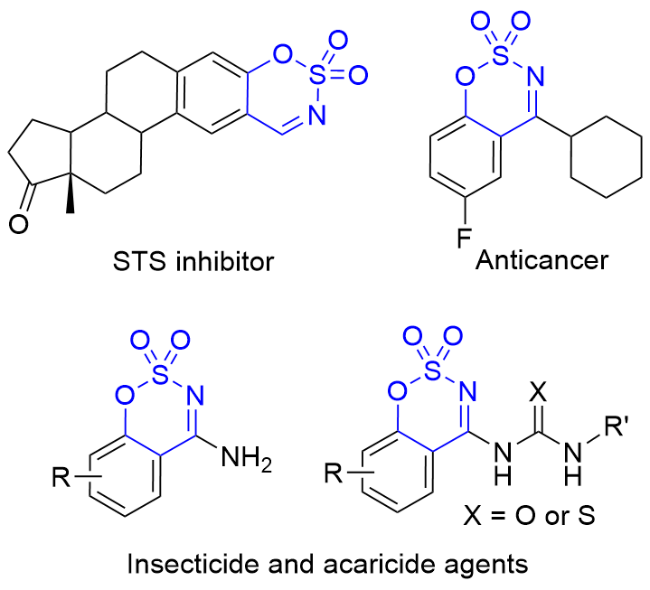
Cyclic N-sulfonyl imine and its derivatives are a class of privileged skeletons for applications in drug chemistry,[1] showing a wide range of biological activities and pharmacological properties, such as the steroid sulfatase (STS) inhibitors,[2] anticancer,[3] insecticide and acaricide agents[4] (Figure 1). In addition, these skeletons could also largely acted as the versatile and powerful building blocks and synthetic intermediates in myriad of useful transformation.[5] In 2021, we[6] firstly developed the radical C—H alkylation of cyclic aldimines with aliphatic carboxylic acids and tertiary cycloalkanols as alkyl sources via C—C bond cleavage strategy (Scheme 1, a). Since then, the radical modifications of cyclic aldimines, especially the direct radical C—H alkylation of cyclic aldimines through different bond activation strategies, have been studied by different research groups.[7] For example, Ren and co-work- ers[8] described photoinduced C—H alkylation of cyclic aldimines with aldehydes as alkyl sources via C—C bond cleavage (Scheme 1, a). Subsequently, Our’s group, He and Yi[9] respectively developed the visible-light-induced C—H alkylation of cyclic aldimines with alkanes as alkyl sources via C—H bond cleavage (Scheme 1, b). Lately, Luo and Ren[10] separately reported air-mediated C—H alkylation of cyclic aldimines with alkylboronic acids as alkyl sources via C—B bond cleavage strategy (Scheme 1, c). Despite these impressive advances, the development of more robust and readily available methods for the direct C—H functionalization of cyclic aldimines through C—O bond cleavage strategy to construct valuable organic molecules is still highly desirable.
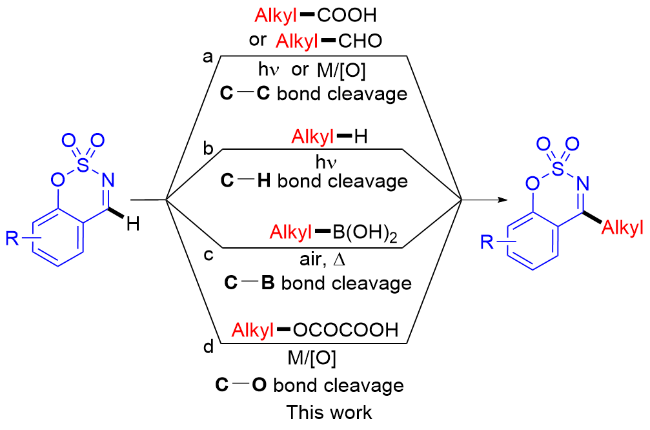
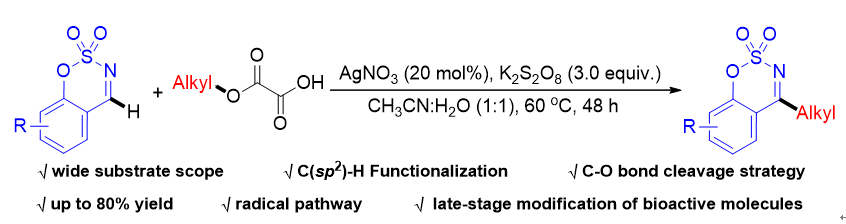
Monoalkyl oxalates are an useful synthetic intermediate and building blocks in organic synthesis, and can be easily prepared by the esterification of readily accessible oxalyl chloride with alcohol and subsequent hydrolysis.[11] Since the pioneering reports by Overmann and MacMillan’s group in 2015,[12] they have been widely applied as alkyl radical precursors for the construction of complex molecules in recent years.[13] For instance, in 2016, MacMillan’s group[14] innovatively discovered metallaphotoredox C(sp3)—C(sp2) cross-coupling of monoalkyl oxalates with aryl halides. In 2019, Wang’s group[15] demonstrated persulfate-mediated Minisci C—H alkylation reactions of N- heteroarenes with monoalkyl oxalates. Recently, Gao and co-workers[16] disclosed a photoredox-catalyzed deoxydisulfuration of monoalkyl oxalates with tetrasulfifides to facilitate the efficient synthesis of unsymmetrical disulfifides. Although a variety of prominent transformations of monoalkyl oxalates have been excavated, to our knowledge, direct radical C—H functionalization of oxalates with imines has not been explored so far. Considering the advantages of decarboxylation radical reaction catalyzed by silver salts,[17] herein, we develop the first silver-catalyzed decarboxylative C—H alkylation of cyclic aldimines with monoalkyl oxalates for the assembly of cyclic ketimines via C—O bond cleavage strategy (Scheme 1, d).
2 Results and discussion
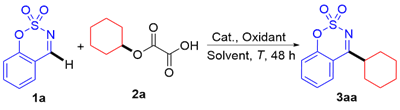
Initially, we commenced our study by selecting the readily available cyclic aldimine 1a and monoalkyl oxalate 2a as the benchmark substrates for the optimization of reaction conditions (Table 1). Pleasingly, the desired product 3aa was obtained in 72% yield with AgNO3 (20 mol%) as catalyst and K2S2O8 (3 equiv.) as oxidant in CH3CN/H2O (V∶V=1∶1) at 60 ℃ (Table 1, Entries 1~4). Further investigation of other Ag salts, such as AgF and AgOAc, gave slightly lower yields (Table 1, Entries 5, 6). Subsequently, other oxidants were screened and the results showed that K2S2O8 was the optimal oxidant (Table 1, Entries 7, 8). Following solvent examination indicated that the reaction worked unfavorably in mixed solvents such as acetone/H2O and dimethyl sulfoxide (DMSO)/H2O (Table 1, Entries 9, 10). When the amount of catalyst is reduced, the reaction just gave rise to negative results (Table 1, Entry 11). Screening experiments indicated that the reaction was completely suppressed in the absence of catalyst and oxidant (Table 1, Entries 12, 13). Thus, based on the above experiments, the optimized conditions were determined to be 1a (0.2 mmol), 2a (0.3 mmol), AgNO3 (20 mol%), K2S2O8 (0.6 mmol) in CH3CN/H2O (V∶V=1∶1, 2 mL) at 60 ℃ for 48 h.
Table 1 Optimization of the reaction conditionsa |
| Entry | Catalyst | Additive | Solvent (V∶V=1∶1) | T/℃ | Yieldb/% |
|---|---|---|---|---|---|
| 1 | AgNO3 | K2S2O8 | CH3CN/H2O | 25 | Trace |
| 2 | AgNO3 | K2S2O8 | CH3CN/H2O | 45 | 56 |
| 3 | AgNO3 | K2S2O8 | CH3CN/H2O | 60 | 72 |
| 4 | AgNO3 | K2S2O8 | CH3CN/H2O | 80 | 70 |
| 5 | AgOAc | K2S2O8 | CH3CN/H2O | 60 | 67 |
| 6 | AgF | K2S2O8 | CH3CN/H2O | 60 | 64 |
| 7 | AgNO3 | Na2S2O8 | CH3CN/H2O | 60 | 69 |
| 8 | AgNO3 | (NH4)2S2O8 | CH3CN/H2O | 60 | 63 |
| 9 | AgNO3 | K2S2O8 | Acetone/H2O | 60 | 36 |
| 10 | AgNO3 | K2S2O8 | DMSO/H2O | 60 | 58 |
| 11c | AgNO3 | K2S2O8 | DMSO/H2O | 60 | 61 |
| 12 | AgNO3 | — | CH3CN/H2O | 60 | Trace |
| 13 | — | K2S2O8 | CH3CN/H2O | 60 | n.d. |
a Reaction conditions: 1a (0.2 mmol), 2a (0.3 mmol), catalyst (20 mol%), oxidant (0.6 mmol), solvent (2 mL), 48 h. b Isolated yields. |
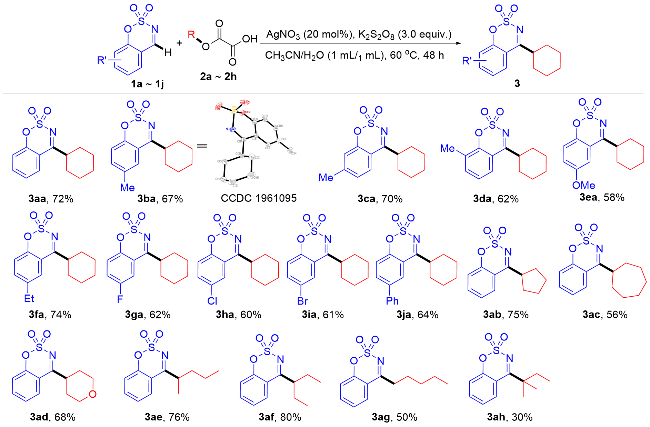
With the optimized reaction conditions in hand, we set out to explore the substrate scope of this reaction. First, a variety of cyclic aldimines were investigated under standard conditions. As shown in Scheme 2, substrates with electron- donating substituents such as Me, OMe, Et at 6-, 7-, and 8-positions displayed good reactivity in the reaction to afford the desired products 3ba~3fa in decent yields. Moreover, the structure of 3ba was unequivocally confirmed through X-ray crystallographic data. What’s more, cyclic aldimines with halogen substituents were well compatible in this transformation, enabling the generation of the target products 3ga~3ia in moderate to good yields. Cyclic aldimine with 6-Ph was also a good candidate, furnishing the desired product 3ja in 64% yield. Subsequently, we started to investigate the scope of monoalkyl oxalates. The secondary cyclic or noncyclic monoalkyl oxalates were proved to be good alkyl donors in the reaction, giving the corresponding products 3ab~3af in good yields. Moreover, alkylation reactions of primary monoalkyl oxalate could also be engaged in this reaction to give the desired products 3ag in moderate yield. However, tertiary monoalkyl oxalate exhibited low reactivity probably due to the relatively large steric hindrance (3ah).
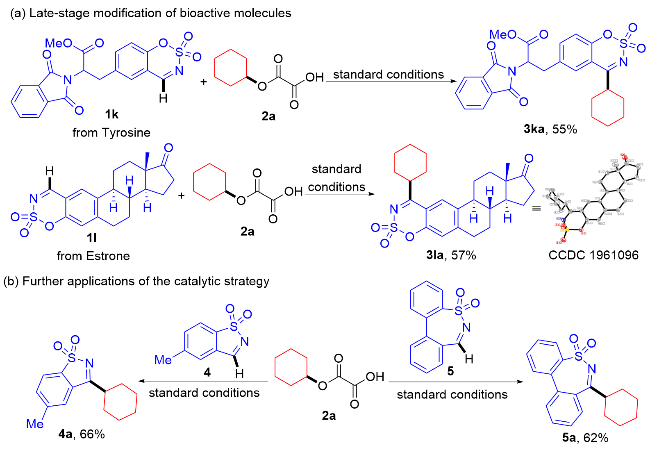
The C—H alkylation strategy of cyclic aldimines with monoalkyl oxalates exhibits broad application prospects in organic synthesis. We conducted the reactions with a series of cyclic aldimine derived natural products, successfully exhibiting the important application values in late-stage modification of bioactive molecules. For example, the tyrosine-derived cyclic aldimine 1k was employed under the standard conditions, and the corresponding alkylated product 3ka was obtained in 55% yield. The estrone-deri- ved cyclic aldimine 1l afforded the corresponding alkylated product 3la in 57% yield, and the structure of 3la was confirmed through X-ray crystallographic data (Scheme 3, a). In addition, we also extended the catalytic strategy to other ring cyclic imines. Pleasingly, the reaction of five- and seven-membered cyclic aldimines also proceeded successfully under the standard conditions, and the corresponding products 4a and 5a were obtained in 66% and 62% yields, respectively (Scheme 3, b).
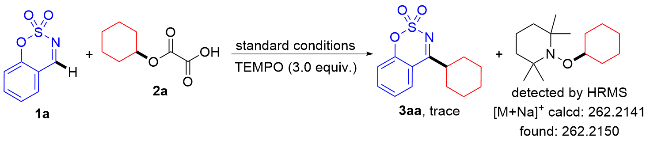
In order to get better understanding of this reaction, we carried out the control experiment for trapping any radical species generated in the process. When 3 equiv. of radical scavenger 2,2,6,6-tetramethyl-1-piperidinyloxy (TEMPO) was added, only trace amount of 3aa was detected, but the TEMPO trapped cyclohexane was detected and confirmed by high resolution mass spectroscopy (HRMS). These results revealed that a radical-type reaction regime was involved in this Ag-catalyzed decarboxylative C—H alkylation reaction (Scheme 4).
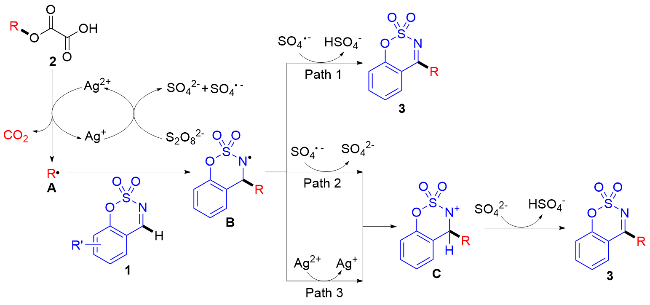
Based on the experiment results and other previous investigations, a plausible mechanism for the reaction is proposed in Scheme 5. First, Ag2+ intermediate is gener-ated by oxidizing Ag+ specie with S2O82-, which undergoes the single-electron transfer (SET) with the oxalates 2 to generate alkyl radical intermediate A via decarboxylation process. Then, radical A attacks cyclic aldimines 1 to afford N-radical intermediate B, along with the formation of a new C—C bond. Finally, N-radical B loses a H atom to give the target product 3. In addition, sulfate radical anion might oxidize the intermediate B nitrogen centered radical via SET or the Ag2+ species is converted to Ag+ species via SET from N-centered radical B to generate nitrogen cation intermediate C. Subsequently, the deprotonation of the intermediate C occurs to give the desired product 3.


3 Conclusions
In conclusion, we have developed a simple and practical silver-catalyzed decarboxylative radical reaction of easily accessible monoalkyl oxalates with cyclic aldimines through C—O bond cleavage strategy under mild reaction conditions. The desired products were obtained in moderate to good yields with broad substrate scope. This reaction strategy has been successfully applied for late-stage modification of bioactive molecules. Moreover, five- and seven-membered cyclic aldimines were also suitable for this transformation. Mechanistic studies showed that the reaction undergoes a radical pathway. Further development of novel and efficient synthetic reactions with cyclic aldimines is currently underway in our laboratory.
4 Experimental section
4.1 General experimental and details:
All commercially available reagents and solvent were used without further purification. Analytical thin layer chromatography was performed on 0.25 mm silica gel plates. Silica gel (200~300 mesh) was used for flash chromatography. Cyclic aldimines[18] and monoalkyl oxalates[11,14] were prepared according to the literatures. The NMR spectra were recorded at Bruker 400 MHz (1H NMR) and 100 MHz (13C NMR) with the solvent resonance as the internal standard (CDCl3 δH 7.26, δC 77.0). Infrared spectra were obtained with an AVATAR 360 FT-IR spectrometer. Melting points were measured with an XT-4 melting point apparatus without correction. X-ray structural analysis was conducted on an XtaLAB mini instrument. The high resolution ESI-MS spectra were obtained with a Waters Vion IMS QTof high resolution mass spectrometer.
4.2 General procedure for the decarboxylative C—H alkylation of monoalkyl oxalates with cyclic aldimines:
To a 10 mL Schlenk charged with cyclic aldimines 1 or 4 or 5 (0.2 mmol), AgNO3 (6.8 mg, 0.04 mmol), K2S2O8 (162 mg, 0.6 mmol) and monoalkyl oxalates 2 (0.3 mmol) were added CH3CN (1.0 mL) and distilled H2O (1.0 mL) via a syringe. Then, the reaction mixture was vigorously stirred at 60 ℃ for 48 h. After the reaction was complete, the mixture was diluted with water (10 mL) and extracted with ethyl acetate (10 mL×3). The organic layers were combined and washed with saturated brine (15 mL), dried with anhydrous MgSO4, and then concentrated in vacuo. The residue was purified by column chromatography on silica gel (petroleum ether/EtOAc (V∶V=10∶1) as the eluent) to afford the desired products 3 or 4a or 5a.
4-Cyclohexylbenzo[e][1,2,3]oxathiazine 2,2-dioxide (3aa): White solid, 72% yield. m.p. 108~110 ℃; 1H NMR (400 MHz, CDCl3) δ: 1.26~1.33 (m, 1H), 1.37~1.47 (m, 2H), 1.58~1.67 (m, 2H), 1.79 (d, J=12.8 Hz, 1H), 1.89~1.96 (m, 4H), 3.15~3.22 (m, 1H), 7.29 (d, J=12.4 Hz, 1H), 7.38 (dt, J=8.0 Hz, 0.8 Hz, 1H), 7.69 (dt, J=8.4 Hz, 1.6 Hz, 1H), 7.29 (dd, J=8.0 Hz, 0.8 Hz, 1H); 13C NMR (100 MHz, CDCl3) δ: 183.7, 153.8, 136.6, 127.7, 125.7, 119.4, 115.4, 43.2, 30.7, 25.8, 25.5; IR (KBr) ν: 2933, 1650, 1556, 1500, 1385, 1188, 749 cm-1; HRMS (ESI) calcd for C13H16NO3S [M+H]+ 266.0845, found 266.0852.
4-Cyclohexyl-6-methylbenzo[e][1,2,3]oxathiazine 2,2- dioxide (3ba): White solid, 67% yield. m.p. 121~123 ℃; 1H NMR (400 MHz, CDCl3) δ: 1.25~1.32 (m, 1H), 1.38~1.48 (m, 2H), 1.56~1.65 (m, 2H), 1.78 (d, J=12.8 Hz, 1H), 1.88~1.94 (m, 4H), 2.44 (s, 3H), 3.17 (t, J=11.2 Hz, 1H), 7.16 (d, J=8.4 Hz, 1H), 7.48 (dd, J=8.4, 1.2 Hz, 1H), 7.59 (s, 1H); 13C NMR (100 MHz, CDCl3) δ: 183.8, 151.8, 137.4, 135.7, 127.5, 119.0, 115.2, 43.0, 30.6, 25.7, 25.5, 20.9; IR (KBr) ν: 2933, 1650, 1556, 1385, 1189, 829 cm-1; HRMS (ESI) calcd for C14H18NO3S [M+H]+ 280.1002, found 280.1013.
4-Cyclohexyl-7-methylbenzo[e][1,2,3]oxathiazine 2,2- dioxide (3ca): White solid, 70% yield. m.p. 92~94 ℃; 1H NMR (400 MHz, CDCl3) δ: 1.24~1.31 (m, 1H), 1.36~1.46 (m, 2H), 1.56~1.65 (m, 2H), 1.77 (d, J=12.8 Hz, 1H), 1.87~1.93 (m, 4H), 2.46 (s, 3H), 3.15 (t, J=7.6 Hz, 1H), 7.07 (s, 1H), 7.17 (d, J=8.0 Hz, 1H), 7.70 (d, J=8.0 Hz, 1H); 13C NMR (100 MHz, CDCl3) δ: 183.6, 153.9, 148.9, 127.5, 126.7, 119.4, 113.0, 43.0, 30.6, 25.7, 25.5, 21.9; IR (KBr) ν: 2933, 2858, 1650, 1554, 1384, 1193, 1130, 788 cm-1; HRMS (ESI) calcd for C14H18NO3S [M+H]+ 280.1002, found 280.0996.
4-Cyclohexyl-8-methylbenzo[e][1,2,3]oxathiazine 2,2- dioxide (3da): White solid, 62% yield. m.p. 88~90 ℃; 1H NMR (400 MHz, CDCl3) δ: 1.26~1.33 (m, 1H), 1.37~1.47 (m, 2H), 1.57~1.66 (m, 2H), 1.79 (d, J=12.0 Hz, 1H), 1.89~1.96 (m, 4H), 2.39 (s, 3H), 3.19 (t, J=7.2 Hz, 1H), 7.27 (t, J=7.6 Hz, 1H), 7.54 (d, J=7.2 Hz, 1H), 7.68 (d, J=7.6 Hz, 1H); 13C NMR (100 MHz, CDCl3) δ: 184.1, 152.2, 137.9, 129.0, 125.2, 124.9, 115.3, 43.2, 30.7, 25.8, 25.5, 15.0; IR (KBr) ν: 2933, 1655, 1561, 1385, 1191, 868, 825 cm-1; HRMS (ESI) calcd for C14H18NO3S [M+H]+ 280.1002, found 280.1012.
4-Cyclohexyl-6-methoxybenzo[e][1,2,3]oxathiazine 2,2- dioxide (3ea): White solid, 58% yield. m.p. 106~108 ℃; 1H NMR (400 MHz, CDCl3) δ: 1.26~1.33 (m, 1H), 1.37~1.46 (m, 2H), 1.57~1.66 (m, 2H), 1.78 (d, J=12.8 Hz, 1H), 1.88~1.96 (m, 4H), 3.08~3.14 (m, 1H), 3.87 (s, 3H), 7.22~7.26 (m, 3H); 13C NMR (100 MHz, CDCl3) δ: 183.4, 156.7, 147.5, 122.0, 120.3, 116.0, 111.9, 56.0, 43.2, 30.6, 25.8, 25.5; IR (KBr) ν: 2936, 1650, 1556, 1385, 1187, 1032, 832 cm-1; HRMS (ESI) calcd for C14H18NO4S [M+H]+ 296.0951, found 296.0957.
4-Cyclohexyl-6-ethylbenzo[e][1,2,3]oxathiazine 2,2-dio- xide (3fa): White solid, 74% yield. m.p. 105~107 ℃; 1H NMR (400 MHz, CDCl3) δ: 1.25~1.32 (m, 4H), 1.39~1.48 (m, 2H), 1.57~1.66 (m, 2H), 1.79 (d, J=12.8 Hz, 1H), 1.88~1.95 (m, 4H), 2.73 (q, J=15.2, 7.6 Hz, 1H), 3.19 (t, J=7.6 Hz, 1H), 7.19 (d, J=8.4 Hz, 1H), 7.51 (d, J=8.4 Hz, 1H), 7.59 (s, 1H); 13C NMR (100 MHz, CDCl3) δ: 183.8, 151.9, 142.0, 136.3, 126.4, 119.2, 115.2, 43.0, 30.7, 28.3, 25.7, 25.5, 15.5; IR (KBr) ν: 2969, 2935, 2852, 1593, 1557, 1455, 1386, 1190, 1138, 840 cm-1; HRMS (ESI) calcd for C15H20NO3S [M+H]+ 294.1158, found 294.1163.
S-(4-Chlorophenyl) 4-chlorobenzenesulfonothioate (3ga): White solid, 62% yield. m.p. 83~84 ℃; 1H NMR (400 MHz, CDCl3) δ: 1.26~1.32 (m, 1H), 1.38-1.48 (m, 2H), 1.57~1.65 (m, 2H), 1.79 (d, J=12.4 Hz, 1H), 1.90~1.96 (m, 4H), 3.08 (t, J=11.2 Hz, 1H), 7.30 (dd, J=8.8 Hz, 4.0 Hz, 1H), 7.41 (t, J=7.2 Hz, 1H), 7.51 (d, J=6.4 Hz, 1H); 13C NMR (100 MHz, CDCl3) δ: 182.7, 159.0 (d, JC-F=246.3 Hz), 149.8, 123.8 (d, JC-F=23.9 Hz), 121.2 (d, JC-F=8.0 Hz), 116.2 (d, JC-F=7.4 Hz), 113.8 (d, JC-F=25.1 Hz), 43.4, 30.6, 25.7, 25.4; IR (KBr) ν: 2934, 2860, 1627, 1563, 1392, 1186, 835 cm-1; HRMS (ESI) calcd for C13H15- FNO3S [M+H]+ 284.0751, found 284.0760.
6-Chloro-4-cyclohexylbenzo[e][1,2,3]oxathiazine 2,2- dioxide (3ha): White solid, 60% yield. m.p. 94~95 ℃; 1H NMR (400 MHz, CDCl3) δ: 1.24~1.33 (m, 1H), 1.39~1.49 (m, 2H), 1.56~1.66 (m, 2H), 1.80 (d, J=12.4 Hz, 1H), 1.90~1.95 (m, 4H), 3.08~3.14 (m, 1H), 7.26 (d, J=8.8 Hz, 1H), 7.64 (dd, J=8.8, 2.4 Hz, 1H), 7.77 (d, J=2.0 Hz, 1H); 13C NMR (100 MHz, CDCl3) δ: 182.6, 152.2, 136.3, 131.2, 127.2, 120.9, 116.4, 43.2, 30.6, 25.6, 25.4; IR (KBr) ν: 2933, 2857, 1633, 1556, 1392, 1106 cm-1; HRMS (ESI) calcd for C13H15ClNO3S [M+H]+ 300.0456, found 300.0467.
6-Bromo-4-cyclohexylbenzo[e][1,2,3]oxathiazine 2,2- dioxide (3ia): White solid, 61% yield. m.p. 108~109 ℃; 1H NMR (400 MHz, CDCl3) δ: 1.26~1.33 (m, 1H), 1.39~1.49 (m, 2H), 1.56~1.66 (m, 2H), 1.80 (d, J=12.8 Hz, 1H), 1.90~1.95 (m, 4H), 3.08~3.15 (m, 1H), 7.19 (d, J=8.8 Hz, 1H), 7.78 (dd, J=8.4, 2.0 Hz, 1H), 7.91 (d, J=2.0 Hz, 1H); 13C NMR (100 MHz, CDCl3) δ: 182.5, 152.8, 139.2, 130.1, 121.1, 118.4, 116.8, 43.2, 30.6, 25.6, 25.4; IR (KBr) ν: 2936, 2857, 1633, 1391, 1190, 895 cm-1; HRMS (ESI) calcd for C13H15BrNO3S [M+H]+ 343.9951, found 343.9959.
4-Cyclohexyl-6-phenylbenzo[e][1,2,3]oxathiazine 2,2- dioxide (3ja): White solid, 64% yield. m.p. 128~130 ℃; 1H NMR (400 MHz, CDCl3) δ: 1.27~1.34 (m, 1H), 1.40~1.50 (m, 2H), 1.61~1.70 (m, 2H), 1.80 (d, J=12.4 Hz, 1H), 1.90~2.00 (m, 4H), 3.27 (t, J=7.2 Hz, 1H), 7.36 (d, J=8.4 Hz, 1H), 7.44~7.47 (m, 1H), 7.50~7.56 (m, 4H), 7.87 (d, J=8.8 Hz, 1H), 7.94 (s, 1H); 13C NMR (100 MHz, CDCl3) δ: 183.8, 153.0, 139.4, 138.6, 135.3, 129.2, 128.3, 127.1, 125.9, 119.7, 115.6, 43.1, 30.7, 25.7, 25.5; IR (KBr) ν: 2938, 2857, 1650, 1556, 1385, 1190, 802 cm-1; HRMS (ESI) calcd for C19H20NO3S [M+H]+ 342.1158, found 342.1174.
4-Cyclopentylbenzo[e][1,2,3]oxathiazine 2,2-dioxide (3ab): White solid, 75% yield. m.p. 101~103 ℃; 1H NMR (400 MHz, CDCl3) δ: 1.68~1.77 (m, 2H), 1.80~1.89 (m, 2H), 1.96~2.10 (m, 4H), 3.64~3.72 (m, 1H), 7.29 (d, J=8.4 Hz, 1H), 7.38 (dt, J=8.4 Hz, 1H), 7.69 (dt, J=8.4 Hz, 1H), 7.86 (dd, J=8.0, 1.6 Hz, 1H); 13C NMR (100 MHz, CDCl3) δ: 183.3, 153.7, 136.5, 128.2, 125.6, 119.2, 116.2, 44.3, 31.3, 25.9; IR (KBr) ν: 2964, 2859, 1650, 1595, 1386, 1188, 850 cm-1; HRMS (ESI) calcd for C12H14NO3S [M+H]+ 252.0689, found 252.0695.
4-Cycloheptylbenzo[e][1,2,3]oxathiazine 2,2-dioxide (3ac): White solid, 56% yield. m.p. 115~116 ℃; 1H NMR (400 MHz, CDCl3) δ: 1.53~1.69 (m, 6H), 1.76~1.89 (m, 4H), 1.97~2.03 (m, 2H), 3.33~3.39 (m, 1H), 7.27 (dd, J=8.4, 0.8 Hz, 1H), 7.38 (dt, J=8.4, 1.2 Hz, 1H), 7.69 (dt, J=8.4, 1.6 Hz, 1H), 7.82 (dd, J=8.0, 0.8 Hz, 1H); 13C NMR (100 MHz, CDCl3) δ: 184.6, 153.9, 136.6, 127.7, 125.7, 119.3, 115.4, 44.2, 32.3, 27.8, 26.5; IR (KBr) ν: 2928, 2853, 1556, 1385, 1187, 851, 771 cm-1; HRMS (ESI) calcd for C14H18NO3S [M+H]+ 280.1002, found 280.0993.
4-(Tetrahydro-2H-pyran-4-yl)benzo[e][1,2,3]oxathiazine 2,2-dioxide (3ad): White solid, 68% yield. m.p. 128~130 ℃; 1H NMR (400 MHz, CDCl3) δ: 1.81~1.84 (m, 2H), 1.93~2.03 (m, 2H), 3.43~3.50 (m, 1H), 3.57 (dt, J=11.6, 1.6 Hz, 2H), 4.09 (dd, J=11.6, 2.4 Hz, 2H), 7.30 (d, J=8.4 Hz, 1H), 7.41 (t, J=7.6 Hz, 1H), 7.71 (t, J=8.0 Hz, 1H), 7.85 (d, J=8.0 Hz 1H); 13C NMR (100 MHz, CDCl3) δ: 181.6, 153.8, 136.9, 127.5, 125.9, 119.5, 115.0, 67.0, 40.3, 30.1; IR (KBr) ν: 2951, 1595, 1556, 1385, 1187, 1126, 852 cm-1; HRMS (ESI) calcd for C12H14NO4S [M+H]+ 268.0638, found 268.0629.
4-(Pentan-2-yl)benzo[e][1,2,3]oxathiazine 2,2-dioxide (3ae): Oil, 76% yield.1H NMR (400 MHz, CDCl3) δ: 0.92 (t, J=7.6 Hz, 3H), 1.33 (d, J=6.8 Hz, 3H), 1.36~1.43 (m, 2H), 1.54~1.62 (m, 1H), 1.81~1.89 (m, 1H), 3.38~3.46 (m, 1H), 7.30 (dd, J=8.4, 0.8 Hz, 1H), 7.39 (dt, J=8.4 Hz, 1H), 7.70 (dt, J=8.4 Hz, 1H), 7.84 (dd, J=8.4, 1.6 Hz, 1H); 13C NMR (100 MHz, CDCl3) δ: 184.5, 153.9, 136.7, 127.6, 125.7, 119.4, 115.8, 38.1, 36.9, 20.3, 18.3, 14.0; IR (KBr) ν: 2931, 2852, 1595, 1556, 1385, 1187, 1130, 850, 750 cm-1; HRMS (ESI) calcd for C12H16NO3S [M+H]+ 254.0845, found 254.0856.
4-(Pentan-3-yl)benzo[e][1,2,3]oxathiazine 2,2-dioxide (3af): Oil, 80% yield. 1H NMR (400 MHz, CDCl3) δ: 0.92 (t, J=7.6 Hz, 6H), 1.67~1.78 (m, 2H), 1.84~1.95 (m, 2H), 3.16~3.23 (m, 1H), 7.30 (d, J=8.4 Hz, 1H), 7.39 (t, J=8.0 Hz, 1H), 7.71 (t, J=8.0 Hz, 1H), 7.86 (d, J=8.0 Hz, 1H); 13C NMR (100 MHz, CDCl3) δ: 184.4, 153.7, 136.8, 127.9, 125.7, 119.3, 116.8, 46.6, 26.2, 11.6; IR (KBr) ν: 2966, 1650, 1556, 1459, 1385, 1188, 748 cm-1; HRMS (ESI) calcd for C12H16NO3S [M+H]+ 254.0845, found 254.0858.
4-Pentylbenzo[e][1,2,3]oxathiazine 2,2-dioxide (3ag): Oil, 50% yield. 1H NMR (400 MHz, CDCl3) δ: 0.92 (t, J=6.8 Hz, 3H), 1.35~1.46 (m, 4H), 1.78~1.86 (m, 2H), 3.01 (t, J=7.6 Hz, 2H), 7.29 (d, J=8.4 Hz, 1H), 7.38 (t, J=8.0 Hz, 1H), 7.69 (dt, J=8.4, 1.2 Hz, 1H), 7.81 (d, J=8.0 Hz, 1H); 13C NMR (100 MHz, CDCl3) δ: 180.3, 153.5, 136.7, 127.9, 125.7, 119.2, 116.1, 35.8, 31.2, 25.6, 22.3, 13.8; IR (KBr) ν: 2932, 2854, 1650, 1556, 1385, 1186, 750 cm-1; HRMS (ESI) calcd for C12H16NO3S [M+H]+ 254.0845, found 254.0852.
4-(tert-Pentyl)benzo[e][1,2,3]oxathiazine 2,2-dioxide (3ah): Oil, 30% yield. 1H NMR (400 MHz, CDCl3) δ: 0.69 (t, J=7.6 Hz, 3H), 1.31 (s, 6H), 1.69 (q, J=7.6 Hz, 2H), 7.22 (s, 1H), 7.37 (dd, J=8.0, 1.2 Hz, 1H), 7.59 (d, J=8.4 Hz, 1H), 8.61 (s, 1H); 13C NMR (100 MHz, CDCl3) δ: 167.2, 162.7, 154.4, 130.2, 124.0, 116.1, 112.9, 39.4, 36.4, 27.9, 8.98; IR (KBr) ν: 2936, 1556, 1386, 1197, 1056, 746 cm-1; HRMS (ESI) calcd for C12H16NO3S [M+H]+ 254.0845, found 254.0837.
Methyl 3-(4-cyclohexyl-2,2-dioxidobenzo[e][1,2,3]oxa- thiazin-6-yl)-2-(1,3-dioxoisoindolin-2-yl)propanoate (3ka): White solid, 55% yield. m.p. 208~210 ℃; 1H NMR (400 MHz, CDCl3) δ: 1.21~1.28 (m, 1H), 1.34~1.50 (m, 3H), 1.53~1.62 (m, 2H), 1.77 (d, J=12.0 Hz, 2H), 1.87 (t, J=12.0 Hz, 2H), 3.05 (t, J=11.2 Hz, 1H), 3.59~3.68 (m, 2H), 3.79 (s, 3H), 5.18 (dd, J=10.4, 6.4 Hz, 1H), 7.14 (d, J=8.4 Hz, 1H), 7.52 (dd, J=8.8, 2.0 Hz, 1H), 7.60 (d, J=1.6 Hz, 1H), 7.71~7.74 (m, 2H), 7.77~7.81 (m, 2H); 13C NMR (100 MHz, CDCl3) δ: 183.3, 168.6, 167.3, 152.8, 137.0, 134.6, 134.5, 131.2, 127.7, 123.6, 119.6, 115.2, 53.1, 52.3, 42.9, 34.0, 30.7, 30.3, 25.7, 25.6, 25.5; IR (KBr) ν: 2936, 2857, 1714, 1650, 1573, 1385, 1188, 721 cm-1; HRMS (ESI) calcd for C25H25N2O7S [M+H]+ 497.1377, found 497.1382.
10-Cyclohexyl-13a-methyl-2,3,3a,3b,4,5,11b,12,13,13a-decahydro-1H-cyclopenta[7,8]phenanthro[3,2-e][1,2,3]oxa-thiazin-1-one 8,8-dioxide (3la): White solid, 57% yield. m.p. 238~240 ℃; 1H NMR (400 MHz, CDCl3) δ: 0.92 (s, 3H), 1.25-1.32 (m, 1H), 1.38~1.70 (m, 10H), 1.79 (d, J=12.4 Hz, 1H), 1.88~1.92 (m, 4H), 2.01~2.11 (m, 3H), 2.14~2.21 (m, 1H), 2.29~2.35 (m, 1H), 2.39~2.42 (m, 1H), 2.49~2.56 (m, 1H), 2.92~3.06 (m, 2H), 3.14 (t, J=11.2 Hz, 1H), 7.00 (s, 1H), 7.66 (s, 1H); 13C NMR (100 MHz, CDCl3) δ: 183.8, 151.7, 147.7, 137.9, 124.3, 118.9, 113.2, 50.2, 47.7, 43.6, 43.0, 37.5, 35.7, 31.2, 30.8, 30.7, 29.8, 25.8, 25.7, 25.6, 25.5, 21.4, 13.7; IR (KBr) ν: 2932, 2853, 1737, 1655, 1614, 1384, 1194, 901 cm-1; HRMS (ESI) calcd for C25H32NO4S [M+H]+ 442.2047, found 442.2055.
3-Cyclohexyl-5-methylbenzo[d]isothiazole 1,1-dioxide (4a): White solid, 66% yield. m.p. 121~123 ℃; 1H NMR (400 MHz, CDCl3) δ: 1.27~1.34 (m, 1H), 1.36~1.49 (m, 2H), 1.60~1.69 (m, 2H), 1.80 (d, J=12.4 Hz, 1H), 1.93 (d, J=12.8 Hz, 2H), 2.03 (d, J=12.4 Hz, 2H), 2.51 (s, 3H), 2.96~3.04 (m, 1H), 7.46 (s, 1H), 7.50 (d, J=7.6 Hz, 1H), 7.76 (d, J=7.6 Hz, 1H); 13C NMR (100 MHz, CDCl3) δ: 179.4, 144.9, 137.3, 133.8, 131.2, 124.3, 122.3, 122.2, 39.8, 30.1, 25.7, 25.6, 21.7; IR (KBr) ν: 2933, 2858, 1650, 1556, 1452, 1333, 1180, 1162, 834 cm-1; HRMS (ESI) calcd for C14H18NO2S [M+H]+ 264.1053, found 264.1038.
7-Cyclohexyldibenzo[d,f][1,2]thiazepine 5,5-dioxide (5a): White solid, 62% yield. m.p. 124~125 ℃; 1H NMR (400 MHz, CDCl3) δ: 0.82~0.92 (m, 1H), 1.05~1.22 (m, 2H), 1.27~1.37 (m, 2H), 1.57~1.65 (m, 2H), 1.67~1.77 (m, 1H), 1.85 (d, J=13.6 Hz, 1H), 2.09 (d, J=13.6 Hz, 1H), 2.95~3.03 (m, 1H), 7.57 (t, J=7.6 Hz 1H), 7.60~7.63 (m, 1H), 7.64~7.67 (m, 1H), 7.68~7.77 (m, 4H), 8.22 (dd, J=8.0, 1.2 Hz, 1H); 13C NMR (100 MHz, CDCl3) δ: 189.3, 140.4, 138.7, 136.4, 135.8, 133.3, 131.5, 130.3, 129.9, 128.7, 128.3, 127.3, 127.2, 49.6, 31.4, 29.6, 26.1, 25.4, 25.2; IR (KBr) ν: 1931, 2853, 1633, 1556, 1329, 1172, 741 cm-1; HRMS (ESI) calcd for C19H20NO2S [M+H]+ 326.1209, found 326.1218.
Supporting Information NMR, IR, melting point, X-ray structural analysis and HRMS spectra of materials and products. The Supporting Information is available free of charge via the Internet at http://sioc-journal.cn.
(Zhao, C.)