


1 Introduction
Diabetes mellitus (DM) is a metabolic disorder characterized by chronic hyperglycemia and has become one of the leading causes of death worldwide.[1] Type 2 diabetes mellitus (T2DM) accounts for approximately 90% of all DM cases, posing a significant threat to public health.[2] In recent years, protein tyrosine phosphatase 1B (PTP1B) has emerged as an attractive therapeutic target for the treatment of T2DM.[3] PTP1B is an intracellular protein tyrosine phosphatase that functions as a negative regulator of insulin and leptin signaling pathways.[4] PTP1B-deficient mice exhibit enhanced insulin sensitivity, increased or prolonged tyrosine phosphorylation of insulin receptors, as well as improved glycemic control and resistance to obesity.[5] Therefore, inhibition of PTP1B represents a promising strategy for simultaneously addressing both diabetes and obesity in T2DM, making PTP1B an exciting target for drug discovery.
Natural products have long served as a valuable source of lead compounds for drug development,[6] in addition to providing essential nutrients for human health.[7] Among them, pentacyclic triterpenoids have attracted considerable attention due to their diverse biological activities, including antidiabetic, anti-inflammatory, and anticancer properties. Specifically, several natural triterpenoids such as oleanolic acid, ursolic acid, and betulinic acid have been reported to exhibit moderate PTP1B inhibitory and hypoglycemic activities. Betulinic acid (BA), a naturally occurring pentacyclic triterpenoid, has been reported to possess PTP1B inhibitory and hypoglycemic activities.[8] Despite its promising bioactivity, BA has not been developed into a clinical drug due to limitations such as poor bioavailability.[9]
Structural modification of natural products has been established as an effective strategy to optimize their drug-like properties.[10] In particular, the introduction of heterocyclic moieties into natural product scaffolds has proven successful in enhancing biological activity and improving pharmacokinetic profiles. Triazoles represent important structural units in medicinal chemistry.[11] They can interact with target proteins through non-covalent forces, thereby enhancing binding affinity and leading to improved bio- activities. Moreover, triazoles exhibit a wide range of biological activities.[12] Recently, the triazole scaffold has also been reported as a core structure for PTP1B inhibitors.[13]
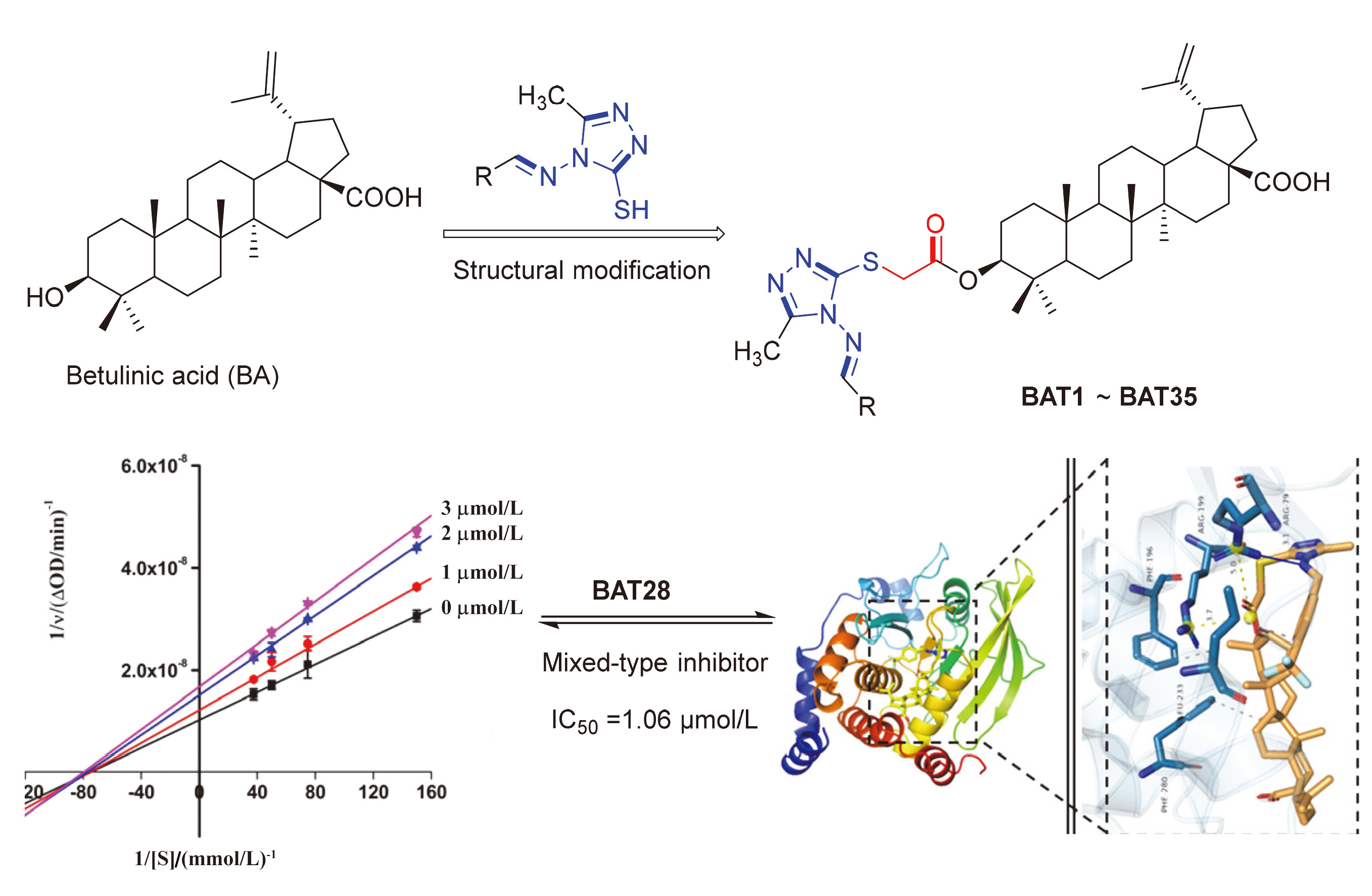
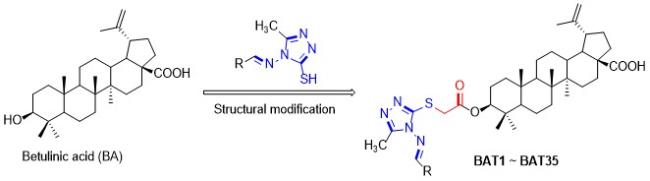
Based on the above considerations, we hypothesized that incorporating a triazole moiety into the BA scaffold could enhance PTP1B inhibitory activity. The triazole ring can serve as a linker to introduce various substituents, allowing exploration of structure-activity relationships (SAR) and optimization of binding interactions with the PTP1B active site. Accordingly, a series of BA-triazole hybrids (BAT1~BAT35, Figure 1) were designed by connecting BA with various aromatic and aliphatic groups via a triazole-con- taining linker. All target compounds were synthesized and evaluated for their PTP1B inhibitory activities, with the aim of identifying novel lead compounds for T2DM treatment.
2 Results and discussion
2.1 Chemistry
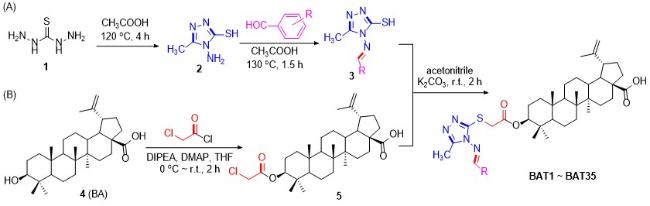
The synthesis of BA-triazole hybrids BAT1~BAT35 was carried out according to the route outlined in Scheme 1. Material 1 was converted to compound 2 in the presence of CH3COOH. Subsequently, 2 underwent condensation with substituted benzaldehydes under reflux conditions to afford intermediates 3. Meanwhile, starting material BA (4) was subjected to acylation with chloroacetyl chloride in the presence of N,N-diisopropylethylamine (DIPEA) and 4-di- methylaminopyridine (DMAP) to give compound 5. Fina- lly, BAT1~BAT35 were obtained via nucleophilic substitution between intermediates 3 and 5. All compounds were characterized by NMR and HRMS.
2.2 PTP1B inhibitory activity
The inhibitory activities of synthesized BA-triazole hybrids BAT1~BAT35 against PTP1B were evaluated, and the results were summarized in Table 1. Compared with the parent compound BA (IC50=8.66±0.81 μmol/L), all derivatives exhibited significantly enhanced inhibitory potency, with IC50 values ranging from (1.06±0.06) to (5.01±0.10) μmol/L. Among them, BAT28 displayed the strongest activity (IC50=1.06±0.06 μmol/L), representing an approximately 8-fold improvement over BA. These results suggest that the incorporation of a triazole moiety into the BA scaffold would be beneficial for enhancing PTP1B inhibition.
Table 1 PTP1B inhibitory activities of BAT1~BAT35 |
| Compound | R | IC50/(μmol•L-1) | Compound | R | IC50/(μmol•L-1) |
|---|---|---|---|---|---|
| BAT1 |  | 2.41±0.18 | BAT19 |  | 3.40±0.19 |
| BAT2 |  | 2.56±0.14 | BAT20 |  | 2.77±0.15 |
| BAT3 |  | 2.08±0.12 | BAT21 | 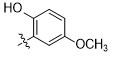 | 3.17±0.19 |
| BAT4 |  | 1.87±0.08 | BAT22 |  | 3.87±0.05 |
| BAT5 |  | 4.25±0.23 | BAT23 | 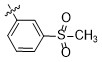 | 4.06±0.27 |
| BAT6 |  | 4.46±0.19 | BAT24 | 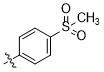 | 2.14±0.14 |
| BAT7 |  | 1.86±0.11 | BAT25 | 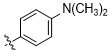 | 2.35±0.16 |
| BAT8 |  | 3.05±0.23 | BAT26 | 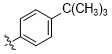 | 3.32±0.21 |
| BAT9 |  | 2.20±0.09 | BAT27 |  | 2.94±0.09 |
| BAT10 |  | 5.01±0.10 | BAT28 |  | 1.06±0.06 |
| BAT11 |  | 1.84±0.05 | BAT29 | 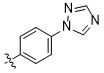 | 3.53±0.27 |
| BAT12 |  | 1.97±0.09 | BAT30 |  | 2.84±0.13 |
| BAT13 |  | 3.13±0.20 | BAT31 |  | 3.91±0.25 |
| BAT14 |  | 3.17±0.22 | BAT32 |  | 1.95±0.16 |
| BAT15 |  | 1.87±0.13 | BAT33 |  | 2.50±0.14 |
| BAT16 |  | 1.91±0.13 | BAT34 |  | 1.68±0.11 |
| BAT17 |  | 2.94±0.17 | BAT35 |  | 4.42±0.28 |
| BAT18 |  | 1.21±0.06 | BA | — | 8.66 ± 0.81 |
Structure-activity relationship (SAR) analysis revealed that the type and position of substituents on aromatic ring significantly influenced inhibitory potency. From a multidimensional perspective considering electronic effects, sub- stituent position, and hydrophobicity, SAR was analyzed. (1) Electronic effects of substituents: For compounds bea- ring a benzene ring (BAT1~BAT29), electron-withdraw- ing groups (e.g., F, Cl, Br, CN, NO2) at the para-position generally conferred greater activity (IC50: 1.06~2.41 μmol/ L) than those at ortho- or meta-positions. In particular, the para-fluorinated derivative BAT28 exhibited the highest potency (IC50=1.06 μmol/L), suggesting that fluorine substitution is favorable for PTP1B binding. In contrast, for electron-donating substituents (e.g., OCH3, CH3), the meta-position appeared more favorable for activity enhancement, as exemplified by BAT11 (3-OCH3, IC50=1.84 μmol/L) and BAT4 (3-CH3, IC50=1.87 μmol/L), which showed better activity than their para-substituted counterparts. (2) Substituent position effects: A clear positional dependence was observed. For halogen substituents, the order of activity was generally para->ortho->meta- for electron-withdrawing groups. For example, BAT28 (4-F, IC50=1.06 μmol/L) was more potent than BAT27 (2-F, IC50=2.94 μmol/L) and BAT26 (3-F, IC50=3.32 μmol/L). (3) Substituent size and hydrophobicity: bulky substituents such as OCF3 (BAT25, IC50=2.35 μmol/L) and CF3 (BAT17, IC50=2.94 μmol/L) were tolerated but did not further improve activity compared to smaller halogens like fluorine. This suggests that a balance between hydrophobicity and steric bulk is important for optimal binding to the PTP1B active site. (4) Aromatic vs. non-aromatic substituents: Derivatives with non-aromatic substituents (BAT30~BAT35) exhibited inhibitory activities (IC50=1.68~4.42 μmol/L) comparable to their aromatic counterparts, indicating that structural diversity at this region is tolerated. Notably, the cyclopropylmethyl-substituted BAT34 (IC50=1.68 μmol/L) showed activity close to the most potent aromatic derivatives, suggesting that small, rigid hydrophobic groups can effectively mimic aromatic rings in binding to PTP1B. Overall, the SAR analysis indicated that the optimal substituents for PTP1B inhibition were small electron-withdrawing groups, particularly fluorine, at the para-position of the aromatic ring. These findings provided valuable guidance for further optimization of BA-triazole hybrids as PTP1B inhibitors.
2.3 Inhibition kinetics
To investigate the inhibitory mechanism of the most potent compound BAT28 against PTP1B, enzyme kinetic studies were carried out using Lineweaver-Burk plots ana- lysis. As illustrated in Figure 2A, with increasing concentra- tions of BAT28, a family of straight lines was obtained, all of which intersected in the third quadrant. This intersection pattern was characteristic of mixed-type inhibition.[14] Further analysis revealed that both the slope and the Y-intercept of the Lineweaver-Burk plots increased with higher inhibitor concentrations (Figures 2B~2C). These kinetic parameters confirmed that BAT28 functioned as a mixed-type inhibitor, capable of binding to both free enzyme and enzyme-substrate complex with different affinities.
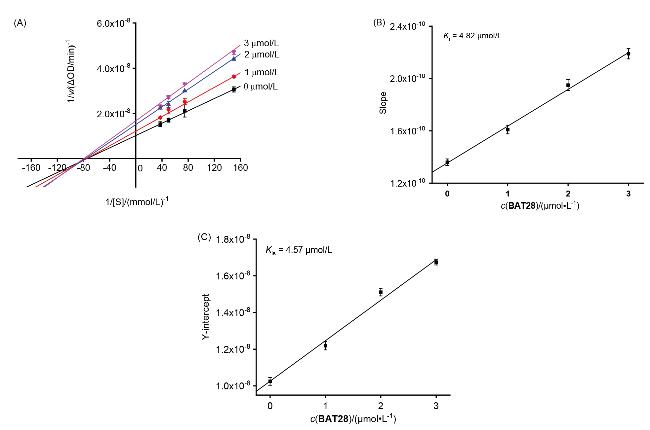
The inhibition constant for BAT28 binding to free PTP1B (Ki) was determined to be 4.82 μmol/L, while that for binding to the enzyme-substrate complex (Kis) was 4.57 μmol/L. The similarity between these two values suggested that BAT28 exhibited comparable affinity for both forms of the enzyme, which was a common feature among mixed- type inhibitors.[15]
2.4 CD spectra
To further investigate the effect of BAT28 on PTP1B conformation, CD spectroscopy was employed. As shown in Figure 3, PTP1B alone exhibited CD characteristic negative bands in the far-UV region (200~230 nm), which were typical of proteins with mixed secondary structures. Upon addition of BAT28, a clear change in the spectral pattern was observed, indicating that compound binding induced conformation alterations in the enzyme.
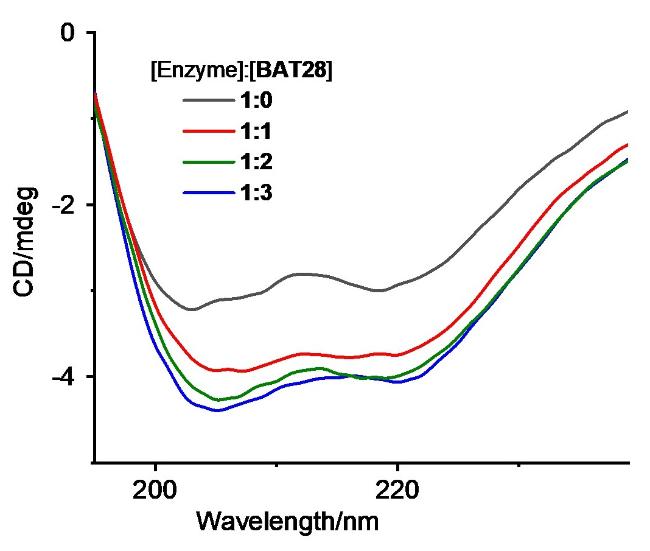
Quantitative analysis of the secondary structure content was performed using the CDNN software, and the results were summarized in Table 2. With increasing molar ratios of BAT28 to PTP1B (from 1∶0 to 3∶1), a progressive increase in α-helix content was observed. Concomitantly, the contents of β-sheet, β-turn, and random coil decreased. These changes suggested that BAT28 binding promoted a more ordered secondary structure in PTP1B, particularly favoring α-helical conformation.
Table 2 Secondary structure contents of PTP1B upon BAT28 |
| [PTP1B]∶[BAT28] | α-Helix/% | β-Sheet/% | β-Turn/% | Random coil/% |
|---|---|---|---|---|
| 1∶0 | 47.2 | 9.4 | 15.5 | 30.3 |
| 1∶1 | 48.0 | 9.1 | 15.2 | 29.0 |
| 1∶2 | 51.1 | 8.1 | 15.0 | 28.8 |
| 1∶3 | 58.3 | 6.0 | 14.1 | 26.5 |
2.5 Docking assay
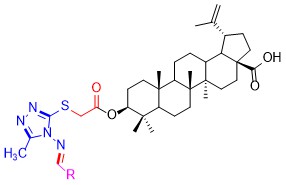
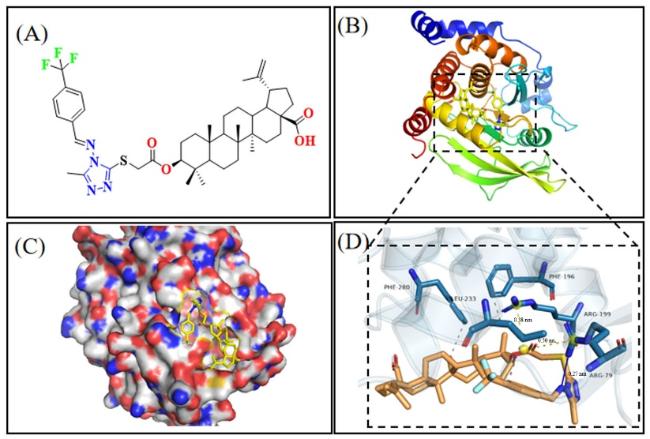
To gain further insight into the binding mode of BAT28 (Figure 4A) with PTP1B (PDB: 2VEY), molecular docking simulations were performed. As illustrated in Figures 4B~4C, BAT28 adopted a characteristic “L”-shaped conformation within the active site. The calculated binding energy was -36.4 kJ/mol, indicating a strong affinity between BAT28 and the target protein. Detailed analysis of the binding interactions (Figure 4D) revealed that BAT28 formed a hydrogen bond (0.27 nm) between the hydroxyl oxygen of its carboxyl group and the guanidinium side chain of Arg-79. This interaction was considered crucial for anchoring the inhibitor within the active site. In addition to this hydrogen bond, BAT28 engaged in multiple hydrophobic interactions with residues such as Phe-196 (0.36 nm), Phe-280 (0.36 nm), and Leu-233 (0.37 nm), which contributed to the stabilization of the ligand-protein complex. Furthermore, salt bridge interactions were observed with Arg-79 (0.50 nm) and Arg-199 (0.38 nm), further reinforcing binding affinity.
2.6 Oral glucose tolerance test
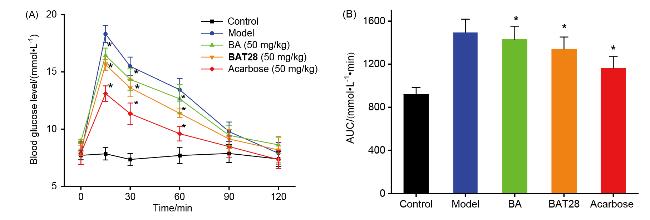
To evaluate the in vivo hypoglycemic potential of BAT28, an oral glucose tolerance test (OGTT) was conducted in Kunming mice. As shown in Figure 5A, blood glucose levels in the blank group remained stable through- out the experiment. In the model group, oral administration of sucrose (2 g/kg) induced a rapid increase in blood glucose, reaching a peak at 15 min, indicating impaired glucose tolerance characteristic of hyperglycemic conditions. Pretreatment with BAT28 (50 mg/kg) significantly attenuated the postprandial blood glucose excursion compared with the model group. The glucose-lowering effect of BAT28 was comparable to that of acarbose (50 mg/kg) and was superior to that of parent compound BA at the same dose. The area under the curve (AUC) of the glucose response (Figure 5B) further corroborated these observations, with the BAT28 group exhibiting a significantly lower AUC than the model group (P<0.05).


2.7 Drug-like properties
To assess the drug-likeness of BAT28, its physicochemical properties were evaluated using the SwissADME online server, and the results were summarized in Table 3. According to Lipinski’s Rule of Five, BAT28 exhibited one hydrogen bond donor (HBD), ten hydrogen bond acceptors (HBA), and eleven rotatable bonds, with a polar surface area (PSA) of 1.32 nm2. While the molecular weight (797.02) and log Po/w (9.34) exceeded the conventional thresholds, such deviations are not uncommon among natural product-derived lead compounds, particularly triter- penoids, which often possess larger, more lipophilic frameworks.
Table 3 Physicochemical properties of BAT28 |
| Molecular formula | Molecular weight | Rotatable bond | H-bond acceptor atoms | H-bond donor atoms | Polar surface area/ nm2 | log Po/w | Water solubility |
|---|---|---|---|---|---|---|---|
| C40H56N4O4 | 797.02 | 11 | 10 | 1 | 1.32 | 9.34 | Insoluble |
3 Conclusions
In summary, thirty-five betulinic acid-triazole hybrids (BAT1~BAT35) were designed, synthesized, and evaluated for their PTP1B inhibitory activity. All synthesized compounds exhibited enhanced potency compared with the parent betulinic acid, demonstrating the value of incorporating a triazole moiety into the triterpenoid scaffold. Among them, BAT28 emerged as the most promising candidate, displaying an IC50 value of (1.06±0.06) μmol/L, which represents an 8-fold improvement over betulinic acid. Kinetic analysis revealed that BAT28 acted as a mixed-type inhibitor. CD spectroscopy confirmed that BAT28 induced conformation changes in PTP1B. Molecular docking studies further elucidated the binding interactions, highlighting key hydrogen bonds and hydrophobic contacts with residues in the active site. In an oral glucose tolerance test, BAT28 significantly reduced postprandial blood glucose levels in mice, demonstrating its potential for in vivo efficacy. Additionally, in silico evaluation of drug- like properties suggested that BAT28 possessed favorable physicochemical characteristics, with most parameters falling within acceptable ranges. Taken together, these findings established BAT28 as a promising lead compound for the development of PTP1B inhibitors. Although BAT28 shows promising in vivo efficacy in an acute glucose tolerance test, its chronic toxicity, pharmacokinetic profile, and long-term efficacy have not been evaluated. The stability of the imine structure under acidic gastric conditions has not been experimentally tested. Moreover, BAT28 does not fully comply with Lipinski’s Rule of Five, which may affect its oral bioavailability. These limitations will be addressed in follow-up studies.
4 Experimental section
4.1 Instruments and reagents
The melting point of the compounds was obtained by SRS automatic melting point analyzer. NMR data were recorded on a Bruker NMR spectrometer. HRMS data were measured on an Apex II by means of the ESI technique. Recombination PTP1B was purified in our laboratory. 6,8-Difluoro-4-methylumbelliferyl phosphate (DiFUMP) was obtained from Invitrogen. Silica gel was obtained from TITAN Scientific. Other reagents were purchased from commercial suppliers.
4.2 Synthesis of BAT1~BAT35
According to our previous work,[16] BAT1~BAT35 were synthesized. A mixture of compound 1 (1.0 equiv.) in glacial acetic acid (10 mL) was heated under reflux at 130 ℃ for 5 h. After cooling to room temperature, the precipitated solid was collected by filtration to afford compound 2. Compound 2 (1.0 mmol, 1.0 equiv.) was dissolved in acetic acid (1 mL), followed by addition of the corresponding substituted benzaldehyde. The resulting mixture was stirred at 130 ℃ for 1.5 h under reflux. Upon completion, the reaction mixture was cooled, and the formed precipitate was filtered to give intermediates 3.
Betulinic acid (4, 1.0 mmol, 1.0 equiv.) was dissolved in anhydrous tetrahydrofuran (THF, 400 μL). Subsequently, chloroacetyl chloride (2.8 mmol, 2.8 equiv.), DIPEA (1.7 mmol, 1.7 equiv.), and DMAP (1.7 mmol, 1.7 equiv.) were added sequentially under an inert atmosphere. The reaction was allowed to proceed at ambient temperature for 2 h. After confirming completion, the solvent was removed under reduced pressure. The residue was diluted with water and extracted with ethyl acetate (15 mL×3). The combined organic phases were washed, dried, and concentrated. The crude product was purified by column chromatography to yield intermediate 5.
To a solution of intermediate 3 (1.0 mmol, 1.0 equiv.) in acetonitrile (4 mL) was added anhydrous K2CO3 (2.0 mmol, 2.0 equiv.), and the suspension was stirred at room temperature for 5 min. Then, intermediate 5 (1.1 mmol, 1.1 equiv.) was introduced, and the mixture was stirred for an additional 2 h. The reaction was quenched with water and extracted with ethyl acetate. The combined organic layers were washed with brine, dried over anhydrous Na2SO4, and concentrated under vacuum. The resulting residue was purified by column chromatography [V(petroleum ether)∶V(ethyl acetate)=4∶1] to obtain the desired products BAT1~BAT35.
(1R, 3aS, 5aR, 5bR, 9S, 11aR)-9-(2-((4-(((E)-Benzylidene)-amino)-5-methyl-4H-1, 2, 4-triazol-3-yl)thio)acetoxy)-5a, 5b, 8, 8, 11a-pentamethyl-1-(prop-1-en-2-yl)icosahydro-3aH-cyclopenta[a]chrysene-3a-carboxylic acid (BAT1): Yield 64%, white solid, m.p. 288.0~288.7 ℃; 1H NMR (500 MHz, DMSO-d6) δ: 12.07 (s, 1H), 8.84 (s, 1H), 7.93 (d, J=10.0 Hz, 2H), 7.64 (t, J=10.0 Hz, 1H), 7.58 (t, J=5.0 Hz, 2H), 4.69 (s, 1H), 4.55 (s, 1H), 4.36 (dd, J=10.0, 5.0 Hz, 1H), 4.09~4.01 (m, 2H), 2.96~2.88 (m, 1H), 2.44 (s, 3H), 2.25~2.15 (m, 1H), 2.12~2.07 (m, 1H), 1.83~1.74 (m, 2H), 1.64 (s, 4H), 1.60~1.56 (m, 1H), 1.52 (d, J=10.0 Hz, 1H), 1.46 (s, 1H), 1.42 (d, J=10.0 Hz, 2H), 1.38~1.26 (m, 9H), 1.25~1.22 (m, 2H), 1.17~1.12 (m, 1H), 1.09~1.05 (m, 1H), 0.93 (s, 3H), 0.86 (s, 3H), 0.78 (s, 3H), 0.72 (d, J=5.0 Hz, 6H); 13C NMR (126 MHz, Chloroform-d) δ: 181.38, 168.16, 163.09, 151.24, 0.63, 145.17, 133.23, 131.81, 129.29, 129.20, 129.14, 109.80, 83.37, 56.47, 55.51, 50.49, 49.36, 47.04, 42.55, 40.80, 38.44, 38.35, 38.03, 37.20, 37.18, 35.84, 34.32, 32.30, 30.70, 29.81, 28.01, 25.55, 23.63, 22.78, 20.98, 19.48, 18.25, 16.50, 16.27, 16.14, 14.77, 11.26; HRMS (ESI-MS) calcd for C42H59N4O4S [M+H]+ 715.4254, found 715.4251.
(1R, 3aS, 5aR, 5bR, 9S, 11aR)-9-(2-((4-(((E)-2-Fluoroben-zylidene)amino)-5-methyl-4H-1, 2, 4-triazol-3-yl)thio)ace-toxy)-5a, 5b, 8, 8, 11a-pentamethyl-1-(prop-1-en-2-yl)icosa-hydro-3aH-cyclopenta[a]chrysene-3a-carboxylic acid (BAT2): Yield 67%, white solid, m.p. 239.1~240.0 ℃; 1H NMR (500 MHz, DMSO-d6) δ: 12.07 (s, 1H), 8.85 (s, 1H), 8.01 (dd, J=10.0, 5.0 Hz, 2H), 7.43 (t, J=10.0 Hz, 2H), 4.68 (s, 1H), 4.55 (s, 1H), 4.36 (dd, J=10.0, 5.0 Hz, 1H), 4.10~3.99 (m, 2H), 2.98~2.91 (m, 1H), 2.44 (s, 3H), 2.26~2.17 (m, 1H), 2.11 (d, J=10.0 Hz, 1H), 1.79 (d, J=10.0 Hz, 2H), 1.64 (s, 3H), 1.61~1.55 (m, 2H), 1.51 (t, J=10.0 Hz, 2H), 1.46 (d, J=5.0 Hz, 1H), 1.44~1.38 (m, 3H), 1.37~1.26 (m, 8H), 1.23 (d, J=5.0 Hz, 2H), 1.17~1.13 (m, 1H), 1.11~1.06 (m, 1H), 0.93 (s, 3H), 0.86 (s, 3H), 0.78 (s, 4H), 0.72 (d, J=5.0 Hz, 6H); 13C NMR (126 MHz, DMSO-d6) δ: 177.25, 167.84, 164.83 (d, J=250.0 Hz), 163.23, 150.31, 149.01, 145.96, 131.47 (d, J=8.8 Hz), 128.57 (d, J=2.5 Hz), 116.49 (d, J=22.5 Hz), 109.68, 81.57, 55.41, 54.58, 49.61, 48.52, 46.62, 42.03, 40.24, 37.64, 37.56, 37.46, 36.59, 36.33, 34.30, 33.70, 31.69, 30.09, 29.21, 29.05, 27.44, 25.04, 23.13, 20.45, 18.94, 17.68, 16.23, 15.84, 15.68, 14.36, 13.99, 11.07; HRMS (ESI-MS) calcd for C42H58FN4O4S [M+H]+ 733.4160, found 733.4166.
(1R, 3aS, 5aR, 5bR, 9S, 11aR)-9-(2-((4-(((E)-3-Fluoroben-zylidene)amino)-5-methyl-4H-1, 2, 4-triazol-3-yl)thio)ace-toxy)-5a, 5b, 8, 8, 11a-pentamethyl-1-(prop-1-en-2-yl)icosa-hydro-3aH-cyclopenta[a]chrysene-3a-carboxylic acid (BAT3): Yield 72%, white solid, m.p. 308.3~308.9 ℃; 1H NMR (500 MHz, DMSO-d6) δ: 12.08 (s, 1H), 9.51 (s, 1H), 8.27 (d, J=10.0 Hz, 1H), 8.10 (d, J=5.0 Hz, 1H), 7.97~7.86 (m, 2H), 4.68 (s, 1H), 4.56 (s, 1H), 4.39 (dd, J=10.0, 5.0 Hz, 1H), 4.16~4.07 (m, 2H), 2.97~2.92 (m, 1H), 2.52 (s, 3H), 2.25~2.18 (m, 1H), 2.11 (d, J=10.0 Hz, 1H), 1.79 (d, J=10.0 Hz, 2H), 1.64 (s, 4H), 1.61~1.55 (m, 2H), 1.54~1.47 (m, 3H), 1.45~1.38 (m, 3H), 1.38~1.27 (m, 8H), 1.24 (d, J=10.0 Hz, 1H), 1.17~1.14 (m, 1H), 1.11~1.06 (m, 1H), 0.93 (s, 3H), 0.86 (s, 3H), 0.78 (s, 3H), 0.74 (d, J=5.0 Hz, 6H); 13C NMR (126 MHz, DMSO-d6) δ: 177.24, 167.82, 157.75, 150.30, 149.17, 146.98, 140.37, 134.35, 132.91, 130.11 (d, J=81.25 Hz), 128.30, 109.67, 81.61, 55.40, 54.59, 49.61, 48.51, 46.62, 44.88, 42.02, 40.24, 37.65, 37.56, 37.49, 36.59, 36.33, 34.02, 33.70, 31.68, 30.08, 29.21, 27.47, 25.03, 23.17, 20.45, 18.94, 17.67, 16.25, 15.85, 15.68, 14.36, 11.65; HRMS (ESI-MS) calcd for C42H58FN4O4S [M+H]+ 733.4160, found 733.4186.
(1R, 3aS, 5aR, 5bR, 9S, 11aR)-9-(2-((4-(((E)-4-Fluoroben-zylidene)amino)-5-methyl-4H-1, 2, 4-triazol-3-yl)thio)ace-toxy)-5a, 5b, 8, 8, 11a-pentamethyl-1-(prop-1-en-2-yl)icosa-hydro-3aH-cyclopenta[a]chrysene-3a-carboxylic acid (BAT4): Yield 87%, white solid, m.p. 259.9~260.1 ℃; 1H NMR (500 MHz, DMSO-d6) δ: 12.08 (s, 1H), 8.96 (s, 1H), 8.04 (t, J=10.0 Hz, 1H), 7.70 (q, J=10.0 Hz, 1H), 7.45~7.38 (m, 2H), 4.69 (s, 1H), 4.55 (s, 1H), 4.36 (dd, J=10.0, 5.0 Hz, 1H), 4.11~4.02 (m, 2H), 2.97~2.89 (m, 1H), 2.45 (s, 3H), 2.24~2.18 (m, 1H), 2.12~2.07 (m, 1H), 1.82~1.76 (m, 2H), 1.64 (s, 4H), 1.58 (d, J=5.0 Hz, 1H), 1.54~1.44 (m, 4H), 1.37~1.27 (m, 10H), 1.23 (s, 1H), 1.15 (d, J=10.0 Hz, 1H), 1.10~1.06 (m, 1H), 0.93 (s, 3H), 0.86 (s, 3H), 0.77 (s, 3H), 0.72 (d, J=5.0 Hz, 6H); 13C NMR (126 MHz, DMSO-d6) δ: 177.25, 167.78, 162.70, 160.68, 157.09, 157.05, 150.31, 149.43, 145.73, 135.22 (d, J=8.7 Hz), 128.02, 125.35, 125.32, 119.65 (d, J=9.8 Hz), 116.57 (d, J=20.4 Hz), 109.68, 81.59, 55.41, 54.57, 49.61, 48.52, 46.62, 42.02, 40.24, 37.64, 37.56, 37.45, 36.59, 36.34, 34.47, 33.70, 31.69, 30.09, 29.21, 27.43, 25.04, 23.12, 20.46, 18.94, 17.67, 16.20, 15.84, 15.67, 14.36, 11.07; HRMS (ESI-MS) calcd for C42H58FN4O4S [M+H]+ 733.4160, found 733.4107.
(1R, 3aS, 5aR, 5bR, 9S, 11aR)-9-(2-((4-(((E)-2-Chloroben-zylidene)amino)-5-methyl-4H-1, 2, 4-triazol-3-yl)thio)ace-toxy)-5a, 5b, 8, 8, 11a-pentamethyl-1-(prop-1-en-2-yl)icosa-hydro-3aH-cyclopenta[a]chrysene-3a-carboxylic acid (BAT5): Yield 86%, white solid, m.p. 245.7~245.8 ℃; 1H NMR (400 MHz, DMSO-d6) δ: 12.07 (s, 1H), 9.08 (s, 1H), 8.12 (d, J=8.0 Hz, 1H), 7.66 (d, J=4.0 Hz, 2H), 7.57~7.51 (m, 1H), 4.69 (s, 1H), 4.55 (s, 1H), 4.38~4.32 (m, 1H), 4.09 (d, J=4.0 Hz, 2H), 2.98~2.89 (m, 1H), 2.47 (s, 3H), 2.20 (d, J=12.0 Hz, 1H), 2.11 (d, J=8.0 Hz, 1H), 1.78 (t, J=8.0 Hz, 2H), 1.64 (s, 4H), 1.60~1.56 (m, 1H), 1.54 (d, J=7.4 Hz, 1H), 1.52~1.45 (m, 3H), 1.40 (t, J=8.0 Hz, 3H), 1.36 (d, J=8.0 Hz, 3H), 1.33~1.29 (m, 4H), 1.26 (d, J=8.0 Hz, 1H), 1.23 (s, 1H), 1.16~1.12 (m, 1H), 1.10~1.06 (m, 1H), 0.92 (s, 3H), 0.85 (s, 3H), 0.77 (s, 3H), 0.72 (d, J=8.0 Hz, 6H); 13C NMR (101 MHz, DMSO-d6) δ: 177.23, 167.69, 158.60, 150.30, 149.74, 145.51, 135.05, 134.25, 130.37, 129.39, 128.11, 128.03, 109.66, 81.61, 55.40, 54.56, 49.60, 48.51, 46.61, 42.01, 40.22, 37.62, 37.55, 37.44, 36.58, 36.32, 34.57, 33.69, 31.68, 30.09, 29.20, 27.43, 25.03, 23.11, 20.44, 18.93, 17.66, 16.20, 15.82, 15.67, 14.35, 11.13; HRMS (ESI-MS) calcd for C42H58ClN4O4S [M+H]+ 749.3865, found 749.3864.
(1R, 3aS, 5aR, 5bR, 9S, 11aR)-9-(2-((4-(((E)-3-Chloroben-zylidene)amino)-5-methyl-4H-1, 2, 4-triazol-3-yl)thio)ace-toxy)-5a, 5b, 8, 8, 11a-pentamethyl-1-(prop-1-en-2-yl)icosa-hydro-3aH-cyclopenta[a]chrysene-3a-carboxylic acid (BAT6): Yield 73%, white solid, m.p. 289.5~290.3 ℃; 1H NMR (500 MHz, Chloroform-d) δ: 8.74 (s, 1H), 7.91 (s, 1H), 7.74 (d, J=10.0 Hz, 1H), 7.57 (d, J=5.5 Hz, 1H), 7.47 (t, J=10.0 Hz, 1H), 4.74 (s, 1H), 4.60 (s, 1H), 4.54~4.47 (m, 1H), 4.11 (s, 2H), 3.10~2.95 (m, 1H), 2.60 (s, 3H), 2.26 (s, 1H), 2.17 (d, J=10.0 Hz, 1H), 2.02~1.93 (m, 2H), 1.69 (s, 4H), 1.65~1.57 (m, 4H), 1.53~1.44 (m, 3H), 1.44~1.30 (m, 9H), 1.25 (s, 2H), 1.17 (d, J=15.0 Hz, 1H), 0.96 (s, 3H), 0.92 (s, 3H), 0.83 (d, J=5.0 Hz, 6H), 0.78 (s, 3H); 13C NMR (151 MHz, Chloroform-d) δ: 180.54, 167.91, 151.30, 150.56, 145.66, 135.62, 133.39, 133.33, 130.62, 128.57, 127.77, 109.86, 83.63, 56.44, 55.54, 50.51, 49.40, 47.05, 42.57, 40.83, 38.87, 38.49, 38.07, 37.23, 37.17, 36.03, 34.34, 32.30, 30.70, 29.84, 29.83, 28.07, 25.57, 23.68, 21.01, 19.50, 18.27, 16.54, 16.30, 16.18, 14.80, 11.20; HRMS (ESI-MS) calcd for C42H58ClN4O4S [M+ H]+ 749.3865, found 749.3863.
(1R, 3aS, 5aR, 5bR, 9S, 11aR)-9-(2-((4-(((E)-4-Chloroben-zylidene)amino)-5-methyl-4H-1, 2, 4-triazol-3-yl)thio)ace-toxy)-5a, 5b, 8, 8, 11a-pentamethyl-1-(prop-1-en-2-yl)icosa-hydro-3aH-cyclopenta[a]chrysene-3a-carboxylic acid (BAT7): Yield 77%, white solid, m.p. 227.8~227.8 ℃; 1H NMR (500 MHz, DMSO-d6) δ: 12.08 (s, 1H), 8.86 (s, 1H), 7.96~7.92 (m, 2H), 7.68~7.64 (m, 2H), 4.68 (d, J=5.0 Hz, 1H), 4.57~4.54 (m, 1H), 4.37~4.32 (m, 1H), 4.05 (d, J=5.0 Hz, 2H), 2.97~2.91 (m, 1H), 2.45 (s, 3H), 2.22 (t, J=10.0 Hz, 1H), 2.13~2.08 (m, 1H), 1.80 (t, J=10.0 Hz, 2H), 1.64 (s, 4H), 1.53~1.48 (m, 2H), 1.46 (t, J=5.0 Hz, 1H), 1.41 (d, J=10.0 Hz, 2H), 1.39~1.26 (m, 10H), 1.24~1.21 (m, 1H), 1.17~1.13 (m, 1H), 1.10~1.06 (m, 1H), 0.93 (s, 3H), 0.86 (s, 3H), 0.77 (s, 3H), 0.72 (d, J=5.0 Hz, 6H); 13C NMR (126 MHz, DMSO-d6) δ: 177.25, 167.83, 162.73, 150.31, 149.03, 146.13, 137.62, 130.82, 130.48, 129.41, 109.67, 81.57, 55.41, 54.58, 49.61, 48.51, 46.62, 42.02, 40.23, 37.64, 37.56, 37.45, 36.58, 36.33, 34.33, 33.70, 31.69, 30.09, 29.21, 27.44, 25.04, 23.12, 20.45, 18.94, 17.67, 16.22, 15.83, 15.68, 14.36, 11.16; HRMS (ESI-MS) calcd for C42H58ClN4O4S [M+H]+ 749.3865, found 749.3862.
(1R, 3aS, 5aR, 5bR, 9S, 11aR)-5a, 5b, 8, 8, 11a-Pentamethyl-9-(2-((5-methyl-4-(((E)-2-methylbenzylidene)amino)-4H-1, 2, 4-triazol-3-yl)thio)acetoxy)-1-(prop-1-en-2-yl)icosa-hydro-3aH-cyclopenta[a]chrysene-3a-carboxylic acid (BAT8): Yield 78%, yellow solid, m.p. 209.4~209.9 ℃; 1H NMR (500 MHz, Chloroform-d) δ: 8.90 (s, 1H), 7.98 (d, J=5.0 Hz, 1H), 7.46 (t, J=5.0 Hz, 1H), 7.35~7.31 (m, 1H), 7.30 (d, J=10.0 Hz, 1H), 4.73 (s, 1H), 4.60 (s, 1H), 4.51~4.47 (m, 1H), 4.14~4.06 (m, 2H), 3.04~2.98 (m, 1H), 2.57 (s, 3H), 2.54 (s, 3H), 2.31~2.25 (m, 1H), 2.23~2.17 (m, 1H), 2.02~1.93 (m, 2H), 1.68 (s, 4H), 1.64~1.59 (m, 3H), 1.50~1.45 (m, 2H), 1.42 (s, 1H), 1.39 (d, J=10.0 Hz, 2H), 1.36 (s, 3H), 1.29 (d, J=5.0 Hz, 2H), 1.27~1.24 (m, 5H), 1.21~1.13 (m, 1H), 0.96 (s, 3H), 0.92 (s, 3H), 0.82 (d, J=5.0 Hz, 6H), 0.77 (s, 3H); 13C NMR (126 MHz, Chloroform-d) δ: 181.34, 168.09, 162.06, 151.35, 150.64, 144.78, 139.66, 132.86, 131.57, 130.03, 128.37, 126.77, 109.81, 83.36, 56.47, 55.51, 50.48, 49.36, 47.04, 42.55, 40.80, 38.44, 38.03, 37.20, 35.87, 34.31, 32.31, 31.72, 30.70, 29.82, 28.01, 25.55, 23.62, 22.79, 20.98, 20.02, 19.48, 18.27, 16.50, 16.28, 16.12, 14.27, 11.27; HRMS (ESI-MS) calcd for C43H61N4O4S [M+H]+ 729.4411, found 729.4411.
(1R, 3aS, 5aR, 5bR, 9S, 11aR)-5a, 5b, 8, 8, 11a-Pentamethyl-9-(2-((5-methyl-4-(((E)-3-methylbenzylidene)amino)-4H-1, 2, 4-triazol-3-yl)thio)acetoxy)-1-(prop-1-en-2-yl)icosa-hydro-3aH-cyclopenta[a]chrysene-3a-carboxylic acid (BAT9): Yield 61%, white solid, m.p. 201.1~202.1 ℃; 1H NMR (500 MHz, DMSO-d6) δ: 12.08 (s, 1H), 8.80 (s, 1H), 7.75 (s, 1H), 7.73~7.70 (m, 1H), 7.46 (d, J=5.0 Hz, 2H), 4.69 (s, 1H), 4.56 (s, 1H), 4.35 (dd, J=10.0, 5.0 Hz, 1H), 4.08~4.00 (m, 2H), 2.97~2.91 (m, 1H), 2.43 (s, 3H), 2.39 (s, 3H), 2.24~2.18 (m, 1H), 2.11 (d, J=10.0 Hz, 1H), 1.80 (d, J=5.0 Hz, 1H), 1.78 (d, J=5.0 Hz, 1H), 1.64 (s, 4H), 1.61~1.55 (m, 2H), 1.51 (t, J=10.0 Hz, 2H), 1.44~1.38 (m, 3H), 1.38~1.32 (m, 5H), 1.29 (dd, J=11.3, 3.9 Hz, 3H), 1.25~1.22 (m, 3H), 1.19~1.13 (m, 1H), 1.10~1.06 (m, 1H), 0.93 (s, 3H), 0.86 (s, 3H), 0.78 (s, 3H), 0.73 (s, 3H), 0.71 (s, 3H); 13C NMR (151 MHz, DMSO-d6) δ: 177.25, 167.86, 164.83, 150.32, 149.06, 145.81, 138.61, 133.71, 131.82, 129.13, 129.03, 126.34, 109.68, 81.59, 55.42, 54.58, 49.61, 48.53, 46.63, 42.03, 40.24, 37.64, 37.57, 37.46, 36.60, 36.33, 34.37, 33.71, 31.69, 30.10, 29.21, 27.46, 25.05, 23.12, 20.84, 20.46, 18.95, 17.67, 16.22, 15.84, 15.69, 14.37, 11.02; HRMS (ESI-MS) calcd for C43H60N4O4S [M+H]+ 729.4411, found 729.4438.
(1R, 3aS, 5aR, 5bR, 9S, 11aR)-5a, 5b, 8, 8, 11a-Pentamethyl-9-(2-((5-methyl-4-(((E)-4-methylbenzylidene)amino)-4H-1, 2, 4-triazol-3-yl)thio)acetoxy)-1-(prop-1-en-2-yl)icosahydro-3aH-cyclopenta[a]chrysene-3a-carboxylic acid (BAT10): Yield 68%, white solid, m.p. 237.1~238.0 ℃; 1H NMR (500 MHz, DMSO-d6) δ: 12.07 (s, 1H), 8.79 (s, 1H), 7.82 (d, J=10.0 Hz, 2H), 7.39 (d, J=10.0 Hz, 2H), 4.68 (s, 1H), 4.56 (s, 1H), 4.35 (dd, J=10.0, 5.0 Hz, 1H), 4.04 (s, 2H), 2.99~2.90 (m, 1H), 2.42 (s, 3H), 2.40 (s, 3H), 2.24~2.18 (m, 1H), 2.12~2.08 (m, 1H), 1.80 (d, J=5.0 Hz, 1H), 1.78 (d, J=5.0 Hz, 1H), 1.64 (s, 4H), 1.61~1.55 (m, 2H), 1.54~1.48 (m, 2H), 1.44~1.38 (m, 3H), 1.34 (d, J=10.0 Hz, 3H), 1.31~1.26 (m, 4H), 1.26~1.22 (m, 3H), 1.14 (d, J=5.0 Hz, 1H), 1.10~1.07 (m, 1H), 0.93 (s, 3H), 0.86 (s, 3H), 0.78 (s, 3H), 0.72 (d, J=10.0 Hz, 6H); 13C NMR (151 MHz, Chloroform-d) δ: 181.03, 168.14, 163.71, 151.08, 150.63, 145.30, 144.30, 130.06, 129.22, 129.09, 109.82, 83.37, 56.47, 55.54, 50.52, 49.39, 47.05, 42.57, 40.83, 38.46, 38.05, 37.22, 37.19, 35.78, 34.34, 32.31, 30.71, 29.83, 28.03, 25.58, 23.64, 21.96, 21.00, 19.49, 18.28, 16.51, 16.28, 16.14, 14.79, 11.21; HRMS (ESI-MS) calcd for C43H61N4O4S [M+H]+ 729.4411, found 729.4387.
(1R, 3aS, 5aR, 5bR, 9S, 11aR)-9-(2-((4-(((E)-2-Bromoben-zylidene)amino)-5-methyl-4H-1, 2, 4-triazol-3-yl)thio)ace-toxy)-5a, 5b, 8, 8, 11a-pentamethyl-1-(prop-1-en-2-yl)icosa-hydro-3aH-cyclopenta[a]chrysene-3a-carboxylic acid (BAT11): Yield 75%, white solid, m.p. 213.1~213.3 ℃; 1H NMR (500 MHz, Chloroform-d) δ: 9.06 (s, 1H), 8.16 (d, J=10.0 Hz, 1H), 7.68 (d, J=10.0 Hz, 1H), 7.47~7.39 (m, 2H), 4.74 (s, 1H), 4.60 (s, 1H), 4.51 (t, J=5.0 Hz, 1H), 4.13 (s, 2H), 3.07~2.96 (m, 1H), 2.58 (s, 2H), 2.30~2.23 (m, 1H), 2.22~2.16 (m, 1H), 1.97 (d, J=10.0 Hz, 2H), 1.69 (s, 4H), 1.65~1.57 (m, 4H), 1.53~1.46 (m, 3H), 1.45~1.34 (m, 7H), 1.26 (d, J=7.8 Hz, 5H), 1.20~1.17 (m, 1H), 0.96 (s, 3H), 0.93 (s, 3H), 0.83 (s, 6H), 0.79 (s, 3H); 13C NMR (126 MHz, Chloroform-d) δ: 167.97, 159.86, 151.24, 150.72, 145.60, 134.01, 133.70, 131.20, 128.59, 128.15, 126.43, 109.77, 83.35, 56.54, 55.51, 50.50, 49.35, 47.06, 42.57, 40.81, 38.43, 38.05, 37.20, 35.65, 34.33, 32.39, 32.06, 30.75, 29.83, 29.50, 28.03, 25.58, 23.64, 22.83, 21.03, 19.48, 18.27, 16.54, 16.29, 16.15, 14.77, 11.59; HRMS (ESI-MS) calcd for C42H58BrN4O4S [M+H]+ 793.3360, found 793.3313.
(1R, 3aS, 5aR, 5bR, 9S, 11aR)-9-(2-((4-(((E)-3-Bromoben-zylidene)amino)-5-methyl-4H-1, 2, 4-triazol-3-yl)thio)ace-toxy)-5a, 5b, 8, 8, 11a-pentamethyl-1-(prop-1-en-2-yl)icosa-hydro-3aH-cyclopenta[a]chrysene-3a-carboxylic acid (BAT12): Yield 75%, white solid, m.p. 252.4~252.4 ℃; 1H NMR (500 MHz, DMSO-d6) δ: 12.08 (s, 1H), 9.04 (s, 1H), 8.30 (d, J=5.0 Hz, 1H), 7.95 (d, J=5.0 Hz, 1H), 7.91 (t, J=5.0 Hz, 1H), 7.85 (t, J=5.0 Hz, 1H), 4.68 (s, 1H), 4.55 (s, 1H), 4.36 (dd, J=10.0, 5.0 Hz, 1H), 4.17~4.01 (m, 2H), 2.98~2.89 (m, 1H), 2.47 (s, 3H), 2.24~2.18 (m, 1H), 2.13~2.07 (m, 1H), 1.78 (t, J=10.0 Hz, 2H), 1.64 (s, 4H), 1.59 (d, J=10.0 Hz, 1H), 1.57~1.52 (m, 1H), 1.51~1.39 (m, 5H), 1.38~1.27 (m, 8H), 1.25~1.21 (m, 2H), 1.18~1.11 (m, 1H), 1.08 (d, J=10.0 Hz, 1H), 0.93 (s, 3H), 0.86 (s, 4H), 0.77 (s, 4H), 0.72 (d, J=5.0 Hz, 6H); 13C NMR (126 MHz, DMSO-d6) δ: 177.24, 167.84, 162.09, 150.31, 149.05, 146.28, 135.38, 134.25, 131.39, 131.10, 127.72, 122.32, 109.67, 81.57, 55.41, 54.57, 49.60, 48.51, 46.61, 42.02, 40.23, 37.63, 37.56, 37.45, 36.59, 36.33, 34.44, 33.70, 31.68, 30.09, 29.20, 27.44, 25.04, 23.12, 20.45, 18.94, 17.66, 16.21, 15.84, 15.68, 14.36, 11.23. HRMS (ESI-MS) calcd for C42H58BrN4O4S [M+H]+ 793.3360, found 793.3365.
(1R, 3aS, 5aR, 5bR, 9S, 11aR)-9-(2-((4-(((E)-2-Cyanoben-zylidene)amino)-5-methyl-4H-1, 2, 4-triazol-3-yl)thio)ace-toxy)-5a, 5b, 8, 8, 11a-pentamethyl-1-(prop-1-en-2-yl)icosa-hydro-3aH-cyclopenta[a]chrysene-3a-carboxylic acid (BAT13): Yield 74%, yellow solid, m.p. 240.4~241.3 ℃; 1H NMR (600 MHz, DMSO-d6) δ: 12.05 (s, 1H), 9.00 (s, 1H), 8.16 (d, J=12.0 Hz, 1H), 8.06 (d, J=6.0 Hz, 1H), 7.91 (t, J=6.0 Hz, 1H), 7.81 (t, J=6.0 Hz, 1H), 4.68 (s, 1H), 4.55 (s, 1H), 4.36 (dd, J=12.0, 6.0 Hz, 1H), 4.10 (d, J=6.0 Hz, 2H), 2.97~2.91 (m, 1H), 2.52 (s, 3H), 2.21 (t, J=12.0 Hz, 1H), 2.11 (d, J=6.0 Hz, 1H), 1.84~1.76 (m, 2H), 1.64 (s, 4H), 1.58~1.54 (m, 1H), 1.53~1.48 (m, 2H), 1.47~1.40 (m, 3H), 1.39~1.26 (m, 9H), 1.23 (s, 1H), 1.17~1.11 (m, 1H), 1.09~1.06 (m, 1H), 0.92 (s, 3H), 0.86 (s, 3H), 0.77 (s, 3H), 0.73 (s, 3H), 0.71 (s, 3H); 13C NMR (151 MHz, DMSO-d6) δ: 177.22, 167.72, 157.84, 150.29, 149.78, 146.10, 134.56, 133.83, 133.80, 132.85, 129.30, 116.80, 111.32, 109.65, 81.60, 55.39, 54.56, 49.60, 48.51, 46.60, 42.01, 40.22, 37.63, 37.55, 37.44, 36.57, 36.32, 34.58, 33.69, 31.67, 30.08, 29.19, 27.43, 25.02, 23.11, 20.44, 18.93, 17.65, 16.19, 15.82, 15.66, 14.34, 11.31; HRMS (ESI-MS) calcd for C43H58N5O4S [M+H]+ 740.4207, found 740.4205.
(1R, 3aS, 5aR, 5bR, 9S, 11aR)-9-(2-((4-(((E)-3-Cyanoben-zylidene)amino)-5-methyl-4H-1, 2, 4-triazol-3-yl)thio)ace-toxy)-5a, 5b, 8, 8, 11a-pentamethyl-1-(prop-1-en-2-yl)icosa-hydro-3aH-cyclopenta[a]chrysene-3a-carboxylic acid (BAT14): Yield 86%, white solid, m.p. 250.1~250.2 ℃; 1H NMR (500 MHz, Chloroform-d) δ: 8.81 (s, 1H), 8.19 (s, 1H), 8.10 (s, 1H), 7.85 (s, 1H), 7.66 (s, 1H), 4.72 (s, 1H), 4.60 (s, 1H), 4.53~4.48 (m, 1H), 4.12 (s, 2H), 3.00 (dd, J=10.0, 5.0 Hz, 1H), 2.57 (s, 3H), 2.31~2.24 (m, 1H), 2.21~2.15 (m, 1H), 1.98~1.91 (m, 2H), 1.68 (s, 4H), 1.66~1.55 (m, 5H), 1.53~1.45 (m, 3H), 1.44~1.31 (m, 8H), 1.29~1.22 (m, 4H), 1.19~1.14 (m, 1H), 0.95 (s, 3H), 0.92 (s, 3H), 0.82 (s, 6H), 0.78 (s, 3H); 13C NMR (101 MHz, Chloroform-d) δ: 181.13, 168.02, 159.41, 151.66, 150.57, 145.18, 135.82, 133.28, 132.91, 132.18, 130.27, 117.75, 113.98, 109.84, 83.64, 56.47, 55.54, 50.52, 49.40, 47.06, 42.58, 40.84, 38.49, 38.46, 38.08, 37.23, 37.18, 36.21, 34.34, 32.31, 30.72, 29.83, 28.05, 25.57, 23.70, 21.01, 19.49, 18.27, 16.54, 16.29, 16.16, 14.79, 11.36; HRMS (ESI-MS) calcd for C43H58N5O4S [M+H]+ 740.4207, found 740.4209.
(1R, 3aS, 5aR, 5bR, 9S, 11aR)-9-(2-((4-(((E)-4-Cyanoben-zylidene)amino)-5-methyl-4H-1, 2, 4-triazol-3-yl)thio)ace-toxy)-5a, 5b, 8, 8, 11a-pentamethyl-1-(prop-1-en-2-yl)icosa-hydro-3aH-cyclopenta[a]chrysene-3a-carboxylic acid (BAT15): Yield 74%, white solid, m.p. 255.8~256.2 ℃; 1H NMR (600 MHz, DMSO-d6) δ: 12.05 (s, 1H), 8.97 (s, 1H), 8.17 (d, J=6.0 Hz, 2H), 8.12 (d, J=12.0 Hz, 2H), 4.68 (s, 1H), 4.55 (s, 1H), 4.37 (dd, J=12.0, 6.0 Hz, 1H), 4.11~4.04 (m, 2H), 3.28 (s, 3H), 2.97~2.89 (m, 1H), 2.21 (t, J=18.0 Hz, 1H), 2.11 (d, J=6.0 Hz, 1H), 1.79 (d, J=12.0 Hz, 2H), 1.64 (s, 4H), 1.61~1.57 (m, 1H), 1.52 (d, J=12.0 Hz, 2H), 1.42 (d, J=12.0 Hz, 2H), 1.38~1.28 (m, 9H), 1.23 (s, 2H), 1.17~1.13 (m, 1H), 1.10~1.06 (m, 1H), 0.93 (s, 3H), 0.86 (s, 3H), 0.78 (s, 3H), 0.72 (d, J=6.0 Hz, 6H); 13C NMR (151 MHz, DMSO-d6) δ: 177.23, 167.80, 161.34, 150.30, 149.06, 146.58, 143.86, 136.46, 129.49, 127.77, 109.66, 81.59, 55.40, 54.56, 49.59, 48.51, 46.61, 43.29, 42.02, 40.23, 37.62, 37.56, 37.46, 36.58, 36.31, 34.26, 33.69, 31.67, 30.08, 29.20, 27.44, 25.03, 23.13, 20.44, 18.93, 17.66, 16.22, 15.83, 15.67, 14.35, 11.33; HRMS (ESI-MS) calcd for C43H58N5O4S [M+H]+ 743.4397, found 743.4362.
(1R, 3aS, 5aR, 5bR, 9S, 11aR)-9-(2-((4-(((E)-2-Hydroxy-benzylidene)amino)-5-methyl-4H-1, 2, 4-triazol-3-yl)thio)-acetoxy)-5a, 5b, 8, 8, 11a-pentamethyl-1-(prop-1-en-2-yl)ico-sahydro-3aH-cyclopenta[a]chrysene-3a-carboxylic acid (BAT16): Yield 87%, white solid, m.p. 265.0~265.4 ℃; 1H NMR (600 MHz, DMSO-d6) δ: 12.10 (s, 1H), 8.89 (s, 1H), 7.84 (d, J=6.0 Hz, 1H), 7.79 (s, 1H), 7.76 (d, J=12.0 Hz, 1H), 7.54 (t, J=6.0 Hz, 1H), 7.38 (t, J=6.0 Hz, 1H), 4.69 (s, 1H), 4.56 (s, 1H), 4.36 (dd, J=12.0, 6.0 Hz, 1H), 4.09~4.02 (m, 2H), 2.97~2.91 (m, 1H), 2.48 (s, 3H), 2.24~2.17 (m, 1H), 2.12~2.07 (m, 1H), 1.83~1.76 (m, 2H), 1.64 (s, 4H), 1.60 (s, 1H), 1.57~1.48 (m, 3H), 1.46~1.37 (m, 4H), 1.35~1.21 (m, 9H), 1.16~1.11 (m, 1H), 1.09~1.05 (m, 1H), 0.92 (s, 3H), 0.85 (s, 3H), 0.76 (s, 3H), 0.72 (d, J=12.0 Hz, 6H); 13C NMR (151 MHz, DMSO-d6) δ: 177.30, 167.90, 155.55, 152.61, 150.34, 149.15, 148.62, 146.30, 128.32, 127.18, 124.11, 123.06, 117.65, 112.02, 109.73, 81.61, 55.43, 54.59, 49.61, 48.52, 46.64, 42.04, 40.23, 37.65, 37.57, 37.48, 36.59, 36.36, 34.46, 33.71, 31.70, 30.10, 29.23, 27.47, 25.05, 23.12, 20.45, 18.96, 17.68, 16.26, 15.84, 15.69, 14.38, 11.30; HRMS (ESI-MS) calcd for C27H18F3N4OS [M+H]+ 731.4204, found 731.4208.
(1R, 3aS, 5aR, 5bR, 9S, 11aR)-9-(2-((4-(((E)-3-Hydroxy-benzylidene)amino)-5-methyl-4H-1, 2, 4-triazol-3-yl)thio)-acetoxy)-5a, 5b, 8, 8, 11a-pentamethyl-1-(prop-1-en-2-yl)ico-sahydro-3aH-cyclopenta[a]chrysene-3a-carboxylic acid (BAT17): Yield 69%, white solid, m.p. 344.5~345.4 ℃; 1H NMR (500 MHz, DMSO-d6) δ: 12.08 (s, 1H), 9.90 (s, 1H), 8.75 (s, 1H), 7.37 (t, J=5.0 Hz, 1H), 7.33 (d, J=10.0 Hz, 2H), 7.04~7.01 (m, 1H), 4.69 (s, 1H), 4.56 (s, 1H), 4.36 (dd, J=10.0, 5.0 Hz, 1H), 4.09~4.00 (m, 2H), 2.98~2.90 (m, 1H), 2.43 (s, 3H), 2.24~2.18 (m, 1H), 2.12~2.08 (m, 1H), 1.84~1.76 (m, 2H), 1.64 (s, 4H), 1.61~1.55 (m, 2H), 1.55~1.40 (m, 5H), 1.40~1.27 (m, 9H), 1.24 (d, J=15.0 Hz, 1H), 1.17~1.13 (m, 1H), 1.11~1.06 (m, 1H), 0.93 (s, 3H), 0.86 (s, 3H), 0.78 (s, 3H), 0.72 (d, J=5.0 Hz, 6H); 13C NMR (126 MHz, DMSO-d6) δ: 177.26, 167.86, 164.70, 157.86, 150.31, 148.98, 145.92, 133.06, 130.30, 120.58, 120.30, 114.20, 109.69, 81.58, 55.41, 54.59, 49.61, 48.52, 46.63, 42.03, 40.24, 37.64, 37.57, 37.46, 36.60, 36.34, 34.25, 33.71, 31.69, 30.09, 29.22, 27.46, 25.04, 23.14, 20.46, 18.95, 17.68, 16.24, 15.85, 15.69, 14.37, 11.05; HRMS (ESI-MS) calcd for C42H59N4O5S [M+H]+ 731.4204, found 731.4207.
(1R, 3aS, 5aR, 5bR, 9S, 11aR)-9-(2-((4-(((E)-4-Hydroxy-benzylidene)amino)-5-methyl-4H-1, 2, 4-triazol-3-yl)thio)-acetoxy)-5a, 5b, 8, 8, 11a-pentamethyl-1-(prop-1-en-2-yl)ico-sahydro-3aH-cyclopenta[a]chrysene-3a-carboxylic acid (BAT18): Yield 91%, white solid, m.p. 275.2~275.5 ℃; 1H NMR (500 MHz, DMSO-d6) δ: 12.06 (s, 1H), 10.47 (s, 1H), 8.66 (s, 1H), 7.77 (d, J=10.0 Hz, 2H), 6.93 (d, J=5.0 Hz, 2H), 4.69 (s, 1H), 4.56 (s, 1H), 4.36 (dd, J=10.0, 5.0 Hz, 1H), 4.06~3.97 (m, 2H), 2.97~2.90 (m, 1H), 2.38 (s, 3H), 2.25~2.17 (m, 1H), 2.13~2.07 (m, 1H), 1.79 (d, J=10.0 Hz, 2H), 1.64 (s, 4H), 1.58~1.52 (m, 1H), 1.52~1.46 (m, 2H), 1.45~1.38 (m, 3H), 1.38~1.27 (m, 8H), 1.26~1.21 (m, 2H), 1.18~1.13 (m, 1H), 1.10~1.05 (m, 1H), 0.93 (s, 3H), 0.86 (s, 3H), 0.78 (s, 3H), 0.72 (d, J=10.0 Hz, 6H); 13C NMR (101 MHz, DMSO-d6) δ: 177.23, 167.86, 165.44, 162.12, 150.30, 148.97, 145.44, 131.20, 122.70, 116.08, 109.66, 81.55, 55.40, 54.58, 49.61, 48.52, 46.61, 42.02, 40.23, 37.64, 37.56, 37.45, 36.59, 36.32, 34.18, 33.70, 31.68, 30.09, 29.20, 27.45, 25.03, 23.11, 20.45, 18.93, 17.67, 16.22, 15.83, 15.67, 14.35, 10.82; HRMS (ESI-MS) calcd for C42H59N4O5S [M+H]+ 733.4360, found 733.4365.
(1R, 3aS, 5aR, 5bR, 9S, 11aR)-9-(2-((4-(((E)-2-Methoxy-benzylidene)amino)-5-methyl-4H-1, 2, 4-triazol-3-yl)thio)-acetoxy)-5a, 5b, 8, 8, 11a-pentamethyl-1-(prop-1-en-2-yl)- icosahydro-3aH-cyclopenta[a]chrysene-3a-carboxylic acid (BAT19): Yield 78%, white solid, m.p. 356.5~357.0 ℃; 1H NMR (600 MHz, DMSO-d6) δ: 12.06 (s, 1H), 8.95 (s, 1H), 7.96 (d, J=12.0 Hz, 1H), 7.62 (t, J=12.0 Hz, 1H), 7.22 (d, J=12.0 Hz, 1H), 7.10 (d, J=6.0 Hz, 1H), 4.68 (s, 1H), 4.56 (s, 1H), 4.36 (dd, J=12.0, 6.0 Hz, 1H), 4.10~4.02 (m, 2H), 3.89 (s, 3H), 2.94 (s, 1H), 2.40 (s, 3H), 2.21 (t, J=18.0 Hz, 1H), 2.11 (d, J=12.0 Hz, 1H), 1.79 (d, J=12.0 Hz, 2H), 1.64 (s, 4H), 1.58 (d, J=12.0 Hz, 1H), 1.51 (t, J=12.0 Hz, 2H), 1.49~1.39 (m, 4H), 1.37~1.26 (m, 8H), 1.23 (s, 1H), 1.15 (d, J=12.0 Hz, 1H), 1.08 (d, J=12.0 Hz, 1H), 0.93 (s, 3H), 0.86 (s, 3H), 0.78 (s, 3H), 0.72 (d, J=6.0 Hz, 6H); 13C NMR (151 MHz, DMSO-d6) δ: 177.22, 167.81, 157.73, 150.30, 149.16, 146.93, 140.36, 134.34, 132.89, 130.43, 129.76, 128.29, 109.65, 81.60, 55.39, 54.58, 49.60, 48.51, 46.61, 44.87, 42.02, 40.23, 37.64, 37.56, 37.48, 36.59, 36.31, 34.02, 33.70, 31.67, 30.08, 29.19, 27.46, 25.03, 23.16, 20.44, 18.93, 17.66, 16.24, 15.83, 15.67, 14.35, 11.63; HRMS (ESI-MS) calcd for C43H61N4O5S [M+H]+ 745.4360, found 745.4359.
(1R, 3aS, 5aR, 5bR, 9S, 11aR)-9-(2-((4-(((E)-3-Methoxy-benzylidene)amino)-5-methyl-4H-1, 2, 4-triazol-3-yl)thio)-acetoxy)-5a, 5b, 8, 8, 11a-pentamethyl-1-(prop-1-en-2-yl)- icosahydro-3aH-cyclopenta[a]chrysene-3a-carboxylic acid (BAT20): Yield 86%, white solid, m.p. 271.6~272.3 ℃; 1H NMR (600 MHz, Chloroform-d) δ: 8.53 (s, 1H), 7.82 (d, J=6.0 Hz, 2H), 7.01 (d, J=10.0 Hz, 2H), 4.74 (s, 1H), 4.60 (s, 1H), 4.52~4.48 (m, 1H), 4.08 (d, J=6.0 Hz, 2H), 3.03~2.98 (m, 1H), 2.53 (s, 3H), 2.27 (d, J=12.0 Hz, 1H), 2.20 (t, J=12.0 Hz, 1H), 2.00~1.94 (m, 2H), 1.69 (s, 4H), 1.63~1.59 (m, 3H), 1.55~1.44 (m, 4H), 1.43~1.33 (m, 7H), 1.27 (t, J=6.0 Hz, 4H), 1.18 (d, J=15.0 Hz, 1H), 0.96 (s, 3H), 0.93 (s, 3H), 0.83 (d, J=6.0 Hz, 6H), 0.78 (s, 3H); 13C NMR (151 MHz, Chloroform-d) δ: 180.52, 168.12, 164.14, 163.96, 150.90, 150.61, 145.51, 131.29, 124.27, 114.83, 109.84, 83.42, 56.44, 55.76, 55.55, 50.52, 49.40, 47.05, 42.57, 40.84, 38.47, 38.06, 37.23, 37.18, 35.75, 34.35, 32.31, 30.71, 29.83, 28.05, 25.58, 23.65, 21.01, 19.50, 18.28, 16.52, 16.30, 16.16, 14.80, 11.15; HRMS (ESI-MS) calcd for C43H61N4O5 [M+H]+ 745.4360, found 745.4361.
(1R, 3aS, 5aR, 5bR, 9S, 11aR)-9-(2-((4-(((E)-4-Methoxy-benzylidene)amino)-5-methyl-4H-1, 2, 4-triazol-3-yl)thio)-acetoxy)-5a, 5b, 8, 8, 11a-pentamethyl-1-(prop-1-en-2-yl)-icosahydro-3aH-cyclopenta[a]chrysene-3a-carboxylic acid (BAT21): Yield 85%, white solid, m.p. 258.4~258.8 ℃; 1H NMR (500 MHz, DMSO-d6) δ: 12.09 (s, 1H), 10.15 (s, 1H), 8.90 (s, 1H), 7.34 (d, J=5.0 Hz, 1H), 7.10 (d, J=10.0 Hz, 1H), 6.94 (d, J=10.0 Hz, 1H), 4.69 (s, 1H), 4.56 (s, 1H), 4.36 (dd, J=10.0, 5.0 Hz, 1H), 4.10~4.02 (m, 2H), 3.74 (s, 3H), 2.98~2.91 (m, 1H), 2.40 (s, 3H), 2.24~2.17 (m, 1H), 2.13~2.07 (m, 1H), 1.79 (d, J=10.0 Hz, 2H), 1.64 (s, 4H), 1.61~1.55 (m, 2H), 1.51 (t, J=10.0 Hz, 2H), 1.47~1.38 (m, 4H), 1.38~1.26 (m, 8H), 1.19~1.12 (m, 1H), 1.10~1.06 (m, 1H), 0.93 (s, 3H), 0.86 (s, 3H), 0.78 (s, 3H), 0.72 (d, J=5.0 Hz, 6H); 13C NMR (126 MHz, DMSO-d6) δ: 177.24, 167.79, 164.72, 161.99, 160.60, 150.31, 149.29, 144.95, 129.62, 110.87, 109.67, 107.47, 100.86, 81.57, 55.50, 55.41, 54.58, 49.61, 48.52, 46.62, 42.02, 40.24, 37.64, 37.57, 37.44, 36.59, 36.33, 34.26, 33.71, 31.69, 30.09, 29.21, 27.44, 25.04, 23.11, 22.08, 20.45, 18.94, 17.67, 16.21, 15.83, 15.68, 14.36, 10.74; HRMS (ESI-MS) calcd for C43H61N4O6S [M+H]+ 761.4310, found 761.4315.
(1R, 3aS, 5aR, 5bR, 9S, 11aR)-5a, 5b, 8, 8, 11a-Pentamethyl-9-(2-((5-methyl-4-(((E)-2-(methylsulfonyl)benzylidene)-amino)-4H-1, 2, 4-triazol-3-yl)thio)acetoxy)-1-(prop-1-en-2-yl)icosahydro-3aH-cyclopenta[a]chrysene-3a-carboxylic acid (BAT22): Yield 67%, white solid, m.p. 336.7~337.6 ℃; 1H NMR (400 MHz, DMSO-d6) δ: 12.06 (s, 1H), 9.51 (s, 1H), 8.27 (d, J=8.0 Hz, 1H), 8.10 (d, J=8.0 Hz, 1H), 7.96~7.86 (m, 2H), 4.69 (s, 1H), 4.56 (s, 1H), 4.39 (dd, J=12.0, 8.0 Hz, 1H), 4.16~4.06 (m, 2H), 3.41 (s, 3H), 2.94 (d, J=8.0 Hz, 1H), 2.52 (s, 3H), 2.22 (t, J=16.0 Hz, 1H), 2.13~2.08 (m, 1H), 1.79 (d, J=8.0 Hz, 2H), 1.64 (s, 4H), 1.59 (d, J=8.0 Hz, 1H), 1.50 (d, J=8.0 Hz, 3H), 1.42 (d, J=8.0 Hz, 3H), 1.39~1.26 (m, 9H), 1.24 (s, 1H), 1.16 (d, J=12.0 Hz, 1H), 1.09 (d, J=12.0 Hz, 1H), 0.93 (s, 3H), 0.86 (s, 3H), 0.79 (s, 3H), 0.75 (d, J=4.0 Hz, 6H); 13C NMR (126 MHz, DMSO-d6) δ: 177.24, 167.09, 157.72, 150.31, 149.16, 146.97, 140.37, 134.35, 132.91, 130.44, 129.78, 128.30, 109.67, 82.07, 55.41, 54.59, 54.49, 49.61, 48.52, 46.62, 44.88, 42.03, 41.33, 37.65, 37.61, 37.56, 36.61, 36.33, 33.70, 31.68, 30.09, 29.21, 27.54, 25.04, 23.20, 20.46, 18.95, 17.69, 16.31, 15.88, 15.68, 14.36, 11.66; HRMS (ESI-MS) calcd for C43H61N4O6S2 [M+H]+ 793.4030, found 793.4040.
(1R, 3aS, 5aR, 5bR, 9S, 11aR)-5a, 5b, 8, 8, 11a-Pentamethyl-9-(2-((5-methyl-4-(((E)-3-(methylsulfonyl)benzylidene)-amino)-4H-1, 2, 4-triazol-3-yl)thio)acetoxy)-1-(prop-1-en-2-yl)icosahydro-3aH-cyclopenta[a]chrysene-3a-carboxylic acid (BAT23): Yield 78%, white solid, m.p. 236.8~236.8 ℃; 1H NMR (500 MHz, Chloroform-d) δ: 9.01 (s, 1H), 8.48 (s, 1H), 8.22 (d, J=5.0 Hz, 1H), 8.17 (d, J=10.0 Hz, 1H), 7.77 (t, J=10.0 Hz, 1H), 4.73 (s, 1H), 4.60 (s, 1H), 4.55~4.49 (m, 1H), 4.15 (s, 2H), 3.14 (s, 3H), 3.04~2.96 (m, 1H), 2.67 (s, 2H), 2.30~2.24 (m, 1H), 2.19~2.13 (m, 1H), 2.01 (t, J=10.0 Hz, 2H), 1.68 (s, 4H), 1.66~1.56 (m, 5H), 1.53~1.44 (m, 3H), 1.42~1.38 (m, 3H), 1.32 (d, J=10.0 Hz, 5H), 1.18 (d, J=10.0 Hz, 1H), 0.96 (s, 3H), 0.92 (s, 3H), 0.83 (s, 6H), 0.79 (s, 3H); 13C NMR (101 MHz, Chloroform-d) δ: 179.97, 167.77, 150.55, 133.97, 131.65, 130.62, 130.07, 130.03, 128.05, 109.86, 83.83, 56.40, 55.52, 50.50, 49.40, 47.06, 44.61, 42.57, 40.83, 38.50, 38.10, 37.23, 36.09, 34.32, 32.30, 32.05, 30.70, 29.92, 29.47, 29.38, 28.11, 27.36, 25.66, 23.71, 22.83, 21.01, 19.50, 18.27, 16.58, 16.31, 16.22, 14.79, 14.27; HRMS (ESI-MS) calcd for C43H61N4O6S2 [M+H]+ 795.4187, found 795.4116.
(1R, 3aS, 5aR, 5bR, 9S, 11aR)-5a, 5b, 8, 8, 11a-Pentamethyl-9-(2-((5-methyl-4-(((E)-4-(methylsulfonyl)benzylidene)-amino)-4H-1, 2, 4-triazol-3-yl)thio)acetoxy)-1-(prop-1-en-2-yl)icosahydro-3aH-cyclopenta[a]chrysene-3a-carboxylic acid (BAT24): Yield 86%, white solid, m.p. 307.7~308.0 ℃; 1H NMR (500 MHz, Chloroform-d) δ: 8.93 (s, 1H), 8.10 (s, 4H), 4.73 (s, 1H), 4.60 (s, 1H), 4.53~4.48 (m, 1H), 4.15 (s, 2H), 3.11 (s, 3H), 3.04~2.95 (m, 1H), 2.62 (s, 3H), 2.27 (d, J=10.0 Hz, 1H), 2.21~2.14 (m, 1H), 1.96 (d, J=10.0 Hz, 2H), 1.68 (s, 4H), 1.61 (d, J=10.0 Hz, 3H), 1.53~1.46 (m, 3H), 1.45~1.34 (m, 7H), 1.29~1.23 (m, 5H), 1.17 (d, J=15.0 Hz, 1H), 0.96 (s, 3H), 0.92 (s, 3H), 0.83 (s, 6H), 0.79 (s, 3H); 13C NMR (151 MHz, Chloroform-d) δ: 180.68, 167.84, 151.51, 150.53, 145.78, 144.32, 136.59, 129.91, 128.37, 109.87, 83.73, 56.44, 55.53, 50.51, 49.40, 47.05, 44.53, 42.57, 40.83, 38.50, 38.45, 38.09, 37.23, 37.16, 36.08, 34.32, 32.29, 31.58, 30.70, 29.83, 28.09, 25.55, 23.70, 21.01, 19.50, 18.27, 16.56, 16.30, 16.19, 14.80, 11.30; HRMS (ESI-MS) calcd for C43H60N4O6S2 [M]+ 794.4109, found 794.4119.
(1R, 3aS, 5aR, 5bR, 9S, 11aR)-9-(2-((4-(((E)-4-(Dimethyl-amino)benzylidene)amino)-5-methyl-4H-1, 2, 4-triazol-3-yl)thio)acetoxy)-5a, 5b, 8, 8, 11a-pentamethyl-1-(prop-1-en-2-yl)icosahydro-3aH-cyclopenta[a]chrysene-3a-carboxylic acid (BAT25): Yield 72%, white solid, m.p. 305.5~306.5 ℃; 1H NMR (500 MHz, DMSO-d6) δ: 12.13 (s, 1H), 8.54 (s, 1H), 7.71 (d, J=5.0 Hz, 2H), 6.81 (d, J=10.0 Hz, 2H), 4.70~4.67 (m, 1H), 4.56 (s, 1H), 4.35 (dd, J=10.0, 5.0 Hz, 1H), 4.04~3.95 (m, 2H), 3.04 (s, 6H), 2.35 (s, 3H), 2.25~2.16 (m, 1H), 2.11 (d, J=10.0 Hz, 1H), 1.83~1.76 (m, 2H), 1.64 (s, 4H), 1.58 (s, 1H), 1.54~1.49 (m, 2H), 1.47~1.40 (m, 3H), 1.38~1.26 (m, 9H), 1.24 (s, 2H), 1.18~1.14 (m, 1H), 1.11~1.06 (m, 1H), 0.93 (s, 3H), 0.87~0.85 (m, 3H), 0.78 (s, 3H), 0.73 (d, J=5.0 Hz, 6H); 13C NMR (126 MHz, DMSO-d6) δ: 177.26, 167.91, 166.02, 153.37, 150.31, 148.97, 145.27, 130.74, 118.37, 111.54, 109.67, 81.51, 55.41, 54.59, 49.62, 48.52, 46.62, 42.02, 40.23, 37.65, 37.56, 37.45, 36.58, 36.33, 34.11, 33.71, 31.69, 30.98, 30.09, 29.21, 27.46, 25.04, 23.12, 22.09, 20.45, 18.94, 17.67, 16.24, 15.84, 15.68, 14.36, 10.75; HRMS (ESI-MS) calcd for C44H64N5O4S [M+H]+ 758.4677, found 758.4675.
(1R, 3aS, 5aR, 5bR, 9S, 11aR)-9-(2-((4-(((E)-4-(tert-Butyl)benzylidene)amino)-5-methyl-4H-1, 2, 4-triazol-3-yl)thio)acetoxy)-5a, 5b, 8, 8, 11a-pentamethyl-1-(prop-1-en-2-yl)icosahydro-3aH-cyclopenta[a]chrysene-3a-car-boxylic acid (BAT26): Yield 77%, white solid, m.p. 345.1~345.6 ℃; 1H NMR (600 MHz, DMSO-d6) δ: 12.06 (s, 1H), 8.80 (s, 1H), 7.86 (d, J=6.0 Hz, 2H), 7.60 (d, J=12.0 Hz, 2H), 4.69 (s, 1H), 4.56 (s, 1H), 4.35 (dd, J=12.0, 6.0 Hz, 1H), 4.06~3.99 (m, 2H), 2.96~2.91 (m, 1H), 2.42 (s, 3H), 2.24~2.19 (m, 1H), 2.12~2.08 (m, 1H), 1.81~1.76 (m, 2H), 1.64 (s, 4H), 1.59~1.55 (m, 1H), 1.54~1.48 (m, 2H), 1.47~1.37 (m, 5H), 1.32 (s, 15H), 1.23 (s, 2H), 1.17~1.13 (m, 1H), 1.10~1.06 (m, 1H), 0.93 (s, 3H), 0.86 (s, 3H), 0.77 (s, 3H), 0.72 (d, J=6.0 Hz, 6H); 13C NMR (151 MHz, DMSO-d6) δ: 177.23, 167.84, 164.81, 156.22, 150.30, 148.99, 145.69, 129.20, 128.80, 126.05, 109.65, 81.54, 55.40, 54.57, 49.61, 48.52, 46.61, 42.01, 40.23, 37.63, 37.56, 37.44, 36.57, 36.32, 34.93, 34.31, 33.70, 31.68, 30.80, 30.08, 29.20, 27.43, 25.03, 23.10, 20.45, 18.93, 17.66, 16.21, 15.83, 15.67, 14.35, 10.95; HRMS (ESI-MS) calcd for C46H67N4O4S [M+H]+ 771.4882, found 771.4875.
(1R, 3aS, 5aR, 5bR, 9S, 11aR)-5a, 5b, 8, 8, 11a-Pentamethyl-9-(2-((5-methyl-4-(((E)-2-(trifluoromethyl)benzylidene)-amino)-4H-1, 2, 4-triazol-3-yl)thio)acetoxy)-1-(prop-1-en-2-yl)icosahydro-3aH-cyclopenta[a]chrysene-3a-carboxylic acid (BAT27): Yield 71%, white solid, m.p. 285.3~285.6 ℃; 1H NMR (600 MHz, DMSO-d6) δ: 12.05 (s, 1H), 9.04 (s, 1H), 8.30 (d, J=6.0 Hz, 1H), 7.95 (d, J=6.0 Hz, 1H), 7.90 (t, J=6.0 Hz, 1H), 7.85 (t, J=6.0 Hz, 1H), 4.68 (s, 1H), 4.55 (s, 1H), 4.36 (dd, J=12.0, 6.0 Hz, 1H), 4.15~4.07 (m, 2H), 2.97~2.91 (m, 1H), 2.47 (s, 3H), 2.24~2.19 (m, 1H), 2.11 (d, J=6.0 Hz, 1H), 1.84~1.75 (m, 2H), 1.64 (s, 4H), 1.57 (d, J=12.0 Hz, 1H), 1.52~1.46 (m, 2H), 1.41 (d, J=6.0 Hz, 2H), 1.39~1.26 (m, 9H), 1.23 (s, 2H), 1.14 (d, J=6.0 Hz, 1H), 1.08 (d, J=12.0 Hz, 1H), 0.93 (s, 3H), 0.86 (s, 3H), 0.77 (s, 3H), 0.72 (d, J=12.0 Hz, 6H); 13C NMR (151 MHz, DMSO-d6) δ: 177.23, 167.64, 157.60, 150.30, 149.89, 145.65, 133.34, 132.85, 129.47, 128.39, 126.56 (d, J=6.0 Hz), 123.74 (d, J=271.5 Hz), 109.65, 81.64, 55.40, 54.55, 49.59, 48.51, 46.61, 42.02, 40.23, 37.61, 37.56, 37.44, 36.57, 36.32, 34.49, 33.69, 31.67, 31.29, 30.08, 29.20, 27.41, 25.03, 23.10, 20.44, 18.93, 17.65, 16.15, 15.81, 15.67, 14.35, 11.11; HRMS (ESI-MS) calcd for C43H57F3N4O4S [M]+ 782.4050, found 782.4095.
(1R, 3aS, 5aR, 5bR, 9S, 11aR)-5a, 5b, 8, 8, 11a-Pentamethyl-9-(2-((5-methyl-4-(((E)-4-(trifluoromethyl)benzylidene)-amino)-4H-1, 2, 4-triazol-3-yl)thio)acetoxy)-1-(prop-1-en-2-yl)icosahydro-3aH-cyclopenta[a]chrysene-3a-carboxylic acid (BAT28): Yield 67%, white solid, m.p. 374.8~375.8 ℃; 1H NMR (500 MHz, DMSO-d6) δ: 12.08 (s, 1H), 8.94 (s, 1H), 8.10 (d, J=10.0 Hz, 2H), 8.05 (d, J=10.0 Hz, 2H), 4.68 (s, 1H), 4.55 (s, 1H), 4.36 (dd, J=10.0, 5.0 Hz, 1H), 4.07 (d, J=5.0 Hz, 2H), 2.96~2.89 (m, 1H), 2.49 (s, 3H), 2.23~2.17 (m, 1H), 2.11~2.06 (m, 1H), 1.79 (d, J=5.0 Hz, 2H), 1.64 (s, 4H), 1.57 (d, J=15.0 Hz, 1H), 1.53~1.48 (m, 2H), 1.42 (d, J=10.0 Hz, 2H), 1.39~1.27 (m, 9H), 1.23 (s, 2H), 1.16~1.13 (m, 1H), 1.09~1.06 (m, 1H), 0.93 (s, 3H), 0.86 (s, 3H), 0.77 (s, 3H), 0.71 (d, J=5.0 Hz, 6H); 13C NMR (151 MHz, DMSO-d6) δ: 177.23, 167.81, 161.73, 150.30, 147.77 (d, J=391.5 Hz), 140.12 (d, J=313.5 Hz), 135.79, 132.11 (d, J=31.5 Hz), 129.46, 128.04 (d, J=91.5 Hz), 126.12, 109.65, 81.58, 55.40, 54.57, 49.60, 48.52, 46.61, 42.02, 40.23, 37.62, 37.57, 37.53, 37.45, 36.58, 36.32, 34.35, 33.69, 31.68, 30.09, 29.20, 27.43, 25.03, 23.12, 20.44, 18.93, 17.66, 16.21, 15.82, 15.67, 14.35, 11.29; HRMS (ESI-MS) calcd for C43H58F3N4O4S [M+H]+ 783.4129, found 783.4152.
(1R, 3aS, 5aR, 5bR, 9S, 11aR)-9-(2-((4-(((E)-4-(1H-1, 2, 4-Triazol-1-yl)benzylidene)amino)-5-methyl-4H-1, 2, 4-triazol-3-yl)thio)acetoxy)-5a, 5b, 8, 8, 11a-pentamethyl-1-(prop-1-en-2-yl)icosahydro-3aH-cyclopenta[a]chrysene-3a-carboxylic acid (BAT29): Yield 56%, white solid, m.p. 279.1~279.7 ℃; 1H NMR (400 MHz, Chloroform-d) δ: 8.76 (s, 1H), 8.70 (s, 1H), 8.16 (s, 1H), 8.04 (d, J=8.0 Hz, 2H), 7.88 (d, J=8.0 Hz, 2H), 4.73 (s, 1H), 4.59 (s, 1H), 4.54~4.48 (m, 1H), 4.12 (s, 2H), 3.05~2.95 (m, 1H), 2.57 (s, 3H), 2.27~2.20 (m, 2H), 1.95 (d, J=8.0 Hz, 2H), 1.68 (s, 4H), 1.65~1.52 (m, 5H), 1.50~1.30 (m, 10H), 1.30~1.22 (m, 3H), 1.16 (d, J=8.0 Hz, 1H), 0.95 (s, 3H), 0.92 (s, 3H), 0.82 (s, 6H), 0.79 (s, 3H); 13C NMR (126 MHz, DMSO-d6) δ: 177.26, 167.84, 162.82, 152.88, 150.31, 149.08, 146.10, 142.87, 139.62, 130.99, 130.45, 119.61, 109.68, 81.58, 55.41, 54.58, 49.61, 48.52, 46.62, 42.02, 40.23, 37.64, 37.56, 37.53, 37.46, 36.58, 36.34, 34.36, 33.70, 31.69, 30.98, 30.09, 29.21, 27.46, 25.03, 23.13, 22.08, 20.45, 18.94, 17.67, 16.24, 15.83, 15.68, 14.35, 11.17; HRMS (ESI-MS) calcd for C44H59N7O4S [M]+ 783.4504, found 783.4492.
(1R, 3aS, 5aR, 5bR, 9S, 11aR)-5a, 5b, 8, 8, 11a-Pentamethyl-9-(2-((5-methyl-4-(((E)-pyridin-2-ylmethylene)amino)-4H-1, 2, 4-triazol-3-yl)thio)acetoxy)-1-(prop-1-en-2-yl)icosahy-dro-3aH-cyclopenta[a]chrysene-3a-carboxylic acid (BAT30): Yield 67%, white solid, m.p. 275.5~276.5 ℃; 1H NMR (600 MHz, Chloroform-d) δ: 9.02 (s, 1H), 8.81 (d, J=6.0 Hz, 1H), 8.78 (s, 1H), 8.28 (d, J=6.0 Hz, 1H), 7.51~7.48 (m, 1H), 4.73 (s, 1H), 4.60 (s, 1H), 4.53~4.49 (m, 1H), 4.12 (s, 2H), 3.04~2.96 (m, 1H), 2.55 (s, 3H), 2.28 (d, J=18.0 Hz, 1H), 2.24~2.19 (m, 1H), 2.01~1.93 (m, 2H), 1.69 (s, 4H), 1.66~1.57 (m, 4H), 1.54~1.45 (m, 3H), 1.43~1.32 (m, 7H), 1.30~1.22 (m, 4H), 1.17 (d, J=18.0 Hz, 1H), 0.96 (s, 3H), 0.93 (s, 3H), 0.82 (d, J=6.0 Hz, 6H), 0.79 (s, 3H); 13C NMR (151 MHz, DMSO-d6) δ: 177.22, 167.81, 161.31, 153.24, 150.29, 150.26, 149.05, 146.27, 135.13, 128.04, 124.32, 109.65, 81.57, 55.40, 54.57, 49.60, 48.51, 46.61, 42.02, 40.23, 37.63, 37.56, 37.45, 36.58, 36.32, 34.31, 33.70, 31.68, 30.08, 29.20, 27.43, 25.03, 23.13, 20.45, 18.93, 17.66, 16.21, 15.83, 15.67, 14.35, 11.22; HRMS (ESI-MS) calcd for C41H58- N5O4S [M+H]+ 716.4207, found 716.4208.
(1R, 3aS, 5aR, 5bR, 9S, 11aR)-5a, 5b, 8, 8, 11a-Pentamethyl-9-(2-((5-methyl-4-(((E)-quinolin-6-ylmethylene)amino)-4H-1, 2, 4-triazol-3-yl)thio)acetoxy)-1-(prop-1-en-2-yl)ico-sahydro-3aH-cyclopenta[a]chrysene-3a-carboxylic acid (BAT31): Yield 69%, white solid, m.p. 269.9~271.0 ℃; 1H NMR (500 MHz, DMSO-d6) δ: 12.08 (s, 1H), 9.04 (s, 1H), 9.02 (s, 1H), 8.56~8.52 (m, 2H), 8.30 (d, J=10.0 Hz, 1H), 8.16 (d, J=5.0 Hz, 1H), 7.65 (dd, J=10.0, 5.0 Hz, 1H), 4.68 (s, 1H), 4.56 (s, 1H), 4.35 (dd, J=10.0, 5.0 Hz, 1H), 4.07 (s, 2H), 2.98~2.90 (m, 1H), 2.51 (s, 3H), 2.20 (t, J=10.0 Hz, 1H), 2.12~2.06 (m, 1H), 1.79 (d, J=6.0 Hz, 2H), 1.64 (s, 4H), 1.60 (d, J=10.0 Hz, 1H), 1.55~1.48 (m, 3H), 1.42~1.35 (m, 4H), 1.35~1.21 (m, 9H), 1.14~1.10 (m, 1H), 1.09~1.04 (m, 1H), 0.91 (s, 3H), 0.84 (s, 3H), 0.75 (s, 3H), 0.72 (d, J=5.0 Hz, 6H); 13C NMR (126 MHz, DMSO-d6) δ: 177.24, 167.86, 163.14, 152.65, 150.31, 149.41, 149.15, 146.12, 137.17, 132.46, 130.17, 130.04, 127.65, 126.36, 122.61, 109.67, 81.56, 55.40, 54.57, 49.59, 48.51, 46.61, 42.01, 40.21, 37.60, 37.55, 37.44, 36.55, 36.33, 34.44, 33.68, 31.68, 30.08, 29.20, 27.45, 25.03, 23.12, 20.42, 18.94, 17.65, 16.22, 15.80, 15.66, 14.35, 11.21; HRMS (ESI-MS) calcd for C45H60N5O4S [M+H]+ 766.4364, found 766.4357.
(1R, 3aS, 5aR, 5bR, 9S, 11aR)-9-(2-((4-(((E)-(1H-Indol-3-yl)methylene)amino)-5-methyl-4H-1, 2, 4-triazol-3-yl)thio)-acetoxy)-5a, 5b, 8, 8, 11a-pentamethyl-1-(prop-1-en-2-yl)ico-sahydro-3aH-cyclopenta[a]chrysene-3a-carboxylic acid (BAT32): Yield 71%, white solid, m.p. 262.2~263.0 ℃; 1H NMR (600 MHz, DMSO-d6) δ: 12.06 (s, 1H), 11.56 (s, 1H), 8.82 (s, 1H), 8.11 (s, 1H), 7.73 (s, 1H), 7.56 (s, 1H), 7.48 (s, 1H), 6.61 (s, 1H), 4.69 (s, 1H), 4.56 (s, 1H), 4.36 (s, 1H), 4.03 (s, 2H), 2.97~2.92 (m, 1H), 2.41 (s, 3H), 2.22 (s, 1H), 2.12 (s, 1H), 1.85~1.76 (m, 2H), 1.64 (s, 4H), 1.62~1.54 (m, 2H), 1.53~1.42 (m, 4H), 1.43~1.26 (m, 10H), 1.23 (s, 1H), 1.18~1.13 (m, 1H), 1.08 (d, J=10.0 Hz, 1H), 0.92 (d, J=5.0 Hz, 3H), 0.86 (s, 3H), 0.77 (s, 3H), 0.73 (s, 6H); 13C NMR (151 MHz, DMSO-d6) δ: 177.23, 167.89, 167.38, 150.30, 149.01, 145.41, 138.52, 127.62, 127.29, 124.39, 122.85, 120.37, 112.40, 109.65, 102.60, 81.55, 55.40, 54.59, 49.61, 48.52, 46.61, 42.02, 40.23, 37.63, 37.56, 37.45, 36.58, 36.33, 34.20, 33.70, 31.69, 30.09, 29.20, 27.46, 25.03, 23.11, 20.44, 18.94, 17.66, 16.22, 15.81, 15.67, 14.35, 10.84; HRMS (ESI-MS) calcd for C44H60N5O4S [M+H]+ 754.4364, found 754.4366.
(1R, 3aS, 5aR, 5bR, 9S, 11aR)-5a, 5b, 8, 8, 11a-Pentamethyl-9-(2-((5-methyl-4-(((E)-thiazol-5-ylmethylene)amino)-4H-1, 2, 4-triazol-3-yl)thio)acetoxy)-1-(prop-1-en-2-yl)icosa-hydro-3aH-cyclopenta[a]chrysene-3a-carboxylic acid (BAT33): Yield 63%, white solid, m.p. 237.0~237.3 ℃; 1H NMR (500 MHz, Chloroform-d) δ: 9.07 (s, 1H), 9.05 (s, 1H), 8.38 (s, 1H), 4.74 (s, 1H), 4.60 (s, 1H), 4.54~4.46 (m, 1H), 4.11 (s, 2H), 3.05~2.95 (m, 1H), 2.55 (s, 3H), 2.27 (d, J=10.0 Hz, 1H), 2.19 (t, J=15.0 Hz, 1H), 2.01~1.89 (m, 2H), 1.68 (s, 4H), 1.66~1.56 (m, 4H), 1.55~1.46 (m, 3H), 1.44~1.34 (m, 6H), 1.32~1.23 (m, 4H), 1.19~1.16 (m, 1H), 0.96 (s, 3H), 0.92 (s, 3H), 0.82 (d, J=5.0Hz, 6H), 0.78 (s, 3H); 13C NMR (151 MHz, Chloroform-d) δ: 180.61, 168.01, 158.48, 154.78, 151.38, 150.57, 150.17, 145.27, 132.38, 109.86, 83.65, 56.44, 55.53, 50.51, 49.39, 47.06, 42.57, 40.83, 38.49, 38.45, 38.08, 37.23, 37.17, 36.21, 34.33, 32.30, 30.70, 29.83, 28.07, 25.56, 23.69, 21.01, 19.49, 18.27, 16.54, 16.30, 16.17, 14.79, 11.18; HRMS (ESI-MS) calcd for C39H55N5O4S2 [M]+ 723.3849, found 723.3842.
(1R, 3aS, 5aR, 5bR, 9S, 11aR)-5a, 5b, 8, 8, 11a-Pentamethyl-9-(2-((5-methyl-4-(((E)-(4-methylthiazol-5-yl)methylene)-amino)-4H-1, 2, 4-triazol-3-yl)thio)acetoxy)-1-(prop-1-en-2-yl)icosahydro-3aH-cyclopenta[a]chrysene-3a-carboxylic acid (BAT34): Yield 69%, white solid, m.p. 277.8~278.6 ℃; 1H NMR (500 MHz, DMSO-d6) δ: 12.07 (s, 1H), 9.31 (s, 1H), 9.15 (s, 1H), 4.68 (s, 1H), 4.56 (s, 1H), 4.37~4.30 (m, 1H), 4.01 (d, J=5.0 Hz, 2H), 2.94 (td, J=10.0, 5.0 Hz, 1H), 2.61 (s, 3H), 2.41 (s, 3H), 2.24~2.18 (m, 1H), 2.13~2.07 (m, 1H), 1.79 (d, J=5.0 Hz, 2H), 1.64 (s, 4H), 1.60~1.56 (m, 1H), 1.52 (d, J=10.0 Hz, 1H), 1.44 (d, J=10.0 Hz, 3H), 1.38~1.27 (m, 9H), 1.24 (d, J=10.0 Hz, 2H), 1.16~1.13 (m, 1H), 1.10~1.06 (m, 1H), 0.93 (s, 3H), 0.86 (s, 3H), 0.78 (s, 3H), 0.72 (d, J=10.0 Hz, 6H); 13C NMR (126 MHz, DMSO-d6) δ: 177.23, 167.83, 160.30, 158.79, 158.27, 150.30, 149.04, 145.63, 125.19, 109.66, 81.58, 55.40, 54.56, 49.60, 48.52, 46.61, 42.02, 40.23, 37.63, 37.56, 37.44, 36.59, 36.32, 34.51, 33.69, 31.68, 30.08, 29.20, 27.45, 25.03, 23.10, 20.45, 18.93, 17.66, 16.21, 15.83, 15.73, 15.67, 14.35, 10.82; HRMS (ESI-MS) calcd for C40H57N5O4S2 [M]+ 737.4006, found 737.4045.
(1R, 3aS, 5aR, 5bR, 9S, 11aR)-5a, 5b, 8, 8, 11a-Pentamethyl-9-(2-((5-methyl-4-(((E)-thiophen-2-ylmethylene)amino)-4H-1, 2, 4-triazol-3-yl)thio)acetoxy)-1-(prop-1-en-2-yl)icos-ahydro-3aH-cyclopenta[a]chrysene-3a-carboxylic acid (BAT35): Yield 84%, white solid, m.p. 275.7~276.6 ℃; 1H NMR (600 MHz, DMSO-d6) δ: 12.06 (s, 1H), 9.02 (s, 1H), 7.99 (d, J=6.0 Hz, 1H), 7.82 (s, 1H), 7.28 (d, J=6.0 Hz, 1H), 4.69 (s, 1H), 4.56 (s, 1H), 4.36 (dd, J=12.0, 6.0 Hz, 1H), 4.07~3.99 (m, 2H), 2.97~2.90 (m, 1H), 2.40 (s, 3H), 2.25~2.18 (m, 1H), 2.11 (d, J=12.0 Hz, 1H), 1.85~1.76 (m, 2H), 1.64 (s, 4H), 1.61~1.56 (m, 1H), 1.51 (t, J=12.0 Hz, 2H), 1.49~1.39 (m, 4H), 1.38~1.26 (m, 8H), 1.26~1.16 (m, 2H), 1.16~1.09 (m, 1H), 1.09~1.04 (m, 1H), 0.93 (s, 3H), 0.86 (s, 3H), 0.79 (s, 3H), 0.72 (d, J=12.0 Hz, 6H); 13C NMR (151 MHz, DMSO-d6) δ: 177.22, 167.80, 159.12, 150.28, 148.94, 145.75, 136.62, 135.84, 133.55, 128.65, 109.64, 81.56, 55.39, 54.56, 49.59, 48.51, 46.60, 42.01, 40.22, 37.63, 37.55, 37.44, 36.57, 36.31, 34.26, 33.69, 31.67, 30.07, 29.19, 27.44, 25.02, 23.10, 20.44, 18.92, 17.66, 16.20, 15.82, 15.66, 14.34, 10.91; HRMS (ESI-MS) calcd for C40H56N4O4S2 [M]+ 722.3897, found 722.3801.
4.3 PTP1B inhibitory activity kinetics
The inhibitory activity of compounds BAT1~BAT35 against PTP1B was evaluated according to a previously established method.[17] 10 μL of the compound was added to 40μ of PTP1B (0.6 μg/L) and incubated for 10 min, followed by the addition of 50 μL of DiFUMP (40 μmol/L). Subsequently, fluorescence intensity changes at λex/λem (355/460 nm) were recorded. The inhibition rate was calculated based on the blank control.
The same inhibitory activity method was used for the kinetic study of PTP1B. The fluorescence intensity changes of BAT28 against PTP1B were detected under different DiFUMP (20~80 μmol/L) conditions. The data obtained are presented in Lineweaver-Burk plots.[18]
4.4 CD spectra
Mixtures with different molar ratios (1∶0, 1∶1, 1∶2, 1∶3) were prepared by adding BAT28 into PTP1B. The CD spectra of the mixture were then recorded. [19] The ratio of secondary conformations of proteins was analyzed using CDNN.
4.5 Molecular docking
Molecular docking was performed using the Vina 1.5.7 software.[20] BAT28 and PTP1B (PDB: 2VEY) were condensed through the built-in program. Then docking was conducted according to a previously methods.
4.6 Oral glucose tolerance test
The animal experiments were approved by the Ethics Committee of Jiangmen International Medical Innovation Research Institute (No. CN2023028). Male Kunming mice weighing 30~33 g were randomly divided into five groups: a blank group, a model group, a BAT28 (50 mg/kg) group, a betulinic acid (50 mg/kg) group, and an acarbose (50 mg/kg) group. Each group of mice was fasted for 11 h prior to oral administration of the compounds or solvent carriers. One hour later, the mice were given glucose (2 g/kg) orally. Subsequently, blood glucose levels were measured at 0~120 min.
4.7 Statistical analysis
Data were presented as mean±SD. One-way ANOVA was performed to assay the difference between groups. P<0.05 was considered significant.[21]
Supporting Information The 1H NMR and 13C NMR spectra of all products BAT1~BAT35. The Supporting Information is available free of charge via the Internet at http://sioc-journal.cn/.
(Cheng, F.)