



1 Introduction
Since the advent of plastics, they have become a key material supporting modern social life and industrial production. While providing immense convenience, their global production and consumption continue to rise. According to statistics, the global annual plastic consumption exceeded 500 million tons in 2024 and is still growing;[1] it is projected that annual production will surpass 1 billion tons by the mid-21st century.[2] Among various plastics, polyolefins (POs)—including polyethylene (PE), polypropylene (PP), polystyrene (PS), and polyvinyl chloride (PVC)—have long dominated commercial plastic production due to their excellent mechanical properties, good chemical stability, ease of processing, and low cost.[3-6] They are widely used in various fields ranging from daily necessities to industrial products. However, their large- scale use and disposal have led to increasingly severe issues of "white pollution" and resource waste.
As traditional polyolefins are difficult to degrade in the natural environment, the continuously accumulating waste not only exacerbates environmental pollution but also results in significant resource depletion.[7] Therefore, developing efficient waste plastic recycling technologies has become crucial for addressing plastic pollution and promoting sustainable recycling. Currently, the main recycling pathways can be categorized into three types: physical recycling, energy recovery, and chemical recycling.[3] Physical recycling (mechanical recycling) is the most widely applied and technologically mature method.[8] It converts waste plastics into recycled pellets through mechanical processes such as sorting, cleaning, shredding, melting, and re-pelletizing. However, this technique requires high feedstock purity and homogeneity. Each recycling cycle leads to polymer chain scission and a decrease in molecular weight, resulting in the progressive deterioration of the mechanical properties of the recycled material, typically enabling only downcycling. Energy recovery involves incinerating plastic waste in specialized facilities to generate electricity or heat from the released thermal energy.[6] Although this approach reduces landfill volume and recovers some energy, the incineration process may emit harmful substances such as dioxins and heavy metal particulates, along with significant amounts of greenhouse gases, posing risks of secondary environmental pollution. In contrast, chemical recycling breaks down polymer macromolecules into monomers,[9] pyrolysis oils,[10] syngas[11] or other basic chemical feedstocks[12] through thermochemical or catalytic reactions.[13] These products can be reused to produce high-quality plastics or other chemicals, enabling true upcycling from waste plastics to valuable commodities. Due to its ability to process mixed and contaminated plastic waste and produce high-value outputs, chemical recycling is regarded as the most promising emerging direction to overcome current recycling bottlenecks and advance the development of a circular plastics economy.[14-17]
Among the various technical pathways for chemical recycling, oxidative degradation represents a highly promising strategy.[18-19] This method selectively oxidizes and cleaves carbon-carbon bonds in polymers, converting waste plastics into high-value small-molecule oxygenated compounds such as carboxylic acids, ketones, and alcohols, thereby offering an attractive route for plastic upcycling. Although noble metal catalysts (e.g., ruthenium (Ru), rhodium (Rh), palladium (Pd), iridium (Ir)) have demonstrated excellent catalytic activity in small-molecule carbon-carbon bond activation and have been extensively studied,[20] their scarcity and high cost severely limit their practical application and economic viability in polyolefins recycling industries. In contrast, catalytic systems based on earth-abundant and low-cost transition metals (e.g., manganese (Mn), iron (Fe), cobalt (Co), copper (Cu)) are becoming a new research focus in this field (Scheme 1a). These catalysts show significant potential for achieving efficient and highly selective oxidative degradation of polyolefins, holding promise for establishing the founda-tion of green, economical, and scalable new processes for chemical recycling of plastics.
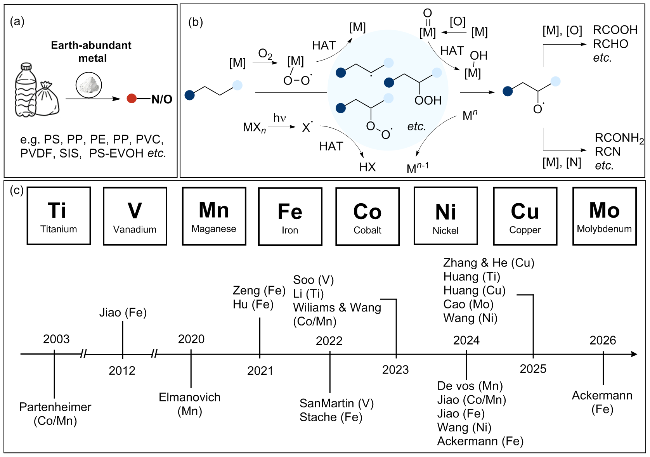
Scheme 1 Earth-abundant metal-catalyzed oxidative degradation of polyolefins(a) Transformation of polyolefin waste into functionalized oxygenates and nitrogenates; (b) Overview of proposed key reaction mechanisms for earth-abundant metal catalysis processes; (c) Summary of earth-abundant metal catalysts used in polyolefin oxidative degradation. |
Currently, most earth-abundant metal-catalyzed oxidative depolymerization pathways of polyolefins follow a radical mechanism.[3,19] Polymer radicals are typically generated by hydrogen-atom transfer (HAT), photoactivation, O2 activation, or oxidant-assisted metal catalysis, and can also be accessed through electrochemical assistance (Scheme 1b). The resulting polymer-centered radicals are readily trapped by O2 to form peroxyl radicals and hydroperoxide intermediates, which can be converted by metal catalysts into highly reactive alkoxyl radicals. Subsequent β-scission cleaves the polymer backbone into lower-mole- cular-weight fragments and oxygenated products such as aldehydes, ketones, and carboxylic acids, driven by the thermodynamic preference for carbonyl formation. In selected Cu- and Co-catalyzed systems, exogenous nitrogen sources can further convert the oxidative intermediates into amides or nitriles.[21-24]
Research teams including Partenheimer,[25] Jiao,[21,22,26] Elmanovich,[27] Zeng,[28] Hu,[29] SanMartin,[30] Stache,[31] Soo,[32] Li,[33] Williams,[34] Wang,[35] Ackermann,[36-37] De Vos,[38] Huang,[39] Zhang & He,[40] Cao,[41] Huang,[24] Wang,[23,42] and have successfully achieved oxidative degradation of various polyolefins such as polystyrene (PS), polypropylene (PP), polyethylene (PE), and polyvinyl chloride (PVC) using earth-abundant metal catalysts (e.g., titanium (Ti), vanadium (V), manganese (Mn), iron (Fe), cobalt (Co), nickel (Ni), copper (Cu), molybdenum (Mo)), converting them into value-added oxygenated or nitrogenated chemicals (Scheme 1c).
This review systematically summarizes recent advances in the oxidative degradation of olefin polymers catalyzed by earth-abundant metals (Table 1), with a focus on their application to real plastic wastes, and highlights the potential of this strategy for plastic valorization and the development of a circular economy. Among the studies surveyed, polystyrene (PS) is the most frequently investigated plastic at the laboratory scale, and its degradation mainly yields carboxylic acids such as benzoic acid and formic acid, although some systems also produce amides or nitriles. Most reported oxidative degradation processes employ molecular oxygen combined with either heat or light; under light irradiation, the reactions can take place at room temperature, whereas thermal processes generally require elevated temperatures. The subsequent chapters are organized by the type of transition metal, focusing on their application to real plastics, discussing the corresponding reaction mechanisms, and comparing the similarities and differences among different metal catalysts in these reactions. The review concludes with an overview of current challenges and future research directions.
Table 1 Overview of earth-abundant metal-catalyzed oxidative degradation of polyolefins for efficient valorization |
| Catalyst | Conditions | Plastic | Product (Yield/%) | Ref. |
|---|---|---|---|---|
| PSA-1-TiO | O2 (0.1 MPa), 370 nm, r.t., 4 h | PS | BA (18~40) | [33] |
| TS-1 | Air (1.5 MPa), H2O, 140~200 ℃, 12 h | PP/PE | Oil-DA (59~85) | [39] |
| VO(acac)2/MBTB | PEG-400, 400~440 nm, NaOAc, 120 ℃, 24 h | PS | BA (58~89) | [30] |
| VO(acac)2 | O2 (101 kPa), White LED, DCM, r.t., 1~7 d | PE/PP/ PS/PVC | FA (3.1~28.9); AA (20.7~35.5); BA (24.1~27.9); FA (82) | [32] |
| Mn2O3 aerogel | O2, CO2 (10 MPa), 135 ℃, 24 h | PP | AA (8); BA (2) | [27] |
| Mn(OAc)2 | O2 (1.5 MPa), NHPI, EA/AcOH (V∶V=2∶1), 150 ℃, 5 h | PS | BA (32~46); TA (7~11) | [38] |
| Co(NO3)2/Mn(NO3)2 | O2 (0.2~0.4 MPa), NHPI, AcOH, 150 ℃, 12 h | PE/PS | BA (21~71); DA (22~39) | [34,35] |
| CoCl2/MnSO4 | O2 (101 kPa)/air flow, HBr, nBuOAc, 120 ℃, 1~3.5 d | PE/PP/PS | FA (41~77); AA (>100); BA (60~65); DA (5~26) | [21] |
| FeCl2 | CH3(CH2)8N3, DDQ, H2O, TFA, 60 ℃, 5 h | PS | PhNH(CH2)8CH3 (17) | [26] |
| FeCl3 | O2 (101 kPa)/air flow, 390 nm, acetone, TBACl, TCE, r.t., 5 d | PS | BA (54~67) | [28] |
| FeCl2 | O2 (101 kPa), 400 nm, DCE/MeCN or acetone, r.t., 20 h | PS | BA (56~67) | [29] |
| FeCl2 | O2 (101 kPa)/air flow, white LED, acetone, r.t., 20 h | PS | BA (2~16) | [31] |
| Fe(acac)2 | O2 (2 MPa), urea, tBuOH, 180 ℃, 24 h | PP | MeCN (5~18); MeCONH2 (16~36); (Me)2CO (13~15) | [22] |
| Fe(TPP)Cl, LiClO4 | O2 (101 kPa), undivided cell, 8 mA, DCM/ MeCN (V∶V=2∶1), AcOH, r.t., 24 h | PS | BA (6~11) | [36] |
| Fe(TPP)Cl, LiClO4 | O2 (101 kPa), 390 nm, undivided cell, 4 mA, 1, 2-DCB/MeCN V∶V=2∶1), AcOH, r.t., 18 h | PS/PE/ PVC/PVDF | BA (38~56); FA (11~19) | [37] |
| CuBr | O2 (2 MPa), H2O, MeCN, 200 ℃, 15 h | PS | PhCN (15~32); PhCONH2 (26~42); PhCOOH (3~12) | [24] |
| (1) CuCl2, CaCl2; (2) Cu(NO3)2 | (1) O2 (101 kPa), Blue LED, MeCN/benzene, r.t., 72 h; (2) MeCN, 140 ℃, 24 h | PS | BA (46~65) | [40] |
| C3N4/MoS2 | Xe lamp, H2O, r.t., 24 h | PE/PP | ROH (80); COx (3); RCOOH (17) | [41] |
| NiO/TiO2 | Air (1 MPa), H2O, 200 ℃, 18 h | PS | PhCOOH (39~52) | [23] |
| NiO/CeO2 | (1) Air (2.5 MPa), NH3 (0.5 MPa), 220 ℃, 2 h; (2) N2, 280 ℃, 4 h | PS | PhCN (43~53) | [42] |
2 Earth-abundant metal-catalyzed oxidative degradation of polyolefins
2.1 Ti-catalyzed oxidative degradation of polyolefins
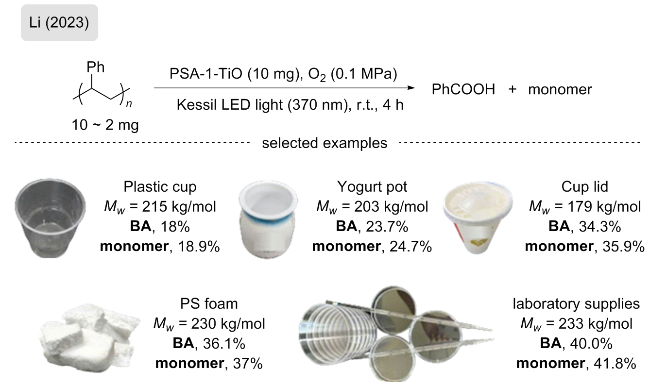
In 2021, Li and colleagues reported a novel heterogeneous photocatalytic oxidative degradation system (Scheme 2).[33] Using potassium stearate (PSA) or N,N-diethyl-3- (trimethoxysilyl)propan-1-amine (DTSPA)-modified TiO2 particles as the photocatalyst under 370 nm light irradiation, the system successfully achieved the oxidative degradation of commercial polystyrene at room temperature, producing benzoic acid with a yield as high as 43.5 mol%. Modified TiO2 exhibits enhanced light absorption capacity and higher photocurrent density in the visible spectrum, significantly promoting the initial oxidation of alkyl C—H bonds and subsequent C—C bond cleavage. Its benzoic acid yield exceeds that of the pure TiO2 system by more than fourfold. To evaluate the practical applicability of the system, several consumer PS plastics items—including disposable cups, yogurt pots, and transparent laboratory supplies such as pipettes and Petri dishes—were subjected to the reported degradation conditions. Benzoic acid yields varied between 18% and 44.2%. Although the system operates efficiently on a small scale (10~12 mg), its efficiency diminishes significantly when scaled up. In a scaled reaction using 1000 mg of substrate, 100% catalyst, and a prolonged reaction time of 16~32 h, the benzoic acid yield dropped to 10.8%.
The use of solid TiO2-based catalysts allows for simple recovery by filtration after the reaction, circumventing the separation difficulties typically encountered with homogeneous catalysts. However, the catalytic activity decreased by approximately 20% after six cycles, and FTIR analysis revealed partial loss of the surface modifiers, indicating that further improvements in long-term economic viability and stability are required. Furthermore, dichloromethane (DCM), a volatile and inherently toxic organic solvent, does not align with the principles of green chemistry; therefore, the development of greener solvent systems is necessary for future applications.
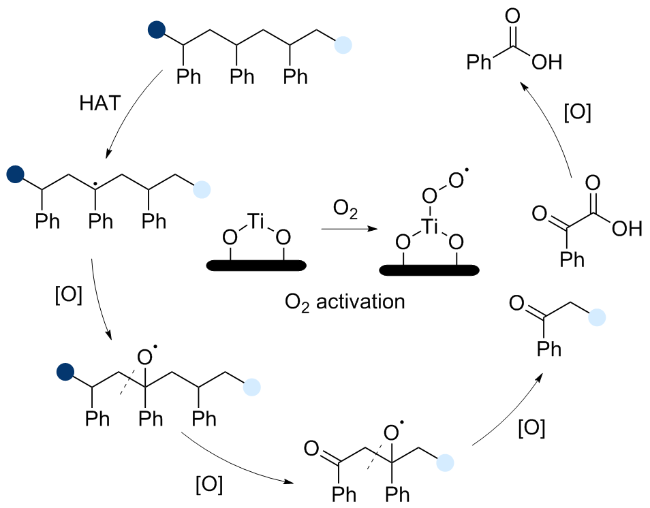
These studies demonstrate that Ti-based catalytic systems can promote the oxidative degradation of plastic waste under relatively mild conditions. The TiO2-based photocatalyst is proposed to activate O2 under light irradiation, generating reactive oxygen species that initiate HAT from the polymer backbone (Scheme 3). The resulting radicals are trapped by O2 to form peroxyl radicals, which undergo successive oxidation, C—C bond cleavage, and product rearrangement to yield low-molecular-weight oxygenated compounds such as benzoic acid. In the TS-1 system, the degradation likely proceeds through a related aerobic radical oxidation pathway on isolated Ti active sites, but under thermal gradient control rather than direct photocatalysis. Overall, these Ti-based platforms provide a promising route for converting plastic waste into value- added acids and other platform chemicals.
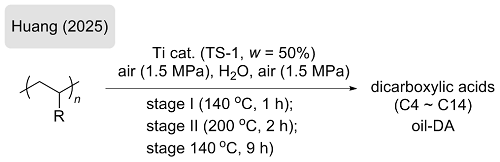
Another significant example of titanium-catalyzed oxidative degradation of polyolefins was reported by Huang and coworkers (Table 2).[39] In their study, through gradient temperature control, an industrial titanium-based catalyst (TS-1 zeolite) was employed to selectively degrade polyethylene (PE) into oil-class dicarboxylic acids (oil- DA). The active TiO4 site in TS-1-zeolite offered high reactivity while the gradient-temperature control strategy avoided catalyst coking and reducing energy consumption. PE, PP, mixture of PEs and PP and several daily PE plastics were degraded, yielding 59%~61% of oil-DA. Comparing to PE, PP possesses higher reaction activity for the large amount of tertiary hydrogen and only 59% oil-DA was recovered. Reducing the reaction time in stage III to inhibit overreaction improved its yield.
Table 2 TiO2 particles-catalyzed oxidative degradation |
| Entry | Plastic | Oil/PE feedstock |
|---|---|---|
| 1 | PP | 59% |
| 2 | LLDPE | 72% |
| 3 | LDPE | 85% |
| 4 | HDPE/LDPE/LDPE/PP (V/V/V/V=1/1/1/1) | 68% |
| 5 | SF Bag | 82% |
| 6 | White Bag | 61% |
In this TS-1 catalyst, oxygen vacancies play a key role in activating oxygen to generate superoxide radicals (O2•-), thereby effectively promoting the cleavage and oxidation of polyethylene chains. Notably, the catalyst can be regenerated through air calcination followed by hydrogen reduction, restoring its activity up to 93%. Although the catalytic system exhibits good performance, and the proposed gradient-temperature control strategy significantly reduces energy consumption and catalyst coking while ensuring a high product yield, further investigation is still needed for aspects such as reaction scale-up, catalyst cost, and product separation.
2.2 V-Catalyzed oxidative degradation of polyolefins
The first report on vanadium-catalyzed oxidative degradation of polyolefins was published in 2022 by the SanMartin group (Scheme 4).[30]. Using a VO(acac)2 catalytic system with triazole-based ligands (MBTB or B1T) in PEG-400 solvent under visible light (400~440 nm) and atmospheric oxygen (101 kPa), PS plastics samples with a wide range of Mw—including commercial pure PS and post-consumer waste from packaging and insulation materials—were selectively converted into benzoic acid (BA) with yields of up to 85%. Mechanistic studies revealed the involvement of reactive oxygen species such as singlet oxygen (1O2), superoxide radical (O2-), and hydroxyl radicals (•OH), with 18O-labeling experiments confirming molecular oxygen as the source of the carbonyl oxygen atom. Notably, acetophenone byproduct produced can act as a photosensitizing additive to accelerate the transformation.
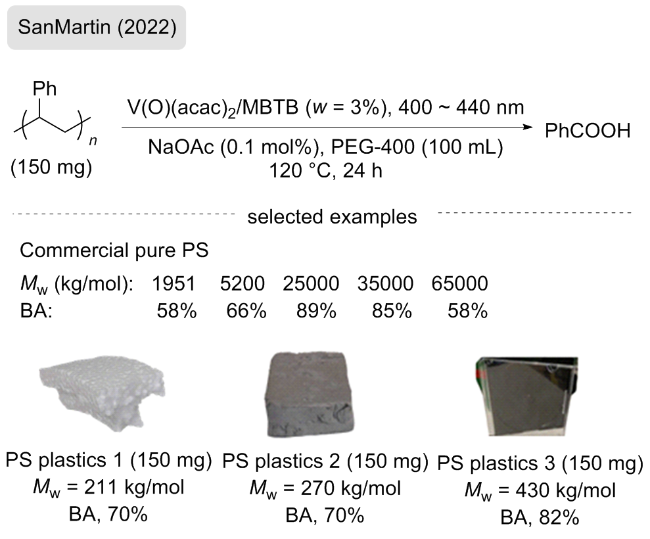
Despite the acceleration provided by visible light, the reaction still requires a temperature of 120 °C, resulting in higher energy consumption compared to room-temperature photocatalysis. Although PEG-400 is less toxic than conventional organic solvents, it remains a synthetic polyether and is used in relatively large amounts (approximately 0.67 mL per gram of PS). Its biodegradability and overall sustainability thus warrant further improvement. Furthermore, the applicability of this method to complex plastic waste streams, such as cross-linked polystyrene (e.g., divinylbenzene-crosslinked polyesters) and copolymers (e.g., ABS, SAN), requires additional evaluation.
In 2023, the Soo research group[32] reported a remarkable broad-spectrum and mild photocatalytic strategy for upcycling plastics using the same vanadium-based photocatalyst VO(acac)2 (Scheme 5). Under white LEDs irradiation at ambient temperature and pressure, a wide range of polyolefin derivatives were oxidized into acidic monomers. For instance, PE was selectively transformed into formic acid (19.2% yield from HDPE, 13.7% from LDPE), while PVC and PVAc provided both formic acid with 11.8% and 14.8% respectively. The protocol was successfully extended to real-world plastic waste, including multilayer packaging (e.g., PP-EVOH-PP) and post-consumer food containers (PS), which offered 14.7% formic acid and 13.0% acetic acid and 35.2% benzoic acid form PS- EVOH-PS.
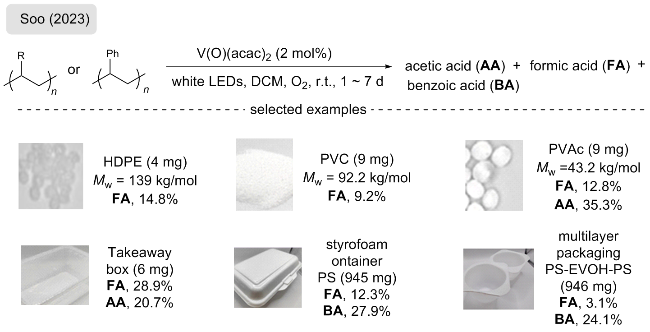
The general plastic upcycling strategy using a vanadium catalyst operates under exceptionally mild conditions, offering a promising low-energy route for converting plastic waste into platform chemicals. In contrast to the thermally assisted photocatalysis reported by SanMartin et al., the work by Soo et al. was conducted at room temperature; however, it required much longer reaction times (4~7 d). Consequently, the efficiency of purely photocatalytic processes is significantly lower than that of thermally assisted photocatalysis. Furthermore, the reaction uses dichloromethane (DCM) as a solvent, which is toxic and volatile. More environmentally friendly solvents need to be developed in the future.
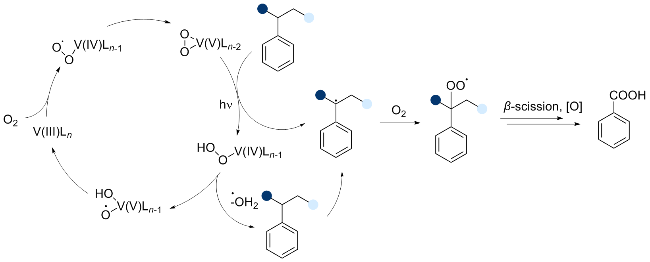
Together, these two vanadium-based photocatalytic systems highlight the ability of vanadium catalysts to promote oxidative degradation of plastic waste. The degradation is proposed to proceed via a HAT process initiated by photoactivated vanadium species and reactive oxygen species, including hydroxyl radicals (Scheme 6). The resulting macroradicals are trapped by molecular oxygen to form peroxyl radicals, which evolve through hydroperoxide and alkoxy-radical intermediates before undergoing β-scission. Subsequent oxidation of the fragmented products affords low-molecular-weight carboxylic acids such as formic acid, acetic acid, and benzoic acid.
2.3 Mn-Catalyzed oxidative degradation of polyolefins
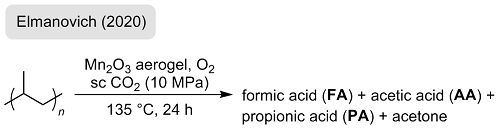
Manganese is known for its strong redox ability and widely used for polyolefins degradation. In 2020, Elmanovich et al.[27] reported a method for the thermal oxidative degradation of polypropylene in oxygen-rich supercritical carbon dioxide using manganese oxide aerogel as a catalyst (Table 3). The study revealed that the use of carbon dioxide enhances the oxidation process even at lower oxygen concentrations, while Mn2O3 nanoparticles not only accelerate the oxidation rate but also influence the product distribution. Under higher oxygen conditions, the application of manganese oxide aerogel as a catalyst promotes the selective oxidation of polypropylene, with acetic acid emerging as the primary liquid product of the process.
Table 3 Mn2O3 aerogel-catalyzed oxidative degradation of poly-olefins |
| Entry | Condition | Selectivity/% | |||
|---|---|---|---|---|---|
| FA | AA | PA | Acetone | ||
| 1 | O2/PP (V∶V ≈ 1.5) | 68 | 14 | 6 | 12 |
| 2 | sc CO2, O2/PP (V∶V ≈ 1.5) | 34 | 28 | 10 | 28 |
| 3 | Mn2O3, O2 /PP (V∶V ≈ 1.5) | 82 | 8 | 2 | 8 |
In this system, the reaction temperature remains relatively high (135 °C), resulting in considerable energy consumption. Future research could explore lower-temperature conditions or photo-thermal synergistic strategies. Further- more, the catalyst is used in the form of nanoparticles, making it difficult to recover; its homogeneous catalytic nature limits recycling. Therefore, the development of supported or magnetically recoverable catalysts may represent an important direction.
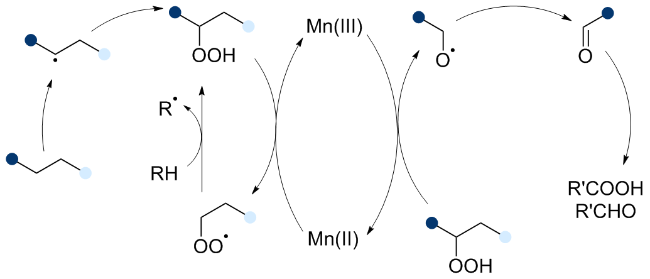
The redox cycling of manganese promotes polymer degradation (Scheme 7). During the reaction, polymer hydroperoxides (OOH) are converted by Mn(III)/Mn(II) into alkoxyl radicals, which undergo β-scission to generate oxygenated fragments such as carboxylic acids and aldehydes. The resulting radicals can further propagate the chain oxidation process, thereby sustaining the radical cascade.
Polyolefins can be converted not only into oxygen-con- taining compounds via catalytic oxidation but also into high-value organic nitrogen-containing compounds throu- gh direct degradation combined with nitrogenation of waste plastics. In 2024, our group reported the first Mn- catalyzed system for the direct transformation of polystyrene (PS) and its copolymers into nitriles and amides using urea as a cheap nitrogen source (Scheme 8).[22] This strategy enables the oxidative degradation of polystyrene (PS) as well as the effective treatment of various styrenic copolymers, such as styrene-butadiene-styrene copolymer (SBS), high-impact polystyrene (HIPS), and styrene-iso- prene-styrene copolymer (SIS). The reactions can all be conducted at the gram scale, affording considerable nitrogen-containing products. Moreover, this method exhibits good degradation performance on structurally complex and widely used consumer PS plastics, such as Lego bricks and cup lids. Notably, even when treating a mixture composed of various PS plastics (5.04 g), the method still achieves yields of 12.2% for benzonitrile and 31.2% for benzamide.
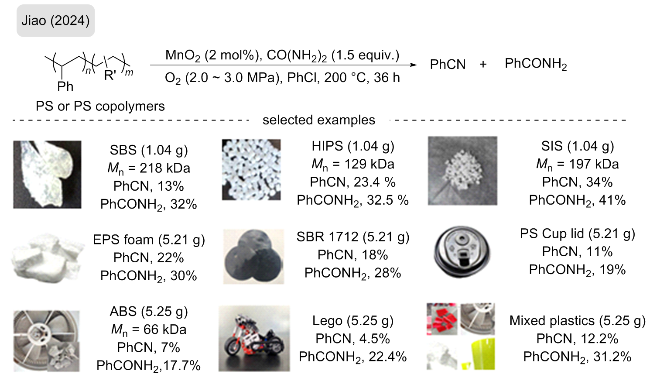
This method successfully converts a range of real-world plastic wastes—including foam, food containers, ABS toys, and tires—offering a new route for the valorization of waste plastics. However, the current reaction conditions are relatively harsh (200 °C, 1.5 MPa O2), and future efforts should focus on developing catalytic systems that operate at lower temperatures and atmospheric pressure to improve energy efficiency.
Besides conversion of PS, alkylated or acylated PS could also be converted into benzoic acid and terephthalic acid under Mn(OAc)2 catalysis.[38]. In 2024, the team of De Vos first reported a remarkable oxidative degradation strategy synergistically catalyzed by Mn(OAc)2 and NHPI, successfully achieving the efficient conversion of alkylated and acylated polystyrene into arene polycarboxylic acids (Scheme 9). Specifically, polystyrene first undergoes the introduction of alkyl or acyl side chains via the Friedel- Crafts reaction, followed by catalysis with Mn(OAc)2 (w=4%) and NHPI (w=60%) for 5 h. This process yields a variety of high-value products, including benzoic acid (BA), terephthalic acid (TA), isophthalic acid (IPTA), and trimesic acid (TMA). Furthermore, this strategy demonstrates promising practical potential in the treatment of real-world polystyrene products. Various plastics, such as plastic cups, pH meter casings, CD cases, and food containers, after undergoing alkylation or acylation pretreatment, are efficiently converted into benzoic acid and terephthalic acid under the Mn(OAc)2/NHPI catalytic system.
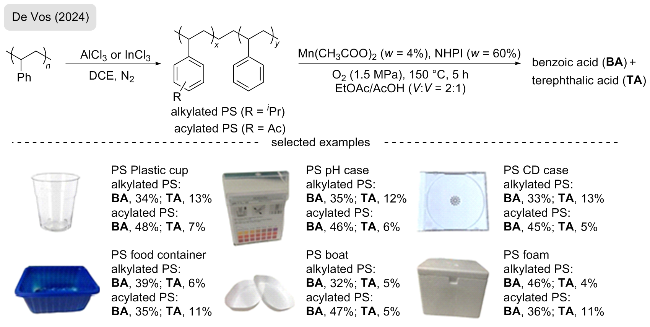
This method offers a new approach for the high-value upcycling of polystyrene (PS). However, the acylation route requires large amounts of AlCl3 or InCl3, which are highly corrosive and difficult to recover. In the future, the development of heterogeneous or recyclable Lewis acid catalysts (e.g., zeolites, MOFs) to replace AlCl3 or InCl3 could be considered. Moreover, the reaction still demands high temperature and pressure, so exploring milder reaction conditions remains a worthwhile direction for future research.
2.4 Co/Mn-Catalyzed oxidative degradation of polyolefins
Besides the Mn catalytic system, the Co/Mn dual catalytic system also exhibits excellent catalytic activity in the oxidative degradation of polyolefins. In 2003, Partenheimer pioneered a Co/Mn catalytic system for the degradation of polyolefins in HOAc solvent.[25]. The reaction was conducted at temperatures above 150 °C and under 7.0 MPa in air, yielding carboxylic acids as the main products. This work marked a significant advancement in the field, particularly in the development of Co/Mn-catalyzed degradation systems for polyolefins. Subsequent research has led to further progress in this area, with a growing focus on optimizing Co/Mn catalysis.
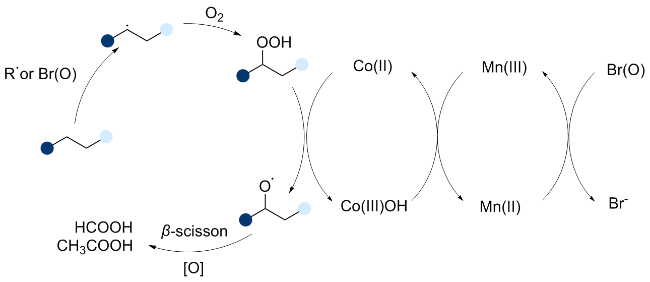
The Co/Mn catalysis system shares a general procedure (Scheme 10). The polymer strain radicals are first generated by Br(O) or other radicals, then captured by oxygen to form peroxide species (ROOH). Co species promote the oxygen radical formation which further undergo rapid β- scission. The Co species are recovered via Mn and Br.
In 2023, the research teams of Williams and Wang once again effectively applied the Co/Mn catalytic system to the oxidative degradation of polyolefins.[34-35]. Specifically, in the presence of O2 and a ternary catalyst system comprising Co(NO3)2, Mn(NO3)2, and N-hydroxyphthalimide (NH- PI) at 150 °C, polyethylene (PE) and polystyrene (PS) were upgraded into alkyl dicarboxylic acids (DA) and benzoic acid (BA) (Scheme 11). This method is also applicable to the treatment of everyday plastic waste from post-con- sumer and marine sources, achieving product yields of up to 71%. Remarkably, the resulting products can serve as feedstocks for the biosynthesis of pharmacologically active fungal secondary metabolites.
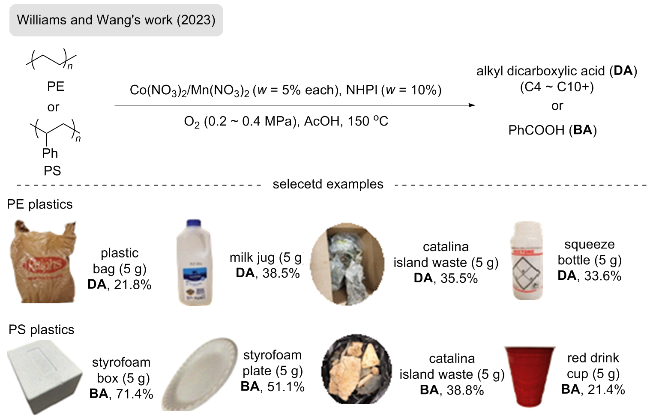
Compared with the Mn-only catalytic system, the Co/Mn co-catalytic system can significantly reduce the required oxygen pressure from 1.5~2.0 MPa to 0.2~0.4 MPa. However, the reaction still requires a high temperature of 150 °C, posing challenges in terms of energy consumption and equipment requirements. Therefore, the development of milder reaction conditions (e.g., lower temperature, ambient pressure, or photo-/electro-driven processes) remains an important direction for future research.
Recently, our group successfully extended the Co/Mn catalytic system to the upcycling of polyolefins under ambient pressure[21] (Scheme 12). Specifically, using n-butyl acetate (AcOnBu) as the solvent and a CoCl2/MnSO4/HBr catalytic system, the oxidative degradation of various polyolefins was efficiently achieved at 120 °C under a stream of O2 or air. AcOnBu not only exhibits excellent solubility for polyolefins—a key factor for achieving efficient conversion under mild conditions—but also partially undergoes in-situ conversion to butyraldehyde during the reaction, which further facilitates the process under atmospheric pressure. This catalytic system demonstrates remarkable versatility, efficiently oxidizing both pristine polyolefins and their mixtures—such as high-density polyethylene (HDPE), low-density polyethylene (LDPE), poly-styrene (PS), and polypropylene (PP)—as well as more complex real-world plastic waste into carboxylic acids. The product distribution varies with polymer structure: LDPE and HDPE primarily yield formic acid, acetic acid, and C4~C7 dicarboxylic acids, whereas the degradation products of PP are mainly formic acid and acetic acid. Notably, the excessively high acetic acid yield is primarily attributable to the degradation of acetoxybutyl ester occurring at 120°C.
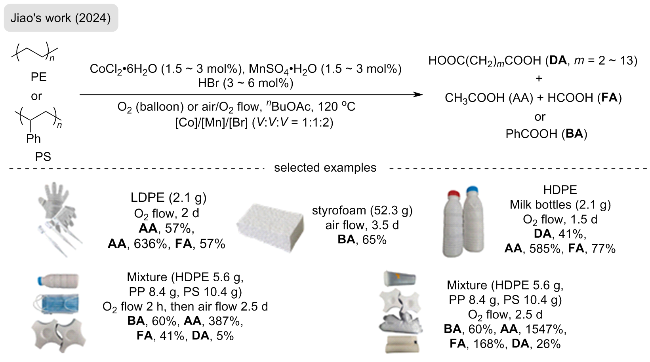
2.5 Fe-Catalyzed oxidative degradation of polyolefins
In 2012, our group pioneered a reaction system using FeCl2 as the catalyst, DDQ as the oxidant, and alkyl azides as the nitrogen source, enabling the selective cleavage and direct amination of C—C bonds in alkylarenes.[26] This method was further extended to the nitrogenative degradation of polystyrene (PS) and could be directly applied to waste polystyrene foam collected from everyday refuse, affording the corresponding alkyl aniline derivatives in 12% yield (Scheme 13). Unlike radical-dominated degradation pathways, the transformation is proposed to proceed through oxidation of the benzylic position by DDQ in the presence of the Fe catalyst, generating a carbocation intermediate, which then undergoes azidation, Schmidt-type rearrangement, and hydrolysis to furnish the aminated product.
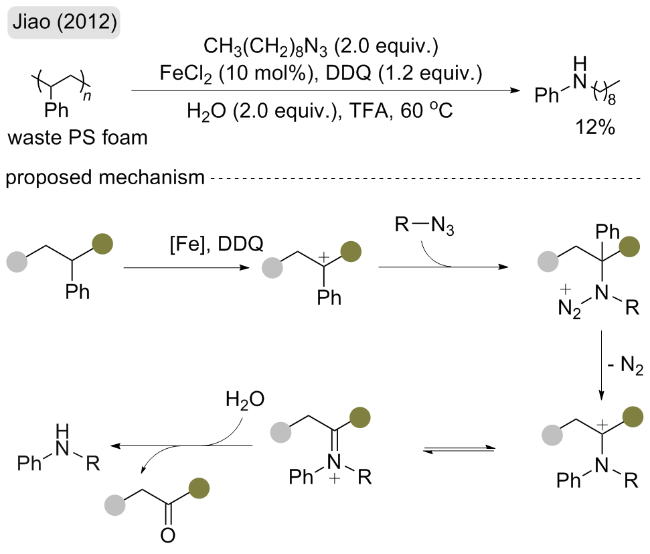
This study represents the first successful attempt in the field of nitrogenative degradation of polystyrene, offering a new approach for the resource recovery and high-value utilization of waste polystyrene materials, but the current degradation yield of polymers still requires considerable improvement.
In 2021, Zeng and coworkers reported an elegant FeCl3-photocatalyzed aerobic degradation of polystyrene (Scheme 14a).[28] Specifically, using FeCl3 (10 mol%), TBACl (10 mol%), and Cl3CCH2OH (10 mol%) in acetone under blue LED irradiation (390 nm), polystyrene was slowly degraded into benzoic acid over 5 days, affording a 54% yield. The yield was slightly higher (67%) when the reaction was conducted under an O2 balloon.
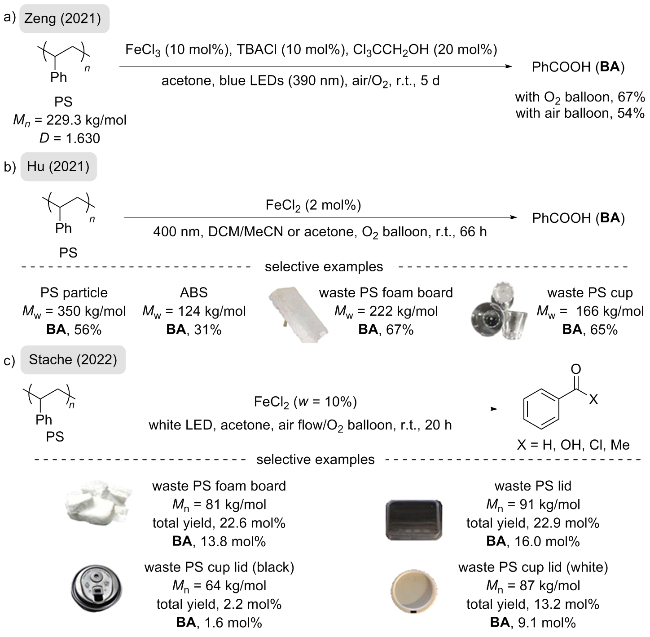
Furthermore, the strategy was notably applied to the oxidative degradation of real-world polystyrene by the groups of Hu[29] and Stache,[31] who independently demonstrated that efficient degradation could be achieved using only FeCl2 under light irradiation. Under Huʼs conditions, the photooxidation of polystyrene was conducted at room temperature using FeCl2 and 400 nm LED irradiation in a DCM/MeCN (3∶2) mixed solvent or acetone (Scheme 14b). After 66 h, a 56% yield of benzoic acid was obtained. Interestingly, Stacheʼs team employed white light (400~700 nm) as the light source, reducing the reaction time to 20 h (Scheme 14c). In addition to benzoic acid as the major product, other benzoyl derivatives such as benzaldehyde, benzoyl chloride, and acetophenone were also generated. Huʼs method was also applicable to polystyrene copolymers such as acrylonitrile-butadiene-styrene (ABS) and real-world PS plastics, including waste PS foam and waste PS cups, affording the corresponding benzoic acid in 31%~67% yields. Stacheʼs method proved similarly effective for real-world plastics such as waste PS foam board, PS lip, and PS cup lid, though the yields of benzoic acid were relatively lower (1.6~16 mol%) due to the shorter reaction time.
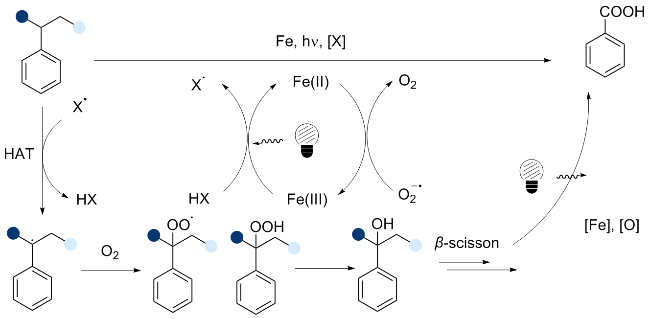
Overall, these Fe/light systems are believed to follow a common aerobic radical pathway (Scheme 15). Photoactivation of the iron halide catalyst generates reactive chlorine-based species and reduced iron intermediates, which initiate HAT from polystyrene. The ensuing polymer radicals undergo oxygen capture, peroxide formation, and β-scission to yield benzoyl fragments that are further oxidized to benzoic acid and related products, while O2 reoxidizes the iron center to close the catalytic cycle.
Compared with conventional thermally driven catalytic systems, the strategy of integrating photocatalysis with iron catalysis enables the reaction temperature to be lowered to room temperature and simplifies the oxygen pressure from high-pressure pure oxygen to atmospheric pressure or an air stream, thereby markedly improving operational safety and energy efficiency. This advantage arises primarily because photocatalysis generates high-energy electron-hole pairs that can activate molecular oxygen under mild conditions, while iron catalysis promotes the generation of reactive oxygen species and substrate oxidation through multivalent cycling (Fe2+/Fe3+). The synergistic effect of these two processes not only reduces the overall activation energy barrier but also enhances the ability to activate inert chemical bonds, thus enabling highly efficient conversion at ambient temperature, ambient pressure, and even with simple air purging. However, this system currently still faces challenges such as limited reaction scalability and a narrow substrate scope (restricted to polystyrene, PS). These issues manifest mainly in insufficient light penetration depth during scale-up, decreased mass transfer efficiency in gas-liquid-solid systems, and concerns regarding catalyst recovery and stability. Further efforts are therefore required to develop flow photoreactors or heterogeneous catalytic systems suitable for large-scale operation, while also extending the approach to other polyolefins such as polypropylene (PP) and polyethylene (PE).
In addition to the photo-promoted pathway, our groupʼs recent report also confirms that iron catalysts can effectively facilitate the oxidative degradation of polypropylene (PP) under thermal catalytic conditions.[22] Specifically, using Fe(acac)2 as the catalyst, the nitrogenation degradation of polypropylene was successfully achieved in an oxygen atmosphere at 180 °C for 24 h, with urea serving as a low-cost nitrogen source (Scheme 16). Under standard reaction conditions, polypropylene can be converted into methyl cyanide (6%), methyl cyanoamide (36%), and acetone (14%). This strategy is also applicable to the degradation of copolymers; for instance, styrene-isoprene-styrene block copolymer (SIS) can be degraded under the same conditions, achieving a total yield of 64%. Furthermore, widely used polypropylene products in daily life, such as natural rubber products, polypropylene masks, and polypropylene food containers, can also withstand this degradation process and yield similar product distributions.
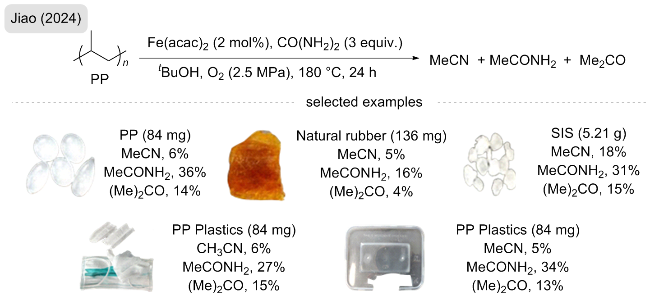
While this strategy has successfully introduced the iron catalytic system into the oxidative degradation of polypropylene (PP), the existing process still requires demanding conditions of high temperature and high pressure (180 °C, oxygen pressure up to 2.5 MPa), which not only results in enormous energy consumption but also presents significant safety risks. In the future, by integrating photocatalysis with iron catalysis—leveraging photogenerated electron-hole pairs to efficiently activate molecular oxygen under mild conditions and utilizing the Fe²⁺/Fe³⁺ multivalent cycle to continuously generate highly reactive oxygen species—it should be possible to substantially broaden the applicable reaction conditions to room temperature, atmospheric pressure, or even an air atmosphere. This would pave the way for a safer, greener, and more economically viable process for the degradation of polyolefins.
In addition to photocatalytic and thermocatalytic approaches, in 2024, Ackerman and colleagues developed a pioneering iron-electrocatalyzed route for the electrochemical oxidation of plastics (Scheme 17a).[36]. Specifically, using FeTPP(Cl) as a catalyst under electrocatalytic conditions and an O2 atmosphere, polystyrene (PS) was degraded into benzoic acid derivatives (including benzoic acid, benzaldehyde, benzoyl chloride, and acetophenone). This strategy is applicable not only to the degradation of various PS types but also to the oxidative degradation of real-world plastic samples, with yields ranging from 7.1% to 14.2%. Furthermore, it was successfully applied to the gram-scale oxidative degradation of waste PS mixtures, affording an isolated total yield of aromatic acyl compounds of 8.7%.
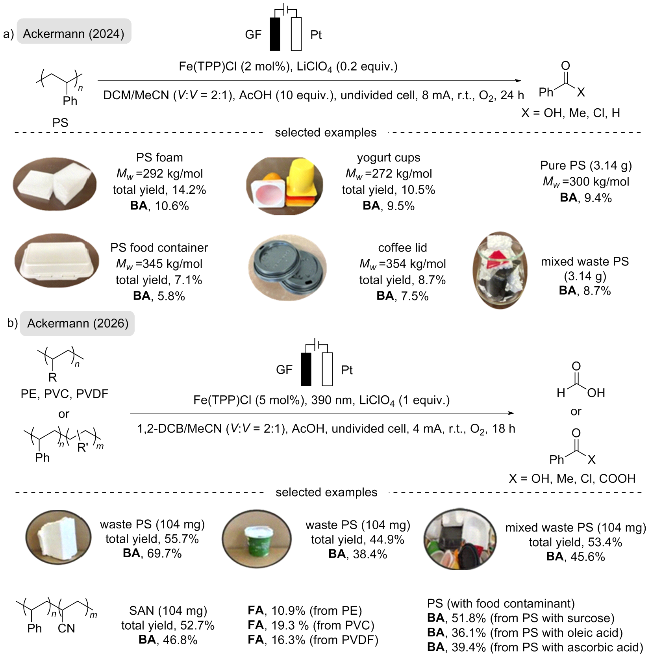
Recently, the Ackermann group further integrated photocatalysis into this system,[37] substantially enhancing reaction efficiency (Scheme 17b).[28] Employing FeTPP(Cl) as the catalyst under 390 nm LED irradiation and an O2 atmosphere, PS was degraded into benzoic acid derivatives, achieving a total yield of 54.4%. This method also demonstrated tolerance towards other polyolefins such as polyethylene, polyvinyl chloride, and polyvinylidene fluoride, recovering 10.0%~19.3% formic acid and 40.7%~59.1% carbon elements under standard conditions. Tests on various commercial PS plastics and copolymers showed that benzoic acid yields consistently remained within the 40%~55% range. Among the selected samples, PS foam exhibited the highest benzoic acid yield (55.7%), while colorless yogurt cups yielded significantly less (38.4%). Gram-scale degradation of expanded polystyrene was also conducted to verify feasibility, yielding 53% isolated benzoic acid and 60.2% total benzoylated products. Notably, addressing another common degradation scenario involving PS waste with food residues, the researchers further validated the robustness and applicability of this photoelectrocatalytic depolymerization strategy. By adding representative food residues—sucrose, oleic acid, and ascorbic acid—to the reaction system, they found that oleic acid (found in rapeseed oil) reduced the reaction efficiency, whereas sucrose and ascorbic acid (found in orange juice) had only a minor impact.
Through strategic integration with electrocatalysis, the iron-based catalytic system can operate efficiently under mild conditions, not only fundamentally overcoming the demanding high-temperature and high-pressure requirements of conventional thermal catalysis, but also successfully extending the photo/Fe catalytic system—previously limited to polystyrene (PS)—to a much broader range of polyolefin materials, including polyethylene (PE), polyvinyl chloride (PVC), and polyvinylidene fluoride (PVDF), thereby demonstrating excellent substrate generality. Nevertheless, the reaction scale of this system remains confined to the laboratory level, future efforts should focus on addressing key scale-up challenges.
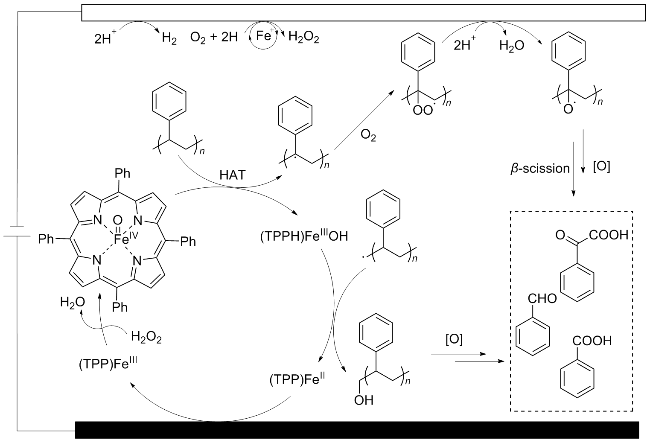
These Fe-porphyrin photoelectrocatalytic systems are proposed to operate through a common aerobic oxidation pathway (Scheme 18). In situ electrochemical reduction of O2 at the cathode generates H2O2, which oxidizes Fe(TPP)- Cl to a high-valent iron-oxo species. The iron-oxo intermediate then initiates hydrogen-atom abstraction from the benzylic C—H bonds of polystyrene, producing polymer- centered radicals. These radicals are subsequently trapped by O2 to form peroxyl intermediates and undergo further oxidation, β-scission, and fragmentation to afford benzoylated products such as benzoic acid derivatives. Meanwhile, the iron center is regenerated during the redox cycle, sustaining the catalytic process.
2.6 Cu-Catalyzed oxidative degradation of polyolefins
Recent significant advances have been made in the copper-catalyzed oxidative degradation of polyolefins. In 2025, Huang and co-workers developed a powerful Cu- catalyzed preoxygenation strategy for the nitrogenative degradation of polystyrene (PS) waste into high-value aromatic nitrogen compounds (Scheme 19).[24] The process employs copper(II) bromide as the key catalyst and acetonitrile as both solvent and nitrogen source, achieving efficient conversion of PS to benzonitrile and benzamide under 200 °C and an oxygen atmosphere for 10 h. This strategy was successfully applied to various PS substrates, including PS homopolymer, PS copolymers, and post- consumer PS products. Under optimized conditions, total yields of nitrogen-containing products ranged from 41% to 80%, with benzonitrile to benzamide molar ratios varying between 1∶1 and 1∶2. Notably, the homogeneous CuBr catalyst transformed into a recoverable solid during the reaction and maintained its activity over multiple cycles, demonstrating excellent recyclability.
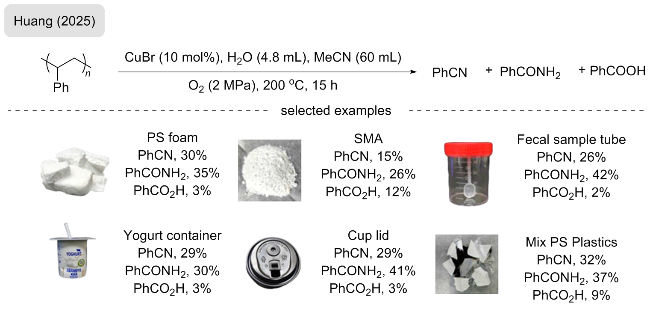
This method features low cost and allows the catalyst to be recycled up to five times, while also demonstrating good compatibility with a wide range of styrene-containing copolymers and real-life plastic waste. However, the current system still requires relatively high temperature and pressure, leading to significant energy consumption and potential safety risks. Therefore, developing catalytic systems that operate under low temperature and atmospheric pressure (e.g., photo- or electrochemically driven strategies) represents a meaningful research direction. More- over, acetonitrile, used as the nitrogen source, has inherent toxicity, and the formation of CO2 as a byproduct limits the atom economy of the process. Future efforts may explore greener and renewable nitrogen sources, such as ammonia, urea, or biomass-derived nitrogen-containing compounds.
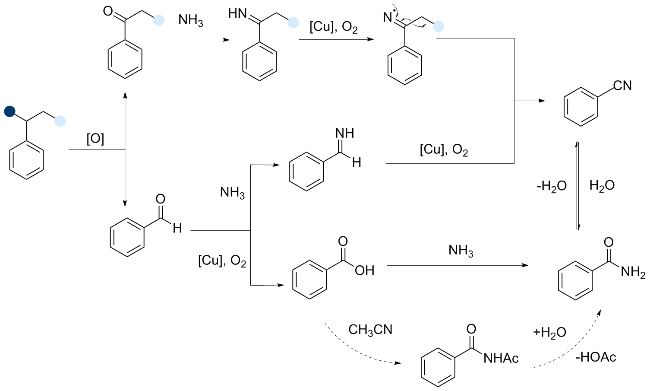
The proposed mechanism for the Cu-catalyzed nitrogenative degradation of polystyrene is illustrated in Scheme 20. The polymer first undergoes a general oxidative process under oxygen (2 MPa) and high temperature (200 ℃) producing aldehyde or ketones. The oxidative products could then further undergo amination and dehydrogenation via Cu catalysis, high temperature and ammonia from the CH3CN solvent to be the nitrogen source, generating high value N-products in one pot.
In the same year, Zhang, He, and coworkers reported an elegant light-driven copper-catalyzed protocol for the aerobic oxidative degradation of actual polystyrene waste (Scheme 21).[40] The strategy employs a one-pot, two-step process: under blue LED irradiation, polystyrene is first oxidized to benzoic acid and styrene oligomers; the result-ing oligomers are subsequently converted to benzoic acid upon heating, achieving a total yield of up to 65%. Mechanistic studies revealed that CuCl2 generates chlorine radicals via ligand-to-metal charge transfer (LMCT), which activate the polystyrene backbone through hydrogen atom transfer (XAT) to form carbocation intermediates, thereby promoting degradation. Furthermore, the method was successfully applied to a range of commercial PS products, including PS foam, food containers, and Petri dishes, affording benzoic acid in yields of 45%~65% and demonstrating excellent substrate compatibility.
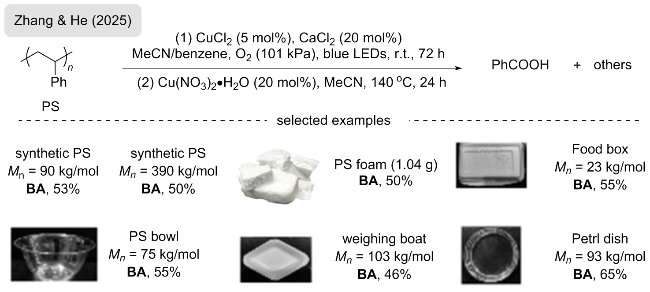
Similarly to iron-catalyzed systems, the introduction of a photocatalytic strategy enables the high-pressure conditions (e.g., 2 MPa) typical of traditional thermal catalysis to be significantly reduced to ambient pressure (using an oxygen balloon for O2 supply), thereby improving operational safety and lowering equipment requirements. However, the current photocatalytic process still predominantly generates large amounts of oxidized oligomers, and a subsequent high-temperature thermal conversion step is required to achieve a high yield of benzoic acid. This not only increases energy consumption but also makes the overall procedure more cumbersome. Future efforts may focus on developing more efficient photocatalysts or constructing synergistic co-catalytic systems to promote the in-situ deep oxidation of oligomers during the photocatalytic stage, thus eliminating the need for a separate thermal conversion step and realizing a truly one-pot synthesis of benzoic acid at room temperature and ambient pressure.
2.7 Mo-Catalyzed oxidative degradation of polyolefins
Traditional photocatalytic methods have been widely reported for the oxidative degradation of polyolefins, converting them into carboxylic acids and ultimately leading to complete oxidation to carbon dioxide.[33] Recently, Cao et al.[41] reported a remarkable C3N4/MoS2 photocatalytic system enables the selective conversion of polyolefins into alcohols in the presence of oxygen, avoiding overoxidation pathways (Table 4). Control experiments demonstrated that MoS2 plays a crucial role in regulating reaction selectivity: when C3N4 was used alone as the photocatalyst, the main products were carboxylic acids and CO2; however, upon introducing MoS2 to construct the Z-scheme heterostructure, gaseous products were significantly reduced, and the selectivity for alcohols reached up to 80.3%.
Table 4 Photocatalytic oxidative degradation of polyolefins with C3N4/MoS2 |

| Entry | Catalyst | Plastic | Yield/% | ||
|---|---|---|---|---|---|
| OH | COOH | COx | |||
| 1 | C3N4 | PP | 47.0 | 53.0 | |
| 2 | MoS2/C3N4-20% | PP | 67.6 | 21.3 | 11.1 |
| 3 | MoS2/C3N4-50% | PP | 69.8 | 26.3 | 3.9 |
| 4 | MoS2/C3N4-100% | PP | 80.3 | 17.1 | 2.6 |
| 5 | C3N4 | PE | 27.2 | 72.8 | |
| 6 | MoS2/C3N4-100% | PE | 54.3 | 22.5 | 23.2 |
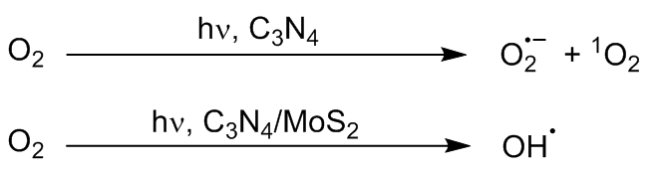
The observed selectivity stems mainly from the formation of hydroxyl radical (•OH) during oxygen reduction (Scheme 22). These species not only drive the production of alcohols but also hinder competing pathways that convert oxygen into reactive oxygen species, such as superoxide anion free radical (•O2-), singlet oxygen (1O2), thus minimizing unwanted overoxidation. Moreover, within the C3N4/ MoS2 system, β-scission of C—C bonds in the polymer chain promotes the generation of alkyl intermediates, which then react with •OH radicals to yield alcohols.[41]
This work presents a new strategy for the targeted regulation of products from the photocatalytic upcycling of polyolefins. However, the photocatalyst loading remains relatively high (w=25%), and the quantum efficiency also needs further improvement. The long-term stability of the catalyst, especially the leaching of MoS2 into the aqueous phase, urgently requires systematic evaluation—this is a key factor in advancing the technology toward practical application. Moreover, future research should also address the catalyst tolerance to real plastic wastes (containing additives, dyes, etc.) and explore effective recovery and regeneration methods, thereby accelerating its progress toward practical use.
2.8 Ni-Catalyzed oxidative degradation of polyolefins
Conventional Ni catalysts were commonly used in polyolefins pyrolysis to obtain short chain alkanes or alkenes. In 2024 and 2025, Wang and colleagues applied NiO dispersed on different supports on the oxidative degradation of PS, yielding valuable benzoic acid and benzonitrile[23,42] (Scheme 23). Up to 51.1% of polystyrene could be converted into benzoic acid with TiO2 support under 1.0 MPa air and maximum of 50.3% of polystyrene could be converted into benzonitrile with CeO2 support under 2.5 MPa air and 0.5 MPa NH3. Both strategies were successfully conducted on real-world PS plastics, like weighing dish, culture dish and PS foam, achieving rough 40%~50% benzoic acid or benzonitrile.

NiO dispersed on different support activate O2 into reactive •O2-, which are involved into polymer oxidative degradation (Scheme 24). Similarly to mechanism mentioned before, polymer could degrade into aldehyde or oligomer with ketone. Oxidative products like acids or aldehyde could further undergo amination by NH3 and dehydrogena-tion in 200 ℃ to produce benzonitrile and benzamide.
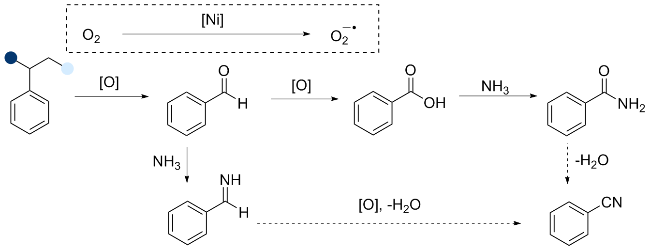


As a complementary approach to other earth-abundant metal catalytic systems, nickel-based catalysts can also selectively degrade polystyrene (PS) into benzoic acid or benzonitrile. However, they share a common drawback with earlier systems: the reactions still need high temperature and high pressure, and the catalyst loading remains substantial (w=50 %). This not only limits energy efficiency and operational convenience but also increases material costs. Future research should therefore aim to develop considerably milder reaction conditions—ideally at room temperature and ambient pressure—while significantly lowering the catalyst loading. Achieving such improvements would make nickel-catalyzed PS degradation far more practical and sustainable for large-scale application.
3 Conclusions and perspectives
In recent years, significant progress has been made in the oxidative degradation of polyolefins catalyzed by earth- abundant metals. Catalysts based on titanium, vanadium, manganese, iron, cobalt, nickel, copper, and molybdenum have all been successfully applied to the oxidative upcycling of polyolefins, converting inert plastic waste into oxygenated products such as benzoic acid, long-chain diacids, and formic acid, as well as nitrogen-containing chemicals including benzonitrile and benzamide. These systems have been validated on various real-world plastic wastes (e.g., disposable cups, foam boxes, food containers, ABS toys), with some achieving gram-scale degradation, thereby offering promising solutions for the resource recovery of waste plastics.
However, different catalytic systems exhibit marked differences when applied to the same polymer or similar scenarios; a systematic comparison helps to clarify their respective advantages and bottlenecks. Polystyrene (PS) serves as a notable example. The degradation of PS to benzoic acid has been most extensively studied: TiO2-based photocatalysis achieves 18%~44% yield at room temperature under ambient oxygen, but requires a catalyst loading as high as 100% and suffers from a sharp drop in efficiency upon scale-up. VO(acac)2 photocatalysis gives 58%~89% yields at 120 °C under ambient oxygen, yet demands PEG-400 as solvent and long reaction times. The FeCl3/ light system operates at room temperature and ambient pressure with 54%~67% yields and only 10 mol% catalyst loading, but the reaction takes five days and is limited to PS. The Co/Mn/NHPI system reaches 60%~71% yields at 150 °C under 0.2~0.4 MPa O2 with a total catalyst loading of ca. 10%, though the temperature is high. CuBr converts PS into benzonitrile and benzamide (41%~80% combined yields) at 200 °C under 2 MPa O2; the catalyst is recyclable, but the conditions are harsh. NiO/TiO2 transforms PS into benzoic acid (ca. 51% yield) at 200 °C under 1 MPa air, yet requires 50% catalyst loading. By contrast, effective systems for degrading polyethylene (PE) and polypropylene (PP) are fewer. TS-1 titanosilicate converts PE into oil- phase diacids (59%~85% yields) through gradient temperature control; the catalyst is regenerable, but multiple heating steps are needed. The Co/Mn/HBr system operates at 120 °C under an ambient air flow, converting PE/PP into formic acid, acetic acid, and C4~C7 diacids in butyl acetate as a relatively mild solvent. The Fe(acac)2/urea system transforms PP into acetonitrile and acetone at 180 °C under 2 MPa O2, albeit with limited yields. The above comparison reveals that photocatalytic strategies (Fe, V, Ti) can run at room or moderate temperatures under ambient pressure, but suffer from long reaction times, poor light penetration, and difficulty in scale-up. Thermocatalytic systems (Co/Mn, Cu, Ni) offer high efficiency and broad substrate scope, yet typically require high temperatures (>120 °C) and elevated oxygen pressures. Electro-/photoelectrocatalytic approa- ches (Fe-porphyrin) can extend to PE, PVC, etc. under mild conditions, but their current efficiency and scalability still need improvement.
The key challenges currently facing the field can be summarized into two points, which should be the focused directions for future research:
(1) The trade-off between reaction conditions and catalytic efficiency. Thermocatalytic systems (e.g., Co/Mn, Cu, Ni) can achieve gram-scale degradation, but usually require temperatures ≥120 °C and oxygen pressures ≥2 MPa, leading to high energy consumption and safety risks. Photocatalytic and electrocatalytic systems can operate at room temperature and ambient pressure, yet face bottlenecks upon scale-up, including long reaction times (days), limited light penetration depth, poor gas-liquid-solid mass transfer, and insufficient catalyst stability. A promising direction is to develop “photo-thermal synergistic” or “photo-electro- thermal integrated” strategies, for example, using photothermal effects or Joule heating to assist photocatalysis, thereby increasing reaction rates under mild conditions. At the same time, designing flow photoreactors or three-phase interfacial reactors could address light attenuation and mass transfer issues during scale-up.
(2) Limited product diversity and selectivity. Currently, nearly all systems yield products confined to simple carboxylic acids, ketones, aldehydes, nitriles, and amides; the targeted conversion to high-value heterocyclic compounds (e.g., pyridine, furan, pyrrole) has not yet been realized. This limitation stems from the fact that the reaction pathways are all radical-mediated C—C bond cleavage and oxidation/nitrogenation, lacking precise control over the carbon chain length of intermediates and the ability to regulate subsequent cyclization. A promising direction is to develop tandem catalytic strategies: first, earth-abundant metal-catalyzed oxidative cleavage of polyolefins to generate dialdehydes or diketones of moderate chain length; then, using the same or a second metal catalyst to promote condensation/cyclization with ammonia, hydroxylamine, or other reagents to construct nitrogen- or oxygen-containing heterocycles. In addition, exploring non-radical pathways (e.g., carbene insertion, combined olefin metathesis and oxidation) may break through the current limitations on product types.
In summary, future research should focus on the two key challenges outlined above. Through rational design of low-loading, highly stable, and recyclable heterogeneous catalysts, combined with multi-field synergistic strategies (photo, electro, thermal), it is expected to achieve efficient and selective upcycling of polyolefin plastics under near- ambient conditions, thereby providing a practical technical foundation for a circular plastic economy.
(Li, L.)