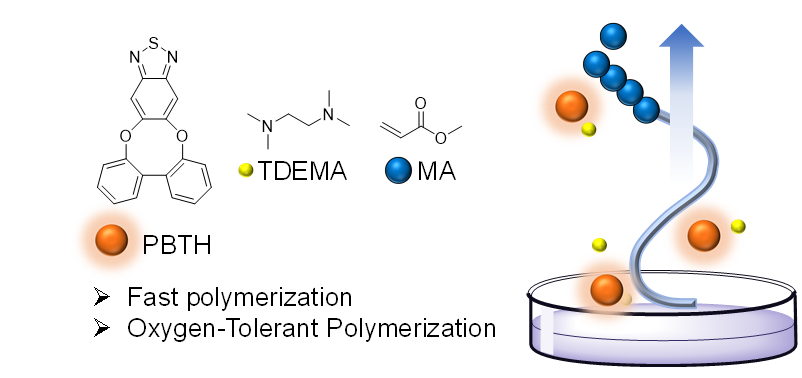
Photopolymerization offers significant advantages over traditional thermally initiated polymerization, such as better temporal control and faster reaction kinetics. However, conventional systems suffer from oxygen inhibition and initiator end-group residue. Herein, we developed a series of benzothiadiazole-based photocatalysts (PBTH, BBTH). By introducing donor-acceptor (D-A) structures, light absorption and intramolecular charge transfer (ICT) capability are promoted, thereby enhancing the photocatalytic performance. Mechanistic studies reveal that the photoexcited PC abstracts an electron from the tertiary amine additive (TMEDA), generating a radical anion and an aminoalkyl radical, which subsequently initiates the polymerization of acrylate monomers. The photocatalyst remains intact and is not covalently incorporated into the polymer chain ends. With an extremely low loading of 0.37 wt%, PBTH achieved near-complete conversion within minutes under ambient conditions and was successfully employed in the photolithographic fabrication of an “AIE” pattern.
Yixuan Chen
,
Zheng Zhao
. Aggregation-Induced Emission Photocatalysts for Fast and Oxygen-Tolerant Radical Photopolymerization[J]. Chinese Journal of Organic Chemistry, 0
: 202605006
.
DOI: 10.6023/cjoc202605006
[1] Zhang B.; Sun, L. Chem. Soc. Rev.2019, 48, 2216.
[2] Romero N. A.; Nicewicz, D. A. Chem. Rev.2016, 116, 10075.
[3] Corrigan N.; Yeow J.; Judzewitsch P.; Xu J.; Boyer C. Angew. Chem. Inter. Ed. 2019, 58, 5170.
[4] Yan C.-N.; Liu Q.; Xu L.; Bai L.-P.; Wang L.-P.; Li G. Polymers2019, 11, 599.
[5] Su H.; Yang M.; Liu Y.; Gao J.; Ge B.; Wang L.; Li, G. Appl. Surf. Sci.2023, 615, 156288.
[6] Layani M.; Wang X.; Magdassi S. Adv. Mater.2018, 30, 1706344.
[7] Qiao L.; Zhou M.; Shi G.; Cui Z.; Zhang X.; Fu P.; Liu M.; Qiao X.; He Y.; Pang, X. J. Am. Chem. Soc.2022, 144, 9817.
[8] Bai R.; Sun Y.; Zhao M.; Han Z.; Zhang J.; Sun Y.; Dong W.; Li S. Talanta2021, 226, 122160.
[9] Huang W.; Zhang X.; Chen J.; Zhang B.; Chen B.; Zhang G. ACS Catal.2023, 13, 2542.
[10] Liu S.-F.; Hou Z.-W.; Lin L.; Li F.; Zhao Y.; Li X.-Z.; Zhang H.; Fang H.-H.; Li Z.; Sun H.-B. Science2022, 377, 1112.
[11] Li, X. Univ. Chem. 2021, 36, 2007078.
[12] Pan H. Y.; Chen S. Q.; Jin M.; Malval J.; Wan D. C.; Morlet-Savary F. Polym. Chem.2019, 10, 1599.
[13] Ma X. Y.; Cao D.; Hu X. T.; Nie J.; Wang, T. Prog. Org. Coat.2020, 144, 105651.
[14] Liu C.; Mo P.; Huang M.; Ma Z.; Yu H.; Xiong Y.; Tang, H. Chem. Eng. J.2026, 532, 174391.
[15] Dietlin C.; Trinh T. T.; Schweizer S.; Graff B.; Morlet-Savary F.; Noirot P.; Lalevée J. Macromolecules2019, 52, 7886.
[16] Liu T. Y.; Wang T. T.; Xie C. B.; Tian X. J.; Song L.; Liu L.; Wang Z. W.; Yu, Q. Prog. Org. Coat.2020, 142, 105603.
[17] Cunningham A. F.; Desobry V.; Dietliker K.; Hüsler R.; Leppard D. G. Chimia1994, 48, 423.
[18] Chen H.; Zhu D.; Kavalli T.; Xiao P.; Schmitt M.; Lalevée J. Polym. Chem.2023, 14, 3543.
[19] Amol A. Pawar, Gabriel Saada, Ido Cooperstein, Liraz Larush, Joshua A. Jackman, Seyed R. Tabaei, Nam-Joon Cho, Shlomo Magdassi. Sci. Adv. 2016, 2, e1501381
[20] Li R.; Guo H.; Luo X.; Wang Q.; Pang Y.; Li S.; Liu S.; Li J.; Strehmel B.; Chen, Z. Angew. Chem. Int. Ed.2024, 63, e202404454.
[21] M.Schmallegger, M.Wiech, G.Gescheidt, Angew. Chem. Int. Ed.2026, 65, e12534.
[22] Hu Z.; Gao F.; Qin H.; Cui X.; Wang L.; Yang W.; Lu C.; Zhang B.; Sun L.Angew. Chem. Int. Ed. 2024, 64, e202415645
[23] Liu D.; Wang W.-J.; Alam P.; Yang Z.; Wu K.; Zhu L.; Xiong Y.; Chang S.; Liu Y.; Wu B.; Wu Q.; Qiu Z.; Zhao Z.; Tang, B. Z. Nat. Photonics2024, 18, 1276.
[24] Yoon J.; Jung Y. J.; Yoon J. B.; Damodar K.; Kim H.; Shin M.; Seo M.; Cho D. W.; Lee J. T.; Lee, J. K. Polym. Chem.2019, 10, 5737.
[25] Coskun H. I.; De Luca Bossa F.; Hu X.; Jockusch S.; Sobieski J.; Yilmaz G.; Matyjaszewski, K. J. Am. Chem. Soc.2024, 146, 28994.
[26] Gupta V.; Sengupta S. Aggregate2025, 6, e70232.
[27] Huang W.; Zhang X.; Su H.; Zhang B.; Feng A.; Jiang J.; Chen B.; Zhang G. Chem2024, 10, 2829.
[28] Günaydin H.; Salman S.; Tüzün N. Ş.; Avci D.; Aviyente, V. Int. J. Quantum Chem.2005, 103, 176.
[29] Li L.; Hao C.; Zhai R.; He W.; Deng C. Fuel2023, 331, 125853.
[30] Yeow J.; Chapman R.; Gormley A. J.; Boyer, C. Chem. Soc. Rev.2018, 47, 4357.
[31] Back J.-H.; Kwon Y.; Cho H.; Lee H.; Ahn D.; Kim H.-J.; Yu Y.; Kim Y.; Lee W.; Kwon M. S.Adv. Mat. 2023, 35, 2204776.
[32] Victoria-Valenzuela D.; Herrera-Ordonez J.; Luna-Barcenas G.; Verros G. D.; Achilias, D. S. Macromol. React. Eng.2016, 10, 577.
[33] Pan Z.-R.高分子化学 (Polymer Chemistry), 3rd ed.; Chemical Industry Press: Beijing, 2007, p139


