

化学学报 ›› 2025, Vol. 83 ›› Issue (3): 212-220.DOI: 10.6023/A25010007 上一篇 下一篇
研究论文
夏新宇†, 侯善凯†, 郭勇, 刘晓晖*( ), 王艳芹
投稿日期:2025-01-04
发布日期:2025-02-26
基金资助:
Xinyu Xia†, Shankai Hou†, Yong Guo, Xiaohui Liu(), Yanqin Wang
Received:2025-01-04
Published:2025-02-26
Contact:
*E-mail: xhliu@ecust.edu.cn
About author:Supported by:文章分享

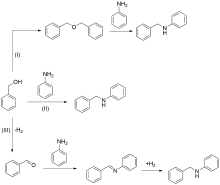
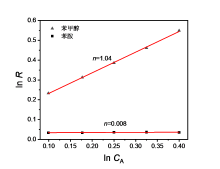
通过固体催化剂实现醇的N-烷基化是一条环境友好的胺类化合物合成路线. 本工作将水热法制备的氧化铌应用于苯甲醇和苯胺的N-烷基化反应中, 与几种金属氧化物和传统的三氯化铝催化剂相比, 氧化铌的催化活性最优, 苯甲醇转化率100%, N-苄基苯胺收率65.2%. 进一步通过反应级数、溶剂和空间位阻效应以及碳正离子的相关实验对氧化铌催化苯甲醇N-烷基化的反应路径和机理进行研究, 结果表明反应经历的是苯甲醇生成碳正离子的SN1反应机制. 此外, 苯甲醇和苯胺的原位红外吸脱附实验证明, 氧化铌能活化苯甲醇的C—O键以及苯胺的N—H键, 促进了碳正离子的生成以及苯胺N—H键的断裂, 从而具有很好的苯甲醇N-烷基化催化活性.
夏新宇, 侯善凯, 郭勇, 刘晓晖, 王艳芹. 氧化铌催化苯甲醇与苯胺N-烷基化反应的研究[J]. 化学学报, 2025, 83(3): 212-220.
Xinyu Xia, Shankai Hou, Yong Guo, Xiaohui Liu, Yanqin Wang. Catalytic N-Alkylation of Benzyl Alcohol and Aniline on Nb2O5 Catalyst[J]. Acta Chimica Sinica, 2025, 83(3): 212-220.
| 催化剂 | 苯甲醇转化率/% | 产物收率/% | ||||
|---|---|---|---|---|---|---|
| 3 | 4 | 5 | 6 | 7 | ||
| SiO2 | 15.8 | 0 | 3.7 | 0 | 0 | 4.0 |
| CeO2 | 9.7 | 0 | 0 | 0 | 0 | 6.4 |
| TiO2 | 43.3 | 29.6 | 3.8 | 0 | 0 | 3.8 |
| Al2O3 | 20.1 | 6.2 | 3.2 | 0 | 0 | 5.4 |
| Nb2O5a | 100 | 65.2 | 2.4 | 10.9 | 5.1 | 0 |
| AlCl3 | 98.7 | 63.1 | <1 | 1.6 | <1 | 0 |
| 催化剂 | 苯甲醇转化率/% | 产物收率/% | ||||
|---|---|---|---|---|---|---|
| 3 | 4 | 5 | 6 | 7 | ||
| SiO2 | 15.8 | 0 | 3.7 | 0 | 0 | 4.0 |
| CeO2 | 9.7 | 0 | 0 | 0 | 0 | 6.4 |
| TiO2 | 43.3 | 29.6 | 3.8 | 0 | 0 | 3.8 |
| Al2O3 | 20.1 | 6.2 | 3.2 | 0 | 0 | 5.4 |
| Nb2O5a | 100 | 65.2 | 2.4 | 10.9 | 5.1 | 0 |
| AlCl3 | 98.7 | 63.1 | <1 | 1.6 | <1 | 0 |






| [6] |
(b) Wang, X.-Z.; Wang, H.-L.; Shi, F. Prog. Chem. 2020, 32, 162 (in Chinese).
pmid: 24678047 |
|
(王新之, 王红利, 石峰, 化学进展, 2020, 32, 162.)
doi: 10.7536/PC190711 pmid: 24678047 |
|
| [7] |
(a) Chakrabortty, S.; Zheng, S.; Kallmeier, F.; Barath, E.; Tin, S.; de Vries, J. G. ChemSusChem 2023, 16, e202202353.
pmid: 36719903 |
|
(b) Wang, Y.-J.; Guo, R.-C.; Zeng, Y.-J.; Hu, D.; Lin, L.; Jiang, Z.-W.; Yan, K. Ind. Eng. Chem. Res. 2023, 62, 2629.
pmid: 36719903 |
|
|
(c) Chang, S.; Lee, J. Synlett 2022, 34, 1356.
pmid: 36719903 |
|
|
(d) Reichert, E. C.; Feng, K.; Sather, A. C.; Buchwald, S. L. J. Am. Chem. Soc. 2023, 145, 3323.
doi: 10.1021/jacs.2c13520 pmid: 36719903 |
|
|
(e) Feng, B.-C.; Xi, B.-H.; Zhao, Z.-C.; Hou, Y.-H.; Jin, Y.; Yao, Q.-L. Chem. Eng. Technol. 2022, 45, 1027.
pmid: 36719903 |
|
|
(f) Sun, Y.-M.; Ding, Q.-F.; Yu, Y.; He, Y.-D.; Huang, F. Chin. J. Org. Chem. 2019, 39, 3363 (in Chinese).
pmid: 36719903 |
|
|
(孙义明, 丁奇峰, 于杨, 何益得, 黄菲, 有机化学, 2019, 39, 3363.)
doi: 10.6023/cjoc201906026 pmid: 36719903 |
|
| [8] |
(a) Nayal, O. S.; Thakur, M. S.; Rana, R.; Upadhyay, R.; Maurya, S. K. ChemistrySelect 2019, 4, 1371.
|
|
(b) Terrasson, V.; Marque, S.; Georgy, M.; Campagne, J.-M.; Prim, D. Adv. Synth. Catal. 2006, 348, 2063.
|
|
| [9] |
(a) Nowak, I.; Ziolek, M. Chem. Rev. 1999, 99, 3603.
|
|
(b) Mao, D.-L.; Zhang, X.-G.; Zhang, X.-F.; Jia, M.-M.; Yao, J.-F. Chin. J. Chem. Eng. 2019, 27, 1067.
|
|
|
(c) Deng, D.; Kita, Y.; Kamata, K.; Hara, M. ACS Sustainable Chem. Eng. 2018, 7, 4692.
|
|
|
(d) Zhou, H.; Chen, L.; Guo, Y.; Liu, X.-H.; Wu, X.-P.; Gong, X.-Q.; Wang, Y.-Q. ACS Catal. 2022, 12, 4806.
|
|
| [10] |
Guo, Y.; Jing, Y.-X.; Xia, Q.-N.; Wang, Y.-Q. Acc. Chem. Res. 2022, 55, 1301.
|
| [11] |
Niu, F.; Wang, Q.-Y.; Yan, Z.; Kusema, B. T.; Khodakov, A. Y.; Ordomsky, V. V. ACS Catal. 2020, 10, 3404.
|
| [12] |
Nayal, O. S.; Thakur, M. S.; Kumar, M.; Kumar, N.; Maurya, S. K. Adv. Synth. Catal. 2018, 360, 730.
|
| [13] |
Dong, L.; Xia, J.; Guo, Y.; Liu, X.-H.; Wang, H.-F.; Wang, Y.-Q. J. Catal. 2021, 394, 94.
|
| [1] |
(a) Guo, X.-N.; Hao, C.-H.; Jin, G.; Zhu, H.-Y.; Guo, X.-Y. Angew. Chem., Int. Ed. 2014, 53, 1973.
pmid: 12215640 |
|
(b) Heung, C. W.; Hu, X. Nat. Commun. 2016, 7, 12494.
pmid: 12215640 |
|
|
(c) Feng, J.; Handa, S.; Gallou, F.; Lipshutz, B. H. Angew. Chem., Int. Ed. 2016, 55, 8979.
doi: 10.1002/anie.201604026 pmid: 12215640 |
|
|
(d) Seayad, A.; Ahmed, M.; Klein, H.; Jackstell, R.; Gross, T.; Beller, M. Science 2002, 297, 1676.
pmid: 12215640 |
|
|
(a) Xu, Q.; Xie, H.-M.; Zhang, E.-L.; Ma, X.-T.; Chen, J.-H.; Yu, X.-C.; Li, H. Green Chem. 2016, 18, 3940.
|
|
|
(b) Roundhill, D. M. Chem. Rev. 1992, 92, 1.
|
|
| [2] |
(a) Magano, J.; Dunetz, J. R. Chem. Rev. 2011, 111, 2177.
|
|
(b) Tan, X.-B.; Wu, W.-Q.; Jiang, H.-F. Sci. Sin. Chim. 2023, 53, 410 (in Chinese).
|
|
|
(谭晓彬, 伍婉卿, 江焕峰, 中国科学: 化学, 2023, 53, 410.)
|
|
| [3] |
Korbad, B. L.; Lee, S. H. Chem. Commun. 2014, 50, 8985.
|
| [4] |
Sheng, T.; Qi, Y.-J.; Lin, X.; Hu, P.; Sun, S.-G.; Lin, W.-F. Chem. Eng. J. 2016, 293, 337.
|
| [5] |
(a) Muller, T. E.; Hultzsch, K. C.; Yus, M.; Foubelo, F.; Tada, M. Chem. Rev. 2008, 108, 3795.
pmid: 20481582 |
|
(b) Senthamarai, T.; Murugesan, K.; Schneidewind, J.; Kalevaru, N. V.; Baumann, W.; Neumann, H.; Kamer, P. C. J.; Beller, M.; Jagadeesh, R. V. Nat. Commun. 2018, 9, 4123.
pmid: 20481582 |
|
|
(c) Reguillo, R.; Grellier, M.; Vautravers, N.; Vendier, L.; Sabo-Etienne, S. J. Am. Chem. Soc. 2010, 132, 7854.
doi: 10.1021/ja102759z pmid: 20481582 |
|
| [6] |
(a) Pera-Titus, M.; Shi, F. ChemSusChem 2014, 7, 720.
doi: 10.1002/cssc.201301095 pmid: 24678047 |
| [14] |
Prystupa, D. A.; Anderson, A.; Torrie, B. H. J. Raman Spectrosc. 1994, 25, 175.
|
| [15] |
Murayama, T.; Chen, J.; Hirata, J.; Matsumoto, K.; Ueda, W. Catal. Sci. Technol. 2014, 4, 4250.
|
| [1] | 王南南, 陈玉贞. CoNi-MOF-74/泡沫镍衍生的CoNi@C/NF复合物用于高效有机电合成[J]. 化学学报, 2024, 82(6): 621-628. |
| [2] | 赵亚婷, 刘帆, 汪秋安, 夏吾炯. 可见光促进(氮杂)芳香胺与重氮乙酸乙酯的N-烷基化反应[J]. 化学学报, 2023, 81(2): 111-115. |
| [3] | 张欣欣, 刘荣, 王蕾, 付宏刚. 细菌纤维素基柔性锌离子电池正极的构筑及性能研究[J]. 化学学报, 2021, 79(5): 670-677. |
| [4] | 罗潇, 焦宁. 三氟乙酸酐(TFAA)促进的Stieglitz重排反应制备苯胺[J]. 化学学报, 2020, 78(8): 758-762. |
| [5] | 杨晶亮, 杨伟民, 林嘉盛, 汪安, 徐娟, 李剑锋. 电场强度对等离激元诱导热电子的影响[J]. 化学学报, 2020, 78(7): 670-674. |
| [6] | 林凤闺蓉, 梁宇杰, 郦鑫耀, 宋颂, 焦宁. 氧气氧化铜催化的苯胺邻位叠氮化反应[J]. 化学学报, 2019, 77(9): 906-910. |
| [7] | 王梦涵, 万里, 高旭宇, 袁文博, 方俊峰, 陶友田, 黄维. D-π-A-π-D型非掺杂小分子空穴传输材料的合成及其在反向钙钛矿太阳能电池中的应用[J]. 化学学报, 2019, 77(8): 741-750. |
| [8] | 张金龙, 蒋高喜. 不对称烯丙基化反应合成含有三苯胺核心单元的荧光非天然氨基酸衍生物[J]. 化学学报, 2018, 76(11): 890-894. |
| [9] | 郑媛, 罗静, 魏玮, 刘晓亚. Pickering乳液法制备聚苯胺-石墨烯空心微球[J]. 化学学报, 2017, 75(4): 391-397. |
| [10] | 张婷, 蔡雪刁, 刘娜, 许春丽. MoO3/C-N复合材料的制备条件对其结构及催化性能的影响[J]. 化学学报, 2016, 74(5): 441-449. |
| [11] | 许智慧, 沈丽明, 吴强, 孙涛, 徐宇洋, 黎聃勤, 杜玲玉, 杨立军, 王喜章, 胡征. 热解聚苯胺/碳纳米笼复合物制备氮掺杂碳材料及其氧还原性能研究[J]. 化学学报, 2015, 73(8): 793-798. |
| [12] | 韩若冰, 芦姗, 王艳杰, 张雪华, 吴强, 贺涛. SO4-和I-共掺杂的聚苯胺对电极在染料敏化太阳电池中的应用[J]. 化学学报, 2015, 73(10): 1061-1068. |
| [13] | 王志强, 肖殷, 金会义, 谈廷风, 王世荣, 李祥高. 含三苯胺基团的二噻吩乙烯光致变色化合物的合成及性能研究[J]. 化学学报, 2014, 72(6): 731-738. |
| [14] | 李梅, 杨树威, 郑建明, 徐春叶. 可吸附紫精化合物电致变色器件[J]. 化学学报, 2014, 72(4): 456-460. |
| [15] | 高珍珍, 佟浩, 陈建慧, 岳世鸿, 白文龙, 张校刚, 潘燕飞, 石明, 宋玉翔. 聚苯胺共价接枝碳纳米管复合材料的制备及其超电容性能的研究[J]. 化学学报, 2014, 72(11): 1175-1181. |
| 阅读次数 | ||||||
|
全文 |
|
|||||
|
摘要 |
|
|||||
