

化学学报 ›› 2025, Vol. 83 ›› Issue (7): 773-802.DOI: 10.6023/A25020057 上一篇
综述
赵瑜a,*( ), 邢彤彤a, 段玉荣a, 赵全庆b,*()
投稿日期:2025-02-27
发布日期:2025-07-28
通讯作者:
赵瑜, 赵全庆
作者简介: |
赵瑜, 延安大学, 讲师. 2011年本科毕业于咸阳师范学院, 同年考入河南大学化学学院攻读有机化学硕士, 导师为江智勇教授, 于2014年7月获得理学硕士学位. 2015年进入华中师范大学化学学院攻读博士, 导师为肖文精教授和陈加荣教授, 于2018年7月毕业获得有机化学博士学位. 2018年7月进入延安大学化学与化工学院, 从事教学科研工作. 2022年12月进入西北工业大学化工学院从事博后工作, 合作导师为张秋禹教授. 研究方向为自由基反应和光化学合成反应. |
 |
邢彤彤, 男, 汉族, 2002出生于陕西西安. 2024年本科毕业于延安大学, 同年考入延安大学有机化学专业攻读硕士学位, 导师为赵瑜博士. 研究方向为光化学反应促进C-C键的构建. |
 |
段玉荣, 女, 汉族, 1998出生于陕西榆林. 2021年本科毕业于商洛学院, 同年考入延安大学有机化学专业攻读硕士学位, 导师为赵瑜博士. 研究方向为光化学反应促进C-C键的构建.赵全庆, 江苏海洋大学, 副教授. 2014年本科毕业于铜仁学院, 同年考入华中师范大学攻读有机化学硕士学位, 于2020年硕博连读获得博士学位, 导师为肖文精教授和陈加荣教授. 之后, 在德国雷根斯堡大学从事博士后研究, 导师为Oliver Reiser教授. 2023年2月入职江苏海洋大学药学院, 从事教学科研工作. 研究方向为绿色有机合成、药物中间体合成及自由基化学. |
 |
赵全庆, 江苏海洋大学, 副教授. 2014年本科毕业于铜仁学院, 同年考入华中师范大学攻读有机化学硕士学位, 于2020年硕博连读获得博士学位, 导师为肖文精教授和陈加荣教授. 之后, 在德国雷根斯堡大学从事博士后研究, 导师为Oliver Reiser教授. 2023年2月入职江苏海洋大学药学院, 从事教学科研工作. 研究方向为绿色有机合成、药物中间体合成及自由基化学. |
基金资助:
Yu Zhaoa,*(), Tongtong Xinga, Yurong Duana, Quanqing Zhaob,*()
Received:2025-02-27
Published:2025-07-28
Contact:
Yu Zhao, Quanqing Zhao
Supported by:文章分享
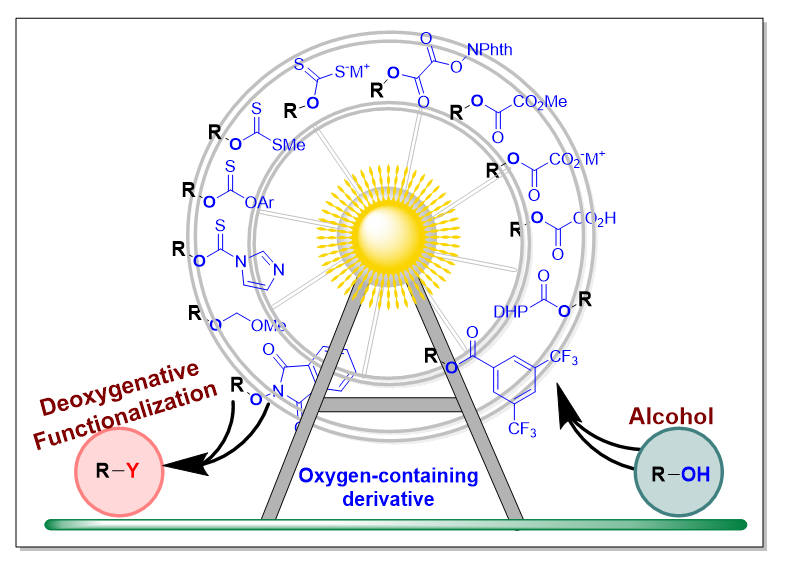
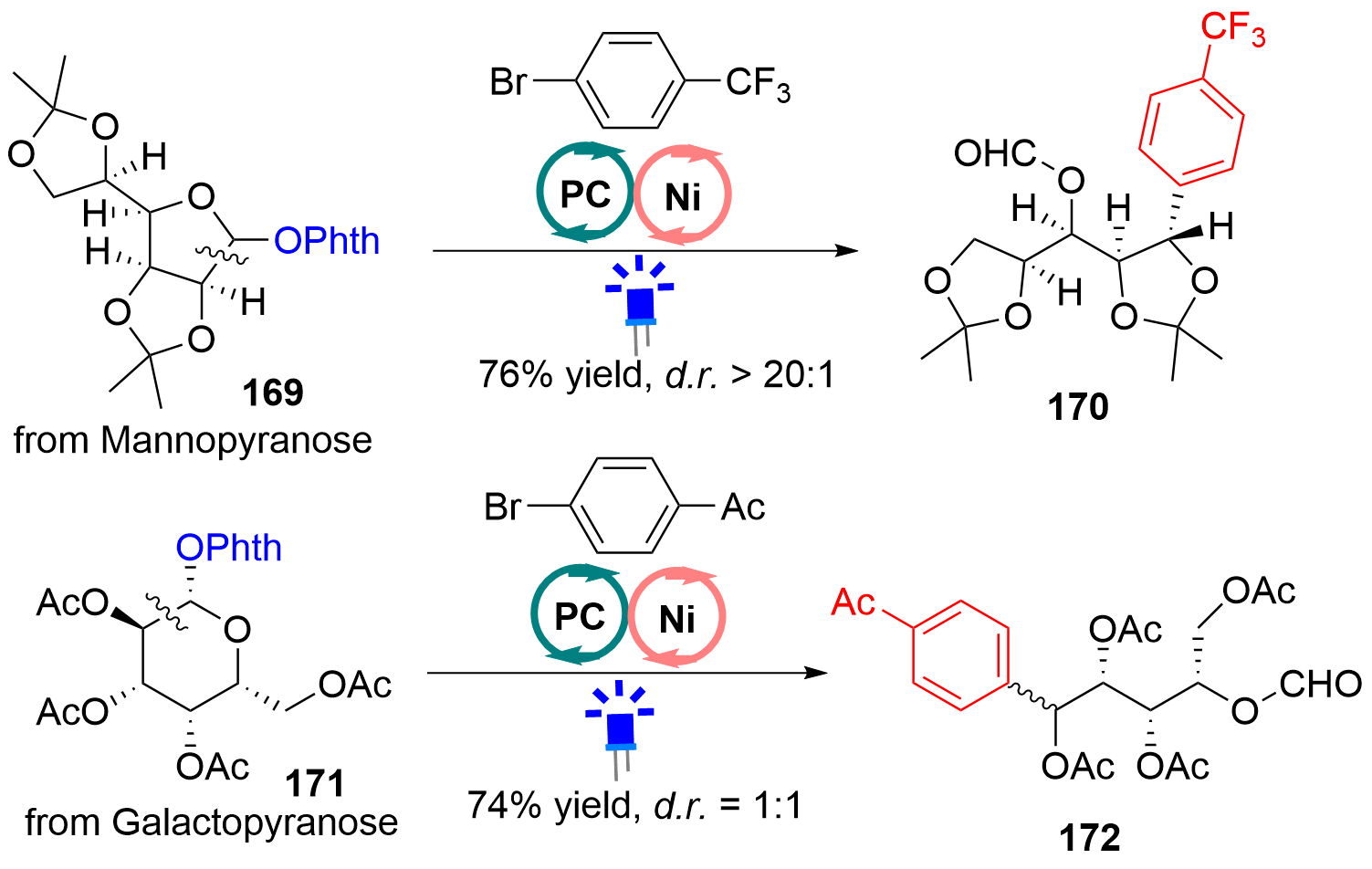
醇类化合物广泛存在于自然界中, 其来源丰富, 是便宜易得的化工原料之一. 早在半个世纪前, Barton- McCombie脱氧反应就被发现, 是研究较为深远的一种醇的脱氧转化方法. 醇的脱氧化反应也是现代有机合成中非常重要的板块之一, 涉及的研究领域相当广泛. 近十几年来, 可见光驱动的氧化还原反应作为一种强劲的有机合成手段, 可以实现许多重要的化学转化, 其具有反应条件温和、官能团兼容性好、反应高效性和环境友好的特点. 对于醇的直接脱氧化反应, 之前已经有文献报道过, 包含可见光促进的光化学反应和过渡金属催化. 在此, 我们主要总结并讨论了从2014年以来, 醇的含氧衍生物, 包括羧酸酯、草酸酯、硫代碳酸酯及其衍生物、醚类和其他醇的含氧衍生物, 在光化学反应中进行的脱氧化/功能化反应的研究进展. 依据醇的含氧衍生物的结构特点进行分类, 详细介绍不同结构类型的醇的含氧衍生物的催化脱氧的反应模式、反应普适性和机理过程等. 展望了该领域所面临的挑战和机遇, 并对其他含羟基结构化合物的光化学脱氧反应具有一定的指导和启发意义.
赵瑜, 邢彤彤, 段玉荣, 赵全庆. 光诱导醇的含氧衍生物的脱氧/功能化反应的研究进展[J]. 化学学报, 2025, 83(7): 773-802.
Yu Zhao, Tongtong Xing, Yurong Duan, Quanqing Zhao. Recent Advances of Photoinduced Deoxygenative Functionalization of Alcohol Derivatives[J]. Acta Chimica Sinica, 2025, 83(7): 773-802.



































| [14] |
(b)
pmid: 32157891 |
|
(c)
doi: 10.1021/acs.orglett.0c00532 pmid: 32157891 |
|
| [15] |
|
| [16] |
|
| [17] |
|
| [18] |
doi: 10.1038/s41467-024-50897-7 pmid: 39117625 |
| [19] |
|
| [20] |
(a)
|
|
(b)
|
|
| [21] |
|
| [22] |
|
| [23] |
|
| [24] |
(a)
|
|
(b)
|
|
| [25] |
(a)
|
|
(b)
|
|
| [26] |
(a)
doi: 10.1039/c9sc03033f pmid: 31762975 |
|
(b)
pmid: 31762975 |
|
| [27] |
|
| [1] |
|
| [2] |
|
| [3] |
(a)
|
|
(b)
|
|
| [4] |
(a)
|
|
(b)
|
|
|
(c)
|
|
| [5] |
(a)
pmid: 12735742 |
| [28] |
|
| [29] |
doi: 10.1021/acs.joc.7b01202 pmid: 28603990 |
| [30] |
(a)
|
|
(b)
|
|
|
(c)
|
|
| [31] |
|
| [32] |
|
| [33] |
doi: 10.1038/s41467-022-30655-3 pmid: 35676260 |
| [34] |
|
| [35] |
|
| [36] |
|
| [37] |
|
| [38] |
|
| [39] |
|
| [5] |
(b)
pmid: 12735742 |
|
(c)
pmid: 12735742 |
|
|
(d)
pmid: 12735742 |
|
|
(e) Ueng, S-H.;
pmid: 12735742 |
|
|
(f)
pmid: 12735742 |
|
|
(g)
pmid: 12735742 |
|
| [6] |
doi: 10.2533/chimia.2016.67 pmid: 26931220 |
| [7] |
Recent advances for photoredox catalysis: (a)
|
| [40] |
|
| [41] |
|
| [42] |
(a)
|
|
(b)
|
|
|
(c)
|
|
|
(d)
|
|
|
(e)
|
|
|
(f)
|
|
| [43] |
|
| [44] |
|
| [45] |
|
| [46] |
|
| [7] |
(b)
|
|
(c)
|
|
|
(d)
|
|
|
(e)
|
|
|
(f)
|
|
|
(g)
|
|
|
(h)
|
|
|
(i)
|
|
|
(j)
|
|
|
(k)
|
|
| [47] |
|
| [48] |
(a)
|
|
(b)
|
|
| [49] |
doi: 10.1021/jacs.0c11172 pmid: 33252234 |
| [50] |
|
| [51] |
|
| [52] |
|
| [53] |
(a)
|
|
(b)
|
|
|
(c)
|
|
|
(d)
|
|
|
(e)
|
|
| [7] |
(l)
|
|
(李康葵, 龙先扬, 黄岳, 祝诗发, 化学学报, 2024, 82, 658.)
doi: 10.6023/A24030090 |
|
|
(m)
|
|
|
(归春明, 周潼瑶, 王海峰, 严琼姣, 汪伟, 黄锦, 陈芬儿, 有机化学, 2023, 43, 2647.)
doi: 10.6023/cjoc202303020 |
|
| [8] |
(a)
pmid: 32905246 |
|
(b)
pmid: 32905246 |
|
|
(c)
pmid: 32905246 |
|
|
(d)
doi: 10.1021/acscatal.0c01923 pmid: 32905246 |
|
|
(e)
pmid: 32905246 |
|
|
(f)
pmid: 32905246 |
|
|
(g)
pmid: 32905246 |
|
| [9] |
Transition metal catalyzed the C—O bond activation: (a)
|
|
(b)
|
|
|
(c)
|
|
|
(d)
|
|
|
(e)
|
|
|
(f)
|
|
|
(g)
|
|
|
(h)
|
|
|
(i)
|
|
|
(j)
|
|
|
(k)
|
|
|
(l)
|
|
|
(m)
|
|
|
(n)
|
|
|
袁芳艳, 李超, 罗美明, 曾小明, 化学学报, 2023, 81, 456).
doi: 10.6023/A23020048 |
|
|
(o)
|
|
|
(p)
|
|
| [10] |
|
| [11] |
|
| [12] |
doi: 10.1021/acs.orglett.5b02378 pmid: 26372674 |
| [13] |
|
| [14] |
(a)
pmid: 32157891 |
| [1] | 胡金婷, 刘暘, 杨凯, 石建兵, 佟斌, 支俊格, 董宇平. 基于苯炔苯及荧光探针芘自组装单分子膜的制备及苯胺检测[J]. 化学学报, 2012, 70(18): 1987-1992. |
| [2] | 张庆友, 冯秀林, 龙海林, 索净洁, 张丹丹, 许力壮, 许禄. 基于MOLMAP 指数的光化学反应分类预测[J]. 化学学报, 2012, 70(08): 989-994. |
| [3] | 胡高硕, 徐永福, 贾龙. 烟雾箱模拟丙烯-NOx的大气光化学反应[J]. 化学学报, 2011, 69(14): 1593-1600. |
| [4] | 刘绪峰, 官文超, 程珍贤. C60吡咯烷羧酸衍生物的合成及其在水溶液中的聚集行为[J]. 化学学报, 2007, 65(5): 430-436. |
| [5] | 林玲,丁万见,方维海,刘若庄. 硫代羰基化合物激发态结构及光化学反应的理论预示[J]. 化学学报, 2003, 61(1): 1-7. |
| [6] | 胡敏,齐斌,陈忠明,张远航,唐孝炎. 乙烷/H2O/O2/N2体系中光致过氧化物的产生[J]. 化学学报, 2002, 60(2): 251-255. |
| [7] | 齐斌,苏克和,胡敏,陈忠明,张远航,唐孝炎. 甲烷-空气-H2O模拟光化学反应体系中CH3OO·自身复合反 应的研究[J]. 化学学报, 2001, 59(4): 610-614. |
| [8] | 贺占博,祁刚,张凤才. 光引发的甘油三乙酯反应的振荡[J]. 化学学报, 2001, 59(3): 316-320. |
| [9] | 张文勤,张明杰,王家喜,杨学茹,王淑丽,江琴,安颖. 杂芳基乙烯光化学反应的研究 2: r-1, c-2, t-3, t-4-1, 3-二(4-甲基苯基)-2, 4-二(4-吡啶基)环丁烷的结构及光解反应[J]. 化学学报, 1998, 56(6): 612-617. |
| [10] | 李培,金松林,刘惠章,林欣荣,谢高阳,邵倩芬. 混合价Keggin结构磷钨钼杂多化合物的光化学合成及其 电子离域性研究[J]. 化学学报, 1998, 56(11): 1106-1111. |
| [11] | 杨博,李干佐,佟振合. 芳砜在微环境中的光化学反应[J]. 化学学报, 1995, 53(10): 937-941. |
| [12] | 李象远,何福城. [2,3]σ键迁移重排立体选择性的Huckel-Hubbard理论研究[J]. 化学学报, 1994, 52(10): 985-989. |
| [13] | 沈燕清,汪鹏飞,吴世康. 铁芳烃配合物光引发剂的敏化研究[J]. 化学学报, 1993, 51(9): 919-927. |
| [14] | 杨军,黄德建,李广年,张良辅. 含磷硫杂配位原子的Pt(Ⅱ)金属有机配合物的合成及其对苯的C-H键活化[J]. 化学学报, 1993, 51(12): 1145-1150. |
| [15] | 吴国生,陶涛,曹建菁,魏夏凉. N-烷基-N-酰基邻氯苯胺的光诱导S~R~N环化[J]. 化学学报, 1992, 50(6): 614-619. |
| 阅读次数 | ||||||
|
全文 |
|
|||||
|
摘要 |
|
|||||
