

化学学报 ›› 2025, Vol. 83 ›› Issue (7): 685-693.DOI: 10.6023/A25030077 上一篇 下一篇
研究论文
闫生荣a,b, 刘文浩a, 段芳a,*( ), 陈明清a,*(), 东为富a, 陆双龙a, 杜明亮a
投稿日期:2025-03-12
发布日期:2025-07-28
基金资助:
Shengrong Yana,b, Wenhao Liua, Fang Duana,*(), Mingqing Chena,*(), Weifu Donga, Shuanglong Lua, Mingliang Dua
Received:2025-03-12
Published:2025-07-28
Contact:
*E-mail: duanfang@jiangnan.edu.cn;E-mail: mqchen@jiangnan.edu.cn
Supported by:文章分享
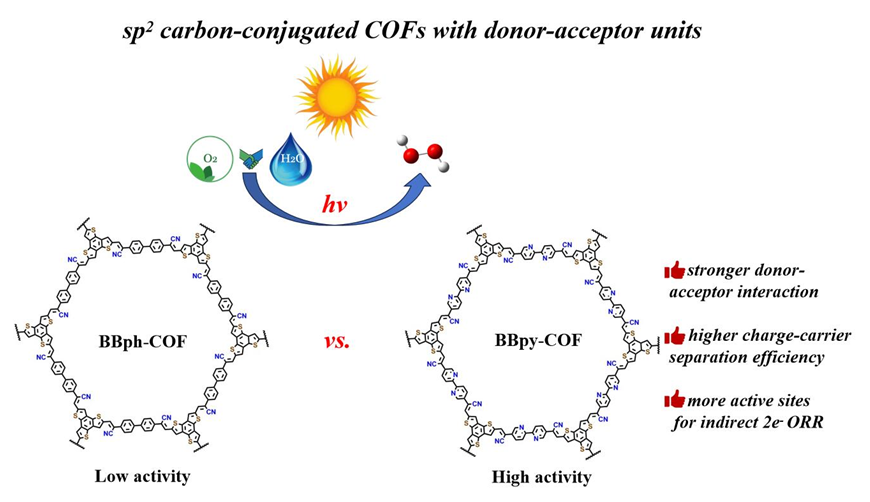
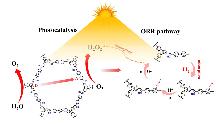
设计高度共轭和电子给体-受体(D-A)结构是提升共价有机框架(COFs)电荷分离和转移的有效手段. 鉴于此, 通过Knoevenagel缩合反应构筑了两种sp²-碳连接的BBpy-COF和BBph-COF光催化剂, 并系统研究了其光催化产双氧水(H2O2)性能. 实验结果表明, BBpy-COF光催化H2O2生成速率可达1394.7 µmol•g−1•h−1, 为BBph-COF (656.5 µmol•g−1•h−1)的2.12倍, 其性能提升归因于苯并三噻吩(Btt)电子给体与联吡啶(Bpy)电子受体间的强D-A作用和C=C双键连接的共轭增强效应调控优化了光生载流子的分离效率, 最后依靠氧还原反应(ORR)活性位点Bpy, 高效通过两步单电子ORR路径实现光催化产H2O2. 本项工作为合理设计和构筑高效COFs光催化材料提供了一定的参考.
闫生荣, 刘文浩, 段芳, 陈明清, 东为富, 陆双龙, 杜明亮. 基于sp2-碳连接具有D-A结构共价有机框架的构筑及其光催化产双氧水性能研究[J]. 化学学报, 2025, 83(7): 685-693.
Shengrong Yan, Wenhao Liu, Fang Duan, Mingqing Chen, Weifu Dong, Shuanglong Lu, Mingliang Du. Constructing of sp2-Carbon Linked Covalent Organic Frameworks with D-A Structure and Evaluating Their Photocatalytic Performance towards Hydrogen Peroxide Production[J]. Acta Chimica Sinica, 2025, 83(7): 685-693.





| [1] |
|
|
(于潇涵, 黄伟, 李彦光, 化学学报, 2022, 80, 1494.)
doi: 10.6023/A22070303 |
|
| [2] |
doi: 10.6023/A22010030 |
|
(王丹, 封波, 张晓昕, 刘亚楠, 裴燕, 乔明华, 宗保宁, 化学学报, 2022, 80, 772.)
doi: 10.6023/A22010030 |
|
| [3] |
|
| [4] |
|
| [5] |
|
| [6] |
|
| [7] |
|
| [8] |
|
| [9] |
|
| [10] |
|
| [11] |
|
| [12] |
doi: 10.1021/jacs.9b05244 pmid: 31318202 |
| [13] |
|
| [14] |
doi: 10.1002/anie.201306775 pmid: 24127339 |
| [15] |
doi: 10.1002/anie.201802220 pmid: 29573097 |
| [16] |
|
| [17] |
|
| [18] |
|
| [19] |
|
| [20] |
|
| [21] |
|
| [22] |
|
| [23] |
|
| [24] |
|
| [25] |
|
| [26] |
|
| [27] |
|
| [28] |
|
| [29] |
|
| [30] |
|
| [31] |
|
| [32] |
|
| [33] |
|
| [34] |
|
| [35] |
|
| [36] |
|
| [37] |
doi: 10.1038/s41563-019-0398-0 pmid: 31263224 |
| [38] |
|
|
(杜俊平, 封珊珊, 张婕, 张永辉, 王诗文, 韩莉峰, 陈俊利, 有机化学, 2022, 42, 2967.)
doi: 10.6023/cjoc202203056 |
|
| [39] |
|
| [40] |
|
| [41] |
|
| [42] |
|
| [43] |
|
| [44] |
|
|
(刘建川, 李翠艳, 刘耀祖, 王钰杰, 方千荣, 化学学报, 2023, 81, 884.)
doi: 10.6023/A23040132 |
|
| [45] |
|
| [46] |
|
| [1] | 魏颖, 王家成, 李玥, 汪涛, 马述威, 解令海. 碳碳键链接的二维共价有机框架研究进展[J]. 化学学报, 2024, 82(1): 75-102. |
| [2] | 刘建川, 李翠艳, 刘耀祖, 王钰杰, 方千荣. 高稳定二维联咔唑sp2碳共轭共价有机框架材料用于高效电催化氧还原★[J]. 化学学报, 2023, 81(8): 884-890. |
| [3] | 杨蓉婕, 周璘, 苏彬. 基于共价有机框架修饰电极的维生素A和C的选择性检测★[J]. 化学学报, 2023, 81(8): 920-927. |
| [4] | 何明慧, 叶子秋, 林桂庆, 尹晟, 黄心翊, 周旭, 尹颖, 桂波, 汪成. 卟啉基共价有机框架的光催化研究进展★[J]. 化学学报, 2023, 81(7): 784-792. |
| [5] | 陈俊畅, 张明星, 王殳凹. 晶态多孔材料合成方法的研究进展[J]. 化学学报, 2023, 81(2): 146-157. |
| [6] | 于潇涵, 黄伟, 李彦光. 二维共价有机框架材料的可控合成及其光催化应用研究进展[J]. 化学学报, 2022, 80(11): 1494-1506. |
| [7] | 浩天瑞霖, 朱子煜, 蔡艳慧, 王微, 王祯, 梁阿新, 罗爱芹. 基于共价有机框架的电化学生物传感器在生物样品检测中的应用[J]. 化学学报, 2022, 80(11): 1524-1535. |
| [8] | 王自陶, 刘耀祖, 王钰杰, 方千荣. 一种新型磺酸修饰的共价有机框架用于二氧化碳吸收和染料吸附[J]. 化学学报, 2022, 80(1): 37-43. |
| [9] | 王涛, 赵璐, 王科伟, 白云峰, 冯锋. 共价有机框架的合成及其在肿瘤治疗中的应用研究进展[J]. 化学学报, 2021, 79(5): 600-613. |
| [10] | 方婧, 赵文娟, 张明浩, 方千荣. 一种新型酰胺功能化的共价有机框架用于选择性染料吸附[J]. 化学学报, 2021, 79(2): 186-191. |
| [11] | 王友付, 刘航海, 朱新远. 网状框架中的机械互锁结构[J]. 化学学报, 2020, 78(8): 746-757. |
| [12] | 蒋成浩, 冯霄, 王博. 共价有机框架膜的制备及其在海水淡化和水处理领域的研究进展[J]. 化学学报, 2020, 78(6): 466-477. |
| [13] | 刘建国, 张明月, 王楠, 王晨光, 马隆龙. 共价有机框架材料催化研究进展[J]. 化学学报, 2020, 78(4): 311-325. |
| [14] | 梅佩, 张媛媛, 冯霄. 氨基酸功能化晶态多孔聚合物的研究进展[J]. 化学学报, 2020, 78(10): 1041-1053. |
| [15] | 王志涛, 李辉, 颜士臣, 方千荣. 一种沿骨架进行质子传导的二维共价有机框架的合成[J]. 化学学报, 2020, 78(1): 63-68. |
| 阅读次数 | ||||||
|
全文 |
|
|||||
|
摘要 |
|
|||||
