

化学学报 ›› 2025, Vol. 83 ›› Issue (9): 1103-1118.DOI: 10.6023/A25050157 上一篇
综述
王源浩, 张照明*( ), 颜徐州*()
投稿日期:2025-05-11
发布日期:2025-07-07
作者简介: |
| 王源浩, 博士生, 就读于上海交通大学化学化工学院, 主要研究方向为机械互锁聚合物的制备和构效关系研究. |
 |
| 张照明, 2019年在日本北海道大学获得博士学位, 随后加入上海交通大学, 先后担任博士后、助理研究员及副研究员等职. 研究领域聚焦超分子聚合物、机械互锁聚合物及智能高分子材料的开发与应用. 以(共同)第一或通讯作者发表J. Am. Chem. Soc.、Nat. Commun.、Angew. Chem. Int. Ed.、Acc. Chem. Res.等学术论文34篇, 论文引用1600余次. 主持国家自然科学基金面上项目、青年项目在内的5项科研项目. |
 |
| 颜徐州, 上海交通大学化学化工学院研究员, 博士生导师. 2014年获得浙江大学博士学位, 2014~2018年分别在美国犹他大学和斯坦福大学从事博士后研究, 2018年9月入职上海交通大学开展独立研究工作. 入选上海市高校特聘教授(东方学者, 2018)和曙光学者(2022)计划, 2021年获得国家自然科学基金优秀青年科学基金资助. 主要研究方向为机械互锁聚合物和动态高分子材料. |
★ “中国青年化学家”专辑.
基金资助:
Yuanhao Wang, Zhaoming Zhang*(), Xuzhou Yan*()
Received:2025-05-11
Published:2025-07-07
Contact:
* E-mail: zhangzhaoming@sjtu.edu.cn;xzyan@sjtu.edu.cn
About author:★ For the VSI “Rising Stars in Chemistry”.
Supported by:文章分享
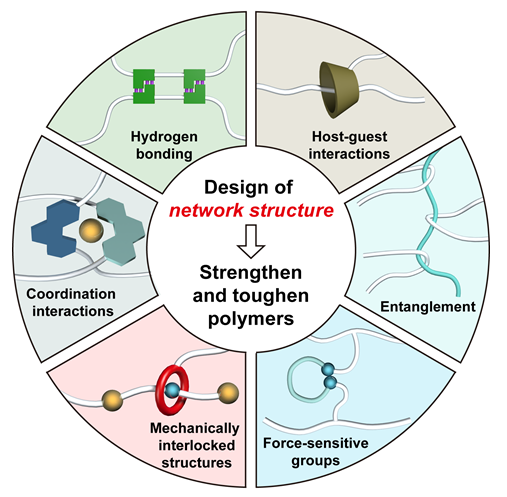
聚合物材料在现代工业和科技领域占据重要地位, 但传统工业的聚合物改性方法往往面临着强度和韧性调节不可控制的难题, 限制了材料的高端应用. 为解决这一问题, 研究者们通过聚合物的结构优化以实现宏观性能的调控. 因此, 本综述以网络结构设计为切入点, 根据能量耗散途径的不同, 将聚合物改性的机制分为氢键作用、配位作用、主客体作用、力敏基团、机械互锁结构和其他作用六个方面. 随后, 分类综述了各个方面近年来具有代表性和创新性的工作, 通过结构分析和性能理解, 重点阐释了不同作用对于增强增韧聚合物材料的影响机制. 最后, 根据现有的研究内容, 指出了未来聚合物材料机械性能提升所面临的关键问题和重要挑战.
王源浩, 张照明, 颜徐州. 强韧化聚合物网络的结构设计策略★[J]. 化学学报, 2025, 83(9): 1103-1118.
Yuanhao Wang, Zhaoming Zhang, Xuzhou Yan. Strategies for Structural Design in Strengthening and Toughening Polymer Networks★[J]. Acta Chimica Sinica, 2025, 83(9): 1103-1118.









| [1] |
|
| [2] |
|
| [3] |
|
| [4] |
doi: 10.1016/j.bioactmat.2023.11.012 pmid: 38282639 |
| [5] |
doi: 10.1021/acs.chemrev.0c01304 pmid: 33792299 |
| [6] |
|
| [7] |
|
| [8] |
doi: 10.1073/pnas.1015862108 pmid: 21278337 |
| [9] |
|
| [10] |
|
| [11] |
|
| [12] |
|
| [13] |
|
| [14] |
|
| [15] |
|
| [16] |
|
| [17] |
|
|
(郑坤贵, 刘君珂, 胡轶旸, 尹祖伟, 周尧, 李君涛, 孙世刚, 化学学报, 2024, 82, 833.)
doi: 10.6023/A24050160 |
|
| [18] |
|
|
(鲁会名, 马拉毛草, 马恒昌, 有机化学, 2023, 43, 4075.)
doi: 10.6023/cjoc202305010 |
|
| [19] |
|
| [20] |
doi: 10.1021/acs.chemrev.2c00696 pmid: 37232480 |
| [21] |
|
| [22] |
|
| [23] |
|
| [24] |
|
| [25] |
|
| [26] |
|
| [27] |
|
| [28] |
doi: 10.1039/c5nr01354b pmid: 26006766 |
| [29] |
|
| [30] |
|
| [31] |
|
|
(李乾坤, 穆红亮, 简忠保, 有机化学, 2024, 44, 3399.)
doi: 10.6023/cjoc202403034 |
|
| [32] |
|
| [33] |
|
| [34] |
|
| [35] |
|
| [36] |
|
|
(张照明, 赵骏, 颜徐州, 高分子学报, 2022, 53, 691.)
|
|
| [37] |
doi: 10.1021/ja5097094 pmid: 25348857 |
| [38] |
|
| [39] |
|
|
(黄文翰, 姜山, 李慧, 赵凤玉, 程海洋, 有机化学, 2024, 44, 3178.)
doi: 10.6023/cjoc202405045 |
|
| [40] |
doi: 10.1021/acsnano.6b06466 pmid: 28024337 |
| [41] |
|
| [42] |
|
| [43] |
|
| [44] |
|
| [45] |
doi: 10.1038/nchembio.2206 pmid: 27748749 |
| [46] |
|
| [47] |
|
| [48] |
|
| [49] |
|
| [50] |
|
| [51] |
|
| [52] |
|
| [53] |
|
| [54] |
|
| [55] |
|
| [56] |
|
|
(张登朝, 贾吉慧, 梁栋, 蔡显宝, 赵雨晴, 胡祥龙, 江钰冰, 卢灿忠, 化学学报, 2024, 82, 887.)
doi: 10.6023/A24040148 |
|
| [57] |
|
| [58] |
|
| [59] |
|
| [60] |
|
| [61] |
|
|
(王泽钜, 绳新如, 李光锋, 颜徐州, 黄飞鹤, 高分子学报, 2022, 53, 1301.)
|
|
| [62] |
|
| [63] |
|
| [64] |
|
| [65] |
|
| [66] |
|
| [67] |
|
| [68] |
|
| [69] |
doi: 10.1038/s41428-020-0352-7 |
| [70] |
|
| [71] |
|
| [72] |
|
| [73] |
|
| [74] |
|
| [75] |
|
| [76] |
|
| [77] |
|
| [78] |
|
| [79] |
doi: 10.1038/s41467-017-01412-8 pmid: 29079772 |
| [80] |
doi: 10.1126/science.adg3229 pmid: 37347867 |
| [81] |
|
| [82] |
|
| [83] |
|
| [84] |
|
| [85] |
|
| [86] |
|
| [87] |
|
|
(李东旭, 徐翔, 宋佳鸽, 梁松挺, 付予昂, 路新慧, 邹应萍, 化学学报, 2023, 81, 1500.)
doi: 10.6023/A23070353 |
|
| [88] |
|
| [89] |
|
| [90] |
|
|
(尹晓璇, 李进杰, 禚可欣, 牟蔚鑫, 黄灵丽, 陈健壮, 林绍梁, 化学学报, 2024, 82, 790.)
doi: 10.6023/A24040123 |
|
| [91] |
|
| [92] |
|
| [93] |
|
| [94] |
|
| [95] |
|
|
(王文彬, 程林, 张照明, 白瑞雪, 俞炜, 颜徐州, 高分子通报, 2025, 38, 226.)
|
|
| [96] |
|
| [97] |
|
| [98] |
|
| [99] |
|
| [100] |
|
| [101] |
|
| [102] |
|
| [103] |
|
| [104] |
|
| [105] |
|
| [106] |
|
| [107] |
|
| [108] |
|
| [109] |
|
| [110] |
|
| [111] |
|
| [112] |
|
| [113] |
|
| [114] |
|
| [115] |
|
| [116] |
|
| [117] |
|
| [118] |
|
| [119] |
|
| [120] |
|
| [121] |
doi: 10.1021/acs.chemrev.0c00938 pmid: 33393759 |
| [122] |
|
| [1] | 王友付, 刘航海, 朱新远. 网状框架中的机械互锁结构[J]. 化学学报, 2020, 78(8): 746-757. |
| [2] | 强黎明, 董雪茹, 吕名秀, 曹书霞, 卢奎, 赵玉芬. N-磷酰化肽酯及小肽与溶菌酶相互作用的ESI-MS研究[J]. 化学学报, 2009, 67(22): 2607-2612. |
| 阅读次数 | ||||||
|
全文 |
|
|||||
|
摘要 |
|
|||||
