

化学学报 ›› 2026, Vol. 84 ›› Issue (2): 208-213.DOI: 10.6023/A25090306 上一篇 下一篇
研究论文
张士民a, 郝朋飞b,*( ), 申秋b, 高敏霞b, 杨海英a, 沈俊菊b, 付云龙b,*()
投稿日期:2025-09-11
发布日期:2025-11-05
基金资助:
Shimin Zhanga, Pengfei Haob,*(), Qiu Shenb, Minxia Gaob, Haiying Yanga, Junju Shenb, Yunlong Fub,*()
Received:2025-09-11
Published:2025-11-05
Contact:
*E-mail: haopengfei_2015@126.com,yunlongfu@sxnu.edu.cn
Supported by:文章分享
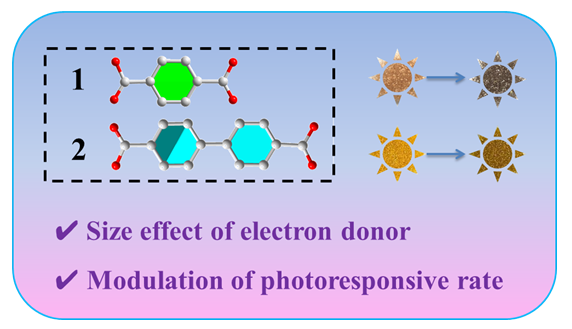
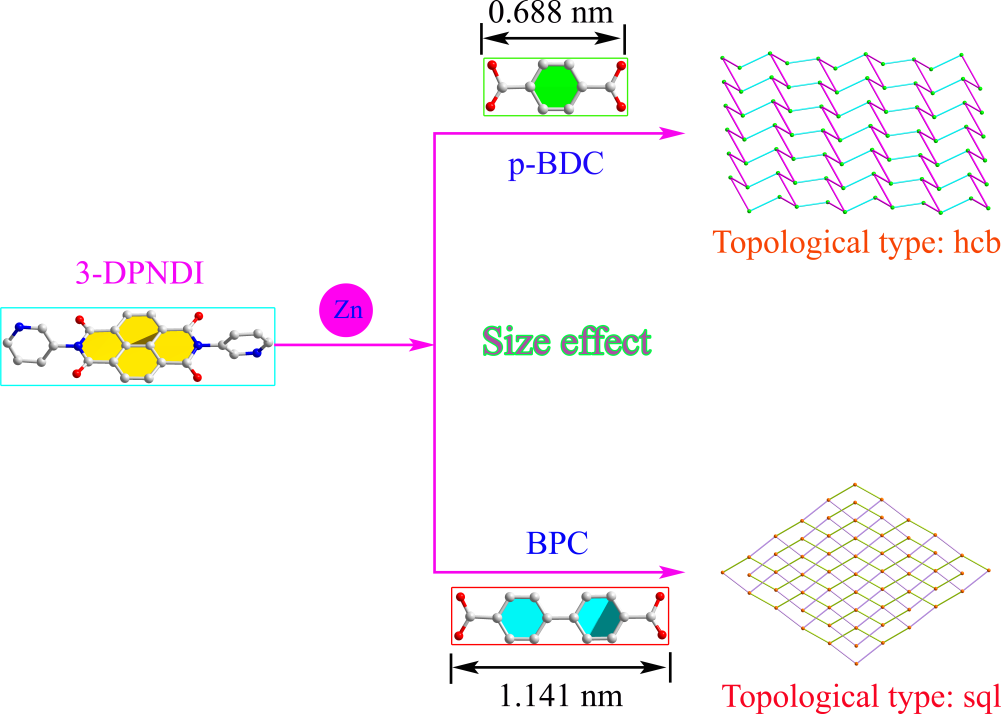
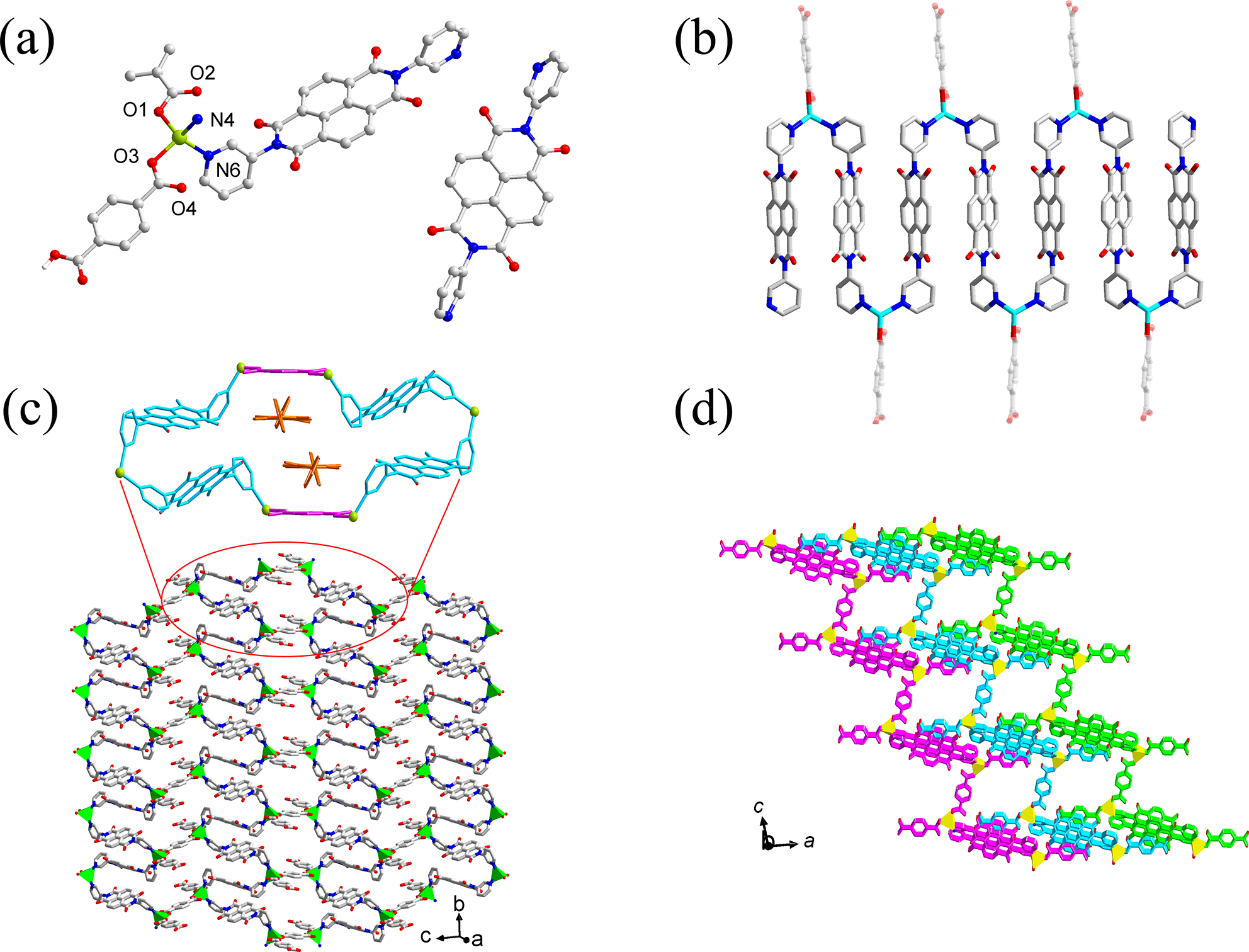
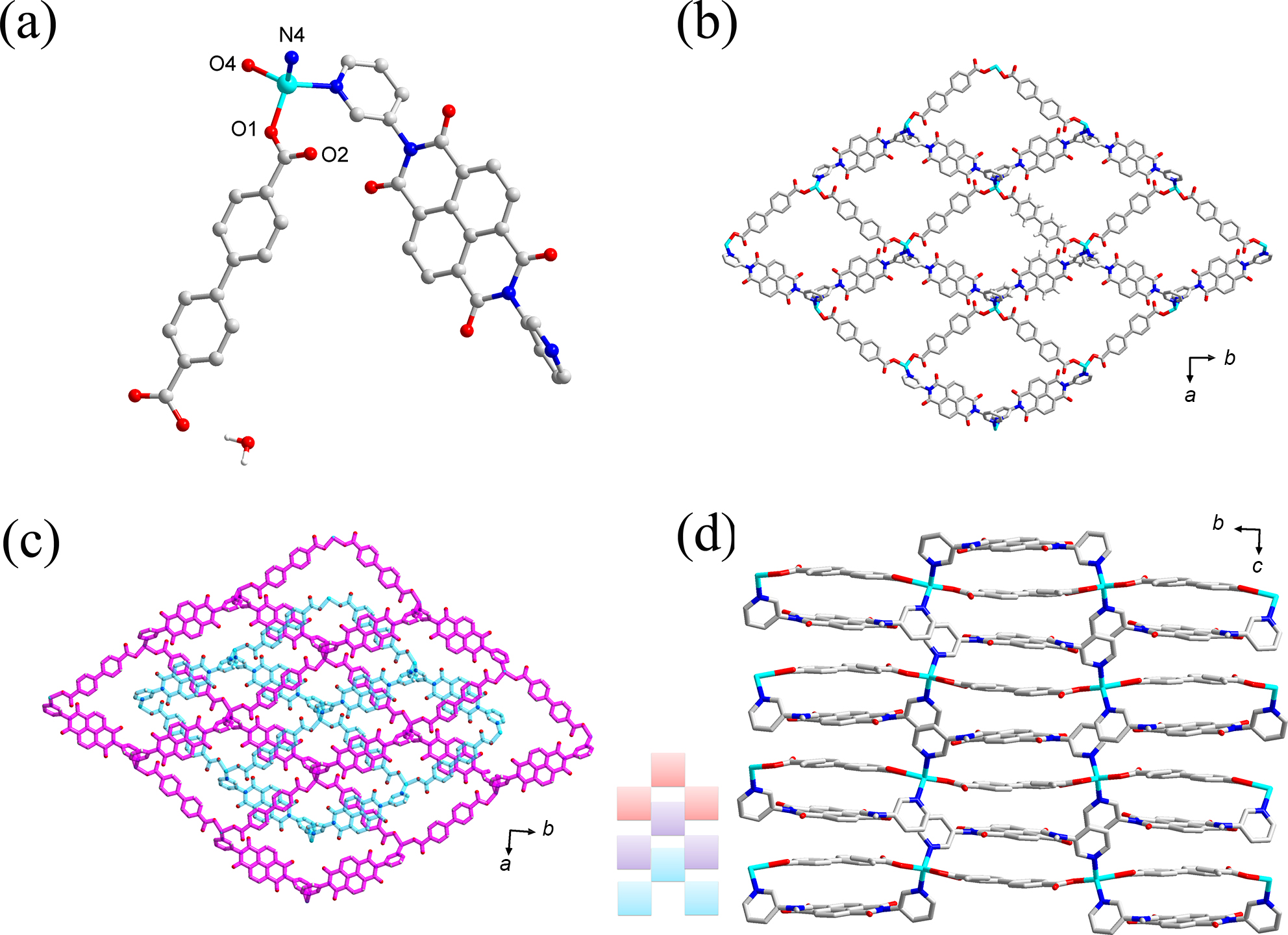
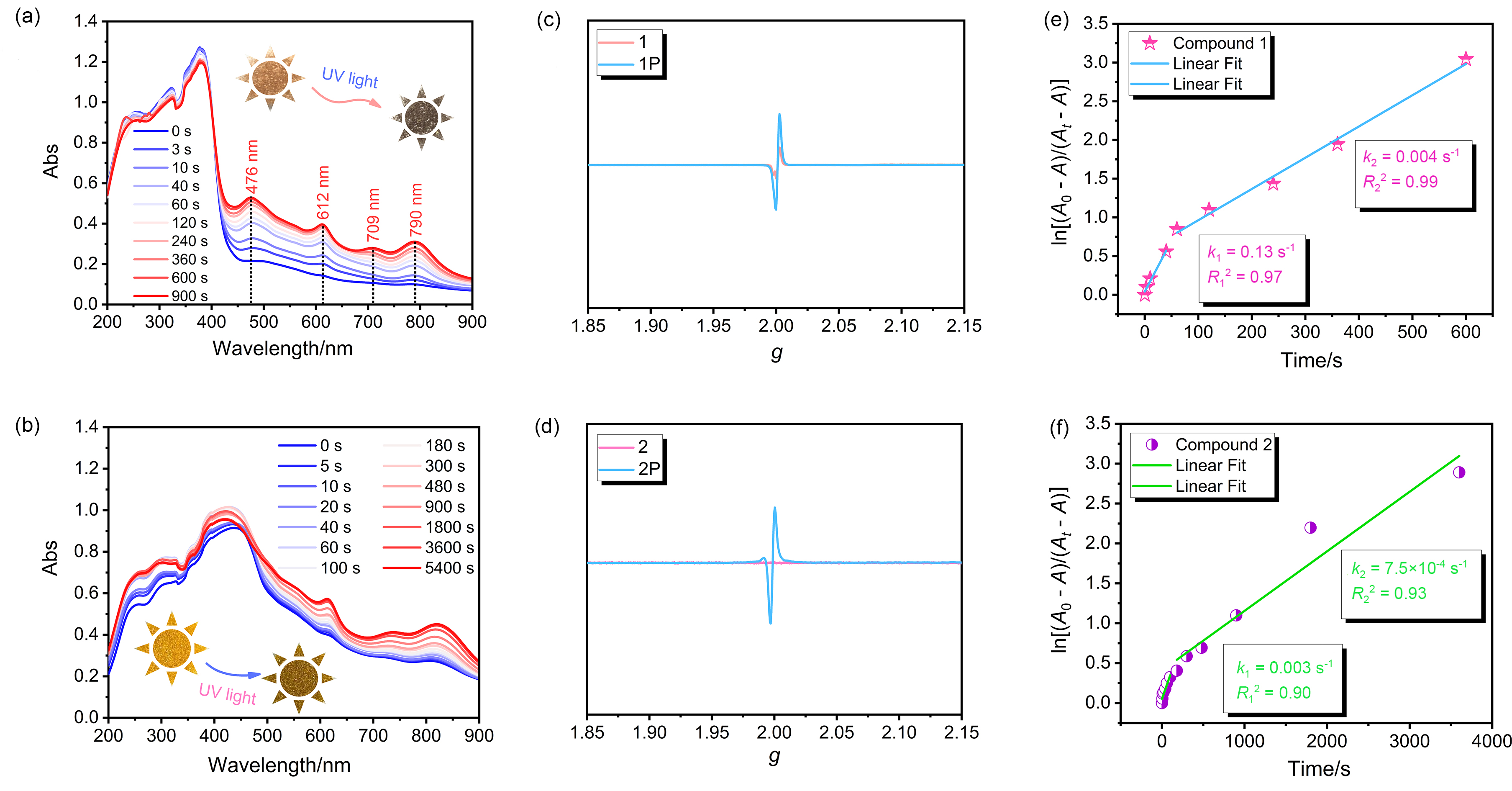
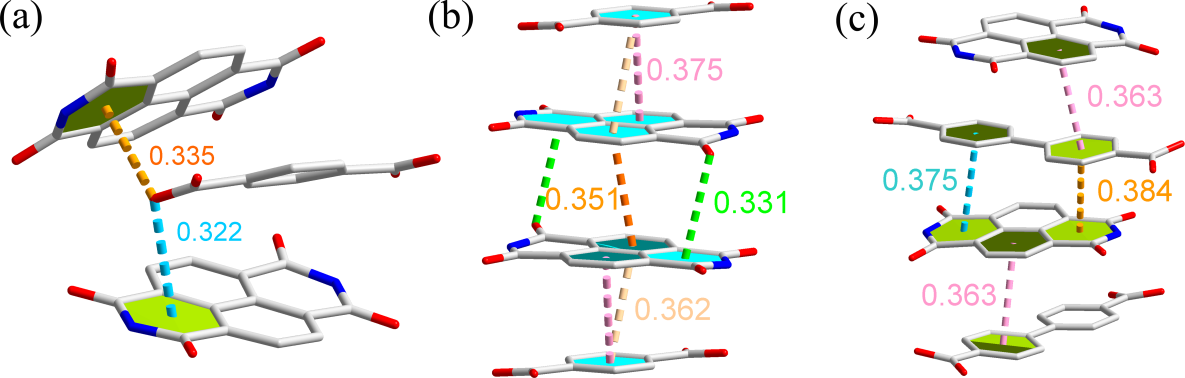
电子转移型(ET)光致变色配位聚合物的光响应速率监测和调控对于优化光致变色性能至关重要, 但仍然是一个巨大的挑战. 以N,N′-二-(3-吡啶基)-1,4,5,8-萘二酰亚胺(3-DPNDI)为电子受体, 对苯二甲酸(p-H2BDC)和4,4'-联苯二甲酸(H2BPC)为电子给体, 以Zn2+为金属节点, 构筑了两例新的二维(2D)光致变色配位聚合物(PCCPs) [Zn2(3-DPNDI)2(p- BDC)(p-HBDC)2]•[3-DPNDI]2 (1)和[Zn(3-DPNDI)(BPC)]•H2O (2). 通过单晶X射线衍射(SC-XRD)对其单晶结构进行分析, 采用粉末X射线衍射(PXRD)和热重(TG)对单晶样品的纯度和热稳定性进行评估, 利用紫外-可见吸收光谱(UV-Vis)对光致变色性能进行研究, 并使用电子顺磁共振谱(EPR)确定光致变色的机理. 在紫外灯照射下(365 nm), 化合物1和2均呈现肉眼可识别的颜色变化. 为了更准确和有效地评估光响应速率, 发展了一种用于评估光响应速率的新方法(光响应速率=ΔAbs/时间, 单位: s-1). 计算表明, 1的光响应速率比2的光响应速率快大约1个数量级. 同时, 采用动力学方程计算的光响应速率也符合1快于2的结论, 进一步验证了上述光响应速率计算方法的准确性. 本研究体现了配体尺寸效应对电子给受体间界面关系、光诱导分子间电子转移(PIET)和光响应速率的有效调控, 为光致变色配位聚合物的可控构筑提供了一个有效的策略.
张士民, 郝朋飞, 申秋, 高敏霞, 杨海英, 沈俊菊, 付云龙. 基于配体尺寸效应调控光致变色配位聚合物的光响应速率[J]. 化学学报, 2026, 84(2): 208-213.
Shimin Zhang, Pengfei Hao, Qiu Shen, Minxia Gao, Haiying Yang, Junju Shen, Yunlong Fu. Regulating the Photoresponsive Rate of Photochromic Coordination Polymers based on the Size Effect of Ligand[J]. Acta Chimica Sinica, 2026, 84(2): 208-213.
| [1] |
doi: 10.6023/A24020062 |
|
(彭红超, 陈胜, 阎斌, 化学学报, 2024, 82, 797.)
doi: 10.6023/A24020062 |
|
| [2] |
doi: 10.6023/A2305023211 |
|
(徐赫, 韩鹏博, 秦安军, 唐本忠, 化学学报, 2023, 81, 1420.)
doi: 10.6023/A23050232 |
|
| [3] |
doi: 10.1039/D3CS01050C |
| [4] |
doi: 10.1021/accountsmr.4c00325 |
| [5] |
doi: 10.1021/jacs.7b11673 pmid: 29275623 |
| [6] |
doi: 10.1039/D1CS00374G |
| [7] |
doi: 10.1016/j.nantod.2018.10.006 |
| [8] |
doi: 10.1021/acs.accounts.1c00061 |
| [9] |
|
| [10] |
doi: 10.1016/j.ccr.2021.214304 |
| [11] |
doi: 10.1021/jacs.5c06958 |
| [12] |
doi: 10.1007/s40843-025-3279-0 |
| [13] |
doi: 10.1039/D5SC03344F |
| [14] |
|
| [15] |
doi: 10.1021/acs.inorgchem.5c01979 |
| [16] |
doi: 10.1021/acs.inorgchem.4c05173 |
| [17] |
doi: 10.1039/D5QI00423C |
| [18] |
|
| [19] |
doi: 10.1039/D5QI01641J |
| [20] |
doi: 10.1021/acs.inorgchem.4c05562 |
| [21] |
doi: 10.1021/acs.inorgchem.4c05331 |
| [22] |
|
|
(郝朋飞, 刘兴, 付云龙, 无机化学学报, 2022, 38, 198.)
|
|
| [23] |
doi: 10.1021/jacs.9b04930 |
| [24] |
doi: 10.1016/j.molstruc.2025.143851 |
| [25] |
doi: 10.1016/j.cej.2025.165131 |
| [26] |
doi: 10.1039/D5QI01111F |
| [27] |
doi: 10.1016/j.dyepig.2023.111677 |
| [28] |
doi: 10.1039/D2QI00100D |
| [29] |
doi: 10.1021/acs.inorgchem.3c01613 |
| [30] |
doi: 10.1039/D1CC05070B |
| [31] |
doi: 10.1002/adfm.v33.14 |
| [32] |
doi: 10.1039/D0CE00025F |
| [33] |
doi: 10.1021/acs.inorgchem.1c03920 |
| [34] |
doi: 10.6023/A25050166 |
|
(张士民, 郝朋飞, 于炜玉, 朱慧慧, 杨海英, 沈俊菊, 付云龙, 化学学报, 2025, 83, 1356.)
doi: 10.6023/A25050166 |
|
| [35] |
doi: 10.1021/acs.inorgchem.5c01573 |
| [36] |
doi: 10.1038/s41467-017-02215-7 pmid: 29247248 |
| [37] |
doi: 10.1021/jacs.5b12664 |
| [38] |
doi: 10.1021/jacs.5c04980 |
| [39] |
doi: 10.1021/ja107382x |
| [40] |
doi: 10.1021/acs.inorgchem.6b01906 |
| [41] |
doi: 10.1021/jacs.5c06962 |
| [42] |
|
|
(白银娟, 张世平, 王云霞, 曾凡龙, 波谱原理及解析(第四版), Science Press, Beijing, 2021.)
|
|
| [43] |
doi: 10.1039/D0CE01733G |
| [44] |
|
|
(申秋, 硕士论文, 西师范大学, 太原, 2023.)
|
| [1] | 李翔宇, 李家凯, 林淑娟, 王明盛, 孙径, 徐忠宁, 郭国聪. PdZn合金催化剂调控CO酯化产物选择性: 从草酸二甲酯到碳酸二甲酯[J]. 化学学报, 2025, 83(3): 206-211. |
| [2] | 张士民, 郝朋飞, 于炜玉, 朱慧慧, 杨海英, 沈俊菊, 付云龙. N-取代基对萘二酰亚胺基配位聚合物光致变色性能的调控作用[J]. 化学学报, 2025, 83(11): 1356-1362. |
| [3] | 何萌萌, 张瑞, 谢玉龙, 葛从伍, 高希珂. 核扩展萘二酰亚胺-插烯四硫富瓦烯衍生物的设计合成与性能研究[J]. 化学学报, 2024, 82(9): 954-961. |
| [4] | 刘洵, 江辉波, 荆凯强, 徐忠宁, 郭国聪. Zn2+通过电子转移提升CO酯化反应Pd基催化剂性能[J]. 化学学报, 2023, 81(7): 691-696. |
| [5] | 温哥华, 温都日娜, 陈秀梅, 麻秀芳, 翁果果, 韦依凡, 鲍松松, 谢小吉, 胡淑贤, 郑丽敏. 层状铀酰膦酸配位聚合物作为双响应光致发光温度计★[J]. 化学学报, 2023, 81(10): 1311-1317. |
| [6] | 陈俊敏, 崔承前, 刘瀚林, 李国栋. 金属有机框架与Pt粒子复合材料催化喹啉选择性加氢性能研究※[J]. 化学学报, 2022, 80(4): 467-475. |
| [7] | 于沫涵, 程媛媛, 刘亚军. 萤火虫生物发光中加氧反应机理的理论研究[J]. 化学学报, 2020, 78(9): 989-993. |
| [8] | 黄荣谊, 沈琼, 张超, 张少勇, 徐衡. 过渡金属催化有机腈和叠氮酸钠反应机理的研究[J]. 化学学报, 2020, 78(6): 565-571. |
| [9] | 琪其格, 杨春帆, 夏烨, 刘坤辉, 苏红梅. 4-硫代尿嘧啶与色氨酸光致电子转移反应研究[J]. 化学学报, 2019, 77(6): 515-519. |
| [10] | 孙才力, 滕坤旭, 牛丽亚, 陈玉哲, 杨清正. 萘二酰亚胺[3]轮烷的设计合成及发光性能研究[J]. 化学学报, 2018, 76(10): 779-784. |
| [11] | 宋颢, 刘小宇, 秦勇. 氮自由基化学新进展:光催化N-H键活化途径[J]. 化学学报, 2017, 75(12): 1137-1149. |
| [12] | 王琴, 聂舟, 胡宇芳, 姚守拙. 基于铜-巯基配位聚合物电化学催化的新型乙酰胆碱酯酶电化学传感器[J]. 化学学报, 2017, 75(11): 1109-1114. |
| [13] | 于海波, 李红玲, 张新富, 肖义, 方沛菊, 吕春娇, 侯伟. 基于Nile Red的线粒体靶向性增强型硫化氢荧光探针及其细胞成像[J]. 化学学报, 2015, 73(5): 450-456. |
| [14] | 李西平, 刘斯佳, 吴战, 蒋健晖. 基于硅量子点电子转移荧光淬灭的2,4,6-三硝基甲苯/2,4,6-三硝基苯酚检测新方法[J]. 化学学报, 2014, 72(5): 563-568. |
| [15] | 倪春燕, 陈阳, 李端秀, 任志刚, 李红喜, 孙真荣, 郎建平. 卤离子导向合成配位聚合物[Hg2X4(ppt)]n (X=I和Br; ppt=1-(4-吡啶基)-吡啶铵-4-硫醇盐)及不同的一维链状结构和三阶非线性光学响应[J]. 化学学报, 2013, 71(06): 906-912. |
| 阅读次数 | ||||||
|
全文 |
|
|||||
|
摘要 |
|
|||||
