

化学学报 ›› 2026, Vol. 84 ›› Issue (2): 214-222.DOI: 10.6023/A25090312 上一篇 下一篇
研究论文
赵宝国a, 李展a, 马慧芳b, 任浩a,*( )
)
投稿日期:2025-09-15
发布日期:2025-11-21
基金资助:
Baoguo Zhaoa, Zhan Lia, Huifang Mab, Hao Rena,*()
Received:2025-09-15
Published:2025-11-21
Contact:
*E-mail: renh@upc.edu.cn
Supported by:文章分享
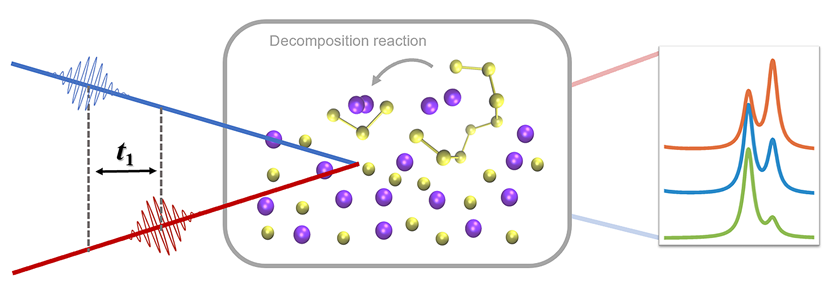
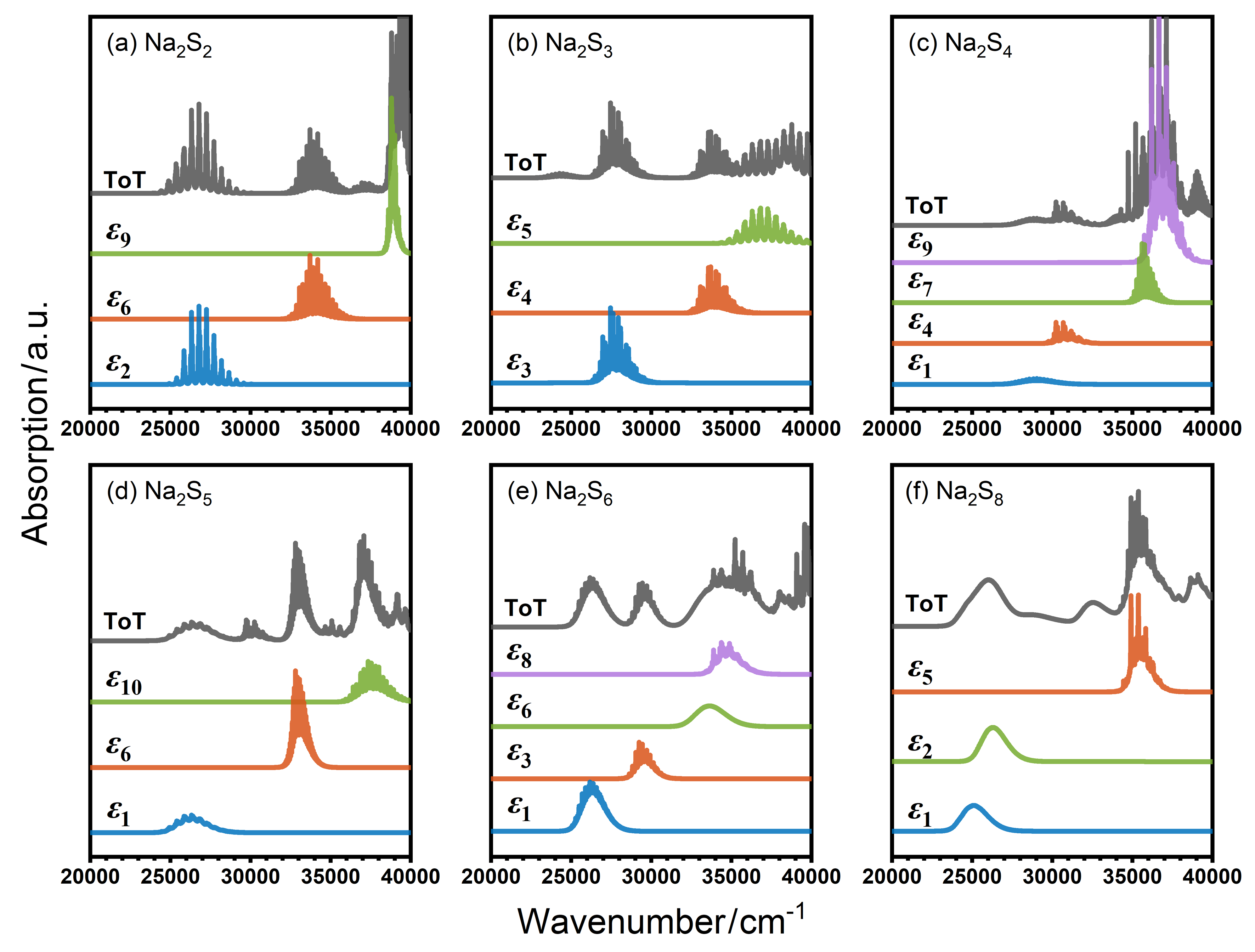
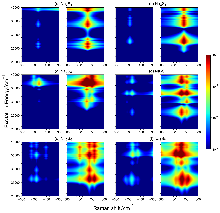
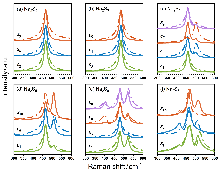
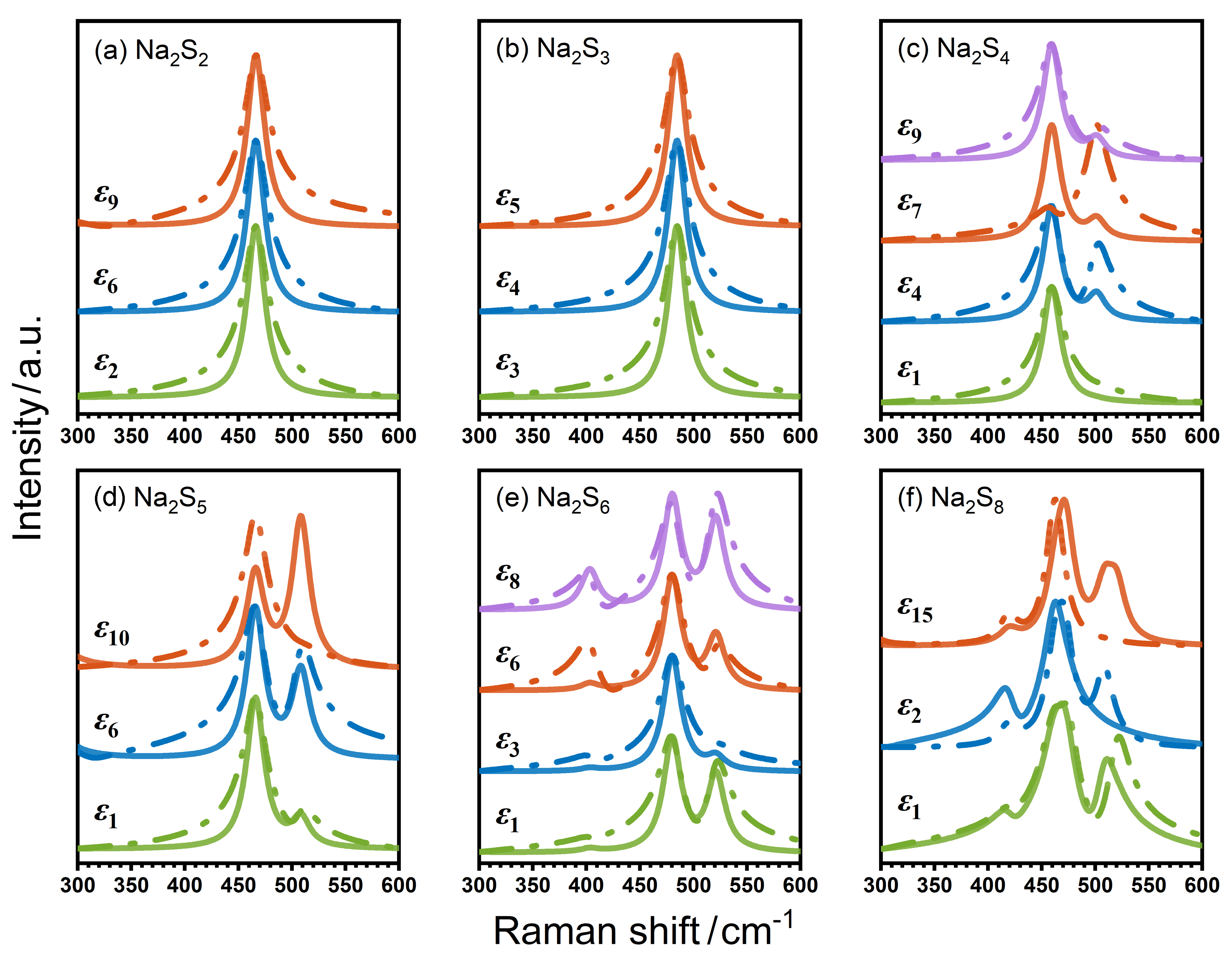
钠硫电池作为极具潜力的储能装置, 其发展长期受能量转化过程中穿梭效应的制约. 工作状态的钠硫电池内部存在多个级联的氧化还原反应, 产物为多种溶于电解质溶液的钠硫化合物. 各类多硫化钠中间体在正负极间的扩散迁移是穿梭效应的主导因素. 目前关于穿梭效应的微观机制, 包括导致活性物质流失的具体化学物种及其氧化还原反应动力学机理仍不明确. 由于多硫化钠具有极快的反应动力学和高度动态的结构演化行为, 传统表征手段难以表征其瞬态过程. 本工作基于高精度量子化学从头计算, 研究了多种多硫化钠中间产物的共振拉曼和超快共振拉曼光谱. 结合了共振拉曼光谱在化学键尺度上的空间分辨能力和超快光谱在飞秒尺度上的时间分辨能力, 具备在钠硫电池工作过程中捕捉多硫化钠光谱特征的潜力. 计算结果表明, 不同多硫化钠中间体的共振拉曼信号同时具有激发波长选择性和电子振动耦合选择性, 其特征显著、易于区分. 本工作为多硫化钠中间体的高时空分辨、实时及原位表征提供了理论依据和参考, 为穿梭效应理论机制的研究提供借鉴.
赵宝国, 李展, 马慧芳, 任浩. 钠硫电池中多硫化钠中间产物超快共振拉曼特征信号的理论解析[J]. 化学学报, 2026, 84(2): 214-222.
Baoguo Zhao, Zhan Li, Huifang Ma, Hao Ren. Ultrafast Resonance Raman Characteristics of Sodium Polysulfides in Sodium-Sulfur Battery: An ab initio Assessment[J]. Acta Chimica Sinica, 2026, 84(2): 214-222.


| Na2Sn | 振动频率/cm−1 | 振动描述 |
|---|---|---|
| Na2S2 | 466 | S—S伸缩 |
| Na2S3 | 488 | 链端S伸缩 |
| Na2S4 | 459 | S2—S3伸缩 |
| Na2S4 | 501 | 链端S伸缩 |
| Na2S5 | 466 | S2—S3伸缩 |
| Na2S5 | 508 | 链端S伸缩 |
| Na2S6 | 403 | S3—S4伸缩 |
| Na2S6 | 480 | 硫链整体伸缩 |
| Na2S6 | 521 | 链端S伸缩 |
| Na2S8 | 425 | S3—S4伸缩 |
| Na2S8 | 473 | 硫链整体伸缩 |
| Na2S8 | 512 | 链端S伸缩(S1—S2) |
| Na2S8 | 520 | 链端S伸缩(S7—S8) |
| Na2Sn | 振动频率/cm−1 | 振动描述 |
|---|---|---|
| Na2S2 | 466 | S—S伸缩 |
| Na2S3 | 488 | 链端S伸缩 |
| Na2S4 | 459 | S2—S3伸缩 |
| Na2S4 | 501 | 链端S伸缩 |
| Na2S5 | 466 | S2—S3伸缩 |
| Na2S5 | 508 | 链端S伸缩 |
| Na2S6 | 403 | S3—S4伸缩 |
| Na2S6 | 480 | 硫链整体伸缩 |
| Na2S6 | 521 | 链端S伸缩 |
| Na2S8 | 425 | S3—S4伸缩 |
| Na2S8 | 473 | 硫链整体伸缩 |
| Na2S8 | 512 | 链端S伸缩(S1—S2) |
| Na2S8 | 520 | 链端S伸缩(S7—S8) |
| [1] |
doi: 10.1038/35104644 |
| [2] |
|
|
(黄俊达, 朱宇辉, 冯煜, 韩叶虎, 谷振一, 刘日鑫, 杨冬月, 陈凯, 张相禹, 孙威, 辛森, 余彦, 尉海军, 张旭, 于乐, 王华, 刘新华, 付永柱, 李国杰, 吴兴隆, 马灿良, 王飞, 陈龙, 周光敏, 吴思思, 卢周广, 李秀婷, 刘继磊, 高鹏, 梁宵, 常智, 叶华林, 李彦光, 周亮, 尤雅, 王鹏飞, 杨超, 刘金平, 孙美玲, 毛明磊, 陈浩, 张山青, 黄岗, 余丁山, 徐建铁, 熊胜林, 张进涛, 王莹, 任玉荣, 杨春鹏, 徐韵涵, 陈亚楠, 许运华, 陈子峰, 杲祥文, 浦圣达, 郭少华, 李强, 曹晓雨, 明军, 皮欣朋, 梁超凡, 伽龙, 王俊雄, 焦淑红, 姚雨, 晏成林, 周栋, 李宝华, 彭新文, 陈冲, 唐永炳, 张桥保, 刘奇, 任金粲, 贺艳兵, 郝晓鸽, 郗凯, 陈立宝, 马建民, 物理化学学报, 2022, 38, 2208008.)
|
|
| [3] |
|
|
(陈海生, 李泓, 徐玉杰, 徐德厚, 王亮, 周学志, 陈满, 胡东旭, 阎景旺, 李先锋, 胡勇胜, 安仲勋, 刘语, 肖立业, 蒋凯, 钟国彬, 王青松, 李臻, 戴兴建, 张宇鑫, 俞振华, 宋振, 彭煜民, 马一鸣, 郭欢, 王星, 周鑫, 胡傲伟, 张弛, 相佳媛, 张浩, 刘为, 岳芬, 张长昆, 谢飞, 夏恒恒, 杨重阳, 邱清泉, 艾巍, 李浩秒, 刘轩, 梅文昕, 李煌, 储能科学与技术, 2023, 12, 1516.)
doi: 10.19799/j.cnki.2095-4239.2023.0330 |
|
| [4] |
doi: 10.1002/aenm.v11.24 |
| [5] |
doi: 10.1038/451652a |
| [6] |
doi: 10.1021/ja3091438 pmid: 23294028 |
| [7] |
doi: 10.1021/acs.jpcc.2c05223 |
| [8] |
|
| [9] |
doi: 10.6023/A25030067 |
|
(朱永朝, 刘冰洁, 梁文杰, 徐海, 化学学报, 2025, 83, 861.)
doi: 10.6023/A25030067 |
|
| [10] |
doi: 10.31635/renewables.023.202300029 |
| [11] |
doi: 10.1039/C4TA06467D |
| [12] |
doi: 10.1038/s41560-022-01084-9 |
| [13] |
doi: 10.1002/celc.v1.8 |
| [14] |
doi: 10.1063/5.0070577 |
| [15] |
doi: 10.1002/smtd.v4.1 |
| [16] |
doi: 10.1088/1361-648X/aae5b8 |
| [17] |
doi: 10.1002/aenm.v7.24 |
| [18] |
doi: 10.1038/ncomms3568 |
| [19] |
doi: 10.1016/j.nanoen.2021.105780 |
| [20] |
doi: 10.1002/jrs.v44.4 |
| [21] |
doi: 10.1039/c3cp51347e |
| [22] |
doi: 10.1039/d3cs01070h pmid: 38596836 |
| [23] |
doi: 10.1103/ndy5-r2nb |
| [24] |
|
| [25] |
doi: 10.1021/jp207849u |
| [26] |
doi: 10.1021/cr200198a |
| [27] |
doi: 10.1021/acs.chemrev.9b00429 |
| [28] |
doi: 10.1002/adma.v36.25 |
| [29] |
doi: 10.1021/acsnano.4c16941 |
| [30] |
doi: 10.1016/j.cej.2024.155230 |
| [31] |
doi: 10.1016/j.cclet.2023.108144 |
| [32] |
doi: 10.1038/ncomms14658 |
| [33] |
doi: 10.1039/d0cp05507g pmid: 33230517 |
| [34] |
doi: 10.1107/S0021889808012016 |
| [35] |
doi: 10.1021/acsanm.2c02405 |
| [36] |
doi: 10.1063/5.0007045 |
| [37] |
|
| [38] |
doi: 10.1021/acs.jctc.9b00823 |
| [39] |
doi: 10.1063/1.3484283 |
| [40] |
doi: 10.1021/ct900298e pmid: 26616623 |
| [41] |
doi: 10.1063/1.1558471 |
| [42] |
doi: 10.1002/jrs.v48.9 |
| [43] |
doi: 10.1063/5.0216272 |
| [44] |
doi: 10.1002/jcc.v33.5 |
| [45] |
doi: 10.1016/0263-7855(96)00018-5 pmid: 8744570 |
| [46] |
doi: 10.1021/ct300640c |
| [47] |
pmid: 27648742 |
| [48] |
doi: 10.1063/5.0058643 |
| [49] |
doi: 10.1063/1.5100733 |
| [50] |
doi: 10.1021/acs.jpcc.5b06022 |
| [51] |
doi: 10.1021/j100664a019 |
| [1] | 甘芮弋, 罗俊淋, 陈瑞, 陈颖, 杨梦, 韦佳雪, 李思雨, 李凯航, 王磊, 杨娜. 活性污泥基生物质炭在锂硫电池正极材料中的应用及性能研究★[J]. 化学学报, 2025, 83(8): 827-832. |
| [2] | 朱永朝, 刘冰洁, 梁文杰, 徐海. 多功能MOFs隔离膜用于锂硫电池的研究[J]. 化学学报, 2025, 83(8): 861-867. |
| [3] | 赵振新, 姚一琨, 陈佳骏, 牛蓉, 王晓敏. 一种高熵磷酸盐正极宿主实现高稳定性锂硫电池[J]. 化学学报, 2023, 81(5): 496-501. |
| [4] | 陈锋, 程晓琴, 赵振新, 王晓敏. 分级多孔N, P共掺杂rGO改性隔膜增强锂硫电池的循环稳定性[J]. 化学学报, 2021, 79(7): 941-947. |
| [5] | 林碧霞, 黄颖珊, 陈帅, 邢震宇. 钠硒电池关键材料的研究进展[J]. 化学学报, 2021, 79(5): 641-648. |
| 阅读次数 | ||||||
|
全文 |
|
|||||
|
摘要 |
|
|||||
