

化学学报 ›› 2026, Vol. 84 ›› Issue (5): 775-804.DOI: 10.6023/A26010037 上一篇
所属专题: “框架材料化学”合集
综述
何乾龙, 胡洁颖, 钟礼匡*( ), 何军*()
投稿日期:2026-01-31
发布日期:2026-04-03
作者简介:★“框架材料化学”专辑
基金资助:
Qianlong He, Jieying Hu, Lai-Hon Chung*(), Jun He*()
Received:2026-01-31
Published:2026-04-03
Contact:
* E-mail: laihonchung@gdut.edu.cn;junhe@gdut.edu.cn
About author: |
Qianlong He is now pursuing a master's study under the supervision of Prof. Jun He at Guangdong University of Technology. His research interests focus on MOF-based catalysts for electrocatalytic nitrate reduction. |
 |
Jieying Hu received her PhD in Chemical Engineering and Technology from Guangdong University of Technology in 2023 under the supervision of Prof. Jun He. She is currently a Postdoctoral Researcher at Guangdong University of Technology, in ongoing collaboration with Prof. Jun He, working on the design and synthesis of sulfur- and alkyne-enriched porous organic frameworks and on their applications. |
 |
Lai-Hon Chung is an Associate Professor at the School of Light Industry and Chemical Engineering, Guangdong University of Technology. He received his bachelor’s degree from City University of Hong Kong in 2010 and his PhD in 2015 under the supervision of Professor Chun-Yuen Wong. His early research focused on organometallic chemistry, particularly transition-metal-mediated alkyne cyclization and functionalization mechanisms, as well as exploration of metalated heterocycles. He joined Guangdong University of Technology in 2019 and was promoted to Associate Professor in 2025. He has published over 70 SCI-indexed papers and co-authored two book chapters. His current research interests focus on metallolinker-based crystalline frameworks for sustainable catalysis. |
 |
Jun He is currently a Professor, PhD supervisor, and Vice Dean of the School of Light Industry and Chemical Engineering at Guangdong University of Technology. He has been selected as a Distinguished Professor under the Pearl River Scholars Program of Guangdong Province, a recipient of Guangdong Provincial Science Fund for Distinguished Young Scholars, and a Top Young Talent of the Guangdong Special Support Program (the “Hundred-Thousand-Ten Thousand” Young Talent Project). His research focuses on the design and synthesis of sulfur-enriched metal-organic frameworks (MOFs) and covalent organic frameworks (COFs), as well as their applications in energy catalysis and conversion. He has published nearly 150 SCI-indexed papers in leading journals, including JACS, Angew. Chem., Nat. Commun., CCS Chem., and holds over 20 granted invention patents. He has served as principal investigator for multiple projects funded by the National Natural Science Foundation of China (4 grants), Department of Science and Technology of Guangdong Province (15 grants) and industries (>10 grants). |
★ For the VSI “Chemistry of Framework Materials”.
Supported by:文章分享
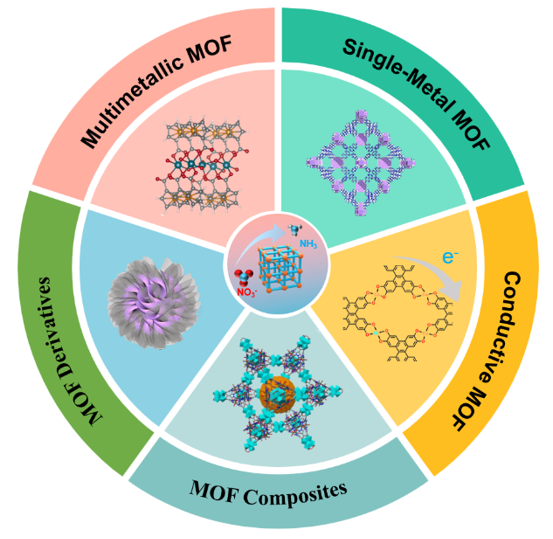
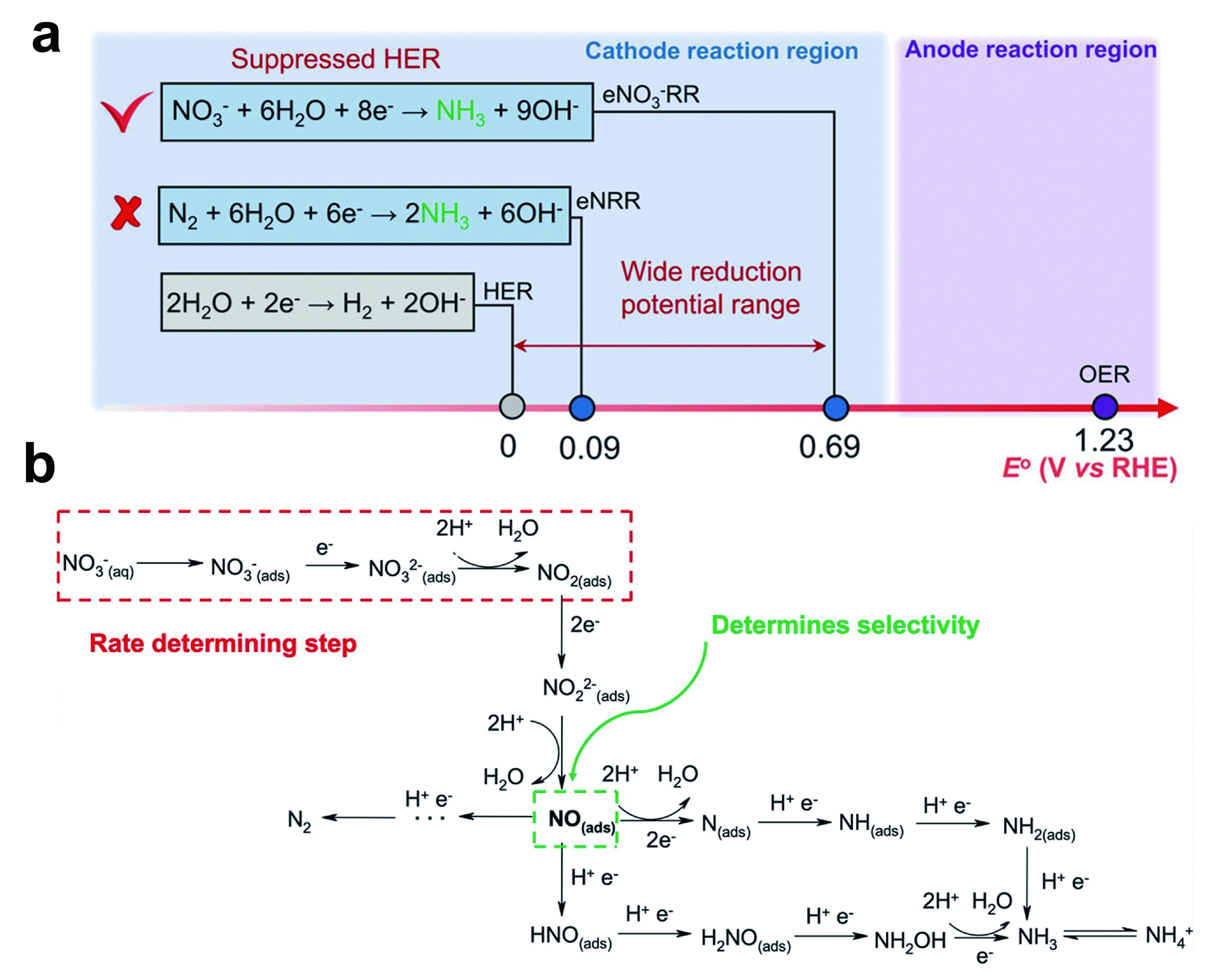
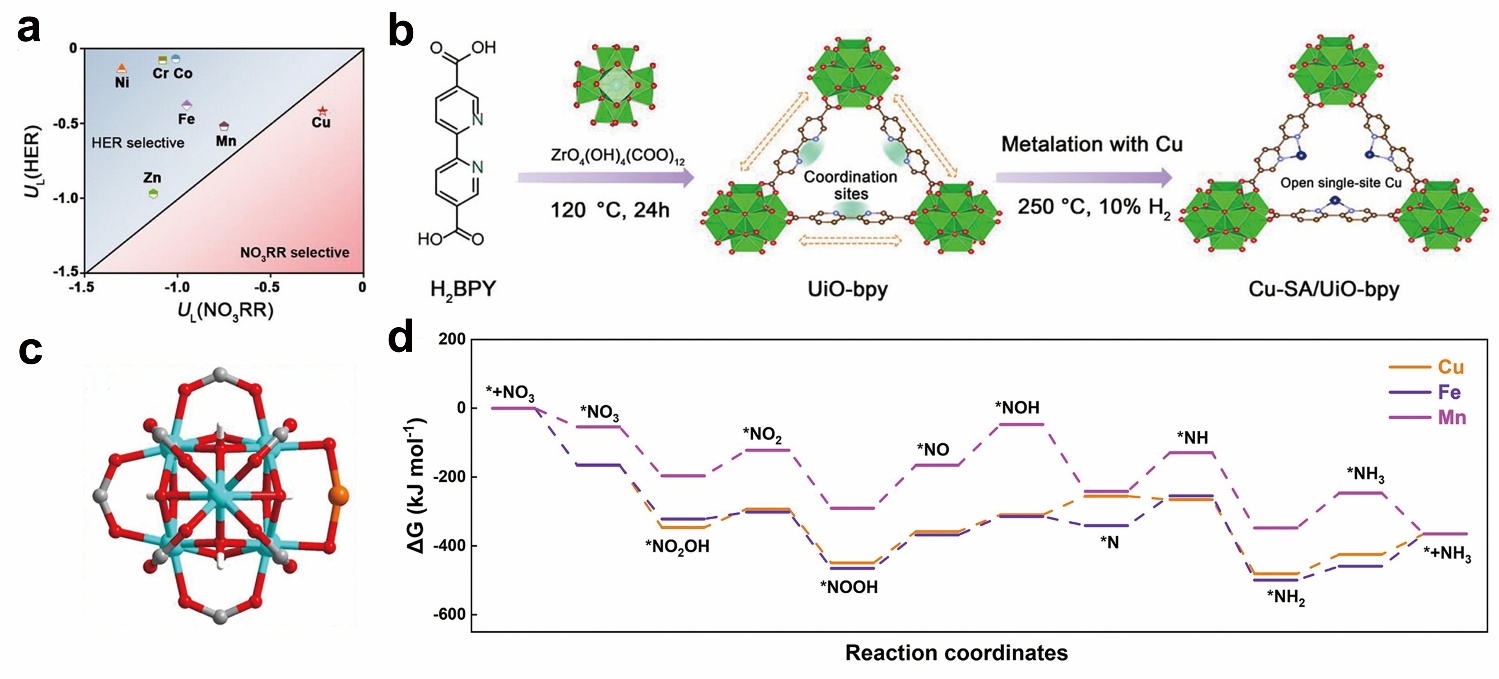
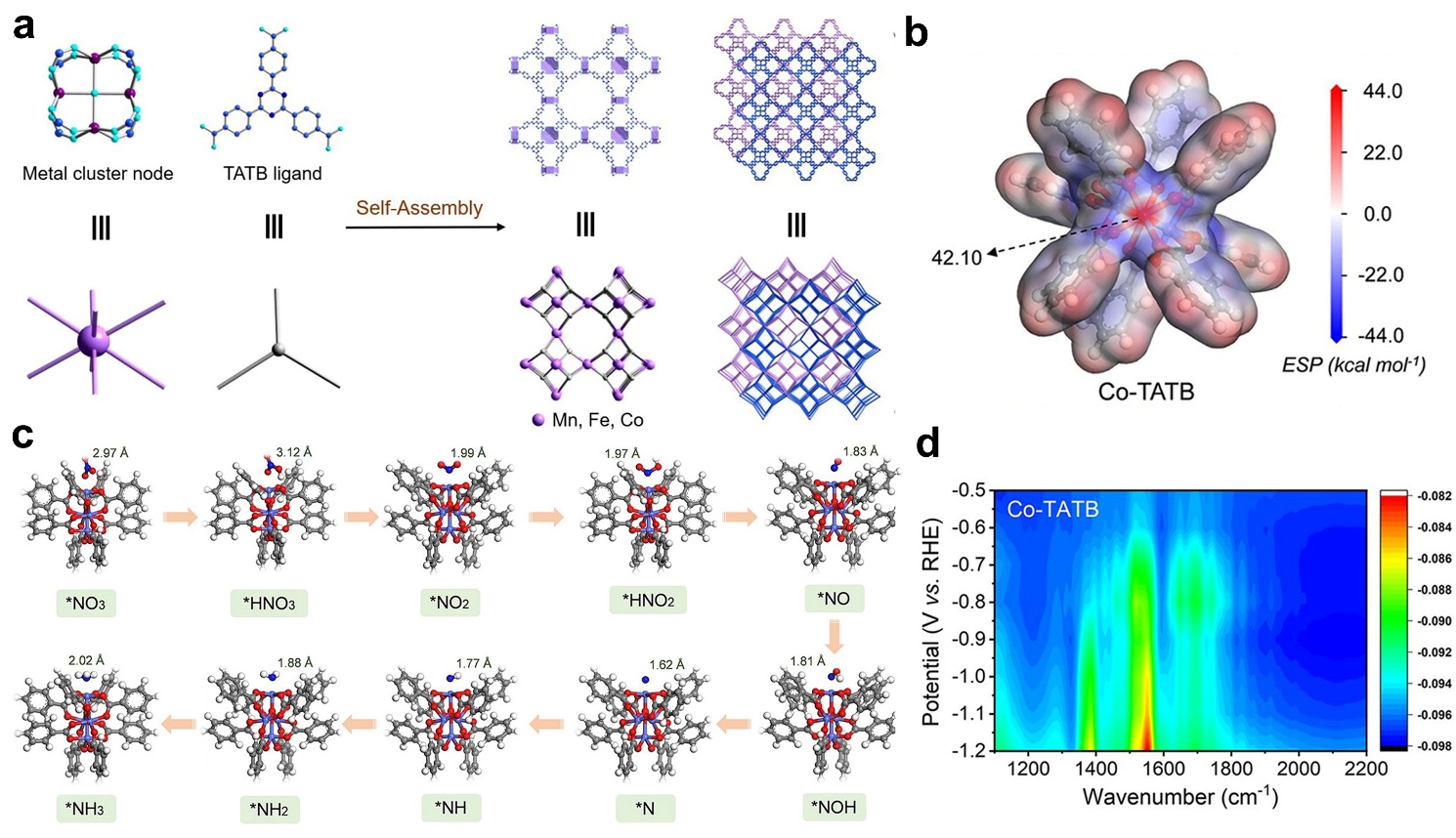
随着农业与工业的不断发展, 目前全球范围内水体中的硝酸盐(NO3−)污染仍然十分严重, 并且呈现出多点分散的特点, 使用硝酸根电化学还原(eNO3RR)技术, 可以在常温常压下将NO3−废弃物还原成对人类有用的物质——氨(NH3). 然而, 在接近实际水体环境的中性pH条件下, eNO3RR面临质子供给受限、析氢副反应竞争、亚硝酸盐(NO2−)累积风险以及催化剂寿命不足等多重瓶颈. 近期备受关注的金属有机框架(MOF)材料潜力巨大, 其可调的多孔结构与明确的活性位点有利于提高NO3-还原效率与选择性. 这一领域近期取得了巨大的进展, 卓越的MOF基材料已达到接近99%的NH3法拉第效率, 在抑制NO2−累积的同时将NH3产率推高至>23000 μg•h−1•mgcat−1, 通过构建导电复合结构与衍生化策略, MOF基材料能在工业级电流密度(>950 mA•cm−2)下保持>90%的法拉第效率和10小时以上的稳定性. 本综述聚焦MOF基电催化剂, 系统剖析了中性eNO3RR的机理, 借助MOF的原子级可设计性, 通过单原子/簇调控、多金属协同、导电复合以及衍生化策略, 可精准克服中性条件下eNO3RR的质子供给、析氢竞争及稳定性瓶颈, 实现从污染物到NH3的高效转化. 但是目前距离这一目标仍存在许多挑战: 催化过程中的活性中心动态识别不够清晰准确, 真实水体中的长效稳定性有待验证, 以及规模化合成等问题亟待解决.
何乾龙, 胡洁颖, 钟礼匡, 何军. 基于金属有机框架的中性介质硝酸盐电催化还原制氨: 设计策略与机理研究★[J]. 化学学报, 2026, 84(5): 775-804.
Qianlong He, Jieying Hu, Lai-Hon Chung, Jun He. Metal-Organic Framework-Based Electrocatalysts for Neutral Nitrate-to-Ammonia Conversion: Design Strategies and Mechanistic Insights★[J]. Acta Chimica Sinica, 2026, 84(5): 775-804.
| Electrocatalyst | Electrolyte | NH3 yield | NH3 Selectivity | FENH3 | Optimal potentials | Stability | Ref. |
|---|---|---|---|---|---|---|---|
| Cu-BDC | 0.5 mol•L−1 Na2SO4 + 0.05 mol•L−1 NaNO3 | 130.16 μmol•h−1•cm−2 | — | 67.42% | −0.946 V | 5 r | [ |
| Zn-MOF | 0.1 mol•L−1 Na2SO4 + 500 ppm KNO3 | 461.1 μmol•h−1•mgcat−1 | — | 80.50% | −1.1 V | 10 r | [ |
| Zn5-NiS4TP MOF | 0.05 mol•L−1 K2SO4 + 0.5 mol•L−1 KNO3 | 1378.52 μmol•h−1•mgcat−1 | 96.20% | 92.87% | −1.3 V | 20 r | [ |
| InCu-MOF | 0.5 mol•L−1 K2SO4 + 300 ppm KNO3 | 52.37 μmol•h−1•mgcat−1 | — | 82% | −1.0 V | 5 r | [ |
| Co-TATB | 0.1 mol•L−1 Na2SO4 + 0.1 mol•L−1 KNO3 | 378.8 mmol•h−1•gcat−1 | — | 98% | −1.0 V | 8 r | [ |
| Co-bpta-btc | 0.05 mol•L−1 Na2SO4 + 0.1 mol•L−1 KNO3 | 604.78 μmol•h−1•mgcat−1 | — | 83.3% | −1.0 V | 12 h | [ |
| HUST-38 | 0.5 mol•L−1 K2SO4 + 0.1 mol•L−1 NO3- | 785.63 μmol•h−1•mgcat−1 | 92.7% | 95.7% | −0.6 V | 96 h | [ |
| agCu(Melm)2-CC | 0.5 mol•L−1 K2SO4 + 75 mmol•L−1 KNO3 | 1.20 mmol•h−1•cm−2 | — | 91% | −1.8 V | 16 h | [ |
| DiMe-Cu3-MOF | 0.5 mol•L−1 K2SO4 + 50 mmol•L−1 KNO3 | 23.54 μmol•h−1•cm−2 | — | 95% | −1.55 V | 12 h | [ |
| Fe-pyNDI | 0.5 mol•L−1 K2SO4 + 0.1 mol•L−1 KNO3 | 861.78 μmol•h−1•mgcat−1 | — | ≈90% | −1.2 V | 10 r | [ |
| Cu-CA | 0.1 mol•L−1 Na2SO4 + 0.1 mol•L−1 KNO3 | 186.72 μmol•h−1•mgcat−1 | — | 90.3% | −0.9 V | 10 r | [ |
| NJUZ-2 | 0.1 mol•L−1 Na2SO4 + 0.1 mol•L−1 KNO3 | 253.7 mmol•h−1•gcat−1 | — | 98.4% | −0.8 V | 70 r | [ |
| NJUZ-3 | 0.1 mol•L−1 Na2SO4 + 0.1 mol•L−1 KNO3 | 214.5 mmol•h−1•gcat−1 | — | 98.8% | −0.8 V | — | [ |
| Cu-BTA | 0.5 mol•L−1 Na2SO4 + 100 ppm KNO3 | 133.87 μmol•h−1•cm−2 | 79.46% | — | −1.2 V | 20 r | [ |
| CuNi0.75-MOF/NF | 0.5 mol•L−1 Na2SO4 + 0.1 mol•L−1 NaNO3 | 3.04 mmol•h−1•cm−2 | — | 95.88% | −1.0 V | 10 r | [ |
| Electrocatalyst | Electrolyte | NH3 yield | NH3 Selectivity | FENH3 | Optimal potentials | Stability | Ref. |
|---|---|---|---|---|---|---|---|
| Cu-BDC | 0.5 mol•L−1 Na2SO4 + 0.05 mol•L−1 NaNO3 | 130.16 μmol•h−1•cm−2 | — | 67.42% | −0.946 V | 5 r | [ |
| Zn-MOF | 0.1 mol•L−1 Na2SO4 + 500 ppm KNO3 | 461.1 μmol•h−1•mgcat−1 | — | 80.50% | −1.1 V | 10 r | [ |
| Zn5-NiS4TP MOF | 0.05 mol•L−1 K2SO4 + 0.5 mol•L−1 KNO3 | 1378.52 μmol•h−1•mgcat−1 | 96.20% | 92.87% | −1.3 V | 20 r | [ |
| InCu-MOF | 0.5 mol•L−1 K2SO4 + 300 ppm KNO3 | 52.37 μmol•h−1•mgcat−1 | — | 82% | −1.0 V | 5 r | [ |
| Co-TATB | 0.1 mol•L−1 Na2SO4 + 0.1 mol•L−1 KNO3 | 378.8 mmol•h−1•gcat−1 | — | 98% | −1.0 V | 8 r | [ |
| Co-bpta-btc | 0.05 mol•L−1 Na2SO4 + 0.1 mol•L−1 KNO3 | 604.78 μmol•h−1•mgcat−1 | — | 83.3% | −1.0 V | 12 h | [ |
| HUST-38 | 0.5 mol•L−1 K2SO4 + 0.1 mol•L−1 NO3- | 785.63 μmol•h−1•mgcat−1 | 92.7% | 95.7% | −0.6 V | 96 h | [ |
| agCu(Melm)2-CC | 0.5 mol•L−1 K2SO4 + 75 mmol•L−1 KNO3 | 1.20 mmol•h−1•cm−2 | — | 91% | −1.8 V | 16 h | [ |
| DiMe-Cu3-MOF | 0.5 mol•L−1 K2SO4 + 50 mmol•L−1 KNO3 | 23.54 μmol•h−1•cm−2 | — | 95% | −1.55 V | 12 h | [ |
| Fe-pyNDI | 0.5 mol•L−1 K2SO4 + 0.1 mol•L−1 KNO3 | 861.78 μmol•h−1•mgcat−1 | — | ≈90% | −1.2 V | 10 r | [ |
| Cu-CA | 0.1 mol•L−1 Na2SO4 + 0.1 mol•L−1 KNO3 | 186.72 μmol•h−1•mgcat−1 | — | 90.3% | −0.9 V | 10 r | [ |
| NJUZ-2 | 0.1 mol•L−1 Na2SO4 + 0.1 mol•L−1 KNO3 | 253.7 mmol•h−1•gcat−1 | — | 98.4% | −0.8 V | 70 r | [ |
| NJUZ-3 | 0.1 mol•L−1 Na2SO4 + 0.1 mol•L−1 KNO3 | 214.5 mmol•h−1•gcat−1 | — | 98.8% | −0.8 V | — | [ |
| Cu-BTA | 0.5 mol•L−1 Na2SO4 + 100 ppm KNO3 | 133.87 μmol•h−1•cm−2 | 79.46% | — | −1.2 V | 20 r | [ |
| CuNi0.75-MOF/NF | 0.5 mol•L−1 Na2SO4 + 0.1 mol•L−1 NaNO3 | 3.04 mmol•h−1•cm−2 | — | 95.88% | −1.0 V | 10 r | [ |
| Electrocatalyst | Electrolyte | NH3 yield | NH3 Selectivity | FENH3 | Optimal potentials | Stability | Ref. |
|---|---|---|---|---|---|---|---|
| Cu/SO3-MOF-808 | 0.5 mol•L−1 Na2SO4 + 0.1 mol•L−1 NaNO3 | 0.383 mmol•h−1•mgcat−1 | 95.6% | 87.5% | −1.19 V | — | [ |
| CoP/Zn-ZIF | 0.5 mol•L−1 Na2SO4 + 0.1 mol•L−1 NaNO3 | 0.9 mmol•h−1•cm−2 | — | ≈97% | −1.0 V | 30 r | [ |
| Cu3P-a | 0.5 mol•L−1 K2SO4 + 50 ppm KNO3-N | 31.86 μmol•h−1•cm−2 | 83.62% | 90.95% | −0.5 V | 8 r | [ |
| FeNx-PC-Fe NPs | 0.5 mol•L−1 Na2SO4 + 1.0 mol•L−1 NaNO3 | 1.77 ± 0.06 mmol•h−1•mgcat−1 | — | 93.5% | −1.0 V | 120 h | [ |
| AuPt@ZIF-8 | 0.5 mol•L−1 Na2SO4 + 50 ppm NaNO3 | 7.72 μmol•h−1•mgcat−1 | 96% | (95.8 ± 3.0)% | −0.5 V | 6 r | [ |
| Ni-MOFs@HsGDY@Cu | 0.5 mol•L−1 Na2SO4 + 0.1 mol•L−1 KNO3 | 0.321 mmol•h−1•cm−2 | — | 95.5% | −0.11 V | 12 r | [ |
| CuCeOx/C | 0.5 mol•L−1 Na2SO4 + 0.5 mol•L−1 NaNO3 | — | 73.40% | 75.5% | −1.29 V | 1 h | [ |
| Cu-Co HOC | 0.5 mol•L−1 K2SO4 + 50 ppm KNO3-N | 0.022 mmol•h−1•cm−2 | — | 90.68% | −0.5 V | — | [ |
| UiO-CuZn | 0.5 mol•L−1 Na2SO4+ 200 ppm NaNO3 | 228.11 μmol•h−1•mgcat−1 | 95.2% | 92.6% | −1.0 V | — | [ |
| UiO-66-derived M-SAC | 1 mol•L−1 KNO3 | 1.76 mmol•h−1•cm−2 | — | >96% | −1.0 V | — | [ |
| Fe-S-Z-C | 0.02 mol•L−1 Na2SO4 + 100 mg•L−1 NO3--N | — | — | 93.9% | −0.47 V | 6 r | [ |
| Cu-Ru@C | 0.1 mol•L−1 Na2SO4 + 50 μg•mL−1 NaNO3 | 99.84 μmol•h−1•mgcat−1 | 84.70% | 90.4% | −0.9 V | 25 h | [ |
| Cu-Co3O4/NF | 0.2 mol•L−1 K2SO4 + 2 mmol•L−1 KNO3 | 0.076 mmol•h−1•cm−2 | — | 92.4% | −0.53 V | 6 r | [ |
| NiPC | 0.5 mol•L−1 Na2SO4 + 200 mg•L−1 KNO3 | 108.04 μmol•h−1•cm−2 | 99.04% | 96.68% | −1.0 V | — | [ |
| NiCoO2@Cu | 0.1 mol•L−1 Na2SO4 + 0.1 mol•L−1 NaNO3 | 348.82 μmol•h−1•cm−2 | 99.7% | 94.2% | −0.7 V | 33 h | [ |
| Co-N-C-500 | 0.05 mol•L−1 K2SO4 + 0.05 mol•L−1 KNO3 | 66.93 μmol•h−1•cm−2 | 74% | 86.8% | −0.6 V | 30 h | [ |
| Co3O4@MoS2 | 0.1 mol•L−1 Na2SO4 + 0.2 mol•L−1 KNO3 | 266.55 μmol•h−1•mgcat−1 | — | 52.69% | −0.64 V | 10 r | [ |
| Electrocatalyst | Electrolyte | NH3 yield | NH3 Selectivity | FENH3 | Optimal potentials | Stability | Ref. |
|---|---|---|---|---|---|---|---|
| Cu/SO3-MOF-808 | 0.5 mol•L−1 Na2SO4 + 0.1 mol•L−1 NaNO3 | 0.383 mmol•h−1•mgcat−1 | 95.6% | 87.5% | −1.19 V | — | [ |
| CoP/Zn-ZIF | 0.5 mol•L−1 Na2SO4 + 0.1 mol•L−1 NaNO3 | 0.9 mmol•h−1•cm−2 | — | ≈97% | −1.0 V | 30 r | [ |
| Cu3P-a | 0.5 mol•L−1 K2SO4 + 50 ppm KNO3-N | 31.86 μmol•h−1•cm−2 | 83.62% | 90.95% | −0.5 V | 8 r | [ |
| FeNx-PC-Fe NPs | 0.5 mol•L−1 Na2SO4 + 1.0 mol•L−1 NaNO3 | 1.77 ± 0.06 mmol•h−1•mgcat−1 | — | 93.5% | −1.0 V | 120 h | [ |
| AuPt@ZIF-8 | 0.5 mol•L−1 Na2SO4 + 50 ppm NaNO3 | 7.72 μmol•h−1•mgcat−1 | 96% | (95.8 ± 3.0)% | −0.5 V | 6 r | [ |
| Ni-MOFs@HsGDY@Cu | 0.5 mol•L−1 Na2SO4 + 0.1 mol•L−1 KNO3 | 0.321 mmol•h−1•cm−2 | — | 95.5% | −0.11 V | 12 r | [ |
| CuCeOx/C | 0.5 mol•L−1 Na2SO4 + 0.5 mol•L−1 NaNO3 | — | 73.40% | 75.5% | −1.29 V | 1 h | [ |
| Cu-Co HOC | 0.5 mol•L−1 K2SO4 + 50 ppm KNO3-N | 0.022 mmol•h−1•cm−2 | — | 90.68% | −0.5 V | — | [ |
| UiO-CuZn | 0.5 mol•L−1 Na2SO4+ 200 ppm NaNO3 | 228.11 μmol•h−1•mgcat−1 | 95.2% | 92.6% | −1.0 V | — | [ |
| UiO-66-derived M-SAC | 1 mol•L−1 KNO3 | 1.76 mmol•h−1•cm−2 | — | >96% | −1.0 V | — | [ |
| Fe-S-Z-C | 0.02 mol•L−1 Na2SO4 + 100 mg•L−1 NO3--N | — | — | 93.9% | −0.47 V | 6 r | [ |
| Cu-Ru@C | 0.1 mol•L−1 Na2SO4 + 50 μg•mL−1 NaNO3 | 99.84 μmol•h−1•mgcat−1 | 84.70% | 90.4% | −0.9 V | 25 h | [ |
| Cu-Co3O4/NF | 0.2 mol•L−1 K2SO4 + 2 mmol•L−1 KNO3 | 0.076 mmol•h−1•cm−2 | — | 92.4% | −0.53 V | 6 r | [ |
| NiPC | 0.5 mol•L−1 Na2SO4 + 200 mg•L−1 KNO3 | 108.04 μmol•h−1•cm−2 | 99.04% | 96.68% | −1.0 V | — | [ |
| NiCoO2@Cu | 0.1 mol•L−1 Na2SO4 + 0.1 mol•L−1 NaNO3 | 348.82 μmol•h−1•cm−2 | 99.7% | 94.2% | −0.7 V | 33 h | [ |
| Co-N-C-500 | 0.05 mol•L−1 K2SO4 + 0.05 mol•L−1 KNO3 | 66.93 μmol•h−1•cm−2 | 74% | 86.8% | −0.6 V | 30 h | [ |
| Co3O4@MoS2 | 0.1 mol•L−1 Na2SO4 + 0.2 mol•L−1 KNO3 | 266.55 μmol•h−1•mgcat−1 | — | 52.69% | −0.64 V | 10 r | [ |
| Electrocatalyst | Electrolyte | NH3 yield | FENH3 | Optimal potentials | Stability | Cost Evaluation | Ref. |
|---|---|---|---|---|---|---|---|
| Au/Cu SAA | 0.5 mol•L−1 Na2SO4+100 ppm of NO3−−N | 0.193 mmol•h−1•cm−2 | 99.69% | −0.8 V | 45 h | High | [ |
| Bi/Cu2O | 0.5 mol•L−1 K2SO4+1000 ppm NO3− | 0.150 mmol•h−1•mgcat−1 | 99.2% | −0.8 V | 14 h | Low | [ |
| Ni1Cu-SAA | 0.5 mol•L−1 K2SO4+200 ppm NO3−−N | 0.326 mmol•h−1•cm−2 | ≈100% | −0.55 V | ≈8.89 h | Medium | [ |
| Rh@Cu-0.6% | 0.1 mol•L−1 Na2SO4 + 0.1 mol•L−1 KNO3 | 1.27 mmol•h−1•cm−2 | 93 % | −0.2 V | 30 h | High | [ |
| Fe-N-C | 0.1 mol•L−1 K2SO4 +0.5 mol•L−1 KNO3 | 0.46 mmol•h−1•cm−2 | 75% | −0.66 V | 20 r | Medium | [ |
| P-Cu0.51Ni0.49 | 0.5 mol•L−1 K2SO4 + 50 ppm KNO3 | 94.94 μmol•h−1•cm−2 | 98.38% | −0.55 V | 10 h | Low | [ |
| hcp/fcc Cu10Ni₉₀ | 0.5 mol•L−1 K2SO4 + 100 mmol•L−1 KNO3 | 3.37 mmol•h−1•mgcat−1 | 98.1% | −0.7 V | 12 r | Low | [ |
| Cl-Cu | 0.1 mol•L−1 K2SO4 + 50~200 mg•L−1 NO3−−N | 4.32 μmol•h−1•cm−2 | 82.5% | −0.65 V | >100 h | Low | [ |
| Cu-SA/UiO-bpy | 0.5 mol•L−1 K2SO4 + 0.1 mol•L−1 KNO3 | 434.5 μmol•h−1•cm−2 | 98.1% | −0.8 V | 10 r | Medium | [ |
| NJUZ-2 | 0.1 mol•L−1 Na2SO4 + 0.1 mol•L−1 KNO3 | 253.7 mmol•h−1•mgcat−1 | 98.8% | −0.8 V | 70 h | Medium | [ |
| Zn5-NiS4 TP MOF | 0.05 mol•L−1 K2SO4 + 0.5 mol•L−1 KNO3 | 1.348 mmol•h−1•mgcat−1 | 92.87% | −1.3 V | 20 r | High | [ |
| FeNx-PC-Fe NPs | 0.5 mol•L−1 Na2SO4 + 1.0 mol•L−1 NaNO3 | 1.77±0.06 mmol•h−1•mgcat−1 | 98.4% | −1 V | 120 h | Medium | [ |
| CuNi0.75-MOF/NF | 0.5 mol•L−1 Na2SO4 + 0.1 mol•L−1 NaNO3 | 3.04 mmol•h−1•cm−2 | 95.88% | −1 V | 10 r | Low | [ |
| HUST-38 | 0.5 mol•L−1 K2SO4 + 0.1 mol•L−1 NO3− | 0.785 mmol•h−1•mgcat−1 | 95.7% | −0.6 V | 96 h | Medium | [ |
| Electrocatalyst | Electrolyte | NH3 yield | FENH3 | Optimal potentials | Stability | Cost Evaluation | Ref. |
|---|---|---|---|---|---|---|---|
| Au/Cu SAA | 0.5 mol•L−1 Na2SO4+100 ppm of NO3−−N | 0.193 mmol•h−1•cm−2 | 99.69% | −0.8 V | 45 h | High | [ |
| Bi/Cu2O | 0.5 mol•L−1 K2SO4+1000 ppm NO3− | 0.150 mmol•h−1•mgcat−1 | 99.2% | −0.8 V | 14 h | Low | [ |
| Ni1Cu-SAA | 0.5 mol•L−1 K2SO4+200 ppm NO3−−N | 0.326 mmol•h−1•cm−2 | ≈100% | −0.55 V | ≈8.89 h | Medium | [ |
| Rh@Cu-0.6% | 0.1 mol•L−1 Na2SO4 + 0.1 mol•L−1 KNO3 | 1.27 mmol•h−1•cm−2 | 93 % | −0.2 V | 30 h | High | [ |
| Fe-N-C | 0.1 mol•L−1 K2SO4 +0.5 mol•L−1 KNO3 | 0.46 mmol•h−1•cm−2 | 75% | −0.66 V | 20 r | Medium | [ |
| P-Cu0.51Ni0.49 | 0.5 mol•L−1 K2SO4 + 50 ppm KNO3 | 94.94 μmol•h−1•cm−2 | 98.38% | −0.55 V | 10 h | Low | [ |
| hcp/fcc Cu10Ni₉₀ | 0.5 mol•L−1 K2SO4 + 100 mmol•L−1 KNO3 | 3.37 mmol•h−1•mgcat−1 | 98.1% | −0.7 V | 12 r | Low | [ |
| Cl-Cu | 0.1 mol•L−1 K2SO4 + 50~200 mg•L−1 NO3−−N | 4.32 μmol•h−1•cm−2 | 82.5% | −0.65 V | >100 h | Low | [ |
| Cu-SA/UiO-bpy | 0.5 mol•L−1 K2SO4 + 0.1 mol•L−1 KNO3 | 434.5 μmol•h−1•cm−2 | 98.1% | −0.8 V | 10 r | Medium | [ |
| NJUZ-2 | 0.1 mol•L−1 Na2SO4 + 0.1 mol•L−1 KNO3 | 253.7 mmol•h−1•mgcat−1 | 98.8% | −0.8 V | 70 h | Medium | [ |
| Zn5-NiS4 TP MOF | 0.05 mol•L−1 K2SO4 + 0.5 mol•L−1 KNO3 | 1.348 mmol•h−1•mgcat−1 | 92.87% | −1.3 V | 20 r | High | [ |
| FeNx-PC-Fe NPs | 0.5 mol•L−1 Na2SO4 + 1.0 mol•L−1 NaNO3 | 1.77±0.06 mmol•h−1•mgcat−1 | 98.4% | −1 V | 120 h | Medium | [ |
| CuNi0.75-MOF/NF | 0.5 mol•L−1 Na2SO4 + 0.1 mol•L−1 NaNO3 | 3.04 mmol•h−1•cm−2 | 95.88% | −1 V | 10 r | Low | [ |
| HUST-38 | 0.5 mol•L−1 K2SO4 + 0.1 mol•L−1 NO3− | 0.785 mmol•h−1•mgcat−1 | 95.7% | −0.6 V | 96 h | Medium | [ |
| [1] |
doi: 10.1002/eft2.2017.5.issue-9 |
| [2] |
doi: 10.1021/cr8003696 |
| [3] |
doi: 10.1039/C9CS00159J |
| [4] |
doi: 10.1016/j.scitotenv.2020.144674 |
| [5] |
|
| [6] |
doi: 10.1038/ncomms10571 pmid: 26853267 |
| [7] |
doi: 10.1016/j.scitotenv.2025.180473 |
| [8] |
doi: 10.1016/j.scitotenv.2017.12.252 |
| [9] |
doi: 10.1016/j.chempr.2021.01.009 |
| [10] |
doi: 10.1039/D5CS00969C |
| [11] |
|
| [12] |
doi: 10.1002/cctc.v16.5 |
| [13] |
|
| [14] |
doi: 10.1002/adsu.v9.11 |
| [15] |
|
| [16] |
doi: 10.1039/D1CS00116G |
| [17] |
doi: 10.1002/smll.v21.39 |
| [18] |
doi: 10.1016/j.cej.2022.135104 |
| [19] |
doi: 10.1073/pnas.2209979120 |
| [20] |
doi: 10.1039/C4CS00003J |
| [21] |
doi: 10.1039/b804680h |
| [22] |
doi: 10.1039/b802258p |
| [23] |
doi: 10.1039/c4cs00101j pmid: 24875583 |
| [24] |
doi: 10.1002/asia.v16.22 |
| [25] |
doi: 10.1002/cssc.v18.8 |
| [26] |
doi: 10.1002/advs.v8.20 |
| [27] |
doi: 10.1016/j.ccr.2020.213191 |
| [54] |
doi: 10.2175/106143006X110665 |
| [55] |
doi: 10.1016/j.jpowsour.2025.236748 |
| [56] |
doi: 10.1038/s41467-024-45534-2 |
| [57] |
doi: 10.1021/acs.est.5c14726 |
| [58] |
doi: 10.1038/s41929-023-00951-2 |
| [59] |
doi: 10.1002/anie.v65.1 |
| [60] |
doi: 10.1002/eem2.v5.1 |
| [61] |
doi: 10.1021/acscatal.1c03666 |
| [62] |
doi: 10.1016/j.ijhydene.2025.01.342 |
| [63] |
doi: 10.1021/acscatal.9b02179 |
| [64] |
doi: 10.1039/D2FD00145D |
| [65] |
doi: 10.1039/D4TA08757G |
| [66] |
doi: 10.1021/acs.jpcc.5c02461 |
| [67] |
doi: 10.1039/D5TA07089A |
| [68] |
doi: 10.1039/c0ee00071j |
| [69] |
|
| [70] |
doi: 10.1016/j.nanoen.2024.109499 |
| [71] |
doi: 10.1039/D4SC07132H |
| [72] |
doi: 10.1016/j.jcis.2023.01.014 |
| [73] |
doi: 10.1016/j.cej.2025.166374 |
| [74] |
doi: 10.1016/j.jhazmat.2024.136036 |
| [75] |
doi: 10.1021/acsnano.2c12491 |
| [76] |
doi: 10.1039/D3GC01914D |
| [77] |
doi: 10.1016/j.seppur.2025.134976 |
| [78] |
doi: 10.1021/cs3005264 |
| [79] |
doi: 10.1021/acs.analchem.3c05095 |
| [80] |
doi: 10.1002/adma.v34.39 |
| [28] |
doi: 10.1039/C6RA01536K |
| [29] |
doi: 10.1039/D4GC03381G |
| [30] |
doi: 10.1021/acsaem.5c00651 |
| [31] |
doi: 10.1021/acscatal.5c00591 |
| [32] |
doi: 10.1002/anie.v65.5 |
| [33] |
doi: 10.1002/cssc.v18.9 |
| [34] |
doi: 10.1002/agt2.v6.5 |
| [35] |
doi: 10.1002/anie.v63.31 |
| [36] |
doi: 10.1021/acscatal.1c01525 |
| [37] |
doi: 10.1021/acs.jpclett.2c02452 |
| [38] |
doi: 10.1021/jacs.2c00089 |
| [39] |
doi: 10.1016/j.ccr.2024.216061 |
| [40] |
doi: 10.1002/anie.v63.11 |
| [41] |
|
| [42] |
doi: 10.1016/j.watres.2024.123077 |
| [43] |
doi: 10.1021/acs.est.4c03949 |
| [44] |
doi: 10.1021/jacs.5c07066 pmid: 40765371 |
| [45] |
doi: 10.1021/acs.inorgchem.9b01611 pmid: 31661254 |
| [46] |
doi: 10.1039/D3GC02613B |
| [47] |
doi: 10.1002/anie.v64.6 |
| [48] |
doi: 10.1002/chem.v26.31 |
| [49] |
doi: 10.1039/C5SC01784J |
| [50] |
doi: 10.1038/s41467-023-43577-5 |
| [51] |
doi: 10.1002/cssc.v18.19 |
| [52] |
doi: 10.1039/D5TA09605G |
| [53] |
doi: 10.1002/aenm.v15.38 |
| [81] |
doi: 10.1016/j.jcis.2025.139141 |
| [82] |
doi: 10.1016/S1872-2067(23)64622-4 |
| [83] |
doi: 10.1039/D2TA08735A |
| [84] |
|
| [85] |
doi: 10.1002/smll.v20.46 |
| [86] |
doi: 10.6023/A25060221 |
|
(王佳雨, 赵文娟, 贾宏宇, 刘永博, 张敏, 董龙龙, 张安杰, 王锐, 化学学报, 2025, 83, 1507.)
doi: 10.6023/A25060221 |
|
| [87] |
doi: 10.6023/A23110508 |
|
(韩晶, 廖润华, 邓文强, 梁博宇, 周雨晴, 任帅, 洪燕, 化学学报, 2024, 82, 295.)
doi: 10.6023/A23110508 |
|
| [88] |
doi: 10.1038/s43246-024-00535-y |
| [89] |
doi: 10.1021/jacs.5c06650 |
| [90] |
doi: 10.1039/C9EE04040D |
| [91] |
doi: 10.1039/D4SC08498E |
| [92] |
doi: 10.1002/anie.v63.47 |
| [93] |
doi: 10.1039/D4CS00962B |
| [94] |
doi: 10.1002/anie.v64.12 |
| [95] |
doi: 10.1039/D5SC02208H |
| [96] |
doi: 10.6023/A25040140 |
|
(吴子林, 张璐, 陈杨, 李晋平, 李立博, 化学学报, 2025, 83, 917.)
doi: 10.6023/A25040140 |
|
| [97] |
doi: 10.1002/cjoc.v43.8 |
| [98] |
doi: 10.1002/cjoc.v43.12 |
| [99] |
doi: 10.1002/anie.v62.48 |
| [100] |
doi: 10.1002/anie.v63.21 |
| [101] |
|
| [102] |
doi: 10.1016/j.jes.2024.01.046 |
| [103] |
doi: 10.1002/anie.v64.11 |
| [104] |
doi: 10.1039/D4GC02536A |
| [105] |
doi: 10.1039/C9TA13473E |
| [106] |
doi: 10.1039/D1TA01970H |
| [107] |
doi: 10.1021/acscatal.5c04411 |
| [108] |
doi: 10.26599/NR.2025.94907592 |
| [109] |
doi: 10.1002/anie.202016591 pmid: 33511743 |
| [110] |
doi: 10.1016/j.jece.2024.115182 |
| [111] |
doi: 10.1016/j.fuel.2024.134021 |
| [112] |
doi: 10.1039/D3EE00840A |
| [113] |
doi: 10.1021/acs.chemmater.3c03222 |
| [114] |
doi: 10.1021/acs.inorgchem.5c02389 |
| [115] |
doi: 10.31635/ccschem.025.202505556 |
| [116] |
doi: 10.1002/adfm.v34.49 |
| [117] |
doi: 10.1021/jacs.4c06098 |
| [118] |
doi: 10.1016/S1872-2067(24)60059-8 |
| [119] |
doi: 10.1039/D4TA09189B |
| [120] |
doi: 10.1021/jacs.5c11655 |
| [121] |
doi: 10.1002/aesr.v2.11 |
| [122] |
|
| [123] |
doi: 10.1021/acsami.0c12388 |
| [124] |
doi: 10.1038/s41467-019-09682-0 |
| [125] |
doi: 10.1002/chem.v26.72 |
| [126] |
doi: 10.1021/acs.langmuir.5c04125 |
| [127] |
doi: 10.1021/acsami.3c16456 |
| [128] |
|
| [129] |
doi: 10.1016/j.jelechem.2019.113301 |
| [130] |
doi: 10.6023/A25040117 |
|
(高春, 张松涛, 庞欢, 化学学报, 2025, 83, 962.)
doi: 10.6023/A25040117 |
|
| [131] |
doi: 10.1002/adfm.v36.18 |
| [132] |
doi: 10.1002/tcr.v22.12 |
| [133] |
doi: 10.1016/j.cej.2024.148776 |
| [134] |
|
| [135] |
doi: 10.1002/anie.v64.46 |
| [136] |
doi: 10.1126/science.ads1466 |
| [137] |
doi: 10.1016/j.jcis.2024.09.185 |
| [138] |
|
| [139] |
doi: 10.1007/s12274-024-6470-3 |
| [140] |
doi: 10.1039/D4CC05045B |
| [141] |
|
| [142] |
doi: 10.1016/j.mser.2024.100886 |
| [143] |
doi: 10.1002/adma.v30.39 |
| [144] |
doi: 10.1007/s40843-022-2374-3 |
| [145] |
doi: 10.6023/A24010040 |
|
(王南南, 陈玉贞, 化学学报, 2024, 82, 621.)
doi: 10.6023/A24010040 |
|
| [146] |
doi: 10.1021/acscatal.6b01222 |
| [147] |
doi: 10.1002/adma.v37.8 |
| [148] |
doi: 10.1039/C9CS00906J |
| [149] |
doi: 10.1039/D4TA05443A |
| [150] |
doi: 10.1016/j.apsusc.2024.161264 |
| [151] |
doi: 10.3390/nano10050983 |
| [152] |
doi: 10.1007/s10853-024-10246-x |
| [153] |
doi: 10.1021/acsami.4c14786 |
| [154] |
doi: 10.1002/adma.v36.26 |
| [155] |
doi: 10.1039/D5TC02164B |
| [156] |
|
| [157] |
doi: 10.1002/anie.v63.30 |
| [158] |
doi: 10.1016/j.electacta.2024.144348 |
| [159] |
doi: 10.1021/acscatal.3c01821 |
| [160] |
doi: 10.1016/j.jhazmat.2024.133484 |
| [161] |
doi: 10.1021/acs.inorgchem.3c04446 |
| [162] |
doi: 10.1016/j.cej.2024.152543 |
| [163] |
doi: 10.1016/j.jelechem.2023.117702 |
| [164] |
doi: 10.1039/D5EY00217F |
| [165] |
doi: 10.1021/acssuschemeng.3c01057 |
| [166] |
doi: 10.1016/j.ces.2025.121845 |
| [167] |
doi: 10.1021/acs.iecr.4c02212 |
| [168] |
doi: 10.1016/j.jcis.2023.01.121 |
| [169] |
doi: 10.1016/j.jcis.2025.137506 |
| [170] |
doi: 10.1038/s41929-024-01200-w |
| [171] |
doi: 10.1002/smll.v22.19 |
| [172] |
doi: 10.1002/smll.v20.43 |
| [173] |
doi: 10.3389/fendo.2024.1429884 |
| [174] |
doi: 10.3390/antiox9030241 |
| [175] |
doi: 10.3390/toxics11020190 |
| [176] |
doi: 10.1016/j.chempr.2023.05.037 |
| [177] |
doi: 10.1016/j.jhazmat.2025.137093 |
| [178] |
doi: 10.1039/C8NR06360E |
| [179] |
doi: 10.1021/acsami.5c05397 |
| [180] |
doi: 10.1002/celc.v9.1 |
| [181] |
doi: 10.1021/acscatal.2c05136 |
| [182] |
doi: 10.1016/j.bej.2012.04.016 |
| [183] |
doi: 10.1039/D4TA08090D |
| [184] |
doi: 10.1016/j.ccr.2024.216361 |
| [185] |
doi: 10.1016/j.esen.2025.100005 |
| [186] |
doi: 10.1002/adma.v34.20 |
| [187] |
|
| [188] |
doi: 10.1016/j.ica.2020.119801 |
| [189] |
doi: 10.1021/jacs.5c05507 pmid: 40503660 |
| [190] |
doi: 10.1039/D5CP04782J |
| [191] |
doi: 10.1021/jacs.5c15567 |
| [192] |
|
| [193] |
doi: 10.1016/j.molstruc.2024.139959 |
| [194] |
doi: 10.1038/s41467-023-41055-6 |
| [195] |
doi: 10.1021/acs.jpcc.5c00971 |
| [196] |
doi: 10.1021/jacs.3c13288 |
| [197] |
doi: 10.1021/acscatal.4c03336 |
| [198] |
doi: 10.1002/aenm.v14.7 |
| [199] |
doi: 10.1002/anie.v65.4 |
| [200] |
doi: 10.1002/anie.v59.13 |
| [201] |
doi: 10.1021/acsami.5c01200 |
| [202] |
doi: 10.1002/advs.v12.39 |
| [203] |
doi: 10.1021/acs.est.2c07968 |
| [204] |
|
| [205] |
doi: 10.1002/anie.v64.28 |
| [206] |
doi: 10.1002/anie.v61.23 |
| [207] |
|
| [208] |
doi: 10.1038/s41467-021-23115-x |
| [209] |
doi: 10.1002/smll.v21.16 |
| [210] |
doi: 10.1002/anie.v64.28 |
| [211] |
doi: 10.1016/j.mser.2025.101123 |
| [212] |
|
| [213] |
|
| [214] |
doi: 10.1016/j.cej.2025.161533 |
| [215] |
doi: 10.1002/advs.v13.11 |
| [216] |
doi: 10.1007/s44422-025-00010-w |
| [217] |
doi: 10.1016/j.rser.2025.116201 |
| [1] | 叶舣, 黄正义, 赵兴雷, 赵娅俐, 刘龙杰, 吴武凤, 魏嫣莹. 垂直排列金属有机框架纳米片膜实现高效H2传输[J]. 化学学报, 2026, 84(1): 129-134. |
| [2] | 王佳雨, 赵文娟, 贾宏宇, 刘永博, 张敏, 董龙龙, 张安杰, 王锐. 铜配位三维共价有机框架提升电催化硝酸盐还原制氨[J]. 化学学报, 2025, 83(12): 1507-1513. |
| [3] | 王自庆, 陈赓, 林建新, 王榕, 魏可镁. Ru/Ba-ZrO2催化剂的制备及其氨合成性能研究[J]. 化学学报, 2013, 71(02): 205-212. |
| [4] | 林建新, 张留明, 倪军, 王榕, 魏可镁. 沉淀方式对氧化还原共沉淀制备Ru/CeO2 氨合成催化剂结构与性能的影响[J]. 化学学报, 2012, 70(02): 137-142. |
| [5] | 罗小军, 王榕, 倪军, 林建新, 魏可镁. 沉淀剂种类对Ru/CeO2氨合成催化剂结构和性能的影响[J]. 化学学报, 2009, 67(22): 2573-2578. |
| [6] | 林敬东, 黄桂玉, 许宗祥, 廖代伟. F离子对钌基氨合成催化剂活性的影响[J]. 化学学报, 2004, 62(18): 1717-1720. |
| 阅读次数 | ||||||
|
全文 |
|
|||||
|
摘要 |
|
|||||
