

化学学报 ›› 2026, Vol. 84 ›› Issue (7): 1067-1076.DOI: 10.6023/A26020047 上一篇 下一篇
研究论文
林雯霞a, 周一丹b, 林凡a, 蔡益民c,*( ), 冯文c,*()
投稿日期:2026-02-05
发布日期:2026-06-12
基金资助:
Wenxia Lina, Yidan Zhoub, Fan Lina, Yimin Caic,*(), Wen Fengc,*()
Received:2026-02-05
Published:2026-06-12
Contact:
* E-mail: ymcai@scu.edu.cn;
wfeng9510@scu.edu.cn
Supported by:文章分享
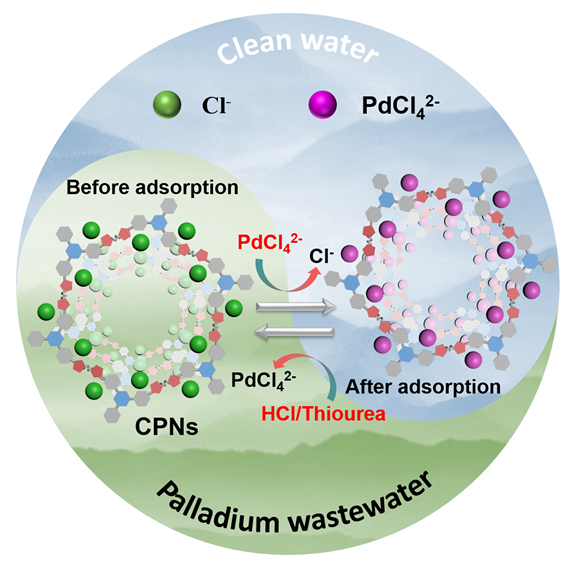
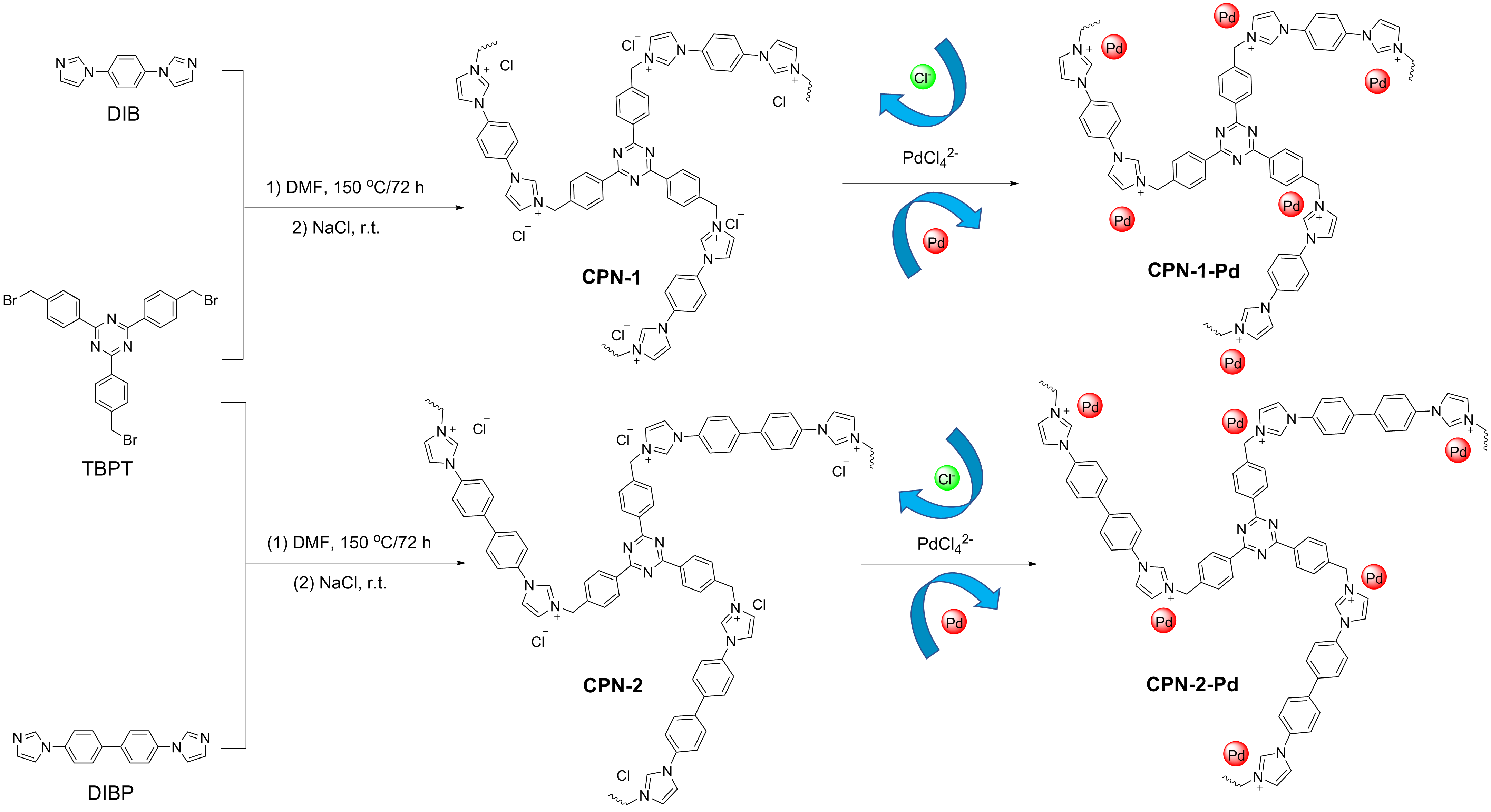
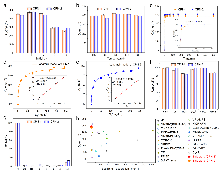
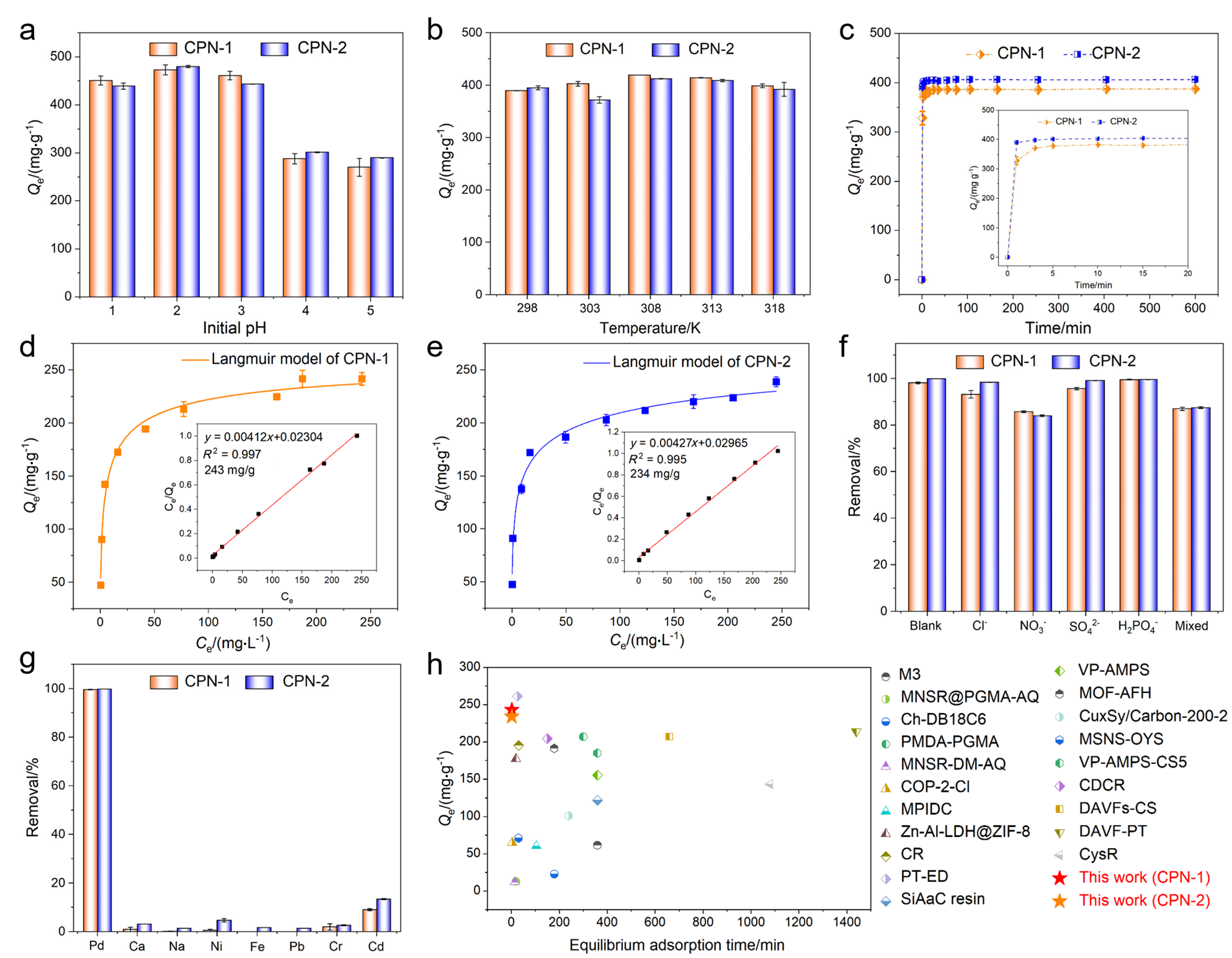
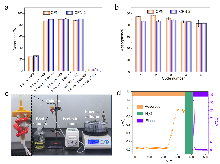
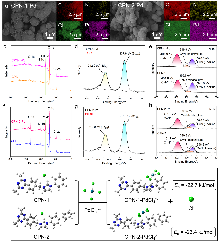
钯(Pd)作为一种稀有贵金属, 因其独特的物化性质和重要的工业应用而备受关注. 从工业废水中回收钯对于缓解贵金属资源短缺、降低废弃物污染具有关键意义. 基于此, 本研究通过N-烷基化反应制备了两种咪唑阳离子聚合物网络CPNs (CPN-1和CPN-2), 实现了对钯的高效吸附分离. CPN-1与CPN-2对Pd(II)的最大吸附量分别达到243 mg•g−1和234 mg•g−1, 且在3 min内实现吸附平衡. 在多种竞争离子共存下, CPNs对Pd(II)仍表现出优异的选择性, 去除率在83%以上. 同时, CPNs具有良好的可重复使用性, 5次循环后吸附率无显著下降. 吸附机理表明, CPNs对钯的吸附主要是通过Cl−与PdCl42−之间的阴离子交换作用. 此外, CPN-1在模拟钯废水的动态吸附实验中展现出出色的去除率(>90%), 证明了该类材料在钯回收领域的潜在应用价值.
林雯霞, 周一丹, 林凡, 蔡益民, 冯文. 咪唑基阳离子聚合物对工业废水中钯的高效吸附分离研究[J]. 化学学报, 2026, 84(7): 1067-1076.
Wenxia Lin, Yidan Zhou, Fan Lin, Yimin Cai, Wen Feng. Efficient Adsorption and Separation of Palladium from Industrial Wastewater by Imidazolium Cationic Polymers[J]. Acta Chimica Sinica, 2026, 84(7): 1067-1076.

| 材料 | 理论值/% | 实际值/% | |||||
|---|---|---|---|---|---|---|---|
| C | H | N | C | H | N | ||
| CPN-1 | 59.94 | 5.01 | 14.51 | 54.12 | 5.24 | 13.31 | |
| CPN-2 | 61.00 | 4.98 | 12.34 | 63.32 | 5.39 | 12.99 | |
| 材料 | 理论值/% | 实际值/% | |||||
|---|---|---|---|---|---|---|---|
| C | H | N | C | H | N | ||
| CPN-1 | 59.94 | 5.01 | 14.51 | 54.12 | 5.24 | 13.31 | |
| CPN-2 | 61.00 | 4.98 | 12.34 | 63.32 | 5.39 | 12.99 | |

| [1] |
doi: 10.1039/D0RA03739G |
| [2] |
doi: 10.1016/j.jclepro.2020.120370 |
| [3] |
doi: 10.1126/science.abj5291 |
| [4] |
doi: 10.1016/j.cej.2023.143171 |
| [5] |
doi: 10.1016/j.chempr.2022.02.016 |
| [6] |
doi: 10.1002/smll.v15.10 |
| [7] |
doi: 10.1016/j.apcatb.2022.122175 |
| [8] |
doi: 10.1016/j.seppur.2024.126460 |
| [9] |
doi: 10.1016/j.jhazmat.2022.129917 |
| [10] |
doi: 10.1016/j.seppur.2021.119514 |
| [11] |
doi: 10.1016/j.hydromet.2019.105241 |
| [12] |
doi: 10.1007/s11243-019-00330-6 |
| [13] |
doi: 10.1002/advs.v8.8 |
| [14] |
doi: 10.1039/D0TA09029H |
| [15] |
doi: 10.1016/j.hydromet.2020.105476 |
| [16] |
doi: 10.1016/j.ijbiomac.2023.125251 |
| [17] |
doi: 10.1016/j.jhazmat.2016.02.029 |
| [18] |
doi: 10.1016/j.cej.2018.10.010 |
| [19] |
doi: 10.1016/j.jhazmat.2020.122253 |
| [20] |
doi: 10.1016/j.jhazmat.2021.125136 |
| [21] |
doi: 10.1016/j.ijbiomac.2024.134766 |
| [22] |
|
|
(宋国林, 芦英, 于梦圆, 李丘林, 材料导报, 2023, 37, 22070147.)
|
|
| [23] |
doi: 10.1002/chem.v29.72 |
| [24] |
doi: 10.6023/cjoc202503012 |
|
(于志起, 陈灿源, 韩佳怡, 周建湖, 王林轩, 岳美娥, 贾肖飞, 有机化学, 2025, 45, 3450.)
doi: 10.6023/cjoc202503012 |
|
| [25] |
doi: 10.6023/cjoc202212034 |
|
(刘露, 张曙光, 胡仁威, 赵晓晓, 崔京南, 贡卫涛, 有机化学, 2023, 43, 2808.)
doi: 10.6023/cjoc202212034 |
|
| [26] |
doi: 10.6023/cjoc202212026 |
|
(廖旭, 王泽宇, 唐武飞, 林金清, 有机化学, 2023, 43, 2699.)
doi: 10.6023/cjoc202212026 |
|
| [27] |
doi: 10.1002/cjoc.v42.24 |
| [28] |
doi: 10.6023/A23080392 |
|
(林航青, 马若茹, 江怡蓝, 许木榕, 林洋彭, 杜克钊, 化学学报, 2024, 82, 62.)
doi: 10.6023/A23080392 |
|
| [29] |
doi: 10.6023/A21100454 |
|
(王自陶, 刘耀祖, 王钰杰, 方千荣, 化学学报, 2022, 80, 37.)
doi: 10.6023/A21100454 |
|
| [30] |
doi: 10.6023/A19010028 |
|
(李樟楠, 沙浩岩, 杨南, 元野, 朱广山, 化学学报, 2019, 77, 469.)
doi: 10.6023/A19010028 |
|
| [31] |
doi: 10.1021/jacs.5b04300 pmid: 26028183 |
| [32] |
doi: 10.1007/s11426-024-2236-1 |
| [33] |
doi: 10.1007/s11426-020-9962-9 |
| [34] |
doi: 10.1038/s41467-018-05380-5 |
| [35] |
doi: 10.1016/j.cej.2022.134785 |
| [36] |
doi: 10.1016/j.cej.2020.127223 |
| [37] |
doi: 10.1016/j.jhazmat.2019.121277 |
| [38] |
doi: 10.1016/j.arabjc.2021.103196 |
| [39] |
|
| [40] |
doi: 10.1103/physrevb.37.785 pmid: 9944570 |
| [41] |
doi: 10.1007/s00214-007-0310-x |
| [1] | 吕天天, 马文, 詹冬笋, 邹燕敏, 李继龙, 冯美玲, 黄小荥. 两例新的镧系金属-有机框架化合物高效去除Cs+离子研究※[J]. 化学学报, 2022, 80(5): 640-646. |
| [2] | 廉纬, 方泽铠, 涂大涛, 李嘉尧, 韩思远, 李仁富, 商晓颖, 陈学元. 模板法控制合成AgInSe2:Zn2+近红外荧光量子点及其生物标记应用※[J]. 化学学报, 2022, 80(5): 625-632. |
| [3] | 左翔宇, 许怡飞, 石士考. 基于层状氢氧化镧的稀土离子激活杂化组装荧光体[J]. 化学学报, 2022, 80(2): 133-140. |
| [4] | 李谦, 张腾, 古宏伟, 丁发柱, 屈飞, 彭星煜, 王洪艳, 吴战鹏. 阳离子交换法制备稳定的近红外区核/壳型PbS/CdS量子点[J]. 化学学报, 2013, 71(06): 929-933. |
| [5] | 杜俊玫, 高保娇, 黄小卫, 张永奇, 王明娟. 基于离子交换和表面引发接枝聚合制备阴离子表面印迹材料及其识别特性研究[J]. 化学学报, 2012, 70(17): 1831-1838. |
| [6] | 加晓丹, 柯从玉, 孙萱, 耿信笃. 关于混合模式色谱固定相对蛋白保留特征的研究[J]. 化学学报, 2012, 70(15): 1631-1636. |
| [7] | 柯从玉, 孙妩娟, 张群正, 郑莉. 谷胱甘肽键合柱对蛋白的选择性研究[J]. 化学学报, 2012, 70(15): 1637-1642. |
| [8] | 李小磊, 蒋平平, 卢云, 张伟杰, 董玉明. 12-磷钨杂多酸根柱撑水滑石合成及催化脂肪酸甲酯环氧化[J]. 化学学报, 2012, 70(05): 544-550 . |
| [9] | 周洪涛, 高岸涛, 邢航, 勾志明, 肖进新. 加盐导致的全氟辛酸盐表面活性的反常行为[J]. 化学学报, 2011, 69(9): 1035-1040. |
| [10] | 张本贵, 张守海, 邢东博, 尹春香, 韩润林, 蹇锡高. 钒电池用季铵化杂萘联苯聚芳醚酮酮阴离子交换膜[J]. 化学学报, 2011, 69(21): 2583-2588. |
| [11] | 付廷俊, 郑华艳, 牛燕燕, 王瑞玉, 李忠. Ce, La和Cs离子对CuY催化甲醇氧化羰基化活性中心的影响[J]. 化学学报, 2011, 69(15): 1765-1772. |
| [12] | 张秀芳, 安晓辉, 刘大欢, 阳庆元, 杨祝红, 仲崇立, 陆小华. 离子交换对usf-ZMOF二氧化碳吸附能力影响的研究[J]. 化学学报, 2011, 69(01): 84-88. |
| [13] | 杨煜, 张森, 潘鼎, 陈惠芳, 雷晓玲. 丙烯腈和二甲基亚砜中铁离子的高效低成本纯化[J]. 化学学报, 2010, 68(23): 2436-2442. |
| [14] | 王婀娜, 段淑静, 何锡文, 陈朗星, 李文友, 张玉奎. 以原子转移自由基聚合法制备强阴离子交换色谱填料及其在蛋白质分离中的应用[J]. 化学学报, 2010, 68(23): 2421-2428. |
| [15] | 徐溪, 李潇, 黄琳娟, 王仲孚. 苹果果胶活性寡聚半乳糖醛酸的分离制备及其ESI-MS分析研究[J]. 化学学报, 2010, 68(15): 1525-1531. |
| 阅读次数 | ||||||
|
全文 |
|
|||||
|
摘要 |
|
|||||
