

化学学报 ›› 2026, Vol. 84 ›› Issue (5): 697-708.DOI: 10.6023/A26020059 上一篇 下一篇
所属专题: “框架材料化学”合集
综述
邬佳悦a, 王文伯a, 谢玉龙b, 方伟慧a,b,*( )
)
投稿日期:2026-02-14
发布日期:2026-04-14
作者简介:★ “框架材料化学”专辑
基金资助:
Jiayue Wua, Wenbo Wanga, Yulong Xieb, Weihui Fanga,b,*()
Received:2026-02-14
Published:2026-04-14
Contact:
* E-mail: fwh@fjirsm.ac.cn
About author: |
Wu, Jiayue, postgraduate of Fujian Institute of Research on the Structure of Matter, Chinese Academy of Sciences, mainly focuses on the design and synthesis of crystalline metal-oxo clusters. |
 |
Wang, Wenbo, postgraduate of Fujian Institute of Research on the Structure of Matter, Chinese Academy of Sciences, mainly focuses on the design and synthesis of crystalline metal-oxo clusters. |
 |
Xie, Yulong, Ph.D. candidate of Fujian Institute of Research on the Structure of Matter, Chinese Academy of Sciences, mainly focuses on the design and synthesis of crystalline metal-oxo clusters. |
 |
Prof. Dr. Fang Weihui is a researcher, doctoral supervisor, and group leader from Fujian Institute of Research on the Structure of Matter, Chinese Academy of Sciences. She dedicates to the chemical research of metal-oxo cluster synthesis, including rare earth-oxo clusters, transition metal-oxo clusters, and main group metal-oxo clusters, with a recent focus on precise structural assembly and performance research of aluminum oxygen clusters. She has presided over and completed the cultivation project of “Major Research Plan on Cluster Structure, Function and Multi level Evolution of the National Natural Science Foundation of China”, and the Youth and General Project of the National Natural Science Foundation of China. She is selected as a distinguished youth of Fujian Province, “Star of Innovation”, an outstanding member of the Youth Innovation Promotion Association of the Chinese Academy of Sciences, and serves as a young editorial board member of Structural Chemistry, POM, and Chin. Chem. Lett. |
★ For the VSI “Chemistry of Framework Materials”.
Supported by:文章分享
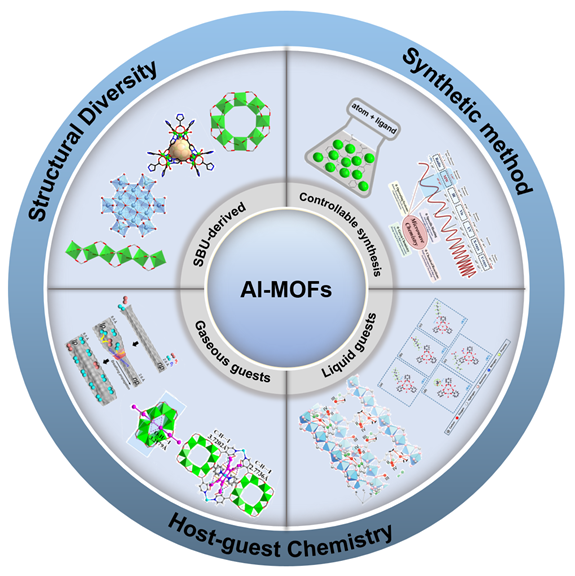
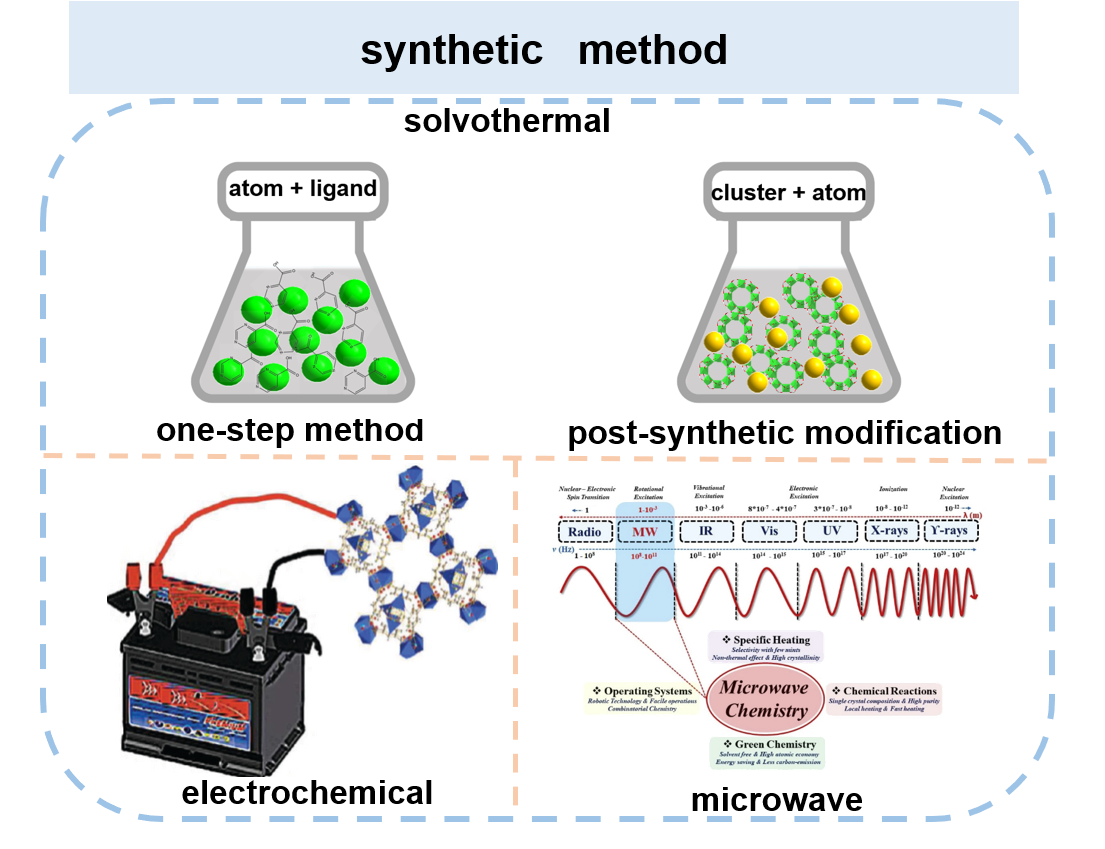
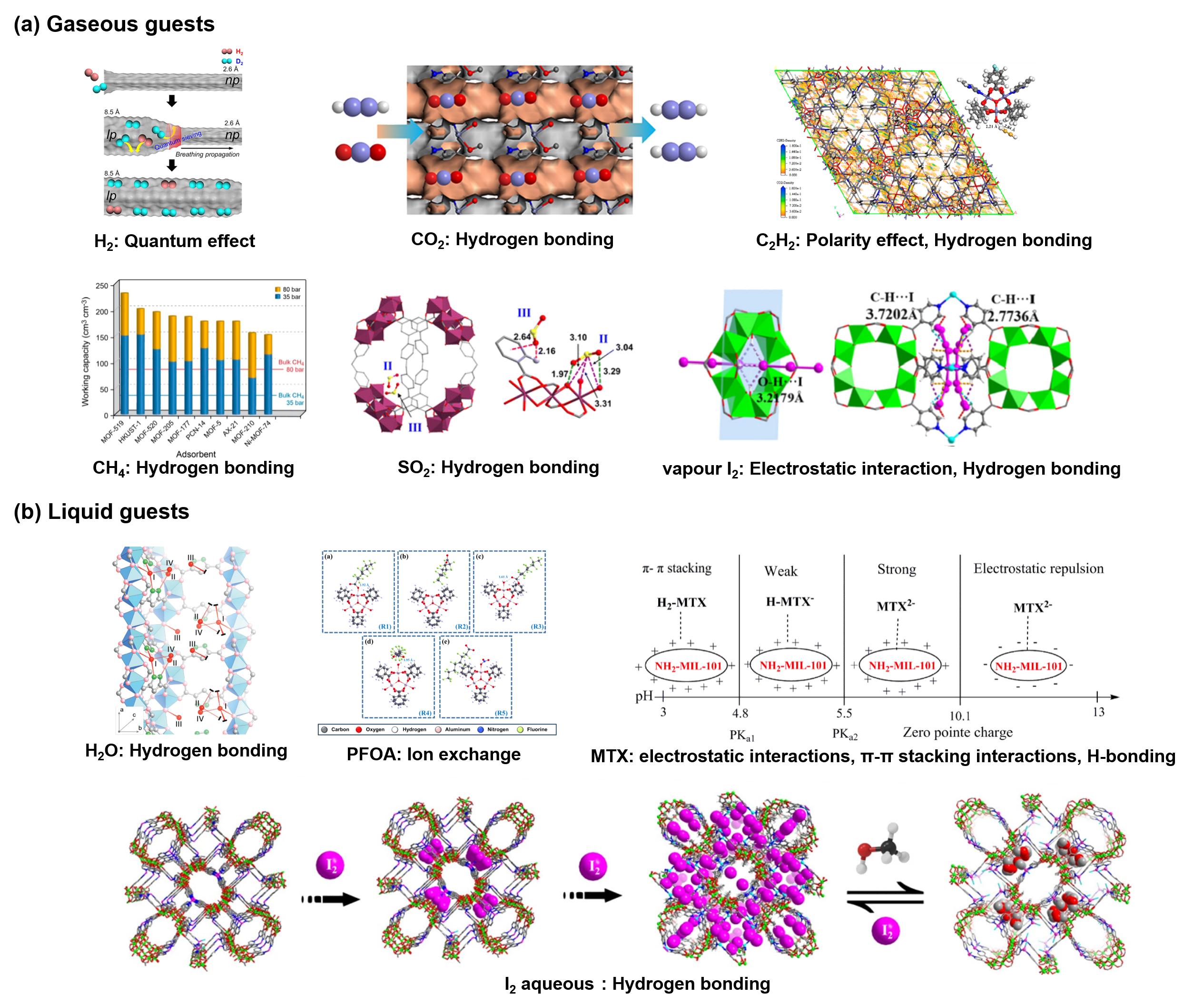
铝基金属有机框架(Al-MOFs)因其主体金属的天然丰度较高, 为构筑经济友好的功能材料提供了新途径. 然而, 由于Al3+的较快的水解动力学, Al-MOFs的结晶过程较为困难, 导致相比于其他金属基MOF发展较为缓慢, 以Al-MOF为平台的主客体化学研究也因此受限. 随着对Al3+水解过程认识的深入, 近年来Al-MOFs得到蓬勃发展, 对该领域进展进行具有时效性的总结具备重要意义. 基于此, 本综述详细总结了Al-MOFs的合成方法、结构的多样性以及其在主客体化学方面的应用. 在合成方法方面, 于传统溶剂热法的基础上加入了对新兴的微波合成法与电化学合成法的介绍, 在结构多样性方面则对迄今为止Al-MOFs中所出现过的所有次级结构单元(Secondary building unit, SBU)进行分类总结, 从次级构筑单元出发, 详细介绍2023年后报道的Al-MOFs结构. 此外, 针对Al-MOFs的主客体化学应用进行调研, 通过对其吸附的客体分子进行分类, 归纳了Al-MOFs作为主体吸附客体分子的机理及其作用位点. 最后, 对Al-MOFs的主客体化学的研究趋势进行了展望.
邬佳悦, 王文伯, 谢玉龙, 方伟慧. 铝基金属有机框架材料的主客体化学研究进展★[J]. 化学学报, 2026, 84(5): 697-708.
Jiayue Wu, Wenbo Wang, Yulong Xie, Weihui Fang. Recent Advances in Host-Guest Chemistry of Aluminum-Based Metal-Organic Framework Materials★[J]. Acta Chimica Sinica, 2026, 84(5): 697-708.
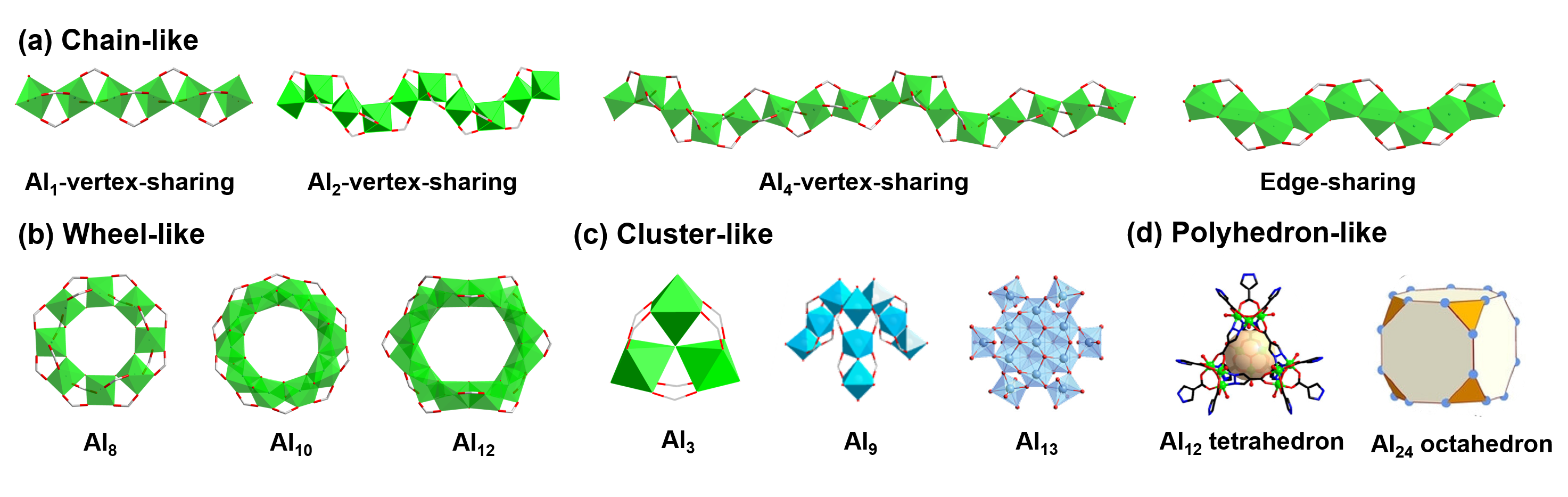
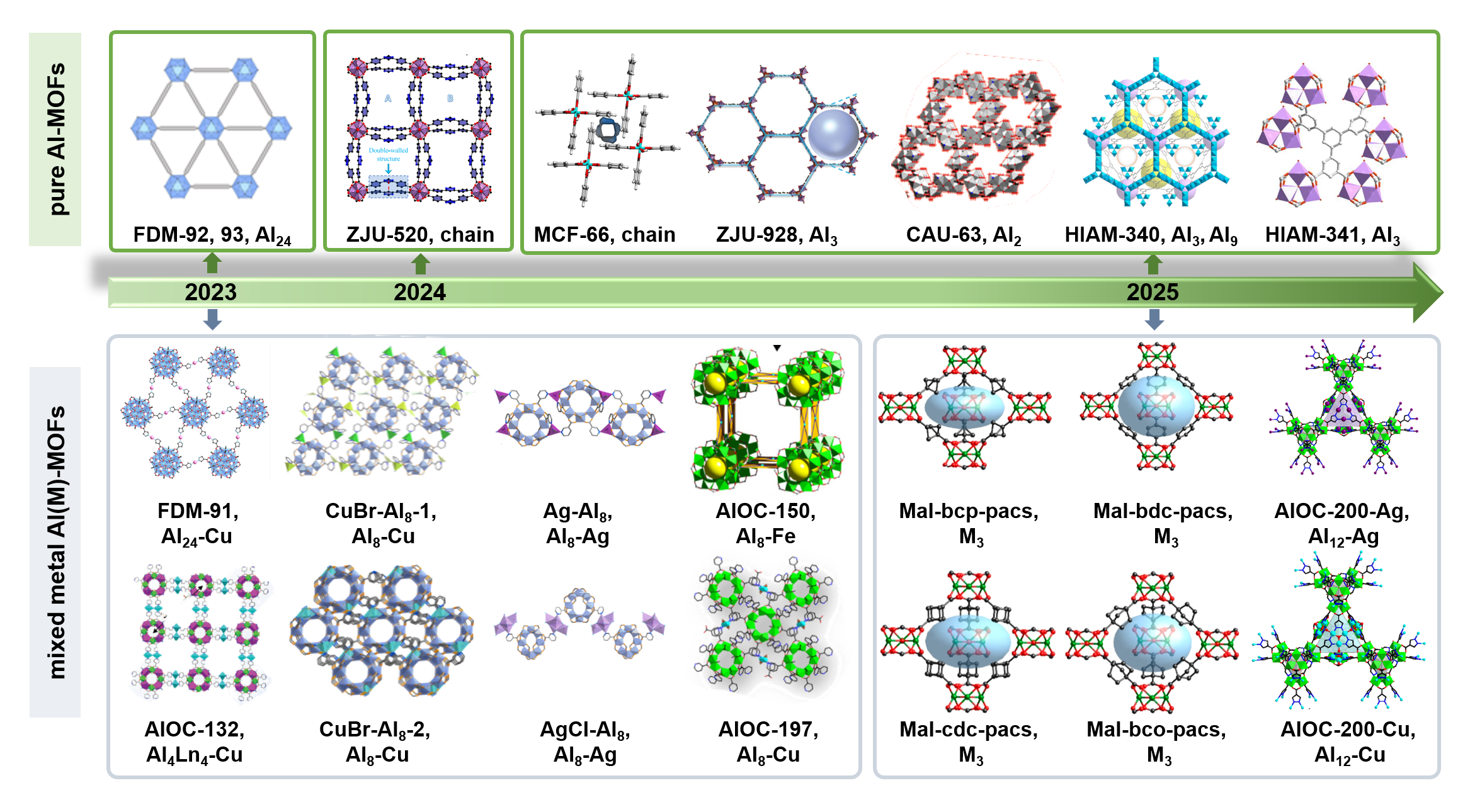
| MOFs | Formula | Linker | SBU | Condition | BET/(m2•g-1)a | Ref. |
|---|---|---|---|---|---|---|
| ZJU-520 | AlC18H10O5N2 | H2DBP | [Al(OH)(COO)2]n | 130 ℃, 72 h | 2235 | [ |
| MCF-66 | AlC14H11O5 | HBA | [Al(OH)(COO)2]n | 160 ℃, 48 h | — | [ |
| ZJU-928 | Al16C90O79H42 | H3BTA | [Al8(OH)15(COO)9] | 130 ℃, 72 h | 2344 | [ |
| HIAM-340 | Al27C222H153O141 | H6btei | [Al9(OH)15(COO)12], [Al3O(COO)4] | 155 ℃, 72 h | 2800 | [ |
| HIAM-341 | Al3C30H12O16 | H6BHB | [Al3O(OH)3(COO)6] | 180 ℃, 72 h | 1094 | [ |
| CAU-63 | Al7C21H24O27N3 | 2,4-H2Pydc | Al4O14N2 | 135 ℃, 6 h | — | [ |
| AlOC-200-Cu | Al12C72H76O56N48Cu12 | HPyzc | [Al12(µ3-O)4(Hpyzc)12(COO)6(H2O)12] | 100 ℃, 24 h | 1526.2 | [ |
| AlOC-200-Ag | Al12C72H48O40N48Ag12 | Hpyzc | [Al12(µ3-O)4(Hpyzc)12(COO)6(H2O)12] | 100 ℃, 24 h | 1461.8 | [ |
| MAl-bcp-pacs | (M)3-x(Al2)x(O/OH)(bcp)3(tpbz) | tpbz | M2Al(OH) (M=Mg, Mn, Co, Ni) | 130 ℃, 24 h | 1027 | [ |
| MAl-bdc-pacs | (M)3-x(Al2)x(O/OH)(bdc)3(tpt) | tpt | M2Al(OH) (M=Mg, Mn, Co, Ni) | 150 ℃, 15 h | 1328 | [ |
| MAl-bdc-pacs | (M)3-x(Al2)x(O/OH)(bdc)3(tppy) | tppy | M2Al(OH) (M=Mg, Mn, Co, Ni) | 130 ℃, 15 h | — | [ |
| AlOC-132 | Al4C88H120O32N16Eu4Cu4I4 | Hpyba | [Al4Eu4(IN)8(COO)8(H2O)] | 100 ℃, 96 h | — | [ |
| AlOC-197 | Al8C96H110N12O37.25Cu2Cl3 | HNA | [Al8(µ-OH)4(OiPr)8(COO)12(Cl)] | 100 ℃, 120 h | — | [ |
| Ag-Al8 | Al8C101H76O46N19Ag2F6S2 | HNA | [Al8(OH)8(COO)16] | 100 ℃, 168 h | — | [ |
| AgCl-Al8 | Al8C98H86O46N16Ag6Cl20F6S2 | HNA | [Al8(OH)8(COO)16] | 100 ℃, 168 h | — | [ |
| CuBr-Al8-1 | Al8C107H80O44N19Cu4Br3 | HNA | [Al8(OH)8(COO)16] | 100 ℃, 168 h | — | [ |
| CuBr-Al8-2 | Al8C108H72O44N18Cu4Br2 | HNA | [Al8(OH)8(COO)16] | 100 ℃, 168 h | — | [ |
| MOFs | Formula | Linker | SBU | Condition | BET/(m2•g-1)a | Ref. |
|---|---|---|---|---|---|---|
| ZJU-520 | AlC18H10O5N2 | H2DBP | [Al(OH)(COO)2]n | 130 ℃, 72 h | 2235 | [ |
| MCF-66 | AlC14H11O5 | HBA | [Al(OH)(COO)2]n | 160 ℃, 48 h | — | [ |
| ZJU-928 | Al16C90O79H42 | H3BTA | [Al8(OH)15(COO)9] | 130 ℃, 72 h | 2344 | [ |
| HIAM-340 | Al27C222H153O141 | H6btei | [Al9(OH)15(COO)12], [Al3O(COO)4] | 155 ℃, 72 h | 2800 | [ |
| HIAM-341 | Al3C30H12O16 | H6BHB | [Al3O(OH)3(COO)6] | 180 ℃, 72 h | 1094 | [ |
| CAU-63 | Al7C21H24O27N3 | 2,4-H2Pydc | Al4O14N2 | 135 ℃, 6 h | — | [ |
| AlOC-200-Cu | Al12C72H76O56N48Cu12 | HPyzc | [Al12(µ3-O)4(Hpyzc)12(COO)6(H2O)12] | 100 ℃, 24 h | 1526.2 | [ |
| AlOC-200-Ag | Al12C72H48O40N48Ag12 | Hpyzc | [Al12(µ3-O)4(Hpyzc)12(COO)6(H2O)12] | 100 ℃, 24 h | 1461.8 | [ |
| MAl-bcp-pacs | (M)3-x(Al2)x(O/OH)(bcp)3(tpbz) | tpbz | M2Al(OH) (M=Mg, Mn, Co, Ni) | 130 ℃, 24 h | 1027 | [ |
| MAl-bdc-pacs | (M)3-x(Al2)x(O/OH)(bdc)3(tpt) | tpt | M2Al(OH) (M=Mg, Mn, Co, Ni) | 150 ℃, 15 h | 1328 | [ |
| MAl-bdc-pacs | (M)3-x(Al2)x(O/OH)(bdc)3(tppy) | tppy | M2Al(OH) (M=Mg, Mn, Co, Ni) | 130 ℃, 15 h | — | [ |
| AlOC-132 | Al4C88H120O32N16Eu4Cu4I4 | Hpyba | [Al4Eu4(IN)8(COO)8(H2O)] | 100 ℃, 96 h | — | [ |
| AlOC-197 | Al8C96H110N12O37.25Cu2Cl3 | HNA | [Al8(µ-OH)4(OiPr)8(COO)12(Cl)] | 100 ℃, 120 h | — | [ |
| Ag-Al8 | Al8C101H76O46N19Ag2F6S2 | HNA | [Al8(OH)8(COO)16] | 100 ℃, 168 h | — | [ |
| AgCl-Al8 | Al8C98H86O46N16Ag6Cl20F6S2 | HNA | [Al8(OH)8(COO)16] | 100 ℃, 168 h | — | [ |
| CuBr-Al8-1 | Al8C107H80O44N19Cu4Br3 | HNA | [Al8(OH)8(COO)16] | 100 ℃, 168 h | — | [ |
| CuBr-Al8-2 | Al8C108H72O44N18Cu4Br2 | HNA | [Al8(OH)8(COO)16] | 100 ℃, 168 h | — | [ |
| [1] |
doi: 10.1038/ncomms6979 |
| [2] |
doi: 10.1021/acssuschemeng.2c00536 |
| [3] |
doi: 10.1002/adfm.v35.28 |
| [4] |
doi: 10.1016/j.foodchem.2021.130763 |
| [5] |
doi: 10.6023/A25040117 |
|
(高春, 张松涛, 庞欢, 化学学报, 2025, 83, 962.)
doi: 10.6023/A25040117 |
|
| [6] |
|
| [7] |
doi: 10.1016/j.ccr.2023.215175 |
| [8] |
doi: 10.1016/j.jhazmat.2022.130422 |
| [9] |
doi: 10.1039/D2NJ03419K |
| [10] |
doi: 10.1016/j.ccr.2022.214921 |
| [11] |
doi: 10.1016/j.crci.2015.08.006 |
| [12] |
doi: 10.1016/j.ccr.2018.06.011 |
| [13] |
doi: 10.1039/D1TA04444C |
| [14] |
doi: 10.1016/j.envres.2022.114422 |
| [15] |
doi: 10.1002/chem.v27.39 |
| [16] |
doi: 10.1021/ic301961q pmid: 23356350 |
| [17] |
pmid: 16881652 |
| [18] |
doi: 10.1038/nmat1991 |
| [19] |
doi: 10.1126/sciadv.aat3198 |
| [20] |
doi: 10.1002/adma.v33.48 |
| [21] |
|
| [22] |
doi: 10.1002/ejic.v2012.32 |
| [23] |
doi: 10.1016/j.micromeso.2011.11.025 |
| [24] |
doi: 10.1021/acs.chemmater.9b02594 |
| [25] |
doi: 10.1021/cr200167v |
| [26] |
doi: 10.1039/C8CE00761F |
| [27] |
doi: 10.1021/acs.cgd.4c01561 |
| [28] |
doi: 10.1002/smll.v13.29 |
| [29] |
doi: 10.1021/cm900069f |
| [30] |
doi: 10.1021/cg300552w |
| [31] |
doi: 10.1038/nchem.1457 |
| [32] |
doi: 10.1002/chem.v21.48 |
| [33] |
doi: 10.1039/C8TA07839D |
| [34] |
doi: 10.1021/acs.cgd.0c01283 |
| [35] |
doi: 10.1021/cm3025445 |
| [36] |
doi: 10.1002/anie.v57.47 |
| [37] |
doi: 10.1002/chem.v23.61 |
| [38] |
doi: 10.1021/acsami.7b17026 |
| [39] |
doi: 10.1002/anie.v60.39 |
| [40] |
doi: 10.1039/c2dt12005d pmid: 22286397 |
| [41] |
|
| [42] |
doi: 10.1021/jacs.0c00805 |
| [43] |
|
| [44] |
doi: 10.1039/c2cc34909d |
| [45] |
|
| [46] |
doi: 10.1002/anie.v62.6 |
| [47] |
doi: 10.1038/s41467-024-47612-x |
| [48] |
doi: 10.1021/jacs.5c12200 |
| [49] |
doi: 10.1002/cjoc.v43.20 |
| [50] |
doi: 10.1021/acs.inorgchem.5c03315 pmid: 41037797 |
| [51] |
doi: 10.1021/jacs.4c18251 |
| [52] |
|
| [53] |
doi: 10.1039/D4QI02507E |
| [54] |
|
| [55] |
doi: 10.1021/acsomega.4c08387 |
| [56] |
doi: 10.1039/D3DT01846F |
| [57] |
doi: 10.1016/j.matchemphys.2022.126933 |
| [58] |
doi: 10.1016/j.electacta.2024.143989 |
| [59] |
doi: 10.6023/A25040140 |
|
(吴子林, 张璐, 陈杨, 李晋平, 李立博, 化学学报, 2025, 83, 917.)
doi: 10.6023/A25040140 |
|
| [60] |
doi: 10.6023/A24120376 |
|
(王丽英, 于吉攀, 刘峙嵘, 石伟群, 化学学报, 2025, 83, 401.)
doi: 10.6023/A24120376 |
|
| [61] |
doi: 10.1126/science.aaz8881 |
| [62] |
doi: 10.1021/cm9023106 |
| [63] |
doi: 10.1021/ja501606h pmid: 24661065 |
| [64] |
doi: 10.1039/D4SC01877J |
| [65] |
doi: 10.6023/A23080392 |
|
(林航青, 马若茹, 江怡蓝, 许木榕, 林洋彭, 杜克钊, 化学学报, 2024, 82, 62.)
doi: 10.6023/A23080392 |
|
| [66] |
doi: 10.1039/D2QI01108E |
| [67] |
doi: 10.1126/science.abj0890 pmid: 34672755 |
| [68] |
doi: 10.1016/j.jhazmat.2024.136687 |
| [69] |
|
| [1] | 黄秀清, 张琦. 葫芦状有机金属配位笼的合成及其对两种药物分子的选择性结合[J]. 化学学报, 2023, 81(3): 217-221. |
| [2] | 吴明港, 杨勇, 薛敏. 四氨基柱[5]芳烃二聚体的合成、结构及性质研究[J]. 化学学报, 2022, 80(8): 1057-1060. |
| [3] | 周丽, 徐立进, 龚汉元. 自组装中的苯二甲酸阴离子形貌及质子化效应[J]. 化学学报, 2014, 72(4): 447-455. |
| [4] | 岳诗雨, 周玉娟, 姚勇, 薛敏. 柱芳烃化学:从合成、主客体性质到自组装性能的研究进展[J]. 化学学报, 2014, 72(10): 1053-1069. |
| [5] | 韩成友, 张子彬, 池小东, 张明明, 喻国灿, 黄飞鹤. 1,4-双正丙氧基柱[7]芳烃的合成及主客体化学[J]. 化学学报, 2012, 70(17): 1775-1778. |
| [6] | 杨登科, 曾志坚, 陈木娟, 潘绍武, 杨宇, 李媚, 雷春燕, 蒋腊生. 二酰胺大环化合物与吡啶N-氧化物的络合作用研究[J]. 化学学报, 2012, 70(12): 1385-1393. |
| 阅读次数 | ||||||
|
全文 |
|
|||||
|
摘要 |
|
|||||
