

化学学报 ›› 2026, Vol. 84 ›› Issue (5): 689-696.DOI: 10.6023/A26010006 上一篇 下一篇
所属专题: “框架材料化学”合集
研究展望
黄大帅, 廖培钦*( )
)
投稿日期:2026-01-05
发布日期:2026-01-29
作者简介: |
黄大帅, 中山大学博士后. 2021年于西北大学获得学士学位, 2025年于中山大学获得博士学位, 导师陈小明教授和廖培钦教授. 目前研究方向为金属−有机框架材料的设计合成及其在电催化领域的应用. |
 |
廖培钦, 中山大学化学学院教授, 博士生导师. 2011年于中山大学获得学士学位, 2016年于中山大学获得博士学位, 导师陈小明教授. 目前的研究方向包括新型多孔材料的设计与合成, 以及其在小分子催化转化中的应用. |
★“框架材料化学”专辑
基金资助:
Dashuai Huang, Peiqin Liao*()
Received:2026-01-05
Published:2026-01-29
Contact:
* E-mail: liaopq3@mail.sysu.edu.cn
About author:★ For the VSI "Chemistry of Framework Materials".
Supported by:文章分享
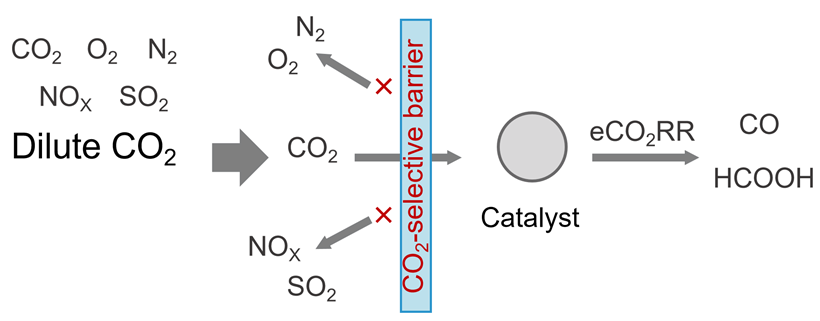
低浓度二氧化碳(烟气中15%、空气中720 mg/m3级)的高效捕集与电催化转化是实现碳减排与资源化利用的重要技术路径. 然而, 受限于CO2传质不足、杂质气体引发的竞争反应以及产物分离成本高等因素, 传统电催化体系在低浓度条件下面临显著性能衰减的问题. 金属−有机框架(MOF)材料凭借其可设计的多孔结构、可调控的化学环境以及高度集成化的功能潜力, 为突破上述瓶颈提供了独特的平台. 本文围绕MOF基材料在低浓度CO2电催化转化中的应用进展, 系统梳理并总结了几类代表性的设计策略: 从单一MOF内部实现CO2捕集-催化双功能集成, 到MOF基分子筛膜-电解池的器件级耦合, 实现烟气或空气源CO2的原位富集、纯化与高选择性转化. 相关研究揭示了低浓度CO2电催化转化从分子尺度活性位点调控, 到反应环境优化, 再到器件级系统集成的递进式创新思路. 最后, 结合当前研究现状, 对该领域在催化机理、耐杂质体系构建等方面面临的挑战与发展机遇进行了展望.
黄大帅, 廖培钦. 金属−有机框架材料在低浓度CO2电催化转化中的应用与展望★[J]. 化学学报, 2026, 84(5): 689-696.
Dashuai Huang, Peiqin Liao. Applications and Perspectives of Metal-Organic Framework Materials in Electrocatalytic Conversion of Low-Concentration CO2★[J]. Acta Chimica Sinica, 2026, 84(5): 689-696.
| [1] |
doi: 10.1038/s41586-021-03984-4 |
| [2] |
doi: 10.1038/nature08019 |
| [3] |
doi: 10.1126/science.aba8767 |
| [4] |
doi: 10.1038/nature18307 |
| [5] |
doi: 10.1038/s41586-024-07449-2 |
| [6] |
pmid: 27560307 |
| [7] |
doi: 10.1126/science.aax4608 |
| [8] |
doi: 10.1021/acs.chemrev.8b00705 |
| [9] |
doi: 10.1038/s41929-025-01411-9 |
| [10] |
doi: 10.1126/science.aay4217 |
| [11] |
doi: 10.1038/s41586-022-05540-0 |
| [12] |
doi: 10.1093/nsr/nwaf329 |
| [13] |
doi: 10.1038/s41565-025-02059-z |
| [14] |
doi: 10.1038/s41467-023-39048-6 |
| [15] |
doi: 10.1021/acscatal.2c01681 |
| [16] |
doi: 10.1038/s41560-023-01389-3 |
| [17] |
doi: 10.1038/s44160-024-00603-8 |
| [18] |
doi: 10.1002/cjoc.v42.16 |
| [19] |
doi: 10.1002/cjoc.v42.22 |
| [20] |
doi: 10.1002/anie.v60.38 |
| [21] |
doi: 10.1002/adma.v37.23 |
| [22] |
doi: 10.1038/s41578-024-00696-9 |
| [23] |
doi: 10.1039/D2EE00472K |
| [24] |
doi: 10.31635/ccschem.022.202202094 |
| [25] |
doi: 10.1039/c2ee21586a |
| [26] |
doi: 10.1126/science.1181637 |
| [27] |
doi: 10.1016/j.joule.2018.05.006 |
| [28] |
|
| [29] |
|
| [30] |
doi: 10.1016/j.apenergy.2015.08.083 |
| [31] |
doi: 10.1016/j.ijggc.2012.06.015 |
| [32] |
|
| [33] |
doi: 10.1021/am507465f |
| [34] |
doi: 10.1038/s44160-025-00850-3 |
| [35] |
doi: 10.1021/acs.iecr.7b03514 |
| [36] |
doi: 10.1038/s41586-023-05918-8 |
| [37] |
doi: 10.1016/j.cej.2022.136210 |
| [38] |
doi: 10.1002/smll.v16.24 |
| [39] |
doi: 10.1002/anie.v59.46 |
| [40] |
doi: 10.1016/j.ccr.2022.214576 |
| [41] |
doi: 10.1016/j.cclet.2024.109676 |
| [42] |
doi: 10.1021/jacs.4c04841 |
| [43] |
doi: 10.1002/anie.v62.52 |
| [44] |
doi: 10.1038/s41560-021-00920-8 |
| [45] |
doi: 10.1039/D3CS00873H |
| [46] |
doi: 10.1038/s44286-024-00062-0 |
| [47] |
doi: 10.1021/jacs.5c07519 |
| [48] |
doi: 10.1038/s41467-024-47498-9 pmid: 38649389 |
| [1] | 李泽洋, 杨宇森, 卫敏. 二氧化碳还原电催化剂的结构设计及性能研究进展[J]. 化学学报, 2022, 80(2): 199-213. |
| 阅读次数 | ||||||
|
全文 |
|
|||||
|
摘要 |
|
|||||
