

化学学报 ›› 2026, Vol. 84 ›› Issue (7): 1105-1113.DOI: 10.6023/A26030092 上一篇 下一篇
研究论文
谢庆娟a, 王琦龙a, 李慧玉a,*( ), 游聪娅b,*(), 刘铭b, 冯拥军a,*()
投稿日期:2026-03-28
发布日期:2026-05-28
基金资助:
Qingjuan Xiea, Qilong Wanga, Huiyu Lia,*(), Congya Youb,*(), Ming Liub, Yongjun Fenga,*()
Received:2026-03-28
Published:2026-05-28
Contact:
* E-mail: huiyuli@buct.edu.cn;
youcy94@163.com;
yjfeng@mail.buct.edu.cn
Supported by:文章分享
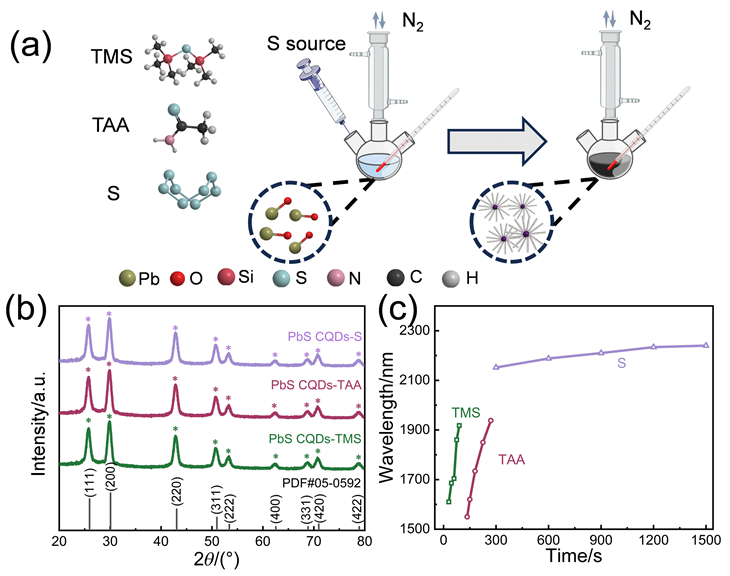
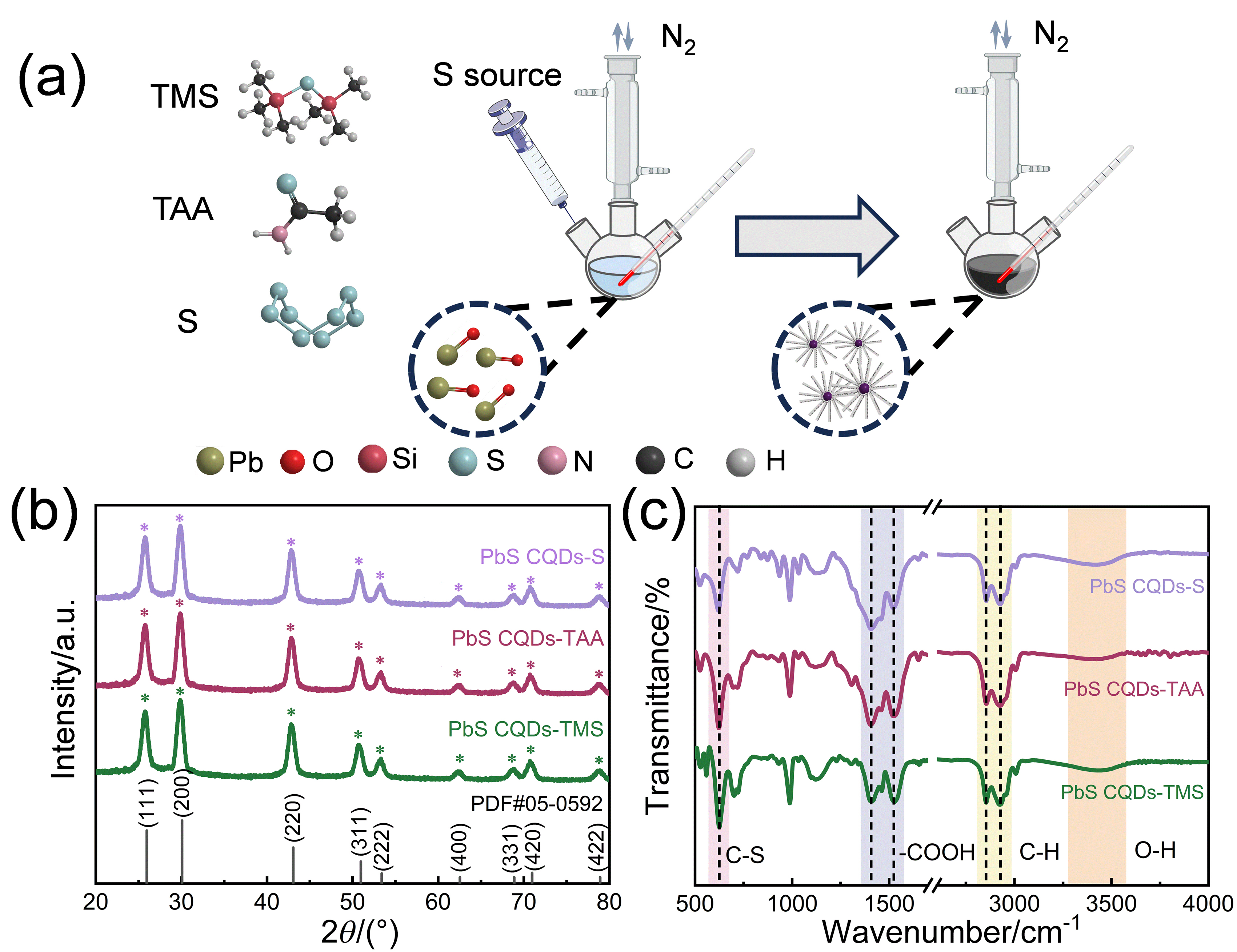
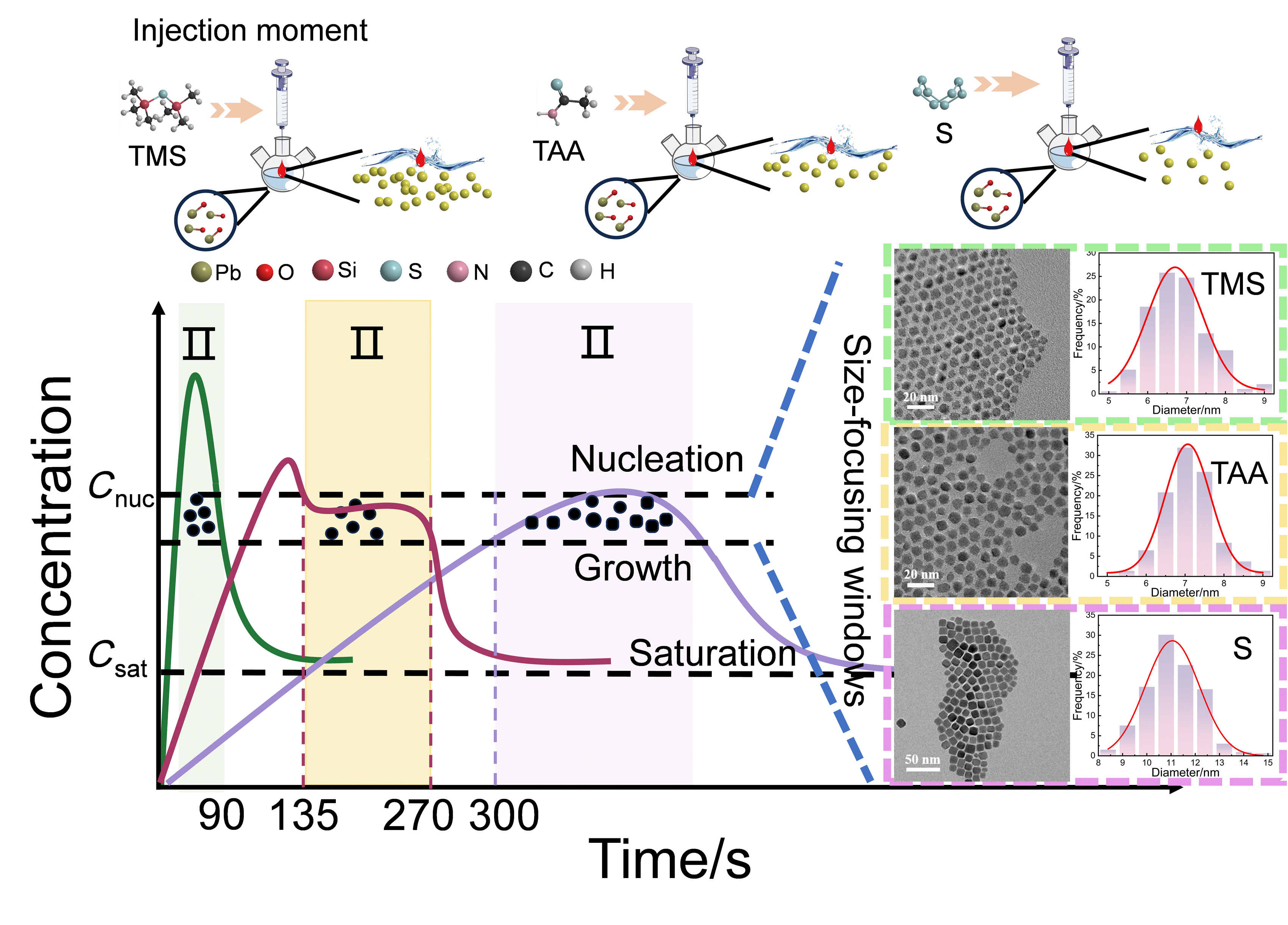
硫化铅胶体量子点(PbS CQDs)因量子尺寸效应显著、吸光波段覆盖近红外区域, 且制备简便、兼容性佳, 是红外光电材料领域的研究重点, 其吸光性能调控是器件高性能化的核心. 该研究为揭示阴离子前驱体活性对PbS CQDs吸光性能的调控机制, 基于传统热注入法优化制备工艺, 选取双三甲基硅基硫醚、硫代乙酰胺、单质硫三种不同活性硫源为阴离子前驱体, 系统探究其对PbS CQDs成核生长、晶体结构及吸光性能的影响. 经过多种表征手段测试, 该研究制备的PbS CQDs均为纯净立方相, 其中以双三甲基硅基硫醚、硫代乙酰胺为硫源制备的量子点呈现准球形形貌, 以单质硫为硫源制备的量子点呈现方形形貌, 且硫代乙酰胺为硫源的量子点粒径分布最窄(变异系数8.5%)、单分散性最优; 进一步调控反应温度、配体比例与生长时间可实现其粒径及光吸收性能的精准调控, 最优工艺下的产物兼具高晶化程度(结晶度为81.74%)与优异光吸收性能, 为红外光电器件应用提供材料支撑.
谢庆娟, 王琦龙, 李慧玉, 游聪娅, 刘铭, 冯拥军. 基于前驱体活性调控的单分散短波红外硫化铅量子点合成及其性能研究[J]. 化学学报, 2026, 84(7): 1105-1113.
Qingjuan Xie, Qilong Wang, Huiyu Li, Congya You, Ming Liu, Yongjun Feng. Synthesis and Performance Study of Monodisperse Short-Wave Infrared Lead Sulfide Quantum Dots Based on Precursor Reactivity Regulation[J]. Acta Chimica Sinica, 2026, 84(7): 1105-1113.

| [1] |
doi: 10.3788/IRLA |
|
(夏溢坪, 杨奥, 李国彬, 陈丽婷, 李鑫龙, 何禅, 李学铭, 唐利斌, 陈晟迪, 红外与激光工程, 2026, 55, 20250394.)
|
|
| [2] |
|
|
(王煜, 刘海峥, 史泽林, 佟秋男, 陕西师范大学学报(自然科学版), 2025, 53, 67.)
|
|
| [3] |
doi: 10.3390/ma16175790 |
| [4] |
doi: 10.1016/j.cej.2025.167554 |
| [5] |
doi: 10.1007/s11082-023-04760-6 |
| [6] |
|
| [7] |
doi: 10.1088/0022-3727/49/13/135302 |
| [8] |
doi: 10.3390/nano12213850 |
| [9] |
doi: 10.3390/nano12132220 |
| [10] |
doi: 10.1007/s11082-020-02356-y |
| [11] |
doi: 10.1002/aelm.v11.17 |
| [12] |
doi: 10.1021/acsaelm.4c01750 |
| [13] |
doi: 10.1088/1674-1056/ab5fb7 |
| [14] |
doi: 10.1016/j.optmat.2025.116714 |
| [15] |
doi: 10.1002/adma.v15:21 |
| [16] |
doi: 10.1002/ejic.v2011.15 |
| [17] |
doi: 10.1039/c7nr04950a pmid: 29072746 |
| [18] |
doi: 10.1126/science.aaa2951 pmid: 26068846 |
| [19] |
doi: 10.1016/j.optmat.2023.113977 |
| [20] |
doi: 10.1021/jacs.5c02597 |
| [21] |
doi: 10.1021/acs.jpclett.4c01982 |
| [22] |
doi: 10.1039/D4TC01414F |
| [23] |
doi: 10.1016/j.mssp.2019.02.020 |
| [24] |
doi: 10.1107/S0021889869006558 |
| [25] |
doi: 10.1007/s10904-023-02592-1 |
| [26] |
doi: 10.1126/science.1252727 pmid: 24876347 |
| [27] |
doi: 10.1002/aenm.v9.13 |
| [28] |
|
| [29] |
doi: 10.1021/acsnano.5c16982 |
| [30] |
doi: 10.1002/tcr.201800085 |
| [31] |
doi: 10.1038/s41467-021-24527-5 |
| [32] |
doi: 10.1016/j.apsusc.2018.06.152 |
| [33] |
doi: 10.1021/acs.jpcc.3c07499 |
| [34] |
doi: 10.1021/nn7003348 |
| [35] |
doi: 10.1021/ja400948t |
| [36] |
doi: 10.1039/D5TC03823E |
| [37] |
doi: 10.1021/acsnano.5c03943 |
| [38] |
doi: 10.1002/adfm.v35.39 |
| [39] |
doi: 10.1039/c6cp02119k pmid: 27156571 |
| [40] |
doi: 10.1021/nn103050w pmid: 21355621 |
| [41] |
doi: 10.1021/jacs.4c04593 |
| [42] |
doi: 10.1002/adma.v36.19 |
| [43] |
doi: 10.1021/acsphotonics.9b01050 |
| [1] | 蔡钊, 邝允, 罗亮, 王利人, 孙晓明. Au-Ni异质结纳米晶的尺寸调控[J]. 化学学报, 2013, 71(9): 1265-1269. |
| [2] | 李谦, 张腾, 古宏伟, 丁发柱, 屈飞, 彭星煜, 王洪艳, 吴战鹏. 阳离子交换法制备稳定的近红外区核/壳型PbS/CdS量子点[J]. 化学学报, 2013, 71(06): 929-933. |
| [3] | 姚雪霞, 徐素明. 葡萄糖激酶M197V突变的活化机理研究[J]. 化学学报, 2011, 69(04): 405-410. |
| [4] | 伊长虹, 张庆刚. HIV-1蛋白酶与抑制剂作用的结合自由能计算[J]. 化学学报, 2010, 68(20): 2029-2034. |
| [5] | 杨丽君,贾若,杨胜勇. 应用MM/PBSA方法研究CDK2活性口袋内溶剂水分子对CDK2-配体结合自由能的影响[J]. 化学学报, 2009, 67(3): 255-260. |
| [6] | 时术华, 扈国栋, 陈建中, 张少龙, 张庆刚. 分子动力学模拟研究质子化态在HIV-1 Protease-Indinavir复合物中的作用[J]. 化学学报, 2009, 67(24): 2791-2797. |
| [7] | 王甫洋,陈建挺,李定龙. 多溴吩噻嗪系列化合物的稳定性和热力学性质的密度泛函理论研究[J]. 化学学报, 2009, 67(14): 1650-1658. |
| [8] | 姚雪霞. β-环糊精和甾类化合物的分子动力学模拟[J]. 化学学报, 2009, 67(12): 1318-1324. |
| [9] | 赵旭升 干建群 刘光华 陈爱民. PbS量子点的一步合成法及其光学性能[J]. 化学学报, 2008, 66(16): 1869-1872. |
| [10] | 胡建平, 孙庭广, 陈慰祖, 王存新. 谷氨酰胺结合蛋白的分子动力学模拟和自由能计算[J]. 化学学报, 2006, 64(20): 2079-2085. |
| [11] | 蒋勇军, 曾敏, 周先波, 邹建卫, 俞庆森. CDK2-抑制剂结合自由能计算[J]. 化学学报, 2004, 62(18): 1751-1754. |
| 阅读次数 | ||||||
|
全文 |
|
|||||
|
摘要 |
|
|||||
