

化学学报 ›› 2026, Vol. 84 ›› Issue (7): 1211-1224.DOI: 10.6023/A26040140 上一篇
综述
丁龙华, 王爱珠, 蔡砺寒*( ), 于欣*()
投稿日期:2026-04-28
发布日期:2026-06-18
作者简介: |
丁龙华, 济南大学前沿交叉科学研究院副教授, 硕士生导师. 于2015年在浙江大学获得博士学位. 主要致力于纳米催化材料设计制备、催化活性调控、催化机理研究及其在生物诊疗方面的应用研究. 在包括Adv. Funct. Mater.、Anal. Chem.等学术期刊发表SCI论文50余篇, 获得授权发明专利4项. 担任Rare Metals, JAT等期刊的青年编委. |
 |
王爱珠, 济南大学前沿交叉科学研究院副教授, 硕士生导师. 2016年博士毕业于山东大学, 2015~2016博士期间曾赴昆士兰科技大学联合培养, 2016~2018加入新加坡国立大学做 Research Fellow, 随后加入济南大学前沿交叉科学研究院. 主要研究方向为低维纳米材料电学、磁学、光学和力学性质的理论研究及其潜在的应用分析; 新型2D Dirac材料及其拓扑特效的理论设计与预测; 氧化还原反应等方面的研究. 在ACS Nano, Angew. Chem. Int. Ed., J. Phys. Chem. Lett., Nano Res.等国际核心刊物上公开发表学术论文70余篇. |
 |
蔡砺寒, 济南大学前沿交叉科学研究院讲师. 2025 年毕业于大连理工大学化工学院精细化工全国重点实验室, 获精细化工专业博士学位. 主要研究方向为纳米材料合成、功能调控及生物治疗应用基础研究. 参与发表SCI论文20余篇, 以第一作者在J. Am. Chem. Soc., ACS Nano, Sci. China Mater.等期刊发表学术论文5篇, 1篇入选ESI高被引论文. |
 |
于欣, 济南大学前沿交叉科学研究院教授, 副院长, 博士生导师, 国家基金委优青, 山东省杰青, 泰山学者青年专家. 于2017年在中国科学院大学获得博士学位. 主要聚焦纳米催化材料在生物治疗及传感与器件领域, 开展多学科交叉的基础与应用研究. 以第一/通讯作者在Angew. Chem. Int. Ed., Adv. Mater., ACS Nano等学术期刊上发表论文70余篇. 担任Advanced Antibacterial Materials杂志的编委, BMEMat杂志的学术副主编, IJMMM的学术编辑等, 现为第七届中国青年科技工作者协会会员, 山东省高层人才发展促进会会员. |
基金资助:
Longhua Ding, Aizhu Wang, Lihan Cai*(), Xin Yu*()
Received:2026-04-28
Published:2026-06-18
Contact:
* E-mail: ifc_cailh@ujn.edu.cn;
ifc_yux@ujn.edu.cn
Supported by:文章分享
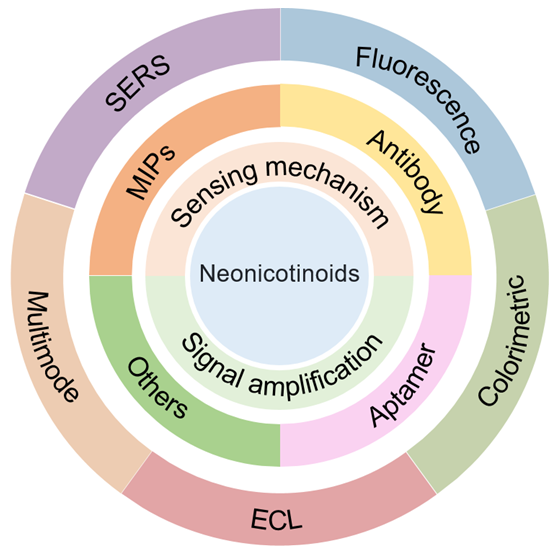
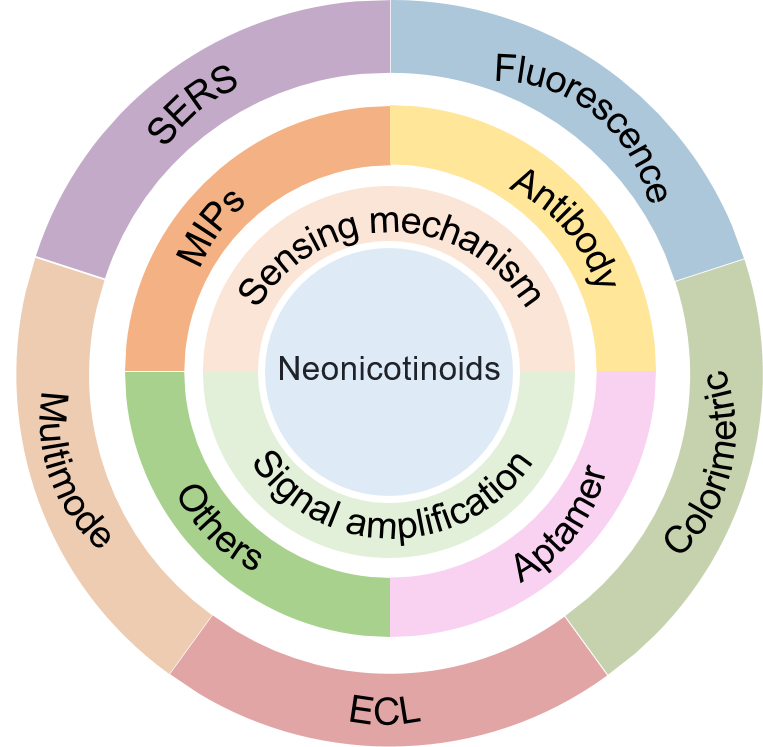
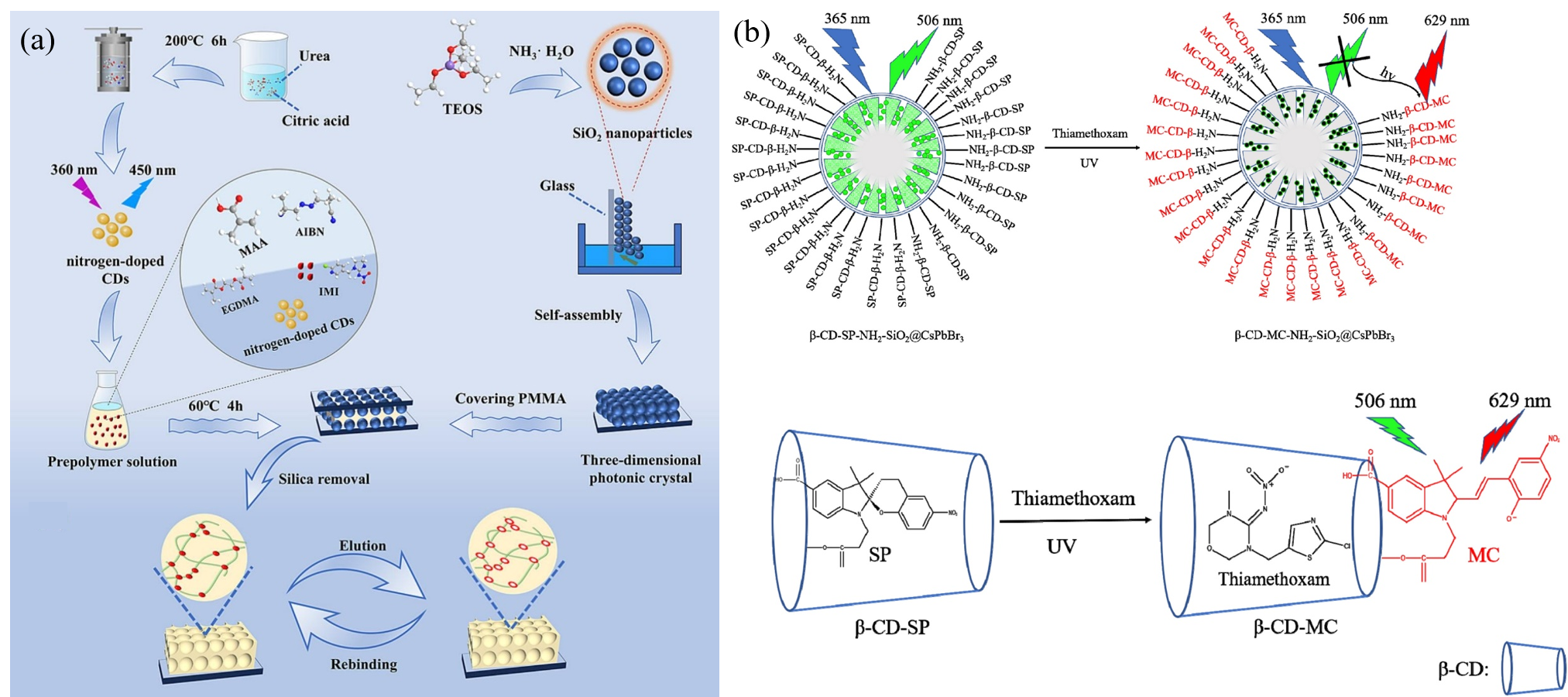
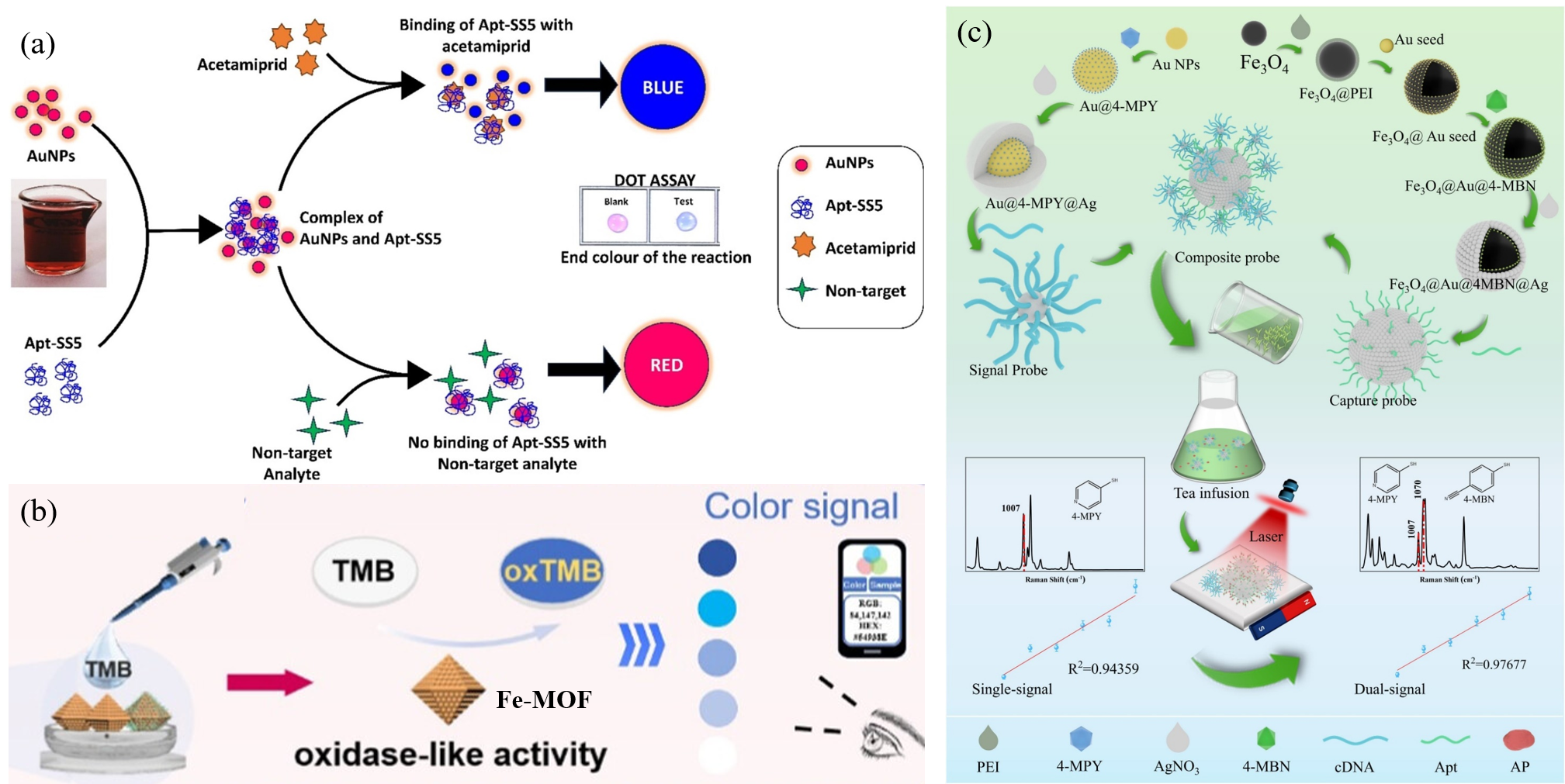
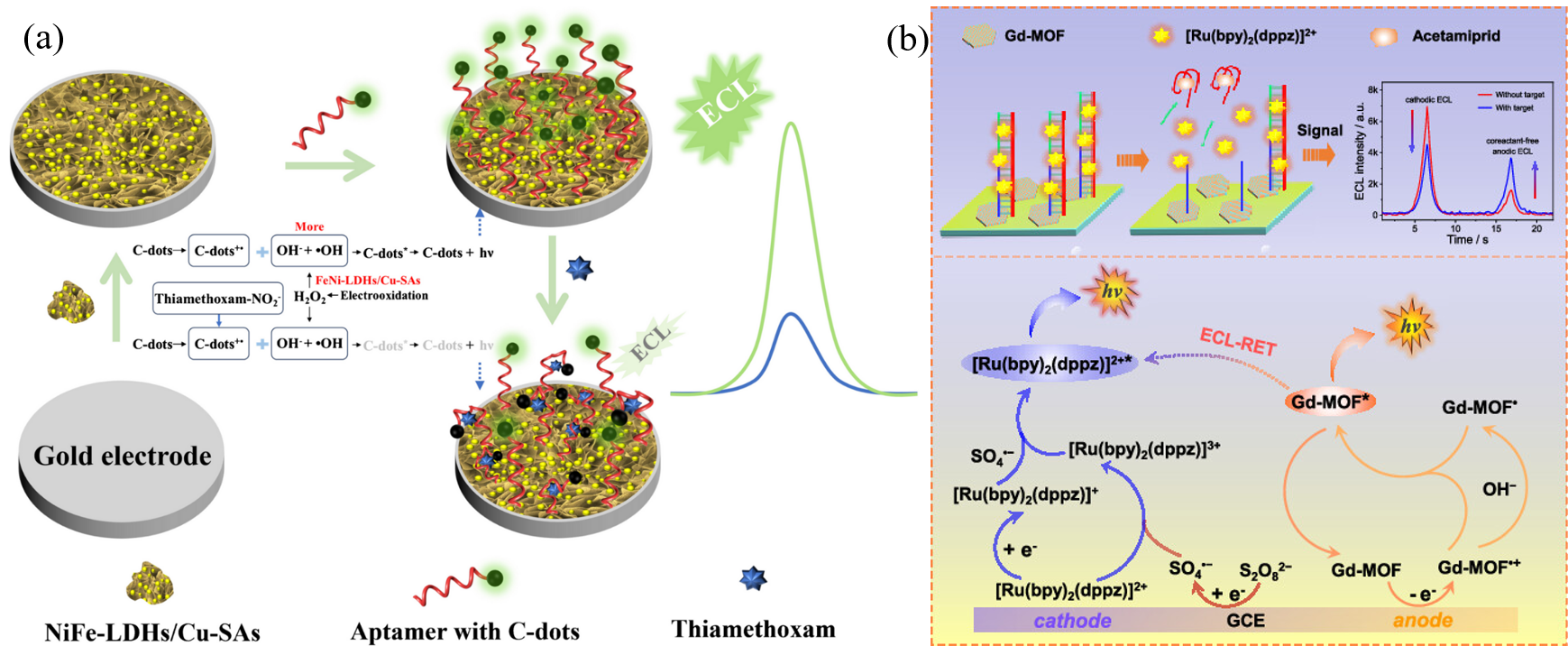
新烟碱类农药作为全球使用量最大的杀虫剂类别之一, 在保障农作物产量的同时, 其不合理使用导致的残留问题对生态环境和人类健康构成严重威胁, 因此, 建立高效、灵敏、快速的残留检测方法具有重要现实意义. 本文系统综述了新烟碱类农药光学传感器的研究进展, 首先阐述了新烟碱类农药的应用现状、残留危害及现有检测方法的优缺点, 重点介绍了光学传感器的核心识别元件(抗体、适配体、分子印迹聚合物等)及其作用机制, 总结了DNA电路放大与纳米材料增强信号放大策略的应用进展, 详细梳理了荧光传感器、比色传感器、表面增强拉曼散射传感器、电化学发光传感器及多模式集成传感阵列与智能识别技术的最新研究成果, 对比分析了不同类型传感器的性能优势与应用场景, 最后指出了当前研究中存在的问题, 并对未来发展趋势进行展望, 旨在为新烟碱类农药光学传感器的进一步研究与实际应用提供全面、新颖的理论参考和技术支撑.
丁龙华, 王爱珠, 蔡砺寒, 于欣. 新烟碱类农药快速检测光学传感器研究进展[J]. 化学学报, 2026, 84(7): 1211-1224.
Longhua Ding, Aizhu Wang, Lihan Cai, Xin Yu. Recent Advances in Optical Sensors for Rapid Determination of Neonicotinoid Pesticides[J]. Acta Chimica Sinica, 2026, 84(7): 1211-1224.
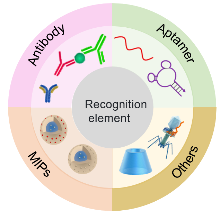
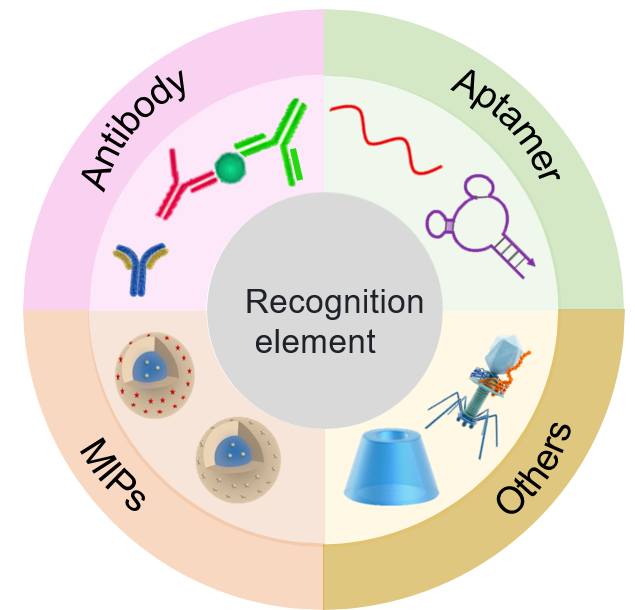
| 识别元件 | 特异性 | 稳定性(温度、pH耐受性) | 制备周期 | 综合成本 |
|---|---|---|---|---|
| 抗体 | 极高 | 较差、不耐高温与酸碱 | 长(数周~数月) | 高 |
| 适配体 | 高 | 良好、耐宽温、弱酸碱 | 中等(1~2周) | 中低 |
| 分子印迹聚合物 | 较高 | 优异、耐高温、强酸碱 | 中等(主流工艺3~7天) | 低 |
| β-环糊精 | 中等 | 优异 | 极短(数小时) | 极低 |
| 噬菌体展示肽 | 高 | 良好 | 较长(2~4周) | 中等 |
| 识别元件 | 特异性 | 稳定性(温度、pH耐受性) | 制备周期 | 综合成本 |
|---|---|---|---|---|
| 抗体 | 极高 | 较差、不耐高温与酸碱 | 长(数周~数月) | 高 |
| 适配体 | 高 | 良好、耐宽温、弱酸碱 | 中等(1~2周) | 中低 |
| 分子印迹聚合物 | 较高 | 优异、耐高温、强酸碱 | 中等(主流工艺3~7天) | 低 |
| β-环糊精 | 中等 | 优异 | 极短(数小时) | 极低 |
| 噬菌体展示肽 | 高 | 良好 | 较长(2~4周) | 中等 |
| Method | Materials | Target | Recognition element | Linear range/(μg•mL−1) | LOD/(μg•mL−1) | Ref. | |
|---|---|---|---|---|---|---|---|
| Fluorescence | B-CDs@MIPs/R-CDs | thiamethoxam | MIPs | 14.59~7292.75 | 3.94 | [ | |
| AuNPs/CDs | acetamiprid | aptamer | 0.005~0.100 | 0.001 | [ | ||
| nitrogen-doped CDs | imidacloprid | MIPs | 0.1~50 | 0.065 | [ | ||
| H2-SiO2@CsPbBr3 | thiamethoxam | β-CD | 0.004~0.018 | 0.001 | [ | ||
| Colorimetry | Fe-MOF | acetamiprid | 1×10⁻⁷~10 | 3.15×10⁻⁸ | [ | ||
| magnetic beads (MBs) | imidacloprid | Antibody | 5×10⁻⁵~0.05 | 6.3×10⁻⁵ | [ | ||
| graphene oxide (GO) | thiamethoxam | aptamer | 0.0015~0.0438 | 5×10⁻⁴ | [ | ||
| ECL | Fe/Zn-BTC@C-dots | thiamethoxam | aptamer | 1.5×10⁻⁵~1.46×10⁻² | 3×10⁻⁶ | [ | |
| NiFe-LDHs/Cu-SAs | thiamethoxam | aptamer | 5.8×10⁻⁷~1.75×10⁻³ | 1.9×10⁻⁷ | [ | ||
| RuZn-MOF | acetamiprid | aptamer | 1.0×10⁻⁷~1 | 3.33×10⁻⁸ | [ | ||
| Gd-MOF | acetamiprid | aptamer | 2.23×10⁻⁸~2.23×10⁻³ | 7.35×10⁻⁹ | [ | ||
| Zn-MOFs/Pt@Cu2O | acetamiprid | aptamer | 0~2.23×10⁻⁶ | 3.90×10⁻⁹ | [ | ||
| SERS | AuNPs/ITO | acetamiprid | MIPs | 0.022~44.53 | 7.12×10⁻⁴ | [ | |
| Au@pBDT-TA | thiamethoxam | Antibody | 2.0×10⁻⁶~8.0×10⁻⁵ | 5.0×10⁻⁷ | [ | ||
| UiO-66@TiO2/Au | thiamethoxam | 0.001 ~10 | 6.6×10⁻⁵ | [ | |||
| Dual-mode | HAuNPs/BSA-AuNCs | imidacloprid | Antibody | 2.0×10⁻⁵~2.0×10⁻³ (fluorescence); 2.0×10⁻⁵~1.0×10⁻³ (colorimetry) | 7.8×10⁻⁶ (fluorescence); 4.78×10⁻⁵ (colorimetry) | [ | |
| Au@Pt | imidacloprid | Antibody | 0~0.02 (fluorescence); 0.001 ~ 0.05 (colorimetry) | 1.14×10⁻³ (fluorescence); 8.8×10⁻⁴ (colorimetry) | [ | ||
| Method | Materials | Target | Recognition element | Linear range/(μg•mL−1) | LOD/(μg•mL−1) | Ref. | |
|---|---|---|---|---|---|---|---|
| Fluorescence | B-CDs@MIPs/R-CDs | thiamethoxam | MIPs | 14.59~7292.75 | 3.94 | [ | |
| AuNPs/CDs | acetamiprid | aptamer | 0.005~0.100 | 0.001 | [ | ||
| nitrogen-doped CDs | imidacloprid | MIPs | 0.1~50 | 0.065 | [ | ||
| H2-SiO2@CsPbBr3 | thiamethoxam | β-CD | 0.004~0.018 | 0.001 | [ | ||
| Colorimetry | Fe-MOF | acetamiprid | 1×10⁻⁷~10 | 3.15×10⁻⁸ | [ | ||
| magnetic beads (MBs) | imidacloprid | Antibody | 5×10⁻⁵~0.05 | 6.3×10⁻⁵ | [ | ||
| graphene oxide (GO) | thiamethoxam | aptamer | 0.0015~0.0438 | 5×10⁻⁴ | [ | ||
| ECL | Fe/Zn-BTC@C-dots | thiamethoxam | aptamer | 1.5×10⁻⁵~1.46×10⁻² | 3×10⁻⁶ | [ | |
| NiFe-LDHs/Cu-SAs | thiamethoxam | aptamer | 5.8×10⁻⁷~1.75×10⁻³ | 1.9×10⁻⁷ | [ | ||
| RuZn-MOF | acetamiprid | aptamer | 1.0×10⁻⁷~1 | 3.33×10⁻⁸ | [ | ||
| Gd-MOF | acetamiprid | aptamer | 2.23×10⁻⁸~2.23×10⁻³ | 7.35×10⁻⁹ | [ | ||
| Zn-MOFs/Pt@Cu2O | acetamiprid | aptamer | 0~2.23×10⁻⁶ | 3.90×10⁻⁹ | [ | ||
| SERS | AuNPs/ITO | acetamiprid | MIPs | 0.022~44.53 | 7.12×10⁻⁴ | [ | |
| Au@pBDT-TA | thiamethoxam | Antibody | 2.0×10⁻⁶~8.0×10⁻⁵ | 5.0×10⁻⁷ | [ | ||
| UiO-66@TiO2/Au | thiamethoxam | 0.001 ~10 | 6.6×10⁻⁵ | [ | |||
| Dual-mode | HAuNPs/BSA-AuNCs | imidacloprid | Antibody | 2.0×10⁻⁵~2.0×10⁻³ (fluorescence); 2.0×10⁻⁵~1.0×10⁻³ (colorimetry) | 7.8×10⁻⁶ (fluorescence); 4.78×10⁻⁵ (colorimetry) | [ | |
| Au@Pt | imidacloprid | Antibody | 0~0.02 (fluorescence); 0.001 ~ 0.05 (colorimetry) | 1.14×10⁻³ (fluorescence); 8.8×10⁻⁴ (colorimetry) | [ | ||
| [1] |
doi: 10.1016/j.envint.2023.108044 |
| [2] |
doi: 10.1021/acs.est.5c00372 |
| [3] |
doi: 10.1021/acs.est.5c18084 |
| [4] |
doi: 10.1016/j.envint.2025.109957 |
| [5] |
doi: 10.1016/j.envpol.2025.126814 |
| [6] |
doi: 10.1016/j.foodchem.2026.148256 |
| [7] |
doi: 10.1016/j.foodchem.2026.147885 |
| [8] |
doi: 10.6023/A26010003 |
|
(邵铭赫, 田烨, 汪娟丽, 苗荣, 房喻, 化学学报, 2026, 84, 484.)
doi: 10.6023/A26010003 |
|
| [9] |
doi: 10.1016/j.trac.2023.117152 |
| [10] |
doi: 10.1016/j.talanta.2024.125937 |
| [11] |
doi: 10.1016/j.trac.2025.118428 |
| [12] |
doi: 10.1016/j.foodchem.2023.137456 |
| [13] |
doi: 10.1021/acssensors.5c03955 |
| [14] |
doi: 10.1038/s44222-023-00067-z |
| [15] |
doi: 10.1016/j.snb.2025.138565 |
| [16] |
doi: 10.1007/s00604-024-06718-1 |
| [17] |
doi: 10.1016/j.talanta.2024.126190 |
| [18] |
doi: 10.1016/j.microc.2024.112083 |
| [19] |
doi: 10.1016/j.aca.2022.339677 |
| [20] |
doi: 10.1016/j.talanta.2023.124712 |
| [21] |
doi: 10.1016/j.trac.2025.118472 |
| [22] |
doi: 10.1016/j.bios.2023.115559 |
| [23] |
doi: 10.1016/j.foodchem.2025.143497 |
| [24] |
doi: 10.1016/j.cej.2024.151301 |
| [25] |
doi: 10.1016/j.foodchem.2023.137194 |
| [26] |
doi: 10.1016/j.jhazmat.2021.128011 |
| [27] |
doi: 10.1016/j.jare.2025.06.082 |
| [28] |
doi: 10.1016/j.trac.2025.118552 |
| [29] |
doi: 10.1016/j.foodchem.2024.141601 |
| [30] |
doi: 10.1039/D5NH00446B |
| [31] |
doi: 10.1002/cjoc.v43.18 |
| [32] |
doi: 10.1021/acsami.4c18752 |
| [33] |
doi: 10.1021/acs.analchem.5c01265 |
| [34] |
doi: 10.1016/j.jhazmat.2020.123619 |
| [35] |
doi: 10.1007/s12161-013-9732-3 |
| [36] |
doi: 10.1016/j.trac.2025.118562 |
| [37] |
doi: 10.1016/j.cej.2025.170337 |
| [38] |
doi: 10.1021/acsnano.5c03245 |
| [39] |
doi: 10.1002/smll.v18.3 |
| [40] |
doi: 10.1021/acs.jafc.5c07935 |
| [41] |
doi: 10.1021/acssensors.5c02604 |
| [42] |
doi: 10.1039/C8AN01166D |
| [43] |
doi: 10.1016/j.snb.2022.131671 |
| [44] |
doi: 10.1016/j.bios.2026.118632 |
| [45] |
doi: 10.1016/j.cej.2024.153325 |
| [46] |
doi: 10.1002/adma.v37.44 |
| [47] |
doi: 10.1016/j.aca.2021.338938 |
| [48] |
|
| [49] |
doi: 10.1016/j.bios.2018.10.006 |
| [50] |
doi: 10.1016/j.bios.2025.117379 |
| [51] |
doi: 10.1002/adfm.v35.47 |
| [52] |
doi: 10.1016/j.bios.2023.115554 |
| [53] |
doi: 10.1016/j.bios.2022.114841 |
| [54] |
doi: 10.1021/acs.analchem.4c05692 |
| [55] |
doi: 10.1016/j.cej.2025.170656 |
| [56] |
doi: 10.1016/j.foodchem.2025.147143 |
| [57] |
doi: 10.1016/j.snb.2025.137398 |
| [58] |
doi: 10.1021/acs.jafc.4c02612 |
| [59] |
doi: 10.1002/smll.v22.16 |
| [60] |
doi: 10.1016/j.snb.2023.134415 |
| [61] |
doi: 10.1007/s00604-025-07457-7 |
| [62] |
doi: 10.1021/acs.analchem.4c00364 |
| [63] |
doi: 10.1016/j.bios.2025.117286 |
| [64] |
doi: 10.1016/j.bios.2025.118107 |
| [65] |
doi: 10.1021/acs.analchem.5c04394 |
| [66] |
doi: 10.1016/j.cej.2025.160813 |
| [67] |
doi: 10.1016/j.foodres.2024.115388 |
| [68] |
doi: 10.1016/j.foodchem.2025.143439 |
| [1] | 苗成旺, 侯佳宁, 汪俊彦, 韩达. 邻近依赖性核酸自组装技术用于蛋白质相互作用解析★[J]. 化学学报, 2025, 83(10): 1285-1292. |
| [2] | 王亚锋, 杨倩, 苏彬. 基于纳米多孔薄膜光学干涉的光学传感器[J]. 化学学报, 2017, 75(11): 1071-1081. |
| [3] | 张佳玉, 周晓毓, 周曼, 贾红霞. 基于杂交链式反应信号放大和磁分离技术荧光检测端粒酶活性[J]. 化学学报, 2016, 74(6): 513-517. |
| [4] | 林洁华, 张慧慧, 楚鹏飞. 基于氧化石墨烯信号放大的化学发光法联合检测甲胎蛋白和癌胚抗原[J]. 化学学报, 2012, 70(22): 2372-2376. |
| [5] | 王潇蕤, 李继睿. 金增强多重胶体金标记树枝状复合物放大的电化学免疫分析新方法[J]. 化学学报, 2011, 69(10): 1211-1216. |
| [6] | 肖毅, 胡玉琴, 黄红梅*, 尹笃林, 肖小明. 含磺酸根侧链的聚苯乙炔-吡啶类共轭聚合物的荧光传感性能[J]. 化学学报, 2011, 69(07): 838-842. |
| [7] | 侯明, 那佳, 沈坤. CdTe/CdS量子点荧光探针测定司帕沙星含量[J]. 化学学报, 2010, 68(14): 1437-1442. |
| 阅读次数 | ||||||
|
全文 |
|
|||||
|
摘要 |
|
|||||
