化学学报 ›› 2026, Vol. 84 ›› Issue (8): 1305-1311.DOI: 10.6023/A26050176 上一篇 下一篇
研究论文
唐允浩a, 周齐治b, 王韬a, 邱智恒a, 乐效靖a, 张燕b,*( ), 余金生a,*()
投稿日期:2026-05-26
发布日期:2026-07-08
基金资助:
Yunhao Tanga, Qizhi Zhoub, Tao Wanga, Zhiheng Qiua, Xiaojing Lea, Yan Zhangb,*(), Jinsheng Yua,*()
Received:2026-05-26
Published:2026-07-08
Contact:
E-mail: Supported by:文章分享

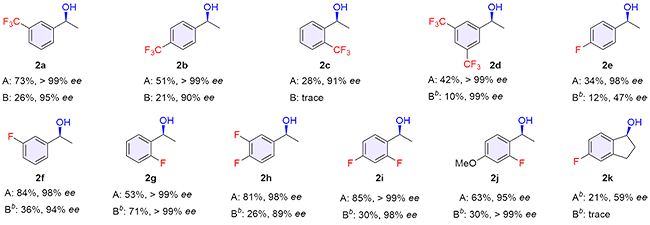
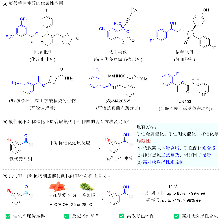
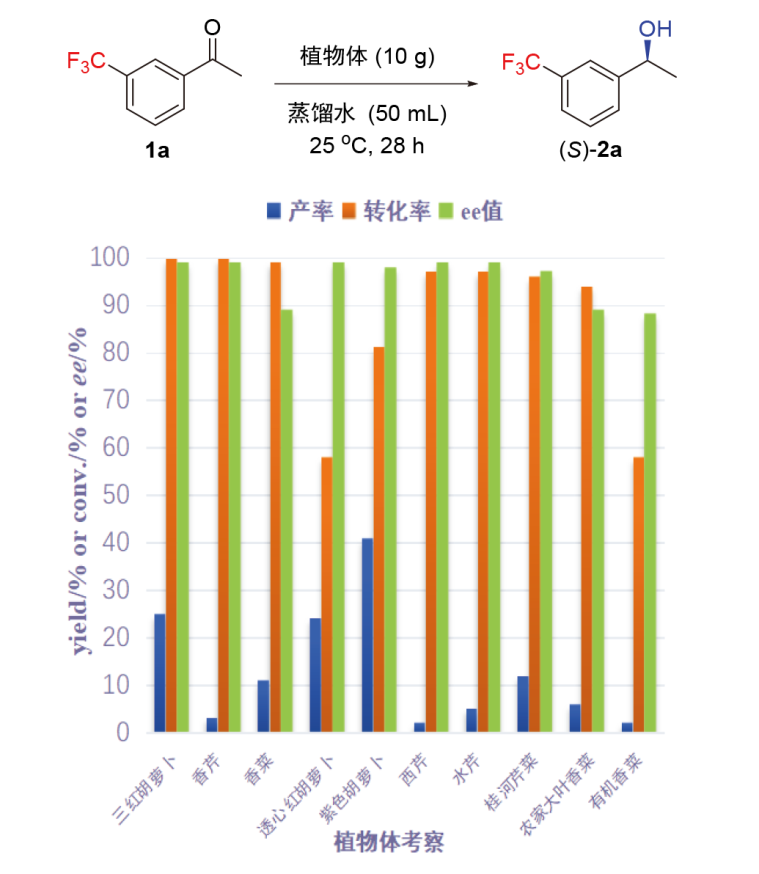
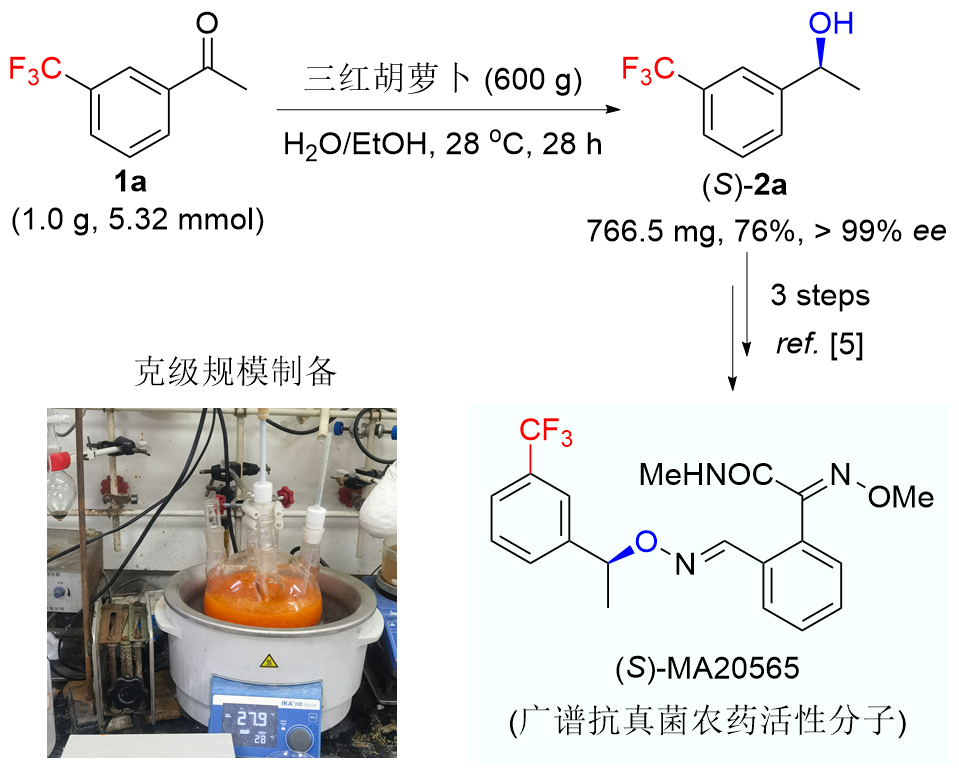
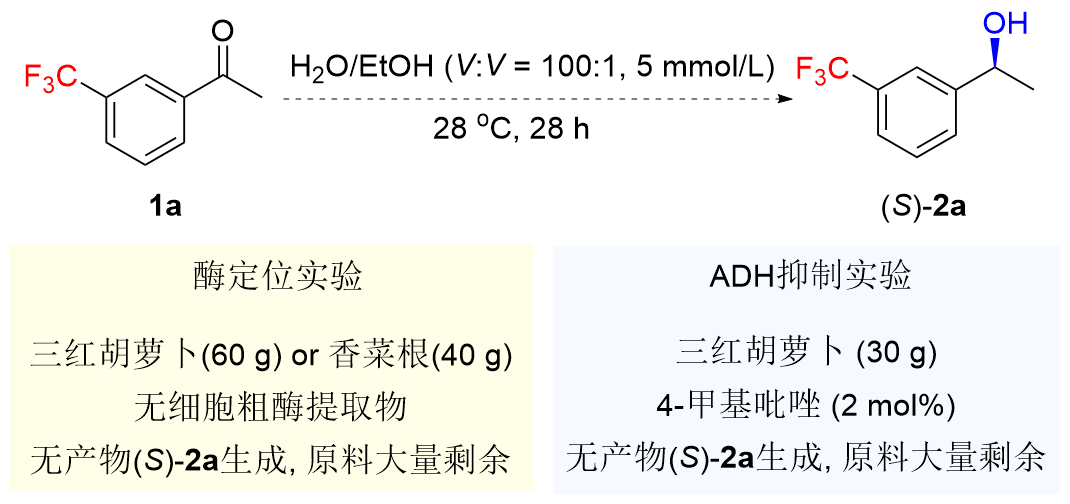
氟代手性仲醇是许多医药、农药及生物活性分子的关键结构单元, 其绿色、高效、高选择性的制备对药物合成工艺创新具有重要意义. 近年来, 植物全细胞生物催化已成为通过不对称还原酮类化合物合成光学活性手性仲醇的一种新策略, 具有催化剂廉价易得、反应条件温和、环境友好等优点. 然而, 利用该方法制备氟代手性仲醇的研究仍较为有限. 本工作系统考察了多种廉价易得的蔬菜植物组织对氟代芳香酮的不对称还原性能, 发现三红胡萝卜能高效、高选择性地还原多种氟代酮, 以中等到良好的分离产率(21%~85%)及中等到优秀的对映选择性(59%~>99% ee)获得相应氟代手性仲醇, 其中包含多个可用于合成医药和农药分子的关键中间体. 该方法具有良好的放大合成潜力, 如1 g间三氟甲基苯乙酮1a经三红胡萝卜催化还原后, 能以76%分离收率和大于99% ee获得0.766 g目标产物(S)-2a. 尤为值得一提的是, 本研究首次发现香菜根可作为全细胞生物催化剂, 实现氟代酮的高选择性还原, 且在部分底物中表现出优于胡萝卜的催化效果, 为植物全细胞催化不对称合成提供了全新的催化剂资源.
唐允浩, 周齐治, 王韬, 邱智恒, 乐效靖, 张燕, 余金生. 三红胡萝卜和香菜介导的氟代芳香酮不对称还原反应[J]. 化学学报, 2026, 84(8): 1305-1311.
Yunhao Tang, Qizhi Zhou, Tao Wang, Zhiheng Qiu, Xiaojing Le, Yan Zhang, Jinsheng Yu. Asymmetric Reduction of Fluorinated Aromatic Ketones Mediated by Daucus carota and Coriandrum sativum[J]. Acta Chimica Sinica, 2026, 84(8): 1305-1311.
| Entry | pH | T/℃ | Y/mL | X/g | Yield a/% | eea/% |
|---|---|---|---|---|---|---|
| 1 | 7.0 | 25 | 50 | 10 | 25 | >99 |
| 2 | 6.5 | 25 | 50 | 10 | 21 | >99 |
| 3 | 7.5 | 25 | 50 | 10 | 7 | >99 |
| 4 | 7.0 | 25 | 25 | 10 | 20 | >99 |
| 5 | 7.0 | 25 | 100 | 10 | 19 | >99 |
| 6 | 7.0 | 28 | 50 | 10 | 36 | >99 |
| 7 | 7.0 | 30 | 50 | 10 | 28 | >99 |
| 8 | 7.0 | 33 | 50 | 10 | 17 | >99 |
| 9 | 7.0 | 28 | 50 | 20 | 71 | >99 |
| 10 | 7.0 | 28 | 50 | 30 | 73 | >99 |
| Entry | pH | T/℃ | Y/mL | X/g | Yield a/% | eea/% |
|---|---|---|---|---|---|---|
| 1 | 7.0 | 25 | 50 | 10 | 25 | >99 |
| 2 | 6.5 | 25 | 50 | 10 | 21 | >99 |
| 3 | 7.5 | 25 | 50 | 10 | 7 | >99 |
| 4 | 7.0 | 25 | 25 | 10 | 20 | >99 |
| 5 | 7.0 | 25 | 100 | 10 | 19 | >99 |
| 6 | 7.0 | 28 | 50 | 10 | 36 | >99 |
| 7 | 7.0 | 30 | 50 | 10 | 28 | >99 |
| 8 | 7.0 | 33 | 50 | 10 | 17 | >99 |
| 9 | 7.0 | 28 | 50 | 20 | 71 | >99 |
| 10 | 7.0 | 28 | 50 | 30 | 73 | >99 |
| Entry | 香菜部位 | T/℃ | X/g | pH | Yield a/% | eea/% |
|---|---|---|---|---|---|---|
| 1 | 茎 | 25 | 10 | 7.0 | 3 | 80 |
| 2 | 叶 | 25 | 10 | 7.0 | 12 | 88 |
| 3 | 根 | 25 | 10 | 7.0 | 7 | 91 |
| 4 | 根 | 28 | 10 | 7.0 | 8 | 91 |
| 5 | 根 | 30 | 10 | 7.0 | 5 | 88 |
| 6 | 根 | 25 | 10 | 6.5 | 3 | 91 |
| 7 | 根 | 25 | 10 | 7.5 | 4 | 91 |
| 8 | 根 | 25 | 20 | 7.0 | 11 | 91 |
| Entry | 香菜部位 | T/℃ | X/g | pH | Yield a/% | eea/% |
|---|---|---|---|---|---|---|
| 1 | 茎 | 25 | 10 | 7.0 | 3 | 80 |
| 2 | 叶 | 25 | 10 | 7.0 | 12 | 88 |
| 3 | 根 | 25 | 10 | 7.0 | 7 | 91 |
| 4 | 根 | 28 | 10 | 7.0 | 8 | 91 |
| 5 | 根 | 30 | 10 | 7.0 | 5 | 88 |
| 6 | 根 | 25 | 10 | 6.5 | 3 | 91 |
| 7 | 根 | 25 | 10 | 7.5 | 4 | 91 |
| 8 | 根 | 25 | 20 | 7.0 | 11 | 91 |
| [1] |
(a)
doi: 10.1021/acsorginorgau.2c00019 |
|
(b)
doi: 10.6023/A12070447 |
|
|
(郑柯, 林丽丽, 冯小明, 化学学报, 2012, 70, 1785.)
doi: 10.6023/A12070447 |
|
|
(c)
doi: 10.1039/D5OB00330J |
|
| [2] |
(a)
doi: 10.1021/jo0203793 pmid: 12590540 |
|
(b)
pmid: 12590540 |
|
|
(c)
pmid: 12590540 |
|
|
(王亮, 徐刚, 杨立荣, 化工进展, 2013, 32, 2691.)
pmid: 12590540 |
|
| [3] |
(a)
doi: 10.1002/anie.v50.13 |
|
(b)
doi: 10.1021/acs.orglett.6b02807 |
|
|
(c)
|
|
| [4] |
(a)
doi: 10.1021/acs.orglett.9b04253 |
|
(b)
doi: 10.1021/acs.oprd.5b00267 |
|
| [5] |
(a)
|
|
(b)
doi: 10.1080/00397910802663378 |
|
| [6] |
(a)
doi: 10.1039/b610738a |
|
(b)
doi: 10.1021/jacsau.3c00481 |
|
|
(c)
doi: 10.1002/anie.v63.24 |
|
| [7] |
(a)
doi: 10.1021/cr4002879 |
|
(b)
doi: 10.1021/acs.orglett.0c02565 |
|
|
(c)
doi: 10.1039/D3OB00193H |
|
| [8] |
(a)
|
|
(杨思娅, 孙成科, 林雪飞, 马思渝, 李宗和, 化学学报, 2003, 61, 192.)
|
|
|
(b)
doi: 10.1002/chem.v25.46 |
|
|
(c)
doi: 10.6023/A25030092 |
|
|
(李斌, 张静枫, 聂慧芳, 卢泽星, 杨贵东, 张生勇, 化学学报, 2025, 83, 661.)
doi: 10.6023/A25030092 |
|
| [9] |
(a)
|
|
(b)
doi: 10.1021/acs.orglett.5b00085 |
|
|
(c)
doi: 10.3390/molecules23102408 |
|
| [10] |
(a)
doi: 10.1016/j.biotechadv.2010.09.001 pmid: 20837129 |
|
(b)
doi: 10.1016/j.bioorg.2013.09.003 pmid: 20837129 |
|
|
(c)
doi: 10.1039/D3OB00193H pmid: 20837129 |
|
| [11] |
(a)
doi: 10.1016/j.tet.2023.133781 |
|
(b)
doi: 10.1021/acs.orglett.6c00812 |
|
| [12] |
(a)
doi: 10.1007/s10295-008-0381-2 |
|
(b)
doi: 10.1080/10242422.2021.1879795 |
|
|
(c)
doi: 10.1016/j.rechem.2024.101564 |
|
| [13] |
doi: 10.1016/j.procbio.2020.03.020 |
| [14] |
(a)
pmid: 12027710 |
|
(b)
pmid: 12027710 |
|
|
(c)
pmid: 12027710 |
|
|
(d)
doi: 10.1021/acsmedchemlett.3c00114 pmid: 12027710 |
|
| [15] |
(a)
|
|
(刘湘, 张宝立, 夏咏梅, 许建和, 化学学报, 2009, 67, 1492.)
|
|
|
(b)
doi: 10.3390/app8122605 |
|
| [16] |
(a)
doi: 10.1007/s12257-009-0207-8 |
|
(b)
doi: 10.3109/10242422.2011.635302 |
|
| [17] |
doi: 10.3109/10242422.2014.976634 |
| [18] |
|
| [19] |
doi: 10.1016/j.jics.2023.101111 |
| [20] |
doi: 10.1039/D5RA00901D |
| [21] |
|
|
(乌雅罕, 吴晶晶, 吴范宏, 生物化学与生物物理进展, 2023, 50, 1614.)
|
|
| [22] |
(a)
doi: 10.1039/D4CS01269K pmid: 38020394 |
|
(b)
doi: 10.1039/D4CS00417E pmid: 38020394 |
|
|
(c)
doi: 10.1039/D4CC03788J pmid: 38020394 |
|
|
(d)
doi: 10.1002/ajoc.201900071 pmid: 38020394 |
|
|
(e)
doi: 10.1039/C9CC07677H pmid: 38020394 |
|
|
(f)
doi: 10.1002/anie.v61.38 pmid: 38020394 |
|
|
(g)
doi: 10.1039/D2SC03958C pmid: 38020394 |
|
|
(h)
doi: 10.1021/acs.orglett.2c03393 pmid: 38020394 |
|
|
(i)
doi: 10.1002/anie.v62.9 pmid: 38020394 |
|
|
(j)
doi: 10.1039/d3sc04474b pmid: 38020394 |
|
|
(k)
doi: 10.1002/cjoc.v44.9 pmid: 38020394 |
|
|
(l)
doi: 10.1007/s11426-025-2720-1 pmid: 38020394 |
|
|
(m)
pmid: 38020394 |
|
| [23] |
doi: 10.1016/j.molcatb.2007.10.003 |
| [24] |
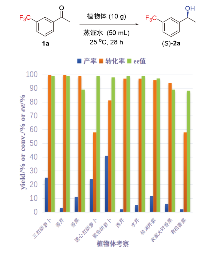
According to the suggestion of one reviewer, we have provided the specific yields of the reactions catalyzed by different plant tissues in Section 2 of the Supporting Information, to better evaluate the catalytic efficiency.
|
| [25] |
|
| [26] |
doi: 10.3923/pjbs.2000.250.256 |
| [27] |
doi: 10.1016/j.cbi.2010.12.005 |
| No related articles found! |
| 阅读次数 | ||||||
|
全文 |
|
|||||
|
摘要 |
|
|||||