

化学学报 ›› 2026, Vol. 84 ›› Issue (8): 1312-1317.DOI: 10.6023/A26050155 上一篇 下一篇
研究论文
蒋东晓a, 杨云b, 代科旭a, 陈樟a, 陈劲进a, 曾要富a,*( )
)
投稿日期:2026-05-11
发布日期:2026-06-23
作者简介:共同第一作者
基金资助:
Dong-Xiao Jianga,†, Yun Yangb,†, Kexu Daia, Zhang Chena, Jinjin Chena, Yao-Fu Zenga,*()
Received:2026-05-11
Published:2026-06-23
Contact:
E-mail: About author:The authors contributed equally to this work.
Supported by:文章分享
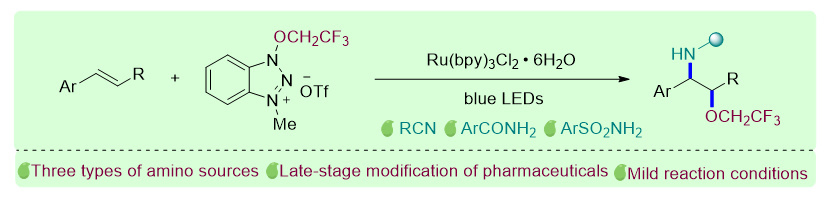
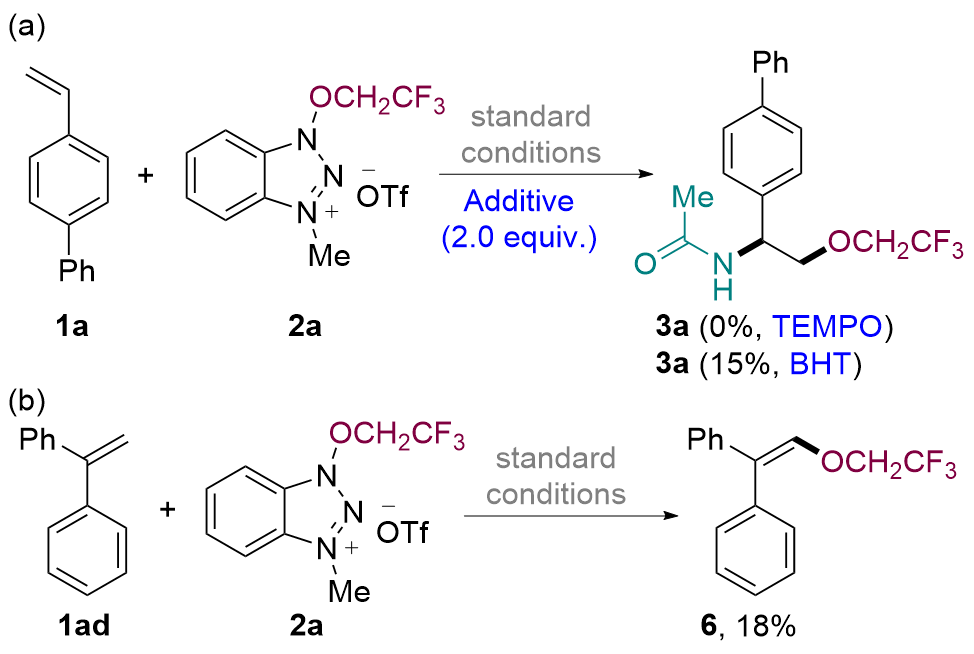
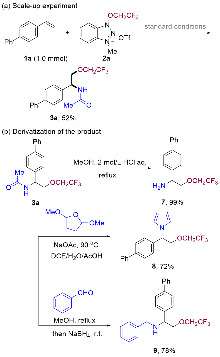
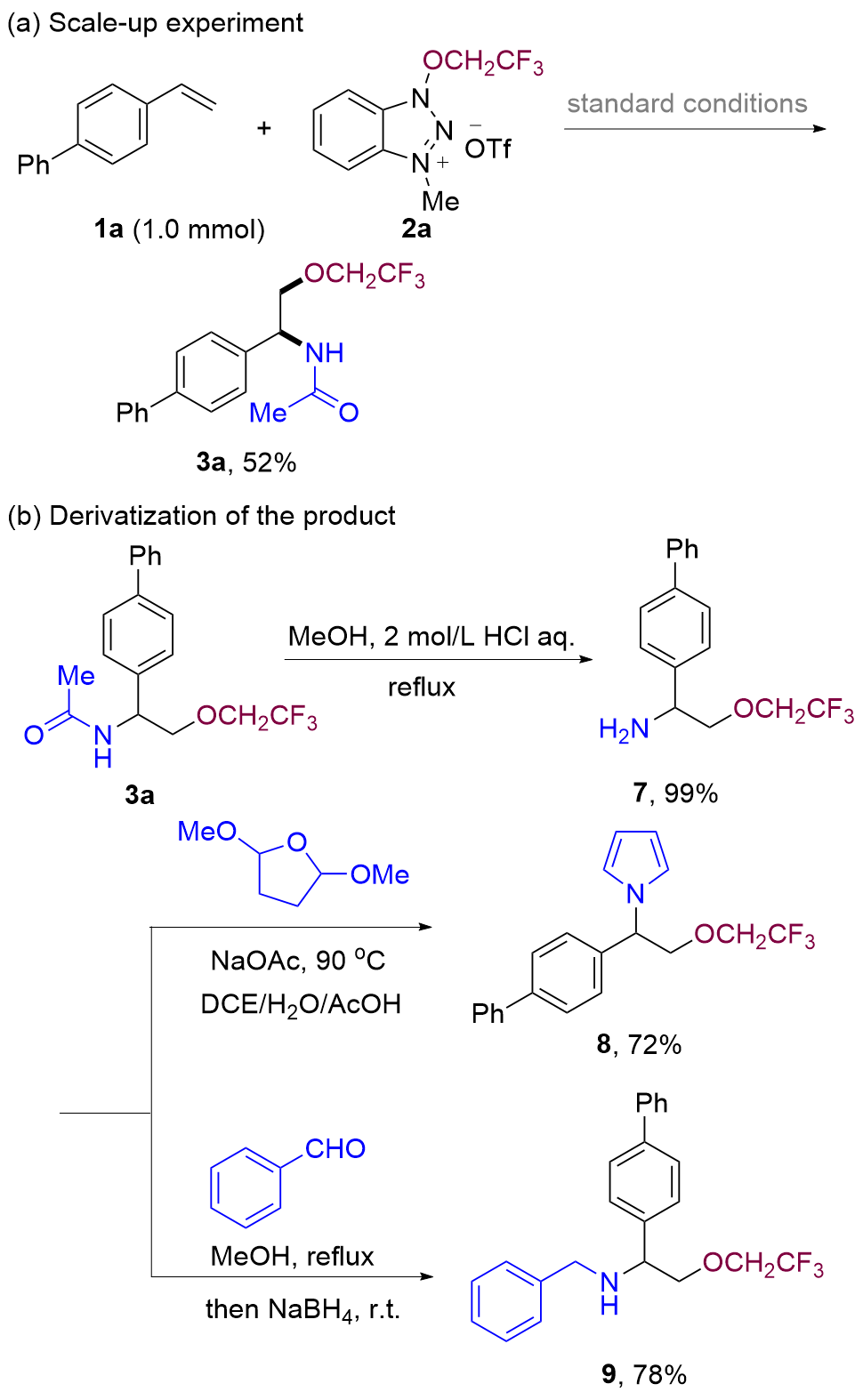
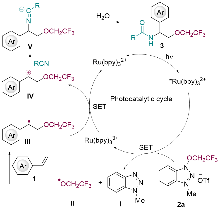
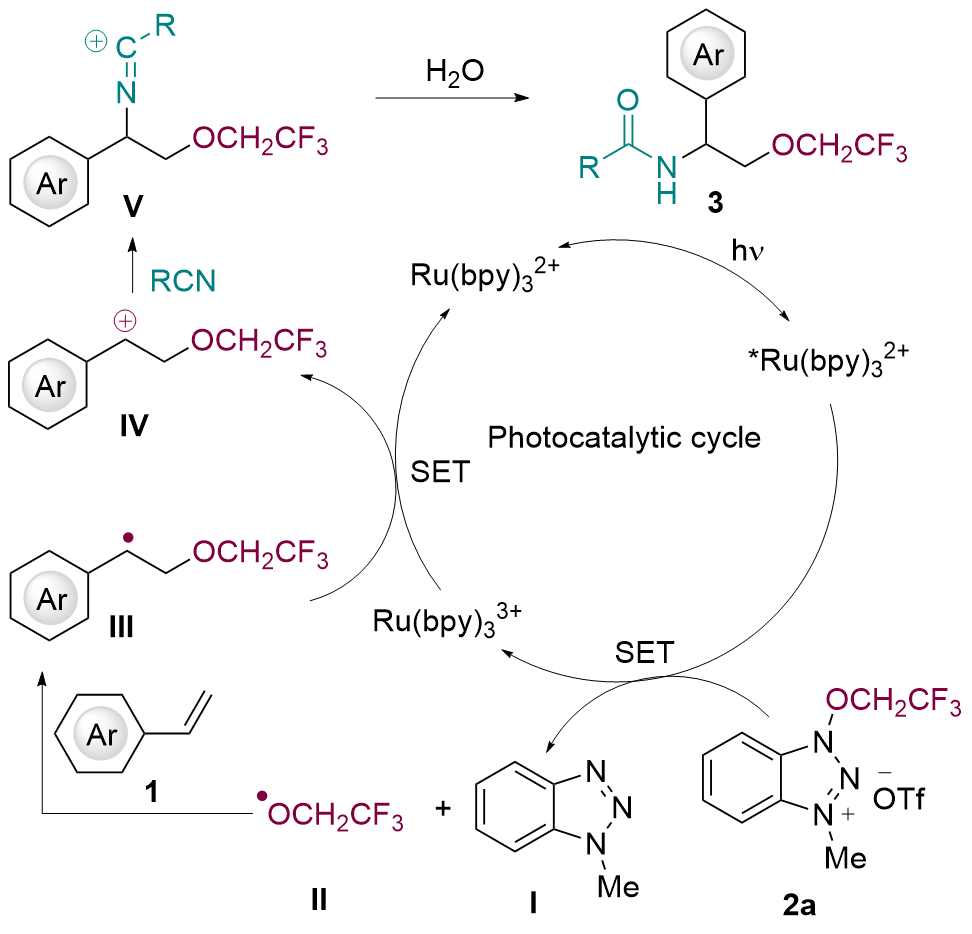
发展了一种高效、温和的可见光氧化还原催化烯烃的自由基三氟乙氧基化/胺化双官能团化反应, 为β-三氟乙氧基胺类化合物的精准合成提供了新的有效路径. 该方法展现出良好的官能团耐受性与广泛的底物适用范围, 能够兼容多种常见的给电子、吸电子官能团, 其中腈类、苯甲酰胺及苯磺酰胺均被证实为适宜的氮中心亲核试剂. 此外, 该方法还可应用于药物分子的后期结构修饰. 反应所得产物可通过后续的官能团转化反应, 衍生得到结构多样的含氟衍生物, 充分验证了该类产物在有机合成中的潜在应用价值. 初步机理研究结果表明, 该反应可能遵循自由基反应路径.
蒋东晓, 杨云, 代科旭, 陈樟, 陈劲进, 曾要富. 光氧化还原催化的烯烃自由基三氟乙氧基化/胺化反应[J]. 化学学报, 2026, 84(8): 1312-1317.
Dong-Xiao Jiang, Yun Yang, Kexu Dai, Zhang Chen, Jinjin Chen, Yao-Fu Zeng. Photoredox-Catalyzed Radical Trifluoroethoxylation/Amination of Alkenes[J]. Acta Chimica Sinica, 2026, 84(8): 1312-1317.
| Entry | Variation from the standard conditions | 3a Yieldb/% | 10 Yieldb/% |
|---|---|---|---|
| 1 | None | 68 (62)c | 12 |
| 2 | Ru(bpy)3(PF6)2 | 62 | 16 |
| 3 | [Ir(dtbbpy)(ppy)2][PF6] | 67 | 12 |
| 4 | 1 mol% Ru(bpy)3Cl2•6H2O | 50 | 16 |
| 5 | 3 h instead of 5 h | 54 | 15 |
| 6 | 1a∶2a=1∶3 | 68 | 13 |
| 7 | 1a∶2a=2∶1 | 27 | 8 |
| 8 | 0.5 mL MeCN | 46 | 14 |
| 9 | 0.1 mmol TFA | 62 | 12 |
| 10 | No Ar | 37 | 14 |
| 11 | No photocatalyst | N.D. | N.D. |
| 12 | In dark | N.D. | N.D. |
| Entry | Variation from the standard conditions | 3a Yieldb/% | 10 Yieldb/% |
|---|---|---|---|
| 1 | None | 68 (62)c | 12 |
| 2 | Ru(bpy)3(PF6)2 | 62 | 16 |
| 3 | [Ir(dtbbpy)(ppy)2][PF6] | 67 | 12 |
| 4 | 1 mol% Ru(bpy)3Cl2•6H2O | 50 | 16 |
| 5 | 3 h instead of 5 h | 54 | 15 |
| 6 | 1a∶2a=1∶3 | 68 | 13 |
| 7 | 1a∶2a=2∶1 | 27 | 8 |
| 8 | 0.5 mL MeCN | 46 | 14 |
| 9 | 0.1 mmol TFA | 62 | 12 |
| 10 | No Ar | 37 | 14 |
| 11 | No photocatalyst | N.D. | N.D. |
| 12 | In dark | N.D. | N.D. |
| [1] |
(a)
doi: 10.1002/ejoc.v27.25 |
|
(b)
doi: 10.1021/jm800219f |
|
|
(c)
doi: 10.1002/ajoc.v14.7 |
|
|
(d)
doi: 10.1021/cr4002879 |
|
|
(e)
doi: 10.1002/cjoc.v42.24 |
|
|
(f)
doi: 10.6023/A25070258 |
|
|
史同同, 李佳, 殷一樊, 孙凯, 化学学报, 2026, 84, 135);
doi: 10.6023/A25070258 |
|
|
(g)
doi: 10.1007/s11426-025-2831-2 |
|
|
(h)
doi: 10.6023/A25060238 |
|
|
(苏秦, 雷平, 王栋,
doi: 10.6023/A25060238 |
|
| [2] |
(a)
doi: 10.1002/ajoc.v8.5 |
|
(b)
doi: 10.1021/ol0479794 |
|
|
(c)
doi: 10.1002/adsc.v362.20 |
|
| [3] |
(a)
doi: 10.1016/j.tetlet.2016.03.023 |
|
(b)
doi: 10.1016/j.jfluchem.2016.07.008 |
|
|
(c)
doi: 10.1002/chem.v23.62 |
|
|
(d)
doi: 10.1002/anie.v54.19 |
|
|
(e)
doi: 10.1016/j.tet.2015.08.071 |
|
|
(f)
doi: 10.1021/acs.orglett.0c02347 |
|
|
(g)
doi: 10.2174/1570178615666181108111232 |
|
| [4] |
(a)
doi: 10.1002/anie.v54.48 |
|
(b)
doi: 10.1016/j.jfluchem.2017.09.009 |
|
|
(c)
doi: 10.1039/D3QO01366A |
|
|
(d)
doi: 10.1016/S0040-4039(02)01719-7 |
|
| [5] |
(a)
doi: 10.1021/acs.orglett.7b01103 |
|
(b)
doi: 10.1002/cctc.v12.13 |
|
|
(c)
doi: 10.1021/acs.orglett.9b01578 |
|
|
(d)
doi: 10.1002/ajoc.v7.4 |
|
| [6] |
(a)
doi: 10.1021/cr300503r |
|
(b)
doi: 10.1002/anie.v51.28 |
|
|
(c)
doi: 10.1021/acs.chemrev.1c00247 |
|
|
(d)
doi: 10.1039/D1CS00311A |
|
|
(e)
doi: 10.1039/B913880N |
|
|
(f)
doi: 10.1021/acs.orglett.5c03734 |
|
|
(g)
doi: 10.1007/s11426-025-2803-3 |
|
|
(h)
doi: 10.6023/A25110372 |
|
|
孟凡荣, 李国锋, 赵杰, 肖文精, 石德清, 陈加荣, 化学学报, 2025, 83, 1472);
doi: 10.6023/A25110372 |
|
|
(i)
doi: 10.6023/A25060220 |
|
|
汪晨程, 欧阳班来, 钟品勇, 张莺瑢, 刘晋彪, 化学学报, 2026, 84, 1);
doi: 10.6023/A25060220 |
|
|
(j)
doi: 10.6023/A25090302 |
|
|
熊雨平, 谢文林, 陈健强, 吴劼, 化学学报, 2025, 83, 1592);
doi: 10.6023/A25090302 |
|
|
(k)
doi: 10.6023/A25120428 |
|
|
张蒙爱, 靳皓冉, 孙凯, 祝艳平, 王薪, 化学学报, 2026, 84, 572);
doi: 10.6023/A25120428 |
|
|
(l)
doi: 10.1002/cjoc.v43.24 |
|
|
(m)
|
|
|
徐磊, 王方, 陈凡, 朱圣卿, 储玲玲, 有机化学, 2022, 42, 1).
doi: 10.6023/cjoc202109002 |
|
| [7] |
(a)
doi: 10.1021/acs.orglett.4c03710 |
|
(b)
doi: 10.1021/acs.orglett.5c00383 |
|
| [8] |
doi: 10.1002/ceur.v3.4 |
| [9] |
doi: 10.1039/D4SC07788A |
| [1] | 管敏慧, 孙超, 耿娜, 陈铃涵, 周泉, 王成烨, 王磊. 光促进4DPAIPN-F/CF3催化偕二氟苯乙烯和N-保护氨基酸偶联反应[J]. 化学学报, 2026, 84(7): 1033-1039. |
| [2] | 张琴, 陈祎瑶, 牛晶, 郅玉春, 徐舒涛, 魏迎旭, 刘中民. 甲醇制烯烃(MTO)反应积炭演化和再生研究进展[J]. 化学学报, 2026, 84(6): 987-1002. |
| [3] | 张伟宏, 马亚男, 方翰, 薛东旭. 面向乙烯一步纯化的多组分金属有机框架: 金属配体导向合成与C2混合气高效分离★[J]. 化学学报, 2026, 84(5): 659-666. |
| [4] | 徐衍泽, 韩南南, 刁小琼, 袁金伟, 肖咏梅, 杨亮茹, 屈凌波. 氮杂环卡宾钯络合物催化Buchwald-Hartwig胺化反应研究进展[J]. 化学学报, 2026, 84(4): 521-571. |
| [5] | 史同同, 李佳, 殷一樊, 孙凯. 光化学驱动α-三氟甲基烯烃的多样性转化[J]. 化学学报, 2026, 84(1): 135-159. |
| [6] | 李文静, 杨黎燕, 关丽, 张雪娇, 尤静, 沈思语, 赵钰琦, 段琛. 可见光/硫酚催化烯烃C=C双键的氧化裂解反应[J]. 化学学报, 2025, 83(6): 596-601. |
| [7] | 胡博, 肖霞, 王鹏, 束小龙, 卞梦琪, 王健捷, 赵震. 二氧化碳加氢制低碳烯烃Fe基催化剂研究进展[J]. 化学学报, 2025, 83(5): 535-550. |
| [8] | 孟凡荣, 李国锋, 赵杰, 肖文精, 石德清, 陈加荣. 光催化氮自由基参与的乙烯基环丙烷加成/环化反应合成四氢吡啶★[J]. 化学学报, 2025, 83(12): 1472-1479. |
| [9] | 苏秦, 雷平, 王栋, Shahid Ali Khan, 阿布拉江•克依木. 可见光诱导的α-三氟甲基烯烃与芳香酸酐的脱氟酰化反应[J]. 化学学报, 2025, 83(11): 1372-1378. |
| [10] | 王波, 朱光宇, 徐广强, 王亮, 侯鸿斌, 张良, 王庆刚. 三齿钛配合物催化的1-丁烯(共)聚合反应研究★[J]. 化学学报, 2025, 83(10): 1134-1141. |
| [11] | 刘浩, 徐旭莉, 郭勇, 刘晓晖, 王艳芹. Ru/NiPOx高效电催化醛还原胺化反应的研究[J]. 化学学报, 2024, 82(5): 477-485. |
| [12] | 邓沈娜, 彭常春, 牛云宏, 许云, 张云霄, 陈祥, 王红敏, 刘珊珊, 沈晓. 自由基Brook重排调控的α-氟烷基-α-硅基甲醇参与的烯烃双官能团化反应[J]. 化学学报, 2024, 82(2): 119-125. |
| [13] | 万义, 何江华, 张越涛. Lewis酸碱对催化极性烯烃单体精准聚合的研究进展★[J]. 化学学报, 2023, 81(9): 1215-1230. |
| [14] | 袁芳艳, 李超, 罗美明, 曾小明. 铬催化酮羰基的脱氧偶联反应合成四取代烯烃★[J]. 化学学报, 2023, 81(5): 456-460. |
| [15] | 汪阳, 阎敬灵. 不同配体的稀土金属配合物在烯烃聚合领域的研究进展[J]. 化学学报, 2023, 81(3): 275-288. |
| 阅读次数 | ||||||
|
全文 |
|
|||||
|
摘要 |
|
|||||
