

化学学报 ›› 2026, Vol. 84 ›› Issue (9): 1497-1506.DOI: 10.6023/A26010027 上一篇 下一篇
研究论文
文洁a, 陈洁a, 郭焕焕b,*( ), 汪佳艳a, 郑松志a, 殷逍遥a, 朱文昊a, 吴韫佳a, 孙伟海a,*()
投稿日期:2026-01-26
发布日期:2026-08-17
通讯作者:
郭焕焕, 孙伟海
基金资助:
Jie Wena, Jie Chena, Huanhuan Guob,*(), Jiayan Wanga, Songzhi Zhenga, Xiaoyao Yina, Wenhao Zhua, Yunjia Wua, Weihai Suna,*()
Received:2026-01-26
Published:2026-08-17
Contact:
Huanhuan Guo, Weihai Sun
Supported by:文章分享
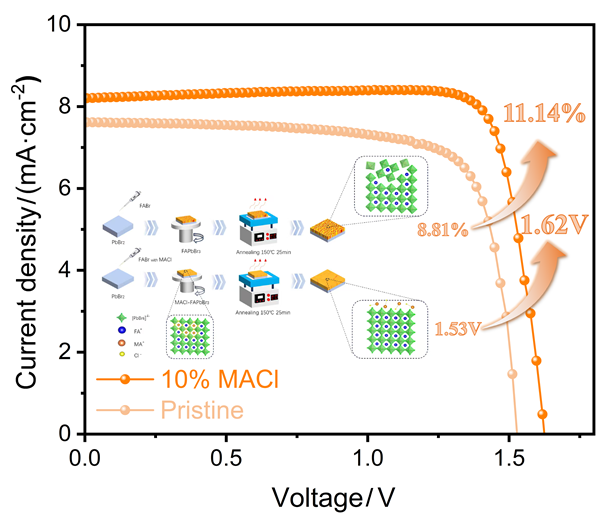
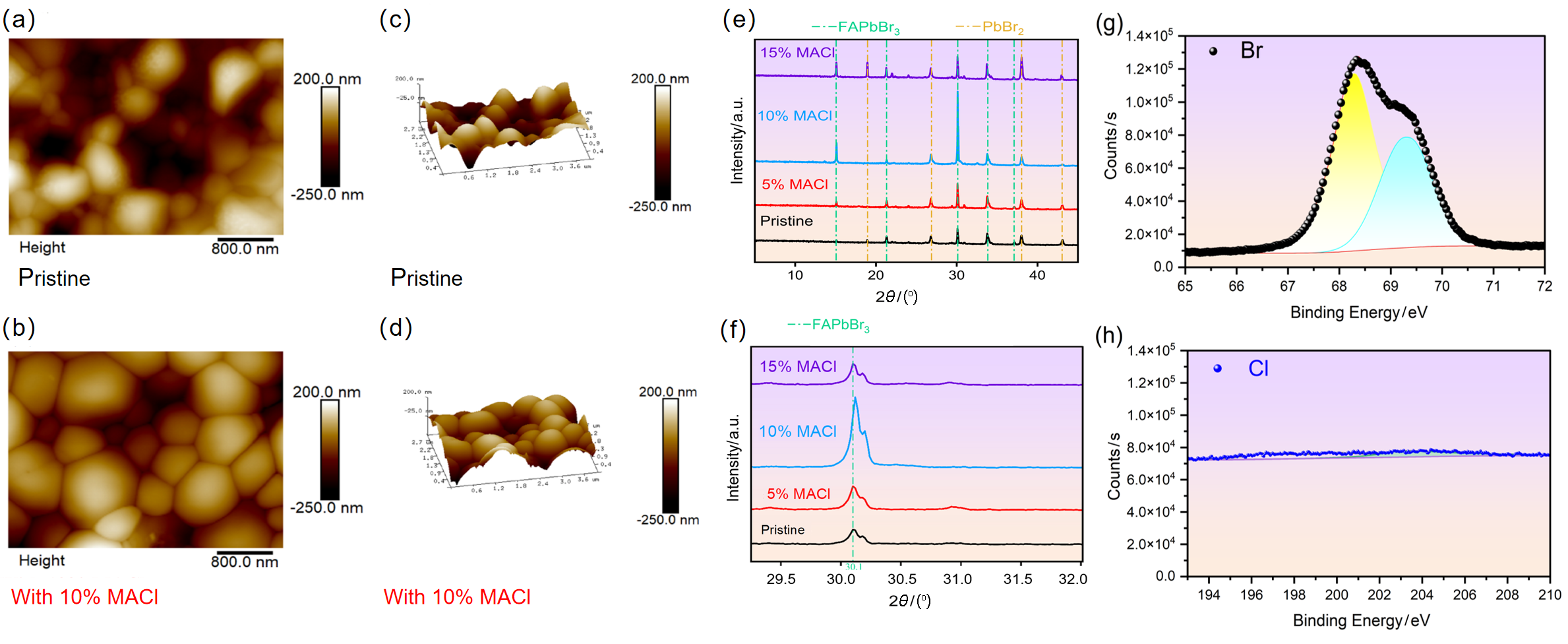
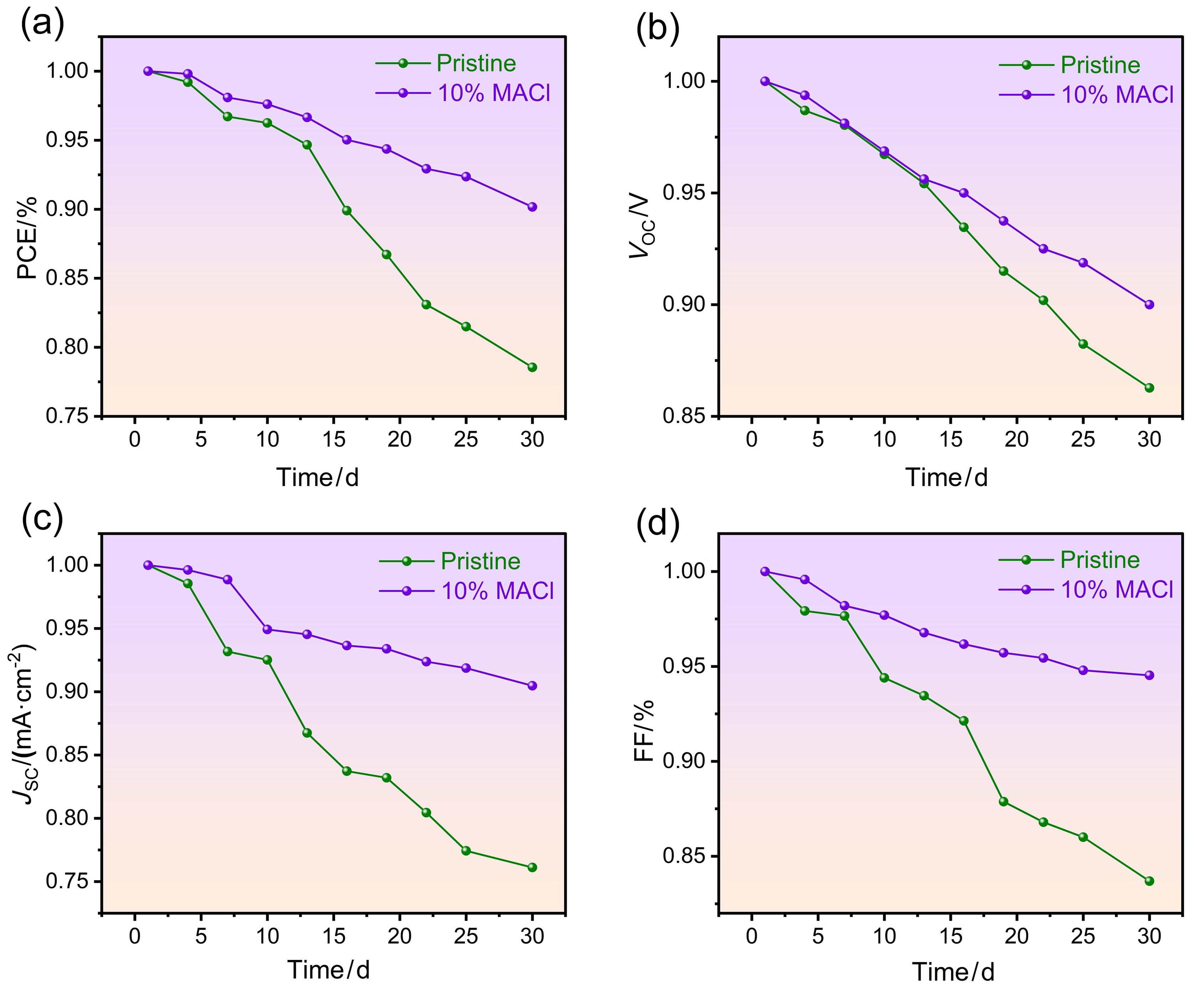
近年来, 钙钛矿太阳能电池(Perovskite solar cells, PSCs)凭借高效率、低成本、带隙可调等优势, 被视为下一代光伏技术的核心竞争者. 本研究系统探究了添加剂氯化甲铵(MACl)对FAPbBr3钙钛矿薄膜的结晶动力学调控及对器件光伏性能的影响, 旨在通过优化添加剂策略提升电池效率与稳定性. 将MACl引入FABr前驱体溶液中, 制备了结构为FTO/TiO2/FAPbBr3-MACl/C的太阳能电池器件. 通过改变MACl-FABr甲醇溶液中MACl相对于FABr的质量分数来调控FAPbBr3钙钛矿晶体的生长. 研究表明当MACl掺杂浓度为10%时制备出了最高开路电压(Open Circuit Voltage, VOC)为1.62 V, 短路电流密度(Short Circuit Current Density, JSC)为8.21 mA•cm⁻2, 填充因子(Fill Factor, FF)为83.73%, 光电转换效率(Photoelectric Conversion Efficiency, PCE)达11.14%的最优器件, 这一结果代表了FAPbBr3器件领域的最高水平, 优于已报道的所有同类数据.
文洁, 陈洁, 郭焕焕, 汪佳艳, 郑松志, 殷逍遥, 朱文昊, 吴韫佳, 孙伟海. 添加剂氯化甲铵对FAPbBr3钙钛矿太阳能电池的光伏性能影响研究[J]. 化学学报, 2026, 84(9): 1497-1506.
Jie Wen, Jie Chen, Huanhuan Guo, Jiayan Wang, Songzhi Zheng, Xiaoyao Yin, Wenhao Zhu, Yunjia Wu, Weihai Sun. Effect of Additive Methylammonium Chloride on the Photovoltaic Performance of FAPbBr3 Perovskite Solar Cells[J]. Acta Chimica Sinica, 2026, 84(9): 1497-1506.
| Device structure | VOC/V | JSC/ (mA•cm⁻2) | FF/% | PCE/% | |
|---|---|---|---|---|---|
| 二氧化锡修饰[ | FTO/SnO2/FAPbBr3/carbon | 1.57 | 8.35 | 82.8 | 10.86 |
| 溴化铯掺杂[ | ITO/SnO2/FAPbBr3/carbon | 1.47 | 8.43 | 72.3 | 8.97 |
| 尿素掺杂[ | FTO/TiO2/FAPbBr3/Spiro-OMeTAD/Au | 1.57 | 7.67 | 70.0 | 8.49 |
| PEABr修饰[ | FTO/TiO2/FAPbBr3/Spiro-OMeTAD/Au | 1.39 | 8.80 | 77.6 | 9.40 |
| Li修饰[ | FTO/TiO2/FAPbBr3/Spiro-OMeTAD/Au | 1.53 | 7.30 | 71.0 | 8.20 |
| 本工作 | FTO/TiO2/FAPbBr3/carbon | 1.62 | 8.21 | 83.7 | 11.14 |
| Device structure | VOC/V | JSC/ (mA•cm⁻2) | FF/% | PCE/% | |
|---|---|---|---|---|---|
| 二氧化锡修饰[ | FTO/SnO2/FAPbBr3/carbon | 1.57 | 8.35 | 82.8 | 10.86 |
| 溴化铯掺杂[ | ITO/SnO2/FAPbBr3/carbon | 1.47 | 8.43 | 72.3 | 8.97 |
| 尿素掺杂[ | FTO/TiO2/FAPbBr3/Spiro-OMeTAD/Au | 1.57 | 7.67 | 70.0 | 8.49 |
| PEABr修饰[ | FTO/TiO2/FAPbBr3/Spiro-OMeTAD/Au | 1.39 | 8.80 | 77.6 | 9.40 |
| Li修饰[ | FTO/TiO2/FAPbBr3/Spiro-OMeTAD/Au | 1.53 | 7.30 | 71.0 | 8.20 |
| 本工作 | FTO/TiO2/FAPbBr3/carbon | 1.62 | 8.21 | 83.7 | 11.14 |
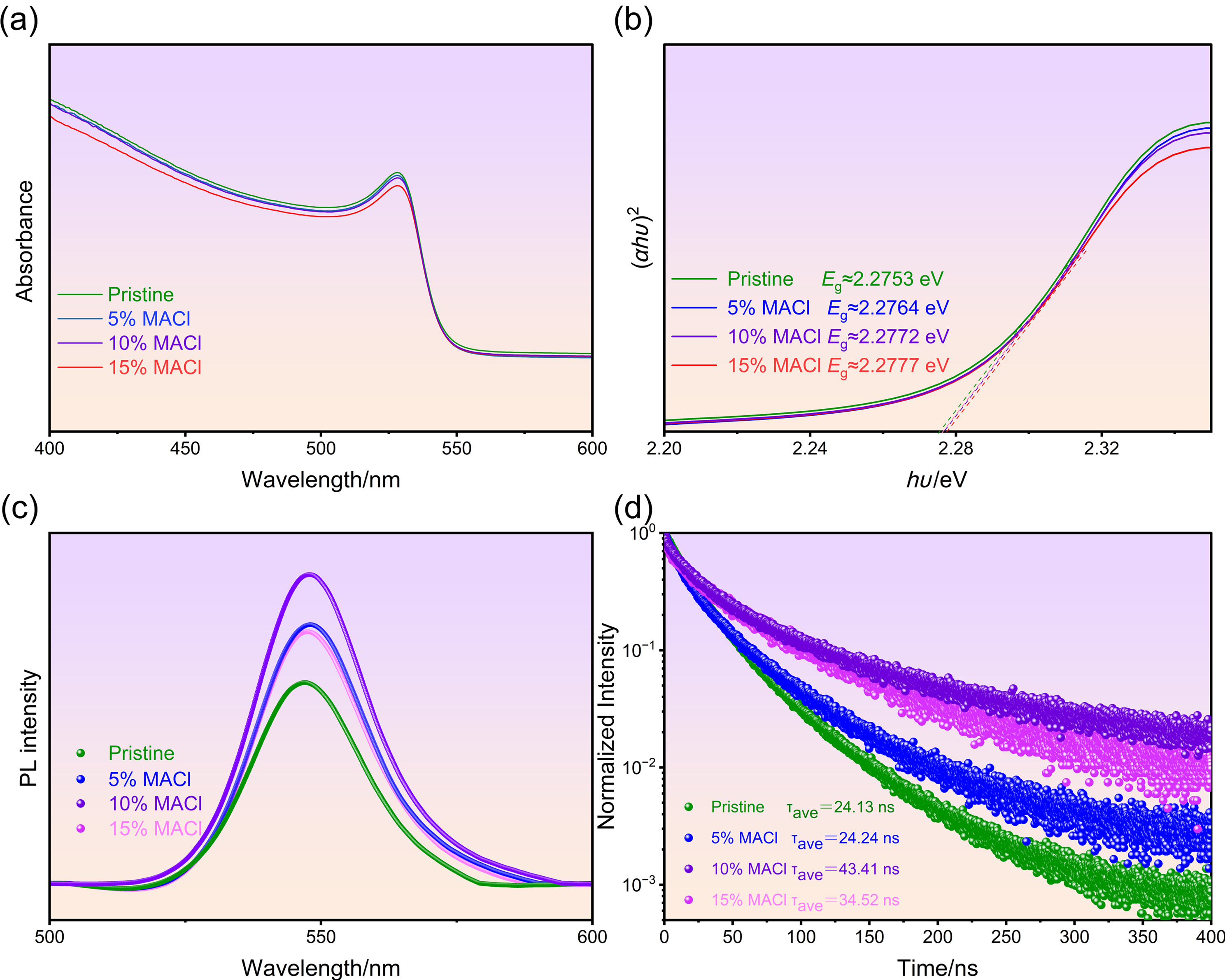
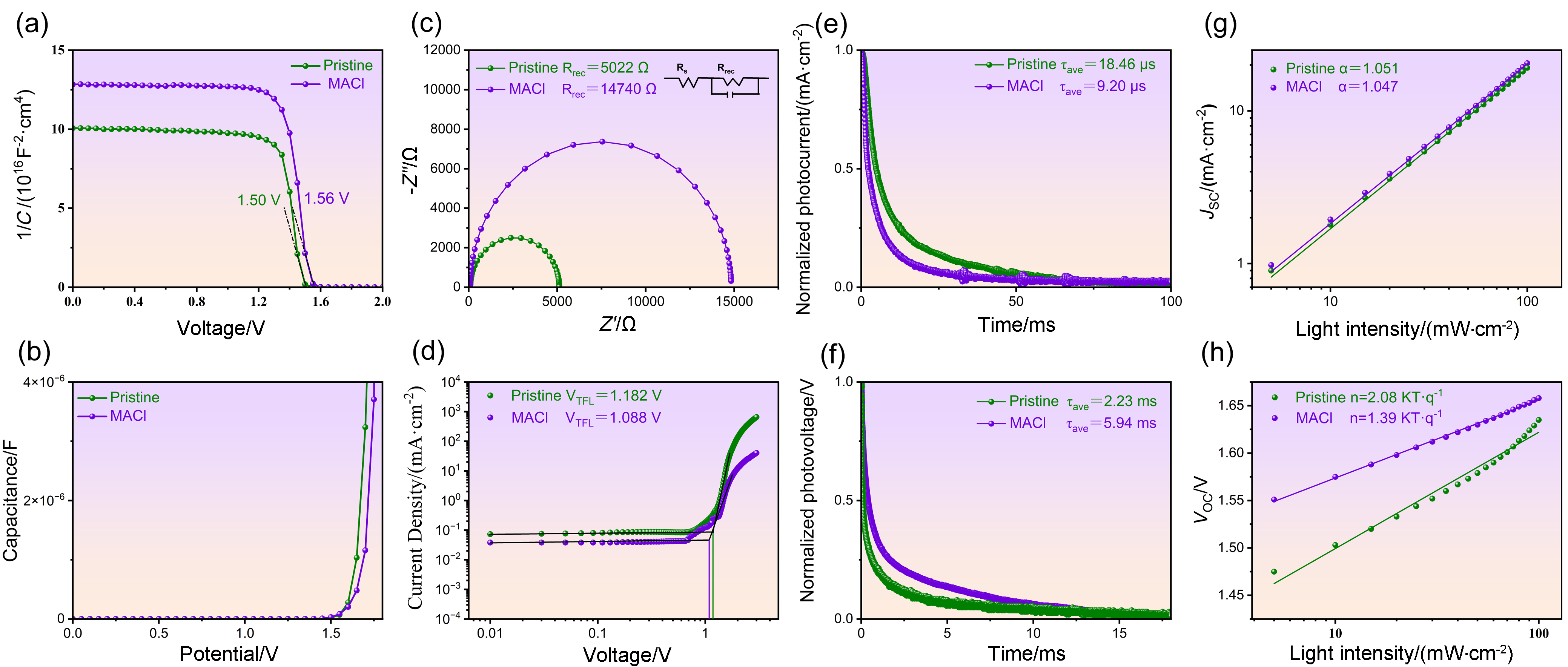
| Sample | τave/ns | A1/% | τ1/ns | A2/% | τ2/ns |
|---|---|---|---|---|---|
| Pristine | 24.13 | 68.48 | 16.07 | 31.50 | 41.67 |
| 5% MACl | 24.24 | 56.85 | 10.29 | 43.15 | 42.64 |
| 10% MACl 15% MACl | 43.41 34.52 | 45.73 48.63 | 13.05 8.35 | 54.27 51.37 | 68.99 59.30 |
| Sample | τave/ns | A1/% | τ1/ns | A2/% | τ2/ns |
|---|---|---|---|---|---|
| Pristine | 24.13 | 68.48 | 16.07 | 31.50 | 41.67 |
| 5% MACl | 24.24 | 56.85 | 10.29 | 43.15 | 42.64 |
| 10% MACl 15% MACl | 43.41 34.52 | 45.73 48.63 | 13.05 8.35 | 54.27 51.37 | 68.99 59.30 |
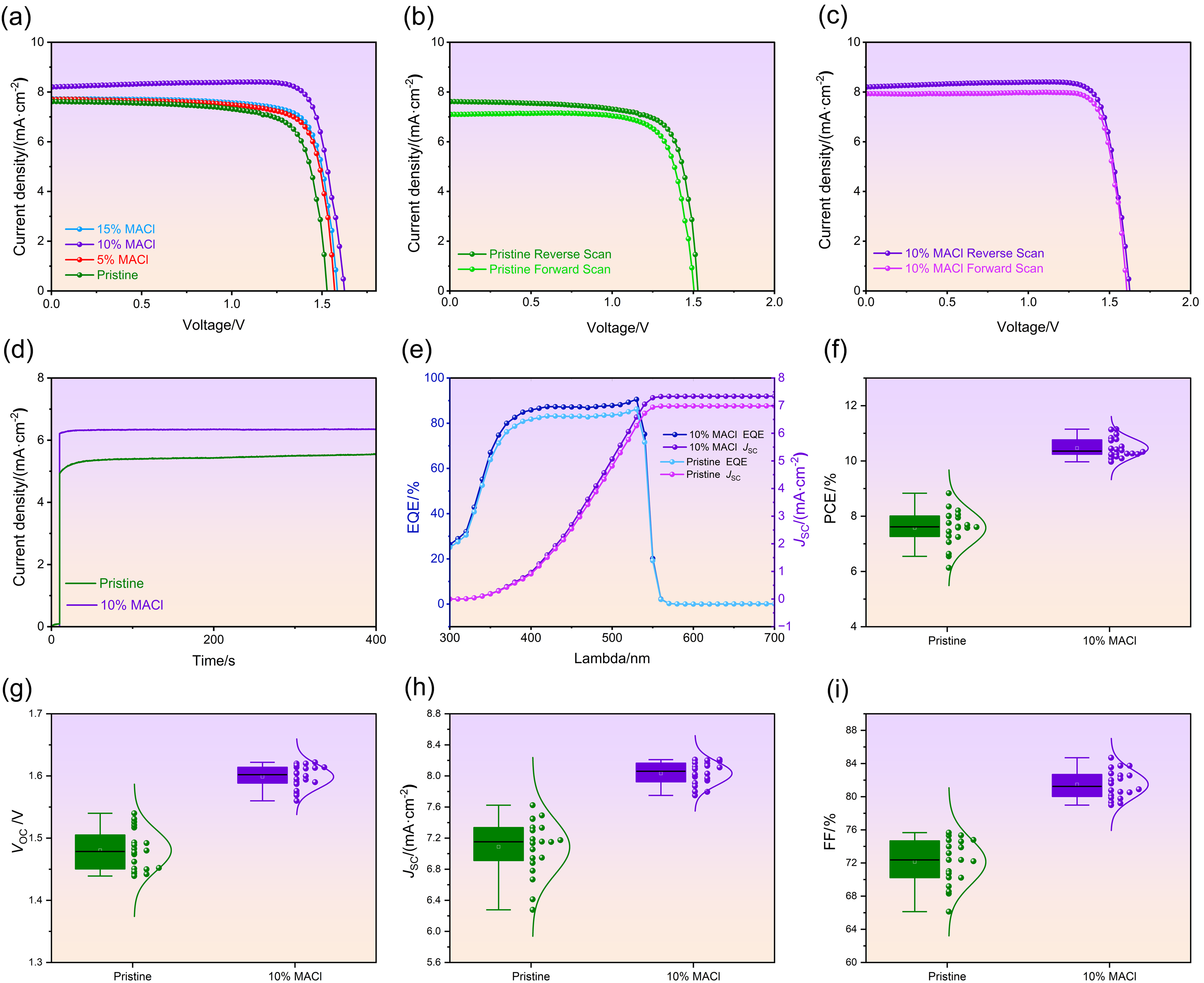
| Sample (mg•mL⁻1) | Voc/V | Jsc/(mA•cm⁻2) | FF/% | PCE/% |
|---|---|---|---|---|
| Pristine | 1.53 | 7.62 | 75.66 | 8.81 |
| 5% MACl | 1.57 | 7.71 | 77.86 | 9.42 |
| 10% MACl | 1.62 | 8.21 | 83.73 | 11.14 |
| 15% MACl | 1.58 | 7.72 | 78.86 | 9.62 |
| Sample (mg•mL⁻1) | Voc/V | Jsc/(mA•cm⁻2) | FF/% | PCE/% |
|---|---|---|---|---|
| Pristine | 1.53 | 7.62 | 75.66 | 8.81 |
| 5% MACl | 1.57 | 7.71 | 77.86 | 9.42 |
| 10% MACl | 1.62 | 8.21 | 83.73 | 11.14 |
| 15% MACl | 1.58 | 7.72 | 78.86 | 9.62 |
| [1] |
|
|
(朱晨溦, 金一诺, 张春虹, 陈衡慧, 陈劭添, 付禹鸣, 吴韫佳, 孙伟海, 无机化学学报, 2023, 39, 1061.)
|
|
| [2] |
doi: 10.1021/ja809598r |
| [3] |
doi: 10.1039/D5SC05095B |
| [4] |
doi: 10.1002/anie.v58.14 |
| [5] |
doi: 10.1016/j.matchemphys.2005.07.007 |
| [6] |
doi: 10.1021/acsenergylett.9b00847 |
| [7] |
doi: 10.1016/j.physb.2019.411884 |
| [8] |
Bhawna; Roy, M.; Kaur, A.; Alam, A.; Aslam, M. Adv. Mater. 2023, 15, 18473.
|
| [9] |
|
|
(谭理, 李海进, 现代化工, 2024, 44, 228.)
doi: 10.16606/j.cnki.issn0253-4320.2024.S2.041 |
|
| [10] |
doi: 10.1039/c5sc00961h pmid: 28706705 |
| [11] |
|
|
(田传明, 博士论文, 东华大学, 2025.)
|
|
| [12] |
doi: 10.1039/D1RA02574K |
| [13] |
|
|
(刘德烨, 博士论文, 吉林大学, 2023.)
|
|
| [14] |
doi: 10.1016/j.joule.2020.09.010 |
| [15] |
doi: 10.1016/j.joule.2019.06.014 |
| [16] |
doi: 10.7498/aps.71.20220966 |
| [17] |
doi: 10.1002/adma.v35.36 |
| [18] |
doi: 10.1002/solr.v8.22 |
| [19] |
doi: 10.1021/acsenergylett.8b00540 |
| [20] |
doi: 10.1021/acsaem.1c01512 |
| [21] |
pmid: 27776210 |
| [22] |
doi: 10.1039/D2TC01373H |
| [23] |
doi: 10.1039/D4TC00996G |
| [24] |
doi: 10.1021/acs.jpclett.5c01012 |
| [25] |
doi: 10.1007/s40820-018-0196-2 |
| [26] |
doi: 10.1002/anie.v57.14 |
| [27] |
|
| [28] |
doi: 10.1038/s41598-018-31184-0 pmid: 30150702 |
| [29] |
doi: 10.1021/acsenergylett.8b00540 |
| [30] |
|
| [31] |
|
|
(杨迎国, 阴广志, 冯尚蕾, 李萌, 季庚午, 宋飞, 文闻, 高兴宇, 物理学报, 2017, 66, 9.)
|
|
| [32] |
|
|
(陈雪莲, 申岩冰, 袁芝聪, 李恺瑞, 潘喜强, 物理学报, 2024, 73, 229.)
|
|
| [33] |
doi: 10.1021/acsaem.3c00791 |
| [34] |
doi: 10.1038/s41586-023-05825-y |
| [35] |
doi: 10.1002/admi.v9.32 |
| [36] |
doi: 10.1002/adma.v35.30 |
| [37] |
|
|
(闵月淇, 谢文钦, 谢亮, 安康, 人工晶体学报, 2025, 54, 605.)
|
|
| [38] |
|
|
(王则远, 郑松志, 李浩, 翁敬菠, 王威, 汪杨, 孙伟海, 无机化学学报, 2024, 40, 1290.)
|
|
| [39] |
doi: 10.1016/j.rio.2022.100273 |
| [40] |
doi: 10.1002/adfm.v33.47 |
| [41] |
|
| [42] |
doi: 10.1016/j.scib.2024.05.025 |
|
(郑松志, 李浩, 王则远, 汪杨, 阴聪, 陈宣衡, 朱文昊, 孙伟海, 科学通报, 2024, 69, 2814.)
|
|
| [43] |
doi: 10.1016/j.jallcom.2023.169084 |
| [44] |
|
| [45] |
doi: 10.1063/1.4966127 |
| [46] |
doi: 10.1039/D1NR00839K |
| [47] |
|
| [48] |
doi: 10.1016/j.electacta.2018.10.032 |
| [49] |
doi: 10.1038/s43586-021-00039-w |
| [50] |
doi: 10.1146/anchem.2010.3.issue-1 |
| [51] |
doi: 10.6023/A24120384 |
|
(朱文昊, 汪玉杰, 李浩, 汪杨, 郑松志, 王则远, 陈劭添, 孙伟海, 赵小敏, 化学学报, 2025, 83, 616.)
doi: 10.6023/A24120384 |
|
| [52] |
doi: 10.1016/j.cej.2023.143019 |
| [53] |
doi: 10.1016/j.solener.2020.06.057 |
| [54] |
doi: 10.1016/j.solener.2018.09.078 |
| [55] |
doi: 10.1002/cjoc.v41.4 |
|
(殷逍遥, 朱文昊, 施谱垚, 李宗盛, 王艺超, 朱能敏, 汪杨, 孙伟海, 无机化学学报, 2025, 41, 469.)
|
|
| [56] |
doi: 10.1021/acsami.4c02559 |
| [57] |
|
|
(高英, 孙燕, 王昕, 李俊生, 田蕾, 李兰兰, 叶灿明, 计量科学与技术, 2021, 65, 66.)
|
|
| [58] |
doi: 10.1002/anie.v58.47 |
| [59] |
doi: 10.1016/j.cej.2024.155699 |
| [60] |
|
|
(杨哲, 博士论文, 中国科学技术大学, 2023.)
|
|
| [61] |
doi: 10.1016/j.cej.2024.154603 |
| [62] |
doi: 10.1007/s40843-022-2199-5 |
| [63] |
doi: 10.1002/adma.v19:12 |
| [64] |
doi: 10.1039/C7EE01675A |
| [65] |
doi: 10.1016/j.nanoen.2024.110268 |
| [1] | 汪佳艳, 郭焕焕, 殷逍遥, 张昀照, 王威, 赵晨瑞, 陈洁, 文洁, 孙伟海. 四乙基氢氧化铵界面修饰制备高效甲脒溴化铅钙钛矿太阳能电池[J]. 化学学报, 2026, 84(2): 231-239. |
| 阅读次数 | ||||||
|
全文 |
|
|||||
|
摘要 |
|
|||||
