
理论研究二米基硼B(Mes)2位置异构对Ir(III)配合物Ir(ppy)2(acac)的光物理性质的影响
收稿日期: 2016-06-24
网络出版日期: 2016-08-10
基金资助
项目受国家自然科学基金(Nos.21473071,21173099,20973078),973项目(No.2013CB834801)和青年基金(No.11504130)资助.
Theoretical Studies on Photophysical Properties of Isomeric Iridium(Ⅲ) Complexes Ir(ppy)2(acac) Containing Dimesitylboron Moiety
Received date: 2016-06-24
Online published: 2016-08-10
Supported by
Project supported by the National Natural Science Foundation of China (Nos. 21473071, 21173099 and 20973078), the National Basic Research Program of China (973 Program) (No. 2013CB834801) and the Youth Program of National Natural Science Foundation of China (No. 11504130).
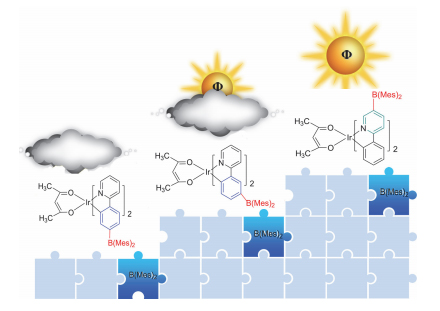
采用DFT/TDDFT方法研究了二米基硼B(Mes)2基团修饰的一类Ir(ppy)2(acac)配合物1~3的光物理性质. 计算了电子结构,吸收和发射光谱以及自旋轨道耦合矩阵< T1α|HSOC|Sn >和辐射跃迁速率(kr),探讨了取代基位置不同对磷光辐射和非辐射跃迁性质的影响. 研究结果表明:向ppy配体的吡啶环引入B(Mes)2基团,能够加强金属铱(Ir)与配体乙酰丙酮(acac)的相互作用,减小单-三重态能级差ΔE(S1-T1),提高系间窜跃速率和磷光辐射跃迁速率. 向ppy配体的苯环引入B(Mes)2基团则增大了S0与T1的结构变形和自旋轨道耦合矩阵< S0|HSOC|T1 >,使非辐射跃迁速率增加. B(Mes)2基团位置异构,导致金属d轨道分裂方式不同,其在三个方向的自旋轨道耦合作用不同,辐射跃迁和非辐射跃迁都随之改变. 从理论上解释了通过对ppy配体的吡啶环修饰可获得高磷光量子产率的原因.
马明硕 , 邹陆一 , 李岩 , 任爱民 , 丁晓丽 . 理论研究二米基硼B(Mes)2位置异构对Ir(III)配合物Ir(ppy)2(acac)的光物理性质的影响[J]. 化学学报, 2016 , 74(9) : 764 -772 . DOI: 10.6023/A16060308
The phosphorescent photophysical properties for three Ir(Ⅲ) complexes 1~3 containing dimesitylboryl moiety were investigated by DFT. The electronic structure of the ground and excited state, absorption and emission spectra, the spin-orbital coupling matrix < T1α|HSOC|Sn >, the radiative and non-radiative transition process for complexes 1~3 were calculated by DFT/TD-DFT approach. The effect of dimesitylboryl substitution at different site of Ir(Ⅲ) complex with phenylpyridine and acetylacetone ligand on the phosphorescent radiative and non-radiative process was discussed. The results reveal that the introduction of B(Mes)2 group to the pyridine ring of the phenylpyridine (ppy) ligand can strengthen the interactions between the metal and the acetylacetone (acac) ligand, reduce the structure relaxation of the molecule from the ground state to the excited triplet state, and maintain the structures of octahedral field, which is conducive to restricted non-radiative transition. Moreover the singlet-triplet energy splitting ΔE(S1-T1) is decreased, the intersystem crossing rate and radiative transition rate are increased. In addition, compared with the substitution at the pyridinyl in complex 1, modifying phenyl group with B(Mes)2 group in complex 2 and 3 could induce larger structural changes from S0 to T1 state and enhance the < S0|HSOC|T1 > value, the spin orbit coupling matrix element between S0 and T1 state of 2 and 3 are greater than that of 1, which will induce a larger non-radiative transition rate for 2 and 3. The variety of substitution position of B(Mes)2 group leads to different d-splitting, different spin-orbital coupling effect in the x, y or z direction, induces the changes of zero field splitting energy and the inequality of radiative transition rates in the three substates (namely, krx, kry, and krz), and the largest radiative rates of 1~3 are all located in z substates with values of 2.32×10⁵, 1.20×10⁵, and 5.50×10⁵ s-1, respectively. Therefore, we explained the reason that complex 1 has higher phosphorescence quantum efficiency through modifying the pyridine ring of the ppy ligand rather than the benzene ring.
[1] Yersin, H.; Finkenzeller, W. J.; Walter, M. J.; Lupton, J. M.; Djurovich, P. I.; Thompson, M. E.; Tsuboyama, A.; Okada, S.; Ueno, K.; Chi, Y.; Chou, P. T.; Yang, X. H.; Jaiser, F.; Neher, D.; Xiang, H. F.; Lai, S. W.; Lai, P. T.; Che, C. M.; Tanaka, I.; Tokito, S.; Dijken, A. V.; Brunner, K.; Börner, H.; Langeveld B. M. W.; Mak, C. S. K.; Chan, W. K.; Nazeeruddin, M. K.; Klein, C.; Grätzel, M.; Zuppiroli, L.; Berner, D.; Bian, Z. Q.; Huang, C. H. Highly Efficient OLEDs with Phosphorescent Materials, Wiley-VCH, 1st edn, Weinheim, 2008.
[2] Templier, F. OLED Microdisplays: Technology and Applications, Chapter: OLED Theory and Principles, Wiley-VCH, 1st edn, Weinheim, 2014.
[3] Förrest, S. R.; Baldo, M. A.; O'Brien, D. F.; You, Y.; Shoustikov, A.; Sibley, S.; Thompson, M. E. Nature 1998, 395, 151.
[4] Hudson, Z. M.; Sun, C.; Helander, M. G.; Amarne, H.; Lu, Z. H.; Wang, S. Adv. Funct. Mater. 2010, 20, 3426.
[5] Zhou, G. J.; Ho, C. L.; Wong, W. Y.; Wang, Q.; Ma, D. G.; Wang, L. X.; Lin, Z. Y.; Marder. T. B.; Beeby, A. Adv. Funct. Mater. 2008, 18, 499.
[6] Lin, C. H.; Chang, Y. Y.; Hung, J. Y.; Lin, C. Y.; Chi, Y.; Chung, M. W.; Lin, C. L.; Chou, P. T.; Lee, G. H.; Chang, C. H.; Lin, W. C. Angew. Chem., Int. Ed. 2011, 50, 3182.
[7] Kim, J. B.; Han, S. H.; Yang, K.; Kwon, S. K.; Kim, J. J.; Kim, Y. H. Chem. Commun. 2015, 51, 58.
[8] Wang, F. F.; Tao, Y. T.; Huang, W. Acta Chim. Sinica 2015, 73, 9. (王芳芳, 陶友田, 黄维, 化学学报, 2015, 73, 9.)
[9] Hudson, Z. M.; Sun, C.; Helander, M. G.; Chang, Y. L.; Lu, Z. H.; Wang, S. J. Am. Chem. Soc. 2012, 134, 13930.
[10] Wang, X.; Chang, Y. L.; Lu, J. S.; Zhang, T.; Lu, Z. H.; Wang, S. Adv. Funct. Mater. 2014, 24, 1911.
[11] Lu, J. S.; Ko, S. B.; Walters, N. R.; Kang, Y. J.; Sauriol, F.; Wang, S. Angew. Chem., Int. Ed. 2013, 52, 4544.
[12] Yang, X. L.; Sun, N.; Dang, J. S.; Huang, Z.; Yao, C. L.; Xu, X. B.; Ho, C. L.; Zhou, G. J.; Ma, D. G.; Zhao, X.; Wong, W. Y. J. Mater. Chem. C 2013, 1, 3317.
[13] Tong, G. S.; Che, C. M. Chem.-A Eur. J. 2009, 15, 7225.
[14] Nozaki, K. J. Chin. Chem. Soc. 2006, 53, 101.
[15] Williams, J. A. G. Top. Curr. Chem. 2007, 281, 205.
[16] Siddique, Z. A.; Yamanoto, Y.; Ohno, T.; Nozaki, K. Inorg. Chem. 2003, 42, 6366.
[17] Cao Q.; Wang J.; Tian, Z. S.; Xie Z. F. J. Comput. Chem. 2012, 33, 1038.
[18] Fraga, S.; Axena, K. M. S.; Karwowski, J., Physical Sciences Data. Amsterdam: Handbook of Atomic Data, Elsevier, Amsterdam, 1976, p. 551.
[19] Tong, G. S. M.; Chow, P. K.; To, W. P.; Kwok, W. M.; Che, C. M. Chem.-Eur. J. 2014, 20, 6433.
[20] Li, Y.; Zou, L. Y.; Ren, A. M.; Ma, M. S.; Fan, J. X. Chem.-Eur. J. 2014, 20, 4671.
[21] Wang, L.; Wu, Y.; Shan, G. G.; Geng, Y.; Zhang, J. Z.; Wang, D. M.; Yang, G. C.; Su, Z. M. J. Mater. Chem. C 2014, 2, 2859.
[22] Wu, Y.; Shan, G. G.; Li, H. B.; Wu, S. X.; Ren, X. Y.; Geng, Y.; Su, Z. M. Phys. Chem. Chem. Phys. 2015, 17, 2438.
[23] Frisch, M. J.; Trucks, G. W.; Schlegel, H. B.; Scuseria, G. E.; Robb, M. A.; Cheeseman, J. R.; Scalmani, G.; Barone, V.; Mennucci, B.; Petersson, G. A.; Nakatsuji, H.; Caricato, M.; Li, X.; Hratchian, H. P.; Izmaylov, A. F.; Bloino, J.; Zheng, G.; Sonnenberg, J. L.; Hada, M.; Ehara, M.; Toyota, K.; Fukuda, R.; Hasegawa, J.; Nakajima, M. T.; Honda, Y.; Kitao, O.; Nakai, H.; Vreven, T.; Montgomery, J. A.; Jr., Peralta, J. E.; Ogliaro, F.; Bearpark, M, Heyd, J. J.; Brothers, E.; Kudin, K. N.; Staroverov, V. N.; Kobayashi, R.; Normand, J.; Raghavachari, K.; Rendell, A.; Burant, J. C.; Iyengar, S. S.; Tomasi, J.; Cossi, M.; Rega, N.; Millam, J. M.; Klene, M.; Knox, J. E.; Cross, J. B.; Bakken, V.; Adamo, C.; Jaramillo, J.; Gomperts, R.; Stratmann, R. E.; Yazyev, O.; Austin, A. J.; Cammi, R.; Pomelli, C.; Ochterski, J. W.; Martin, R. L.; Morokuma, K.; Zakrzewski, V. G.; Voth, G. A.; Salvador, P.; Dannenberg, J. J.; Dapprich, S.; Daniels, A. D.; Farkas, O.; Foresman, J. B.; Ortiz, J. V.; Cioslowski, J.; Fox, D. J. Gaussian 09, Revision A.02, Gaussian, Inc., Wallingford CT, 2009.
[24] Shi, Q. H.; Peng, Q.; Sun, S. R.; Shuai, Z. G. Acta Chim. Sinica 2013, 71, 884. (史清华, 彭谦, 孙少瑞, 帅志刚, 化学学报, 2013, 71, 884.)
[25] Ma, M. S; Zou, L. Y.; Li, Y.; Ren, A. M.; Feng, J. K. Org. Electron. 2015, 22, 180.
[26] Zhang, J. P.; Jin, L.; Zhang, H. X. Acta Phys.-Chim. Sin. 2011, 27, 1089. (张建坡, 金丽, 张红星, 物理化学学报, 2011, 27, 1089.)
[27] Zhang, J. P.; Jin, L.; Zhang, H. X.; Bai, F. Q. Chem. J. Chin. Univ. 2011, 32, 2885. (张建坡, 金丽, 张红星, 白福全, 高等学校化学学报, 2011, 32, 2885.)
[28] Li, Z. D.; Suo, B. B.; Zhang, Y.; Xiao, Y. L.; Liu, W. J. Mol. Phys. 2013, 111, 3741.
[29] Li, Z. D.; Xiao, Y. L.; Liu, W. J. J. Chem. Phys. 2014, 137, 154114.
[30] Li, Z. D.; Liu, W. J. J. Chem. Phys. 2014, 141, 014110.
[31] You, Y.; Park, S. Y. Dalton Trans. 2009, 8, 1267.
[32] Zhu, R.; Lin, J.; Wen, G. A.; Liu, S. J.; Wan, J. H.; Feng, J. C.; Fan, Q. L.; Zhong, G. Y.; Wei, W.; Huang, W. Chem. Lett. 2005, 34, 1668.
[33] Uoyamal, H.; Goushi, K.; Shizu1, K.; Nomura1, H.; Adachi, C. Nature 2012, 492, 234.
[34] Yao, L.; Zhang, S. T.; Wang, R.; Li, W. J.; Shen, F. Z.; Yang, B.; Ma, Y. G. Angew. Chem., Int. Ed. 2014, 53, 2119.
[35] Li, W. J. Y.; Pan, Y.; Xiao, R.; Peng, Q. M.; Zhang, S. T.; Ma, D. G.; Li, F.; Shen, F. Z.; Wang, Y. H.; Yang, B.; Ma, Y. G. Adv. Funct. Mater. 2014, 24, 1609.
/
| 〈 |
|
〉 |

