
基于香豆素荧光团的新型极性检测荧光探针的开发及其成像应用
收稿日期: 2022-06-13
网络出版日期: 2022-08-24
基金资助
国家自然科学基金(21672083); 国家自然科学基金(21877048); 国家自然科学基金(22077048); 国家自然科学基金(22104019); 广西省自然科学基金(2021GXNSFDA075003); 广西省自然科学基金(AD21220061); 广西省自然科学基金(2019GXNSFBA245068); 广西大学启动基金(A3040051003)
Development of a Novel Fluorescent Probe Based on Coumarin Fluorophore for Polarity Detection and Its Imaging Applications
Received date: 2022-06-13
Online published: 2022-08-24
Supported by
National Natural Science Foundation of China(21672083); National Natural Science Foundation of China(21877048); National Natural Science Foundation of China(22077048); National Natural Science Foundation of China(22104019); Natural Science Foundation of Guangxi Province(2021GXNSFDA075003); Natural Science Foundation of Guangxi Province(AD21220061); Natural Science Foundation of Guangxi Province(2019GXNSFBA245068); Startup Fund of Guangxi University(A3040051003)
极性是生物微环境的重要参数之一, 在很大程度上, 生物体内许多生命活动都受到极性变化的影响, 本工作通过改变香豆素母体上的推-拉电子基团, 设计并合成了一种具有较大斯托克斯位移的新型极性荧光探针COM-PO, 该探针的荧光强度和波长会随着测试体系的极性变化而发生改变. 当极性增加时, COM-PO的激发态能量会通过偶极-偶极的相互作用散失在溶剂中, 荧光发射强度降低, 而在低极性溶剂中荧光发射强度增强, 利用这种特性实现了对极性的检测. 本工作通过荧光光谱、荧光成像实验表明COM-PO能够在样品中实现极性检测, 该探针有望实现与极性相关的疾病的早期诊断.
宋思睿 , 唐永和 , 孙良广 , 郭锐 , 姜冠帆 , 林伟英 . 基于香豆素荧光团的新型极性检测荧光探针的开发及其成像应用[J]. 化学学报, 2022 , 80(9) : 1217 -1222 . DOI: 10.6023/A22060261
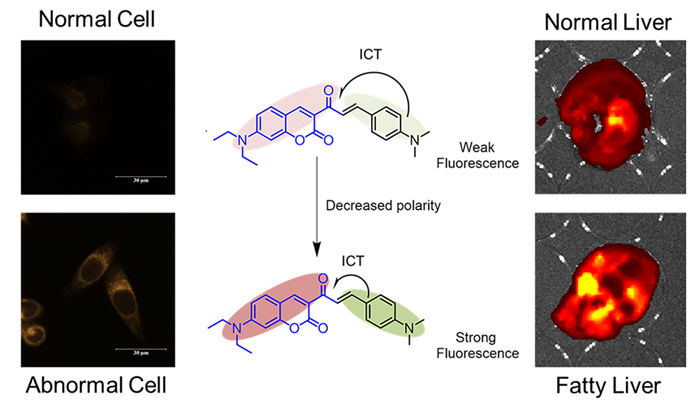
Polarity is one of the important factors in cell microenvironment. Polarity, to a large extent, is involved in various physiological activities and has an important influence on many life activities of organisms. Studies show that many metabolic diseases in the body can cause polarity changes, such as diabetes, fatty liver, atherosclerosis, and so on. Therefore, it is important to detect polarity changes in living organisms. In this paper, a novel polar fluorescent probe COM-PO with large Stokes-shift was designed and synthesized by altering the push and pull electron groups on coumarin to alter the intramolecular charge transfer (ICT). The fluorescence intensity and wavelength of the probe changed with the polarity of the test system. In polar solvents, the excited state energy of COM-PO dissipates in the solvent through dipole-dipole interaction, and its fluorescence emission intensity decreases. On the contrary, the fluorescence emission intensity of the probe increases significantly in low polar solvents. Since the probe has a large Stokes shift, it can avoid the relatively high signal-to-noise ratio and the serious fluorescence self-extinguishing in the imaging process. Therefore, we applied the probe to cell diagnosis and in vivo disease diagnosis. It is well known that cancer cells are less polar than normal cells, and when the probe enters cancer cells, their fluorescence intensity increases by two to three times compared to normal cells. The fluorescence intensity of the probe COM-PO was also twice as high as that of the normal mice. The COM-PO probe was tested by solution spectroscopy, cell imaging, tissue imaging and mouse in vivo imaging. The experimental results show that the probe COM-PO has the advantages of high polarity sensitivity, high selectivity, strong pH adaptability and good biocompatibility, and can detect the polarity changes of abnormal states of cells, tissues and even livers, which is expected to realize the early diagnosis of polarity related diseases.
Key words: polarity; coumarin; fluorescent probe; fluorescence imaging
| [1] | Nagy M.; Rácz D.; Nagy Z. L.; Nagy T.; Fehér P. P.; Purgel M.; Zsuga M.; Keki S. Dyes Pigm. 2016, 133, 445. |
| [2] | Li M.; Fan J.; Li H.; Du J.; Long S.; Peng X. Biomaterials 2018, 164, 98. |
| [3] | Fan L.; Wang X.; Zan Q.; Fan L.; Li F.; Yang Y.; Zhang C.; Shuang S.; Dong C. Anal. Chem. 2021, 93, 8019. |
| [4] | Gissen P.; Arias I. M. J. Hepatol. 2015, 63, 1023. |
| [5] | Doherty J.; Raoof A.; Hussain A.; Wolna M.; Cinque G.; Brown M.; Gardner P.; Denbigh J. Analyst 2019, 144, 997. |
| [6] | Liu H.; Chen L.; Xu C.; Li Z.; Zhang H.; Zhang X.; Tan W. Chem. Soc. Rev. 2018, 47, 7140. |
| [7] | Yin J.; Huang L.; Wu L.; Li J.; Jame D. T.; Lin W. Chem. Soc. Rev. 2021, 50, 12098. |
| [8] | Ren M.; Li Z.; Deng B.; Wang L.; Lin W. Anal. Chem. 2019, 91, 2932. |
| [9] | Wang J.; Lin W.; Li W. Biomaterials 2013, 34, 7429. |
| [10] | Zheng K.; Lin W.; Tan L. Org. Biomol. Chem. 2012, 10, 9683. |
| [11] | Yuan L.; Lin W.; Yang Y.; Song J. Chem. Commun. 2011, 47, 4703. |
| [12] | Yu X.; Xiang L.; Yang S.; Qu S.; Zeng X.; Zhou Y.; Yang R. Spectrochim. Acta, Part A 2021, 245, 118887. |
| [13] | Chen X.; Wang F.; Hyun J. Y.; Wei T.; Qiang J.; Ren X.; Shin I.; Yoon J. Chem. Soc. Rev. 2016, 45, 2976. |
| [14] | Jiang C.; Huang H.; Kang X.; Yang L.; Xi Z.; Sun H.; Pluth M. D.; Yi L. Chem. Soc. Rev. 2021, 50, 7436. |
| [15] | Gao L.; Wang W.; Wang X.; Yang F.; Xie L.; Shen J.; Brimble M. A.; Xiao Q.; Yao S. Q. Chem. Soc. Rev. 2021, 50, 1219. |
| [16] | Xiao H.; Zhang W.; Li P.; Zhang W.; Wang X.; Tang B. Angew. Chem. Int. Ed. 2020, 59, 4216. |
| [17] | Cai F.; Hou B.; Zhang S.; Chen H.; Ji S.; Shen X. C.; Liang H. J. Mater. Chem. B 2019, 7, 2493. |
| [18] | Zhang S.; Chen H.; Wang L.; Qin X.; Jiang B. P.; Ji S. C.; Shen X. C.; Liang H. Angew. Chem. Int. Ed. 2022, 61, e202107076. |
| [19] | Liu L.; Xu J.; Zhang S.; Chen H.; Wang L.; Shen X. C.; Chen H. Sens. Actuators, B 2022, 367, 132171. |
| [20] | Ma Y.; Chen K. X.; Guo Z.-L.; Liu S. J.; Zhao Q.; Huang W.-Y. Acta Chim. Sinica 2020, 78, 23. (in Chinese) |
| [20] | (马云, 陈可欣, 郭则灵, 刘淑娟, 赵强, 黄维扬, 化学学报, 2020, 78, 23.) |
| [21] | Li Y.; Zhang H.; Li M. New Chem. Mater. 2019, 47, 135.(in Chinese) |
| [21] | (李阳, 张辉, 李明, 化工新型材料, 2019, 47, 135.) |
| [22] | Margar S. N.; Sekar N. Chemistry 2016, 327, 58. |
| [23] | Cao D.; Liu Z.; Verwilst P.; Koo S.; Jangjili P.; Kim J. S.; Lin W. Chem. Rev. 2019, 119, 10403. |
| [24] | Sun Q.; Sun D.; Song L.; Chen Z.; Chen Z.; Zhang W.; Qian J. Anal. Chem. 2016, 88, 3400. |
| [25] | Bai H.; Qian J.; Tian H.; Pan W.; Zhang L.; Zhang W. Dyes Pigm. 2014, 103, 1. |
| [26] | Heo W.; Joo T. ChemPhysChem 2019, 20, 1448. |
| [27] | Cui J.; Zang S.; Nie H.; Shen T.; Su S.; Jing J.; Zhang X. Sens. Actuators, B 2021, 171, 129069. |
| [28] | Hao G.; Xu Z.; Li L. RSC Adv. 2018, 8, 22182. |
| [29] | Thomsen A. B.; Kim S.; Aalbaek F.; Aalkjaer C.; Boedtkjer E. J. Cereb. Blood. Flow. Metab. 2014, 34, 161. |
| [30] | Li M.; Fan J.; Li H.; Du J.; Long S.; Peng X. Biomaterials 2018, 164, 98. |
| [31] | Wang Y.; Wang G.; Wang K.; Wang Z.; Guo Y.; Zhang H. Sens. Actuators, B 2018, 261, 210. |
| [32] | Wang Y.; Zhang C. Front. Immunol. 2019, 10, 1582. |
/
| 〈 |
|
〉 |

