


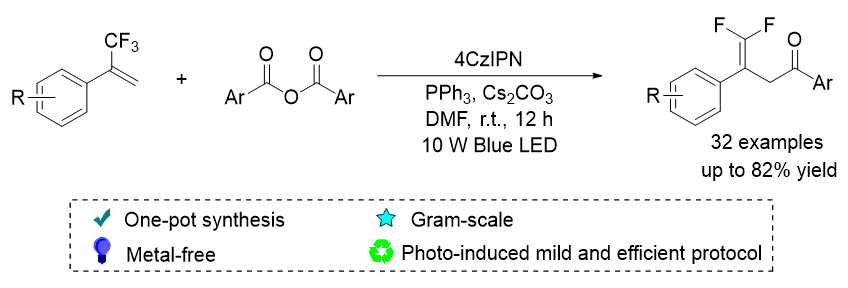
1 引言
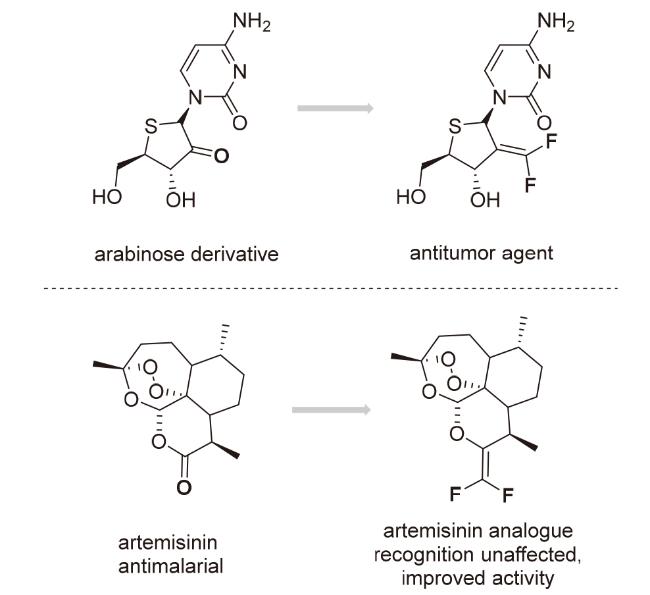
含氟化合物因在药物化学、农药以及材料科学领域的潜在应用而备受关注[1-3]. 氟原子具有高亲脂性、代谢稳定性以及强电子提取能力等特性, 能够使含氟骨架的结构具有更丰富的性能和生物利用度[4]. 将氟原子引入有机化合物中, 已成为一种设计新分子的基本策略[5]. 偕二氟烯烃结构在空间和电子方面与传统的羰基基团有显著的相似性, 在现代药物的发现中被认为是理想的羰基生物电子等排体, 这使得它在生物活性分子的优化中得到了广泛的应用(图1)[6]. 因此, 偕二氟烯烃片段已成为当代有机氟化学中一个有价值的结构单元[7], 众多研究都致力于合成和应用偕二氟烯烃结构的有机分子. 偕二氟烯烃中的碳(sp2)原子对亲核试剂的进攻具有高度反应性[8], 可以通过加成-消除、环加成以及分子内质子转移反应分别生成单氟化物、二氟烷基化合物和三氟甲基化合物[9-11].
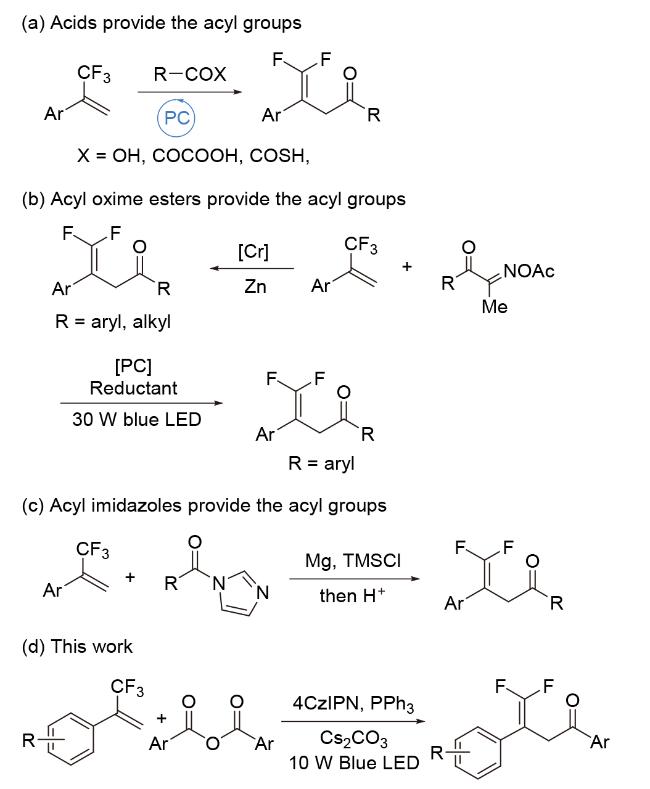
构建偕二氟烯烃的传统方法主要依赖于官能团相互转化策略, 包括Wittig型[12], Julia-Kocienski型[13], 和使用羰基前体的Horner-Wadsworth-Emmons型反应[14], 或使用重氮化合物的二氟烷烃前体[15]. 虽然这些方法已经建立了基本的路线, 但它们的实际操作经常受到苛刻的反应条件(例如, 强碱、高温和金属催化剂)和有限的后功能化兼容性的限制. 于是, α-三氟甲基烯烃中β-氟消除成为了通过光氧化还原催化策略合成偕二氟烯烃的一种普遍可行的方法. 2017年, Molander课题组[16]报道了在可见光照射下使用不同的烷基自由基前体, 例如: 烷基羧酸盐、三氟硼酸盐、α-硅胺、双(儿茶酚酸)硅酸盐, 与α-三氟甲基烯烃发生自由基加成, 并经过β-氟消除途径合成偕二氟烯烃. 在含有偕二氟烯烃基序的化合物中, γ,γ-二氟烯丙基酮的合成普遍受到关注. 研究者们分别利用α-酮酸、芳基羧酸和硫代酸提供酰基源, 与α-三氟甲基烯烃反应合成γ,γ-二氟烯丙基酮(图2a)[17-18]. 此外, 酰基肟酯也可作为提供酰基源的中间体, 在光诱导[19]以及过渡金属催化[20]不同的反应条件中, 以优异的产率得到γ,γ-二氟烯丙基酮(图2b). 随后, 韩课题组[21]发现酰基咪唑也是与α-三氟甲基烯烃合适的偶联伙伴, 反应获得γ,γ-二氟烯丙基酮(图2c).
2 结果与讨论
2.1 反应条件优化
选用4-甲基取代的α-三氟甲基苯乙烯1a和苯甲酸酐2a为模型底物, 对反应条件进行研究(表1). 经过对各种反应参数的系统性筛选(支持信息, 表S1~S4), 使用4CzIPN作为光催化剂、PPh3作为还原剂、Cs2CO3作为碱, N,N-二甲基甲酰胺(DMF)作为溶剂, 在氮气氛围中, 10 W蓝光照射室温反应12 h, 得到相应的产物3a, 产率为82%(表1, Entry 1). 将4CzIPN更换为其他光催化剂, 如Ir[dF(CF3)ppy]2(dtbbpy)PF6, Eosin Y和Ru(bpy)3Cl2时, 产率明显降低, 甚至不发生反应(表1, Entries 2, 3), 说明该反应的发生和光催化剂的关系密切. 在这一转化过程中, 碱是生成目标产物的关键因素. 使用有机碱, 例如1,8-二氮杂二环[5.4.0]十一碳-7-烯(DBU)和N,N-二异丙基乙胺(DIPEA), 反应收率大幅降低(表1, Entry 4). 将Cs2CO3换为NaHCO3和K2CO3, 仅达到一般的反应效果(表1, Entry 5). 对一系列溶剂的测试表明, DMF是此反应中最有效的反应溶剂(表1, Entry 6). 最后, 在反应中加入4 Å分子筛, 发现产率有所降低(表 1, Entry 7), 表明反应中需含有微量的水. 值得注意的是, 对照实验表明, 光催化剂、碱、可见光、PPh3以及氮气氛围, 是成功实现反应所必需的条件(表1, Entries 8~10). 当我们尝试改变光源, 将蓝光换为紫光, 发现蓝光的辐射效果优于紫光(表1, Entry 11).
表1 反应条件优化aTable 1 Conditions optimization |
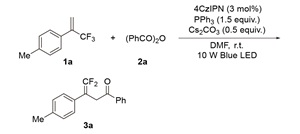
| Entry | Variations from standard conditions | Yieldb/% |
|---|---|---|
| 1 | None | 82 |
| 2 | Ir[dF(CF3)ppy]2(dtbbpy)PF6 or Eosin Y was used | 43, 16 |
| 3 | Ru(bpy)3Cl2 was used | N.R. |
| 4 | DBU or DIPEA was used | 46, 50 |
| 5 | NaHCO3 or K2CO3 was used | 36, 38 |
| 6 | EA, MeOH, DCE or DMSO was used | 34, Trace, 33, 30 |
| 7 | Addition 4 Å molecular sieves | 64 |
| 8 | No PC, or no Cs2CO3 | trace |
| 9 | No light, or no Ph3P | N.R. |
| 10 | Under air | N.R. |
| 11 | λ=390~395 nm | 69 |
a Unless otherwise noted, the standard reaction conditions were as follows: 1a (0.15 mmol), 2a (0.3 mmol), PC (0.0045 mmol), Ph3P (0.225 mmol), and base (0.075 mmol) in solvent (1.5 mL) with irradiation by 10 W Blue LEDs (λ=455~460 nm) under N2 at room temperature for 12 h. b Isolated yield. N.R.: no reaction. |
2.2 反应底物拓展
在确定了最优反应条件之后, 我们探究了α-三氟甲基苯乙烯与苯甲酸酐2a的脱氟酰化反应的通用性(图3). 各种芳基和杂环取代的三氟甲基烯烃耐受性良好, 可提供所需产物(3a~3v), 产率为67%~82%. 在化合物的电子性质方面, α-三氟甲基苯乙烯(1b)及其类似物带有供电子基团, 如—Me、—OMe和—tBu, 与反应条件相容, 得到相应的γ,γ-二氟烯丙基酮(3a~3d). 接下来, 一系列的吸电子基团, 包括—F, —Cl, —Br, 能够取得中等以上的产率(3e~3g). 在苯环的对位上含有—OCF3或—CF3基团的底物, 表现出较好的反应活性3h和3i. 结果表明, α-三氟甲基苯乙烯的电子效应对该反应活性没有显著的影响. 在芳香环上含有间取代基的底物也具有良好的耐受性, 顺利得到3j~3l. 值得注意的是, 双取代的α-三氟甲基苯乙烯和单取代的烯烃反应结果一致, 在该反应中表现出良好的反应活性, 以74%的产率提供3m. 含醚类的官能团(—OMe, —OCH2O—, —SMe)可以很好地兼容该反应体系, 以良好的分离收率得到目标产物(3n~3p). 多种在有机合成中的重要官能团如联苯基(3q)、萘基(3r和3s)及杂环(3t~3v)均能够在反应体系中稳定存在, 充分证明了该反应体系具有良好的官能团耐受性. 有趣的是, 在某些情况下副产物的产率极低, 甚至几乎没有. 比较遗憾的是, α-三氟甲基苯乙烯对位带有—CHO基团的底物无法生成酰化产物.
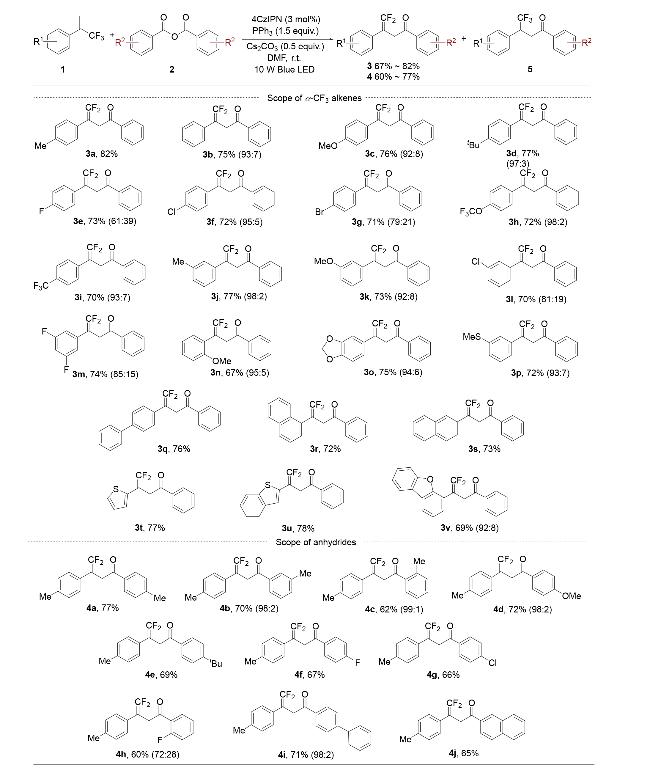
图3 底物范围Figure 3 Substrate scope a Reaction conditions: 1a~1v (0.3 mmol), 2a~2j (0.6 mmol), 4CzIPN (0.009 mmol), PPh3 (0.45 mmol), and Cs2CO3 (0.15 mmol) in DMF (3 mL) under 10 W blue LED light, under nitrogen atmosphere at room temperature for 12 h; the ratio of product 3 or 4 to byproduct 5 is given in parentheses, determined by 19F NMR. b Isolated yield. |
随后, 我们研究了与4-甲基取代的α-三氟甲基苯乙烯(1a)反应的芳香酸酐的通用性(图3). 苯甲酸酐的对位、间位或邻位上带有甲基基团时, 顺利生成了目标产物(4a~4c). 在芳基酸酐对位带有供电子取代基(如—OMe和—tBu)或吸电子取代基(如—F和—Cl)对反应产率的影响不大, 以良好的收率得到酰化产物(4d~4g). 该反应对空间位阻较为敏感, 邻位有—F取代的酸酐底物反应活性较低, 以60%的产率取得4h. 此外, 二苯基和萘基取代的芳香酸酐的酰化反应进展顺利, 都能很好地适用于该反应体系, 以中等产率生成4i和4j. 然而, 当使用环状的邻苯二甲酸酐, 烷基类的乙酸酐和三氟乙酸酐时, 并未观察到预期产物的生成.
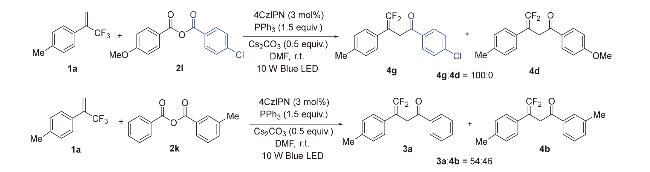
为深入探究本方法的选择性, 研究了不对称芳基酸酐的反应行为(图4). 当酸酐的一个芳基带有吸电子基团(如对位—Cl)而另一芳基带有供电子基团(如对位—OMe)时, 仅观察到4-氯苯甲酰基对三氟甲基苯乙烯的烯丙基去氟酰化产物, 而未检测到4-甲氧基苯甲酰基化产物. 这表明吸电子基团能够增强酸酐中4-氯苯甲酰基的C(酰基)—O键的亲电性, 从而促进该键的断裂并生成活性更高的4-氯苯甲酰自由基, 从而赋予其更高的反应活性. 此外, 当使用间位—Me不对称芳基酸酐时, 得到了苯甲酰基化与间甲基苯甲酰基化产物的混合物(54∶46), 表明底物中空间位阻同样影响反应的选择性.
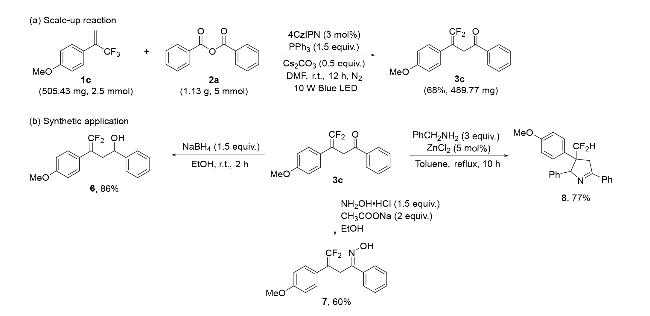
2.3 放大反应
2.4 反应机理的推测
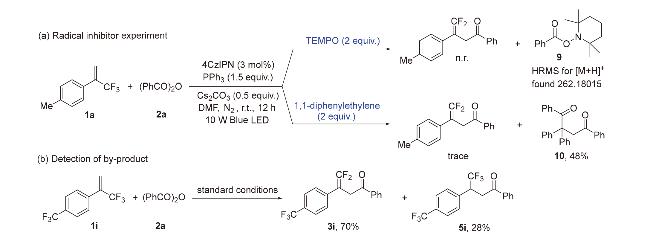
为了阐明反应机制, 我们进行了控制实验(图6). 首先, 向模型反应中加入自由基猝灭剂2,2,6,6-四甲基哌啶氧化物(TEMPO), 发现完全阻止了该转化, 没有得到预期产物, 表明该反应可能经历了单电子转移的自由基历程. 通过高分辨率质谱(HRMS), 将相应的自由基捕获产物9进行检测. 在标准条件下加入1,1-二苯乙烯时,偶联反应再次受到抑制, 分离出来自由基捕获产物10, 产率为48%[23]. 同时, 副产物5i的生成表明质子化过程在该反应中是存在的, 根据前人研究, 阴离子进行β-氟消除反应起主导作用, 并通过自由基/极性交叉过程获得所需的γ,γ-二氟烯丙基酮[16]. 开关灯实验证明了光在反应体系中起到重要作用(支持信息, 表S3). 接下来, 对Stern-Volmer实验的分析表明, 4CzIPN在三苯基膦和三氟甲基烯烃1a反应时会发生荧光猝灭现象. 相比之下, 2a未能使光激发的光催化剂发生猝灭(支持信息, 表S4). 机理研究揭示了可见光诱导的单电子转移在激活自由基链中的关键作用. 它通过自由基/极性交叉过程提供所需的γ,γ-二氟烯丙基酮.
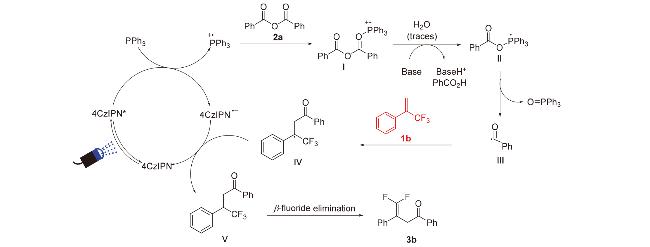
根据上述机理的研究和前人的报道[17b,24], 推测出该烯丙基去氟酰化反应的机理(图7). 首先, 光激发的4CzIPN* [E1/2red(4CzIPN*/4CzIPNˉ)=+1.35 V vs SCE; τ=5.1 μs]催化剂首先从Ph3P中提取一个电子[25-26], 生成膦自由基阳离子物种, 由于膦自由基阳离子明显的亲脂性, 能够激活苯甲酸酐, 生成中间体I. 随后, 通过水解中间体I形成中间体II, 它进一步发生β-选择性的C(酰基)—O键断裂, 形成三苯基膦氧化物(Ph3P(O))和苯甲酰基自由基III. 然后, 苯甲酰基自由基III与α-三氟甲基烯烃发生作用, 生成CF3-苯乙烯基碳自由基IV. 中间体IV在4CzIPN-的存在下转化为CF3-苯乙烯碳离子V, 并且再生出光催化剂. 这一过程完成了光催化循环. 最后, 中间体V发生β-氟消除过程, 生成我们所需的γ,γ-二氟烯丙基酮.


3 结论
综上所述, 本研究发展了可见光诱导的苯基酸酐中C—O和α-三氟甲基芳基烯烃中C—F键裂解的方法, 利用苯甲酸酐作为酰基源成功合成γ,γ-二氟烯丙基酮. 该酰化反应的特点是条件温和、操作简单, 具有广泛的官能团兼容性. 本方法对于不对称芳基酸酐的反应表现出显著的选择性, 主要受吸电子基团对酰基氧键亲电性的增强以及底物空间位阻的双重影响. 机理研究揭示了可见光诱导的单电子转移在激活自由基链中的关键作用. 它通过自由基/极性交叉过程提供所需的γ,γ-二氟烯丙基酮. 所得的含羰基官能团的偕二氟烯丙基化合物可以在一定程度上转化为带有氟原子的各种产物, 具有特殊的潜在应用价值. 这项工作补充了对偕二氟烯烃化合物的广泛研究.
4 实验部分
4.1 α-三氟甲基芳基烯烃的制备
将芳基硼酸(1.0 equiv.)和双三苯基膦二氯化钯(3 mol%)加入100 mL圆底烧瓶中, 用橡皮塞封口, 向圆底烧瓶中充入氮气(重复3次), 在氮气氛围下依次加入碳酸钾溶液(2.0 mol/L), 四氢呋喃以及2-溴-3,3,3-三氟丙烯, 在60 ℃油浴下搅拌12 h. 待反应结束, 将有机混合物冷却至常温, 进行常规的萃取、抽滤、旋蒸等步骤. 再用柱色谱法对产物进行分离, 得到相应的α-三氟甲基芳基烯烃.
4.2 取代的苯甲酸酐的制备
向100 mL圆底烧瓶中加入芳基羧酸(1.0 equiv.), 用橡皮塞封口, 向圆底烧瓶中充入氮气(重复3次), 在氮气氛围下加入Et3N (2.0 equiv.)和CH2Cl2 (0.50 mol/L), 将圆底烧瓶放置平行反应仪上, 在室温搅拌下缓慢滴加芳基酰氯(1.0 equiv.), 反应剧烈搅拌15 h. 等反应结束后, 用CH2Cl2(30 mL)稀释反应混合物. 将反应混合物依次用5%的HCl (30 mL×1)、5%的NaHCO3 (30 mL×1)、H2O (30 mL×1)洗涤, 干燥浓缩, 得到粗产物. 除非另有说明, 以石油醚/乙酸乙酯10∶1 (V∶V)为洗脱液, 用柱层析纯化所得粗产物, 得到酸酐产物.
4.3 γ,γ-二氟烯丙基酮的一般合成程序
将α-三氟甲基芳基烯烃(0.3 mmol, 1.0 equiv.)、苯甲酸酐(0.6 mmol, 2.0 equiv.)、4CzIPN (3 mol%)、PPh3 (0.45 mmol, 1.5 equiv.)、Cs2CO3 (0.15 mmol, 0.5 equiv.)和DMF (3 mL)加入到一个15 mL的光反应瓶中. 将反应混合物通过用氮气吹气的方式进行脱气处理(使用出口针头, 持续2 min), 然后用聚四氟乙烯盖子密封小瓶. 随后, 搅拌混合物, 并在室温下用10 W蓝灯照射12 h. 反应完成后(通过薄层色谱分析监测), 将反应混合物冷却至室温. 向其中加入饱和NaCl溶液, 然后用乙酸乙酯(3次, 20 mL×3)萃取产物. 将有机层合并, 用无水MgSO4干燥, 然后在减压下除去溶剂. 粗产物通过使用200~300目硅胶(石油醚∶乙酸乙酯=80∶1至40∶1, V∶V)的柱层析进行纯化, 得到所需的产物.
(Lu, Y.)